Pharmaceutical 3D printing has emerged as a technically powerful approach for producing personalised, flexible, and on-demand dosage forms. Its appeal lies in the ability to vary dose, geometry, release profile, and patient acceptability without requiring a new conventional manufacturing line for every product variant. Despite this promise, the field remains constrained by a persistent mismatch between design capability and translational readiness. Many studies demonstrate sophisticated printed tablets, films, lattices, and personalised dosage forms, yet far fewer address the manufacturing controls, release strategies, and regulatory evidence needed for routine clinical implementation. This critical review evaluates pharmaceutical 3D printing through the connected lenses of design logic, manufacturing constraints, and regulatory readiness. The review treats additive manufacturing not as one technology but as a family of processes whose material requirements, process risks, and quality attributes differ substantially. The review concludes that pharmaceutical 3D printing will not translate through formulation novelty alone. A technology-agnostic, risk-proportionate regulatory pathway combined with scalable, PAT-integrated manufacturing platforms is essential to move from promise to practice.
The clinical need for pharmaceutical 3D printing arises from the limitations of mass-manufactured medicines in settings that require flexible dosing, complex release profiles, or patient-specific therapy. Norman, Madurawe, Moore, Khan and Khairuzzaman framed 3D-printed drug products as a new chapter in pharmaceutical manufacturing because they allow dose and structure to be digitally defined rather than fixed by conventional tooling [1]. This logic is particularly relevant for paediatrics, geriatrics, rare diseases, and polypharmacy, where standard strengths often fail to match clinical need. The critical issue is not whether unusual dosage forms can be printed, but whether they can be manufactured reproducibly and released under credible quality systems.
The evolution of pharmaceutical 3D printing has been driven by multiple platforms rather than a single dominant technology. Fused deposition modelling has been used to produce thermoplastic oral dosage forms, while selective laser sintering has enabled solvent-free porous printlets and stereolithography has supported high-resolution drug-loaded hydrogels [2-4]. Semi-solid extrusion, inkjet printing, and binder jetting add further design options, but each introduces distinct constraints in rheology, droplet formation, powder consolidation, or post-processing. Treating these platforms as interchangeable creates a false sense of maturity because each requires a different control strategy.
The literature has increasingly moved from proof-of-concept fabrication toward patient-centred and clinical-facing applications. Goyanes, Madla, Umerji, Duran Piñeiro, Montero, Lamas Diaz, Gonzalez Barcia, Taherali, Sánchez-Pintos, Couce, Gaisford and Basit reported a prospective crossover study of 3D-printed isoleucine formulations, demonstrating that personalised printing can be evaluated in real clinical pathways [5]. Öblom, Sjöholm, Rautamo and Sandler extended the practical relevance by comparing printed paediatric warfarin films with conventional oral powders used in hospital settings [6]. These studies are important because they shift the field from design possibility toward clinical usefulness.
The central argument of this review is that pharmaceutical 3D printing has focused heavily on what can be designed while underestimating what can be manufactured, controlled, and regulated. Reviews by Jamróz, Szafraniec, Kurek and Jachowicz and by Gioumouxouzis, Karavasili and Fatouros described broad technological achievements, but the gap between laboratory creativity and quality-assured production remains substantial [7, 8]. Okafor-Muo, Hassanin, Kayyali and ElShaer identified numerous challenges for solid oral dosage printing, including formulation, equipment, and regulatory limitations [9]. This review therefore links design choices to manufacturing feasibility and regulatory acceptability rather than treating 3D printing as inherently translational.
The review was based on peer-reviewed journal articles published between 2017 and 2025, reflecting the period in which pharmaceutical 3D printing became both experimentally diverse and increasingly translation-oriented. The search logic prioritised studies from pharmaceutical sciences, drug delivery, additive manufacturing, and regulatory science that addressed technology selection, printed dosage form design, manufacturing constraints, process control, or clinical readiness [1, 7, 10]. Articles were selected from the approved reference set only, with emphasis on International Journal of Pharmaceutics, Pharmaceutical Research, Journal of Controlled Release, Pharmaceutics, Journal of Pharmaceutical Sciences, Advanced Drug Delivery Reviews, and related high-impact journals. Conference papers, preprints, theses, reports, and non-peer-reviewed sources were excluded.
Selection was not based only on whether a study successfully printed a dosage form. Studies were prioritised when they linked formulation design to measurable performance, such as modified release, disintegration, dose flexibility, mechanical behaviour, printability, or clinical workflow relevance [11-13]. For example, filament screening, feed-force evaluation, and rheology-based prediction were included because they reveal the manufacturing dependencies behind apparently simple printed tablets [14-16]. This approach allowed the review to distinguish design novelty from process understanding.
The selected studies were also evaluated for their contribution to regulatory readiness and quality assurance. Work on machine learning, artificial intelligence, machine vision, and clinical trial frameworks was included because these areas address the evidence infrastructure needed for future product approval [17-20]. Studies on selective laser sintering, fused deposition modelling, semi-solid extrusion, and stereolithography were considered together only when their platform-specific risks were preserved. The result is a critical synthesis of 35 peer-reviewed articles rather than a quantitative meta-analysis, because the available evidence remains heterogeneous in APIs, excipients, process parameters, and performance endpoints.
The design logic of pharmaceutical 3D printing begins with the relationship between process energy, material behaviour, and intended product function. Fused deposition modelling relies on thermoplastic filament preparation and thermal extrusion, making polymer miscibility, filament strength, drug stability, and melt viscosity central to dosage form design [4, 21]. Selective laser sintering avoids filament production but depends on powder flow, laser absorption, thermal fusion, and bed behaviour, which makes it attractive for porous oral structures but sensitive to powder and energy variation [2, 12]. Stereolithography offers high resolution, yet drug-loaded photopolymerisation introduces concerns about resin selection, photoinitiator exposure, and residual reactive species [3].
Semi-solid extrusion follows a different design logic because it uses rheologically structured pastes, gels, or suspensions rather than solid filaments or powder beds. Elbadawi, Gustaffson, Gaisford and Basit showed that rheological data can help predict printability and dissolution, which means that formulation viscosity and yield behaviour become direct determinants of product quality [14]. This creates opportunities for low-temperature processing and patient-friendly dosage forms but also raises risks of solvent loss, drying variability, microbial control, and shape deformation. The design logic is therefore not only geometric but also temporal, because the material may continue changing after deposition.
The most sophisticated printed dosage forms demonstrate that geometry can act as a functional design variable. Fina, Goyanes, Madla, Awad, Trenfield, Kuek, Patel, Gaisford and Basit used gyroid lattices to show how internal architecture can influence release behaviour, while Sadia, Arafat, Ahmed, Forbes and Alhnan demonstrated that channels can accelerate drug release from printed tablets [13, 22]. These studies challenge the conventional assumption that excipient composition is the dominant determinant of release. However, geometry-based control becomes translationally useful only if internal structures can be reproduced and verified at clinically relevant scale.
Technology selection should therefore begin with the clinical and quality objective, not with printer availability. Awad, Fina, Goyanes, Gaisford and Basit emphasised the principles and pharmaceutical applications of selective laser sintering, while Trenfield, Awad, Madla, Hatton, Firth, Goyanes, Gaisford and Basit placed 3D printing within a wider healthcare transformation [10, 23]. Table 1 categorises the dominant 3D printing technologies according to their design logic and material requirements. The comparison shows that each platform carries intrinsic capabilities and intrinsic regulatory liabilities.
Table 1. Categorization of Pharmaceutical 3D Printing Technologies: Design Logic, Material Compatibility, and Intrinsic Capabilities
Printing technology | Core pharmaceutical design logic | Typical material requirements | Intrinsic capabilities | Principal translation risk |
Fused deposition modelling | Drug-loaded thermoplastic filaments are deposited layer by layer to define dose, geometry, and release surface area | Thermoplastic polymers, plasticisers, API–polymer miscibility, mechanically robust filaments | Personalised strengths, geometry-controlled release, decentralised production potential | Thermal degradation, filament variability, limited API compatibility, slow unit production |
Semi-solid extrusion | Rheologically tuned pastes or gels are extruded into shape-retaining dosage forms | Controlled viscosity, yield stress, solvent content, drying behaviour, microbial quality | Low-temperature processing, flexible doses, paediatric-friendly formats | Rheological drift, drying variability, microbial risk, poor high-throughput scalability |
Stereolithography | Photopolymerisation creates high-resolution drug-loaded structures | Photocurable resins, photoinitiators, optically compatible drug systems | High resolution, smooth surfaces, complex geometries | Residual monomer, limited approved excipients, phototoxicity concerns |
Selective laser sintering | Laser energy fuses powder particles into porous or dense printlets | Flowable powders, laser absorbers, thermally stable API–excipient blends | Solvent-free production, porous printlets, rapid disintegration | Powder handling, heat exposure, bed recycling, dose uniformity |
Inkjet printing | Drug solutions or suspensions are deposited as controlled droplets onto a substrate | Low-viscosity fluids, stable droplets, compatible substrates, rapid drying | Micro-dosing, patterned deposition, flexible dose loading | Nozzle clogging, solvent control, substrate dependence, limited drug loading |
Binder jetting | Binder droplets consolidate powder beds into shaped drug products | Cohesive powder beds, binder compatibility, controlled liquid penetration | Potentially scalable powder-based fabrication | Binder migration, friability, powder segregation, complex post-processing |
Figure 1 presents an integrated architecture linking pharmaceutical 3D printing design logic, material–process constraints, dosage-form performance, and regulatory readiness requirements.
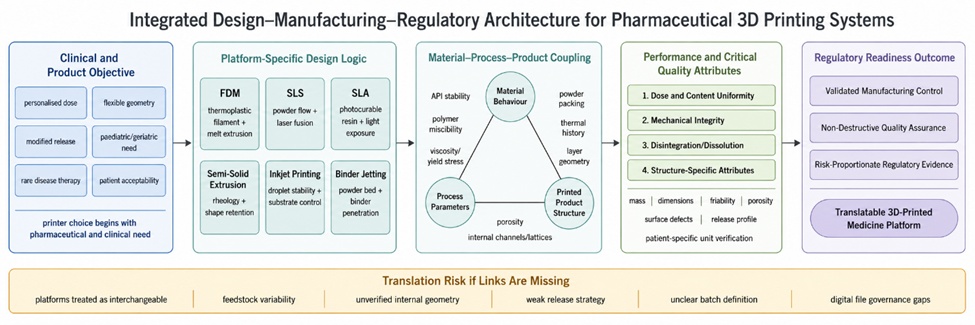
Figure 1. Integrated Design–Manufacturing–Regulatory Architecture for Pharmaceutical 3D Printing Systems
The strongest body of dosage form evidence concerns oral solid products, especially printlets designed for immediate release or rapid disintegration. Fina, Madla, Goyanes, Zhang, Gaisford and Basit demonstrated selective laser sintering of orally disintegrating printlets, and Allahham, Fina, Marcuta, Kraschew, Mohr, Gaisford, Basit and Goyanes extended this platform to ondansetron-containing printlets [12, 24]. Kempin, Domsta, Grathoff, Brecht, Semmling, Tillmann, Weitschies and Seidlitz showed that immediate-release fused-deposition tablets can be produced even with a thermosensitive drug, although the processing window remains narrow [21]. These studies establish feasibility, but they do not yet establish routine manufacturing robustness.
Modified-release and complex-release designs show how 3D printing can combine formulation composition with structural control. Goyanes, Fina, Martorana, Sedough, Gaisford and Basit developed modified-release tablets using pharmaceutical excipients, while Fina, Goyanes, Madla, Awad, Trenfield, Kuek, Patel, Gaisford and Basit used gyroid lattices to alter release through architecture [11, 22]. Sadia, Arafat, Ahmed, Forbes and Alhnan showed that channels can accelerate release, demonstrating that void space and fluid access can be used as formulation variables [13]. The unresolved issue is whether such structures remain reproducible when transferred from laboratory-scale printing to validated routine production.
Patient-facing evidence remains limited but highly significant. The prospective crossover study of 3D-printed isoleucine formulations by Goyanes, Madla, Umerji, Duran Piñeiro, Montero, Lamas Diaz, Gonzalez Barcia, Taherali, Sánchez-Pintos, Couce, Gaisford and Basit provides one of the most important examples of personalised printed therapy in a real clinical context [5]. Öblom, Sjöholm, Rautamo and Sandler compared printed paediatric warfarin films with conventional oral powders, which is valuable because it tests printed medicines against an actual hospital practice alternative rather than an idealised comparator [6]. Tagami, Ito, Hayashi, Sakai and Ozeki broadened the dosage form landscape by printing hollow suppository shells, showing that the technology is not restricted to tablets [25].
The available evidence confirms that 3D printing can produce immediate-release, modified-release, paediatric, rare-disease, and unconventional dosage forms, but the evidence is uneven across technologies and clinical use cases. Parulski, Jennotte, Lechanteur and Evrard demonstrated fused deposition modelling of itraconazole amorphous solid dispersions, while Uboldi, Melocchi, Moutaharrik, Briatico-Vangosa, Zema, Gazzaniga and Maroni investigated personalised timapiprant dosage forms [26, 27]. Tabriz, Nandi, Hurt, Hui, Karki, Gong and Douroumis further demonstrated personalised carvedilol tablets using selective laser sintering [28]. Table 2 collates recent evidence on dosage form designs achieved with 3D printing and their critical performance attributes.
Table 2. Summary of Pharmaceutical 3D Printing Studies (2017–2025): Dosage Form Designs, Active Pharmaceutical Ingredients, and Key Performance Findings
Reference | Printing technology | Dosage form design | Active pharmaceutical ingredient or model system | Key performance finding | Critical limitation |
Goyanes, Fina, Martorana, Sedough, Gaisford and Basit [11] | Additive manufacturing of excipient-based systems | Modified-release printlets | Drug-loaded pharmaceutical excipient systems | Release behaviour could be tuned through formulation and structure | Laboratory-scale evidence with limited scale-up assessment |
Fina, Madla, Goyanes, Zhang, Gaisford and Basit [12] | Selective laser sintering | Orally disintegrating printlets | Drug-loaded SLS printlets | Porosity supported rapid oral disintegration | Powder-bed control and heat exposure require further validation |
Allahham, Fina, Marcuta, Kraschew, Mohr, Gaisford, Basit and Goyanes [24] | Selective laser sintering | Orally disintegrating printlets | Ondansetron | Rapidly disintegrating medicine was achieved without compression | Product release still depends on robust non-destructive quality checks |
Kempin, Domsta, Grathoff, Brecht, Semmling, Tillmann, Weitschies and Seidlitz [21] | Fused deposition modelling | Immediate-release tablets | Thermosensitive drug | Immediate release was possible despite hot-melt processing | Thermal stability remains a platform-specific constraint |
Sadia, Arafat, Ahmed, Forbes and Alhnan [13] | 3D printed tablet architecture | Channelled tablets | Drug-loaded oral tablets | Channels accelerated drug release by increasing fluid access | Internal channel reproducibility must be verified |
Goyanes, Madla, Umerji, Duran Piñeiro, Montero, Lamas Diaz, Gonzalez Barcia, Taherali, Sánchez-Pintos, Couce, Gaisford and Basit [5] | Automated 3D printing | Personalised amino-acid formulations | Isoleucine | Clinical crossover evidence supported rare-disease therapy preparation | Broader clinical replication is needed |
Öblom, Sjöholm, Rautamo and Sandler [6] | 2D and 3D printing | Orodispersible paediatric films | Warfarin | Printed films were compared with conventional hospital oral powders | Hospital workflow and stability evidence remain central |
Tagami, Ito, Hayashi, Sakai and Ozeki [25] | 3D printed shell fabrication | Hollow suppository shells | Drug-fillable suppository systems | Printing enabled hollow non-tablet dosage architectures | Filling, sealing, and quality assurance require further development |
Parulski, Jennotte, Lechanteur and Evrard [26] | Fused deposition modelling | Amorphous solid dispersion dosage forms | Itraconazole | Printing was explored as a bioavailability-enhancement strategy | Physical stability and process history must be controlled |
Tabriz, Nandi, Hurt, Hui, Karki, Gong and Douroumis [28] | Selective laser sintering | Personalised tablets | Carvedilol | Personalised tablets were produced using powder-bed printing | SLS process and powder variability remain important risks |
Manufacturing constraints often begin upstream of the printer, especially when feedstock preparation determines whether printing is possible at all. Solanki, Tahsin, Shah and Serajuddin showed that fused deposition modelling requires simultaneous screening for drug release, drug–polymer miscibility, and filament printability [4]. Xu, Li, Meda, Osei-Yeboah, Peterson, Repka and Zhan developed a quantitative method to evaluate filament printability, making clear that the filament itself should be treated as a controlled intermediate [15]. If feedstock variability is not controlled, downstream printer qualification cannot compensate for inconsistent material behaviour.
Throughput and mechanical reproducibility remain major barriers to scale-up. Gottschalk, Bogdahn, Harzsch, Franke, Hohl, Krumme and Quodbach showed that feed forces influence fused deposition modelling process understanding and mass conformity, linking mechanical process behaviour directly to product quality [16]. Oladeji, El-Hagrasy and Drennen investigated plasticised filaments to improve printability, but plasticisation introduces additional stability, mechanical, and regulatory questions [29]. Tikhomirov, Evdokimov, Kiryukhin, Evdokimov, Nifontova, Fedorov, Belyaev and Tikhonov showed that selective laser sintering quality depends on both formulation and process variables [30].
Post-processing is another neglected constraint because the printed object is not always the finished medicine. Semi-solid extrusion may require drying, stereolithography may require post-curing or washing, selective laser sintering may require powder removal, and fused deposition modelling may require cooling and mechanical stabilisation [3, 14, 23]. Thakkar, Zhang, Zhang and Maniruzzaman addressed this manufacturing reality by combining twin-screw granulation with selective laser sintering, suggesting that hybrid pharmaceutical processing may be more realistic than isolated printer-based production [31]. This undermines the simplistic claim that 3D printing automatically enables immediate bedside manufacture.
GMP integration requires validated equipment, controlled software, cleaning procedures, environmental monitoring, material traceability, and deviation management. Okafor-Muo, Hassanin, Kayyali and ElShaer identified numerous barriers to solid oral dosage printing, and Parramon-Teixido, Goyanes, Aguilar-de-Leyva, Melocchi, Gaisford, Basit and García-Montoya showed that clinical trials involving 3D printing require specific frameworks [10, 20]. Table 3 systematically maps the manufacturing constraints that limit the scalability and GMP compliance of printed dosage forms. The table makes clear that manufacturing readiness depends as much on process architecture as on formulation performance.
Table 3. Manufacturing Constraints in Pharmaceutical 3D Printing: Process, Material, and Equipment Limitations with Implications for Scale-Up
Constraint domain | Practical manifestation | Technologies most affected | Impact on product quality | Implication for scale-up and GMP |
Feedstock preparation | Filament extrusion, powder conditioning, paste preparation, or resin formulation must be controlled before printing | FDM, SLS, SSE, SLA | Variability in feedstock changes mass, geometry, dissolution, and mechanical properties | Feedstock must be specified, tested, documented, and released as a controlled intermediate |
Print speed and throughput | Unit-by-unit fabrication may be slower than compression, encapsulation, or coating | FDM, SSE, SLA | Longer runs increase drift, operator exposure, and process variability | Scale-up may require parallel printers, automation, or hybrid manufacturing lines |
Thermal stress | Hot-melt extrusion, nozzle heating, or laser fusion may expose APIs to degradation | FDM, SLS | Drug potency, impurity profile, and solid state may change | API suitability must be assessed under process-relevant thermal conditions |
Rheological instability | Pastes or gels may change viscosity during printing or drying | SSE, inkjet | Shape fidelity, dose uniformity, and release behaviour may vary | In-process rheological monitoring and time limits may be required |
Powder-bed variability | Powder flow, packing, laser absorption, and bed recycling affect fusion | SLS, binder jetting | Density, porosity, friability, and dose uniformity may shift | Powder handling and recycling rules must be validated |
Post-processing burden | Drying, curing, washing, cooling, or depowdering may be needed | SSE, SLA, SLS, binder jetting | Residual solvent, residual monomer, moisture, or surface defects may remain | Post-processing must be included in the validated manufacturing process |
Cleaning and cross-contamination | Nozzles, beds, cartridges, and reservoirs may retain formulation residue | SSE, inkjet, binder jetting, SLS | Cross-contamination can compromise safety in multi-product settings | Cleaning validation is essential for pharmacy or decentralised production |
Software and operator variability | Design files, slicing settings, calibration, and printer operation affect output | All platforms | Small digital or operational changes may alter the medicine | Version-controlled digital recipes and operator competency systems are required |
Quality control for printed medicines must be more process-integrated than conventional end-product testing because many personalised units cannot be destructively sampled. Elbadawi, Gustaffson, Gaisford and Basit showed that rheological data can predict both printability and dissolution, supporting a process analytical technology logic for formulation and process control [14]. Sun, Alkahtani, Gaisford, Basit, Elbadawi and Orlu demonstrated machine vision trained on photorealistic images for quality control of 3D-printed medicines [19]. These approaches are promising, but visual and rheological indicators must be linked to clinically relevant attributes such as dose, disintegration, dissolution, and stability.
Artificial intelligence is becoming central to both formulation design and quality prediction, but its regulatory role remains unresolved. Elbadawi, Muñiz Castro, Gavins, Ong, Gaisford, Pérez, Basit, Cabalar and Goyanes developed M3DISEEN to predict medicine printability, while Elbadawi, McCoubrey, Gavins, Ong, Goyanes, Gaisford and Basit argued that machine learning could disrupt 3D printing of medicines [17, 18]. Elbadawi, Gaisford and Basit linked advanced machine-learning techniques to 3D-printed medicines, and Elbadawi, Li, Sun, Alkahtani, Basit and Gaisford showed that artificial intelligence can generate novel printing formulations [32, 33]. The critical question is whether such models remain development aids or become validated release-supporting tools.
Regulatory readiness also depends on how the product, printer, digital file, material, and site of manufacture are defined. Norman, Madurawe, Moore, Khan and Khairuzzaman identified 3D-printed drug products as a new pharmaceutical manufacturing paradigm, while Awad, Trenfield, Gaisford and Basit described printed medicines as part of digital healthcare [1, 34]. Parramon-Teixido, Goyanes, Aguilar-de-Leyva, Melocchi, Gaisford, Basit and García-Montoya proposed a framework for clinical trials involving 3D printing of medicines, which is a necessary step toward regulatory maturity [20]. However, clinical trial frameworks must be accompanied by manufacturing frameworks that define platform changes, site changes, and patient-specific dose variation.
The batch concept is especially difficult for on-demand printed medicines because a platform may produce many patient-specific units that are individually different but procedurally related. Gottschalk, Bogdahn, Harzsch, Franke, Hohl, Krumme and Quodbach connected feed forces with mass conformity, and Tikhomirov, Evdokimov, Kiryukhin, Evdokimov, Nifontova, Fedorov, Belyaev and Tikhonov showed that process and formulation variables jointly determine SLS product quality [16, 30]. Table 4 summarises the quality control strategies proposed for 3D-printed pharmaceuticals and their alignment with current regulatory expectations. The unresolved challenge is to convert promising control concepts into validated release strategies acceptable for personalised production.
Table 4. Quality Control and Regulatory Readiness for 3D-Printed Drug Products: Current Approaches, Guidances, and Unresolved Challenges
Quality or regulatory domain | Current approach in the literature | Relevant quality objective | Alignment with regulatory expectations | Unresolved challenge |
Critical quality attributes | Mass, dimensions, friability, mechanical strength, disintegration, dissolution, content uniformity, and appearance | Demonstrate that each printed unit performs as intended | Consistent with conventional oral dosage assessment | Printed geometries may require additional structure-specific CQAs |
Process analytical technology | Rheology, feed force, extrusion pressure, printer logs, thermal history, and image analysis | Detect variability during manufacture rather than only after printing | Aligns with quality-by-design and process-understanding principles | Few methods are validated as release-supporting PAT tools |
Non-destructive inspection | Machine vision, dimensional inspection, and defect recognition | Preserve personalised units while checking quality | Supports decentralised and small-batch production | External inspection may not verify internal dose or microstructure |
Digital design control | Use of design files, slicing parameters, and digital recipes | Ensure file-to-product traceability | Compatible with electronic batch records and controlled manufacturing instructions | Cybersecurity, version control, and audit trails require stronger governance |
AI and predictive models | Printability prediction, formulation generation, and defect detection | Accelerate development and support control strategies | Potentially compatible with model-informed development | Model drift, explainability, and data representativeness remain unresolved |
Batch definition | Platform-based, prescription-specific, or campaign-based grouping | Define release, recall, and deviation boundaries | Existing batch concepts only partly fit personalised printing | Regulators must clarify how unique units are grouped and released |
Printer qualification | Hardware calibration, feed-force monitoring, and process parameter control | Demonstrate equipment suitability | Consistent with GMP equipment qualification | Standard pharmaceutical printer qualification protocols are lacking |
Clinical evidence | Patient-facing studies and clinical trial frameworks | Demonstrate therapeutic and workflow benefit | Supports eventual regulatory submissions | Comparative evidence against standard therapy remains limited |
The first major gap is the lack of standardised characterisation across technologies, materials, and product types. Jennotte, Koch, Lechanteur and Evrard reviewed 3D printing as a tool for enhancing bioavailability of poorly water-soluble molecules, but the field still lacks harmonised reporting of material state, print parameters, geometry, drug loading, and dissolution relevance [35]. Jamróz, Szafraniec, Kurek and Jachowicz described achievements and challenges, yet the diversity of methods continues to prevent direct comparison across studies [7]. Without standardisation, evidence accumulates as isolated demonstrations rather than as a reliable translational knowledge base.
The second barrier is the weak connection between technical sophistication and clinical necessity. Goyanes, Madla, Umerji, Duran Piñeiro, Montero, Lamas Diaz, Gonzalez Barcia, Taherali, Sánchez-Pintos, Couce, Gaisford and Basit and Öblom, Sjöholm, Rautamo and Sandler are persuasive because they address concrete clinical or pharmacy problems rather than abstract design possibilities [5, 6]. Many other printed dosage forms remain valuable scientifically but do not yet prove that printing is superior to conventional manufacturing, compounding, dose banding, or commercially available alternatives. The field must become more disciplined in identifying where additive manufacturing solves a problem that existing systems cannot solve well.
Economic viability is the third barrier and is often treated as external to pharmaceutical science, even though it directly affects adoption. Thakkar, Zhang, Zhang and Maniruzzaman suggested hybrid manufacturing through twin-screw granulation and selective laser sintering, while Uboldi, Melocchi, Moutaharrik, Briatico-Vangosa, Zema, Gazzaniga and Maroni and Tabriz, Nandi, Hurt, Hui, Karki, Gong and Douroumis expanded personalised tablet evidence [27 ,28, 31]. Table 5 consolidates the critical gaps and translation barriers that must be addressed before routine clinical use. A practical readiness assessment must therefore include clinical value, quality risk, workflow burden, and cost, not only printability.
Table 5. Critical Gaps and Translation Barriers in Pharmaceutical 3D Printing: A Structured Assessment of Technological, Regulatory, and Economic Hurdles
Translation barrier | Current state of the field | Why it matters | Evidence needed for readiness | Practical consequence if unresolved |
Standardised characterisation | Reporting varies widely across platforms and studies | Weak comparability prevents evidence consolidation | Harmonised material, process, geometry, and CQA reporting | Promising results remain difficult to reproduce or regulate |
Clinical value proposition | Many studies emphasise design novelty | Regulators and payers need evidence of clinical benefit | Comparative studies against conventional, compounded, or dose-banded products | Adoption may remain limited to academic demonstrations |
GMP integration | Most systems are laboratory prototypes | Routine production requires validated facilities and procedures | Cleaning, qualification, deviation, training, and documentation evidence | Decentralised manufacture may fail inspection readiness |
Non-destructive release testing | Destructive tests are common in research | Patient-specific units cannot be sacrificed routinely | Validated PAT, imaging, model-based, or sensor-based release tools | Individualised products may lack feasible release pathways |
Regulatory classification | Product, printer, software, and site are intertwined | Approval responsibilities may be unclear | Platform-based and product-specific regulatory frameworks | Developers may face uncertain or duplicative requirements |
Economic viability | Cost models are rarely reported | Personalisation may be expensive and slow | Health-economic comparisons and workflow analyses | Printing may be restricted to narrow niche indications |
Workforce competence | Operation requires formulation, digital, and manufacturing skills | Human variability can affect medicine quality | Training standards and competency assessments | Pharmacy-based production may be inconsistent |
Data governance | Design files and algorithms influence product quality | Digital errors can become medication errors | Secure file control, audit trails, and validated software changes | Cybersecurity and traceability risks may block adoption |
Future development should prioritise platform-based GMP systems rather than isolated product prototypes. Feedstock specifications, printer qualification, digital recipe control, and validated release logic must be developed together, because the quality of a printed medicine is distributed across material, machine, file, and operator [15, 16]. Selective laser sintering and fused deposition modelling studies already show that process variables and formulation variables cannot be separated in any meaningful control strategy [23, 30]. The field should therefore move toward modular platforms in which materials, process windows, and product families are qualified as connected elements.
Digital quality assurance should become the organising framework for translation, but it must be implemented cautiously. Predictive printability models, machine-learning workflows, and machine vision systems show how development and inspection may become faster and less destructive [17-19]. Artificial intelligence may also accelerate formulation discovery, as shown by AI-generated 3D printing formulations [33]. However, regulatory confidence will depend on data provenance, model validation, explainability, locked change-control procedures, and evidence that algorithmic outputs remain clinically and pharmaceutically meaningful.
Industrial–academic–regulatory consortia are needed because no single stakeholder can resolve the combined formulation, device, software, GMP, clinical, and regulatory challenges. Reviews by Trenfield, Awad, Madla, Hatton, Firth, Goyanes, Gaisford and Basit and by Awad, Trenfield, Gaisford and Basit support the view that printed medicines belong within a broader digital healthcare ecosystem [10, 34]. Parramon-Teixido, Goyanes, Aguilar-de-Leyva, Melocchi, Gaisford, Basit and García-Montoya provide a useful clinical trial framework, but implementation will require shared standards and regulatory dialogue [20]. The most practical path forward is a risk-proportionate model that evaluates printer platforms, materials, digital designs, and patient-specific outputs through connected but separable evidence packages.
Figure 2 outlines a risk-proportionate translation pathway for moving pharmaceutical 3D printing from laboratory prototypes toward GMP-ready, clinically justified, and regulatorily auditable production.
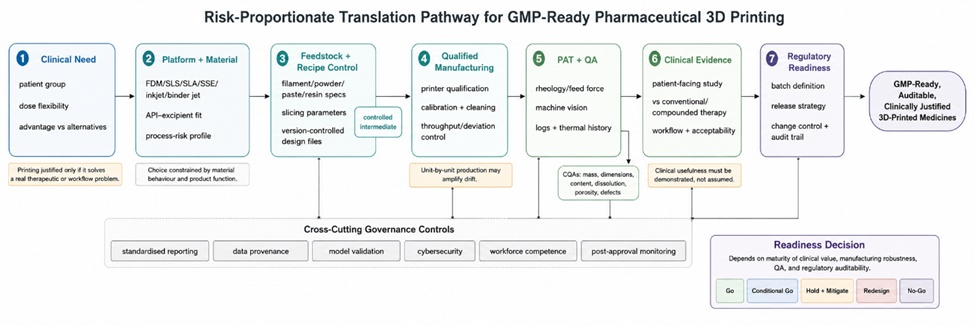
Figure 2. Risk-Proportionate Translation Pathway for GMP-Ready Pharmaceutical 3D Printing
Pharmaceutical 3D printing has demonstrated remarkable design capability, but design capability has outpaced manufacturing and regulatory readiness. The evidence shows that printed dosage forms can be engineered for rapid disintegration, modified release, personalised dosing, complex geometry, and specialised clinical needs, yet these achievements remain unevenly connected to scalable GMP workflows.
The essential shift is from isolated formulation demonstrations to validated platform thinking. Translation will require standardised characterisation, robust feedstock controls, non-destructive quality testing, qualified equipment, secure digital workflows, and clinical evidence that printed medicines offer meaningful advantages over conventional or compounded alternatives.
Pharmaceutical 3D printing will deliver on its clinical promise only if governed by a rigorous, scalable quality framework that evolves alongside the technology. The field should now prioritise manufacturable, auditable, and clinically justified systems over increasingly elaborate prototypes.
None
None
None
None
Open Access The author(s) retain copyright. This article is licensed under the Creative Commons Attribution-NonCommercial-ShareAlike 4.0 International License. It may be shared and adapted for non-commercial purposes with appropriate attribution, an indication of changes, and distribution of adaptations under the same license. Third-party material may be subject to separate terms identified in its credit line. View the license at https://creativecommons.org/licenses/by-nc-sa/4.0/.
 Publication System