Drug delivery systems are often developed as bespoke technological solutions for a single molecule, route, indication, or patient group. This custom-build logic can generate highly sophisticated systems, but it also produces long development timelines, repeated formulation work, high translation costs, and limited scalability. As therapeutic pipelines become more diverse, this one-product–one-platform paradigm increasingly constrains the ability of pharmaceutical technology to respond efficiently to emerging clinical needs. The central problem addressed in this article is the absence of a formalised design principle for pharmaceutical modularity. Although modular behaviours can be observed in lipid nanoparticles, polymeric carriers, implantable systems, and three-dimensional printed medicines, these examples have not yet been unified into a coherent theory of reconfigurable delivery platform design. Without such a principle, modularity remains an implicit engineering convenience rather than an explicit pharmaceutical development strategy. This article proposes the Pharmaceutical Modularity Principle as a non-empirical theory for reconfigurable delivery platforms across molecules, diseases, and populations. The principle argues that delivery systems should be architected through a decoupled core-platform structure in which drug-specific, disease-targeting, release-modulating, and population-adaptation functions can be independently designed, validated, and substituted. The goal is not to eliminate product-specific optimisation, but to reduce unnecessary reinvention by defining which delivery functions can remain stable and which should remain reconfigurable. The proposed theory contributes a formal design vocabulary for platform-based pharmaceutical development. It reframes modularity as a disciplined architecture of functional partitioning, interface standardisation, module-level validation, and controlled reconfiguration. Future empirical work will be required to test whether the principle can reduce development time, support regulatory bridging, and enable adaptable product families without compromising quality, safety, or therapeutic performance.
Contemporary drug delivery innovation has achieved remarkable technical sophistication, but its translational pathway remains highly product-specific. Precision nanoparticles, lipid nanoparticles, polymeric micelles, implantable systems, and printed dosage forms are frequently engineered around a defined therapeutic payload, indication, or administration context rather than around a reusable platform architecture [1]. This logic has supported major advances in nucleic acid delivery, cancer nanomedicine, and personalised dosage design, yet it has also normalised repeated reinvention whenever the molecule, disease target, or patient group changes [2]. The present article begins from the premise that this reinvention problem is not only operational, but conceptual.
The need for reconfigurable delivery platforms is especially visible in RNA therapeutics, where similar delivery challenges recur across messenger RNA, small interfering RNA, and genome-editing cargoes. Lipid nanoparticles have shown that a relatively stable core architecture can be adapted to different nucleic acid payloads and biological targets, suggesting a latent modular logic within current pharmaceutical technologies [3]. Advances in nucleic acid therapeutics further indicate that the delivery problem often concerns the adjustment of carrier chemistry, organ tropism, intracellular release, and immunological profile rather than the invention of an entirely new delivery philosophy for each product [4]. This makes RNA delivery a useful model for thinking about modular pharmaceutical architecture.
A comparable pattern can be seen across polymeric micelles, cancer nanomedicine, and implantable drug delivery devices. Block copolymer micelles demonstrate that core–shell organisation, cargo loading, circulation behaviour, and targeting can be conceptually separated even when they remain chemically integrated in practice [5]. Cancer nanomedicine has similarly moved from generic tumour accumulation toward increasingly smart and targeted strategies, but many such systems still remain product-specific rather than deliberately reconfigurable [6, 7]. Implantable polymeric devices show another form of platform potential because material matrix, geometry, loading strategy, and release duration can be varied within a broader device family [8].
This article proposes that the pharmaceutical field requires a formal design principle comparable in ambition to platform thinking in other engineering domains, but adapted to the scientific, regulatory, and manufacturing constraints of medicines. The Pharmaceutical Modularity Principle is therefore presented as a non-empirical theory that defines how delivery platforms may be designed for controlled reconfiguration rather than repeated redesign. Existing examples, including targeted RNA interference platforms, organ-selective lipid nanoparticles, and three-dimensional printed medicines, show that modular elements already exist across the field [9-11]. The aim is to convert these scattered exemplars into a systematic theory of platform design for molecules, diseases, and populations.
The dominant design logic in drug delivery treats the delivery system as an integrated whole optimised for a single drug–indication pair. This approach can be scientifically powerful because it allows each carrier, excipient, targeting element, and release mechanism to be tuned to the chosen molecule and biological context [1]. However, it also creates architectural lock-in: once the delivery system is optimised as a tightly coupled whole, changing the cargo, target tissue, administration route, or patient group may require extensive redesign. In this sense, product-specific optimisation can become a barrier to platform scalability.
This problem is evident in the way nanoparticle technologies are repeatedly adapted through trial-and-error modifications rather than through predefined reconfiguration protocols. Targeted delivery systems for cancer therapeutics have advanced through changes in size, surface chemistry, ligand presentation, payload chemistry, and biological conditioning, but these changes are often treated as new formulations rather than as module substitutions within a reusable architecture [6]. The continuing debate around the enhanced permeability and retention effect also illustrates how disease context can destabilise assumptions built into a delivery platform [12]. A modular theory would require these disease-specific dependencies to be explicitly assigned to reconfigurable modules rather than hidden within the entire system.
The absence of formal modularity also multiplies cost and uncertainty because every new platform variant may require renewed characterisation, manufacturing adaptation, and translational justification. Three-dimensional printed pharmaceuticals reveal the opposite possibility: dose, geometry, release profile, and patient acceptability can be varied through a common manufacturing logic, even though each printed medicine must still satisfy product-specific requirements [13, 14]. Similarly, implantable devices can vary materials, reservoir structures, degradation profiles, and loading strategies within a platform family [8]. These examples suggest that the problem is not a lack of technological feasibility, but a lack of a design philosophy that deliberately separates stable platform functions from changeable therapeutic modules.
Figure 1 illustrates how bespoke delivery-system design creates architectural lock-in, while pharmaceutical modularity converts repeated redesign into controlled platform reconfiguration.
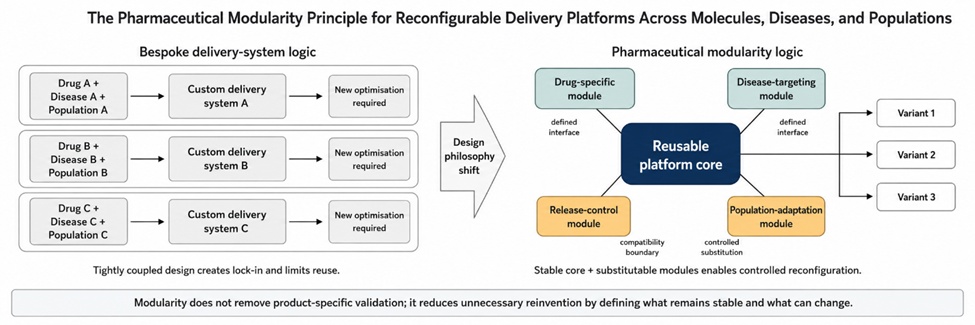
Figure 1. From Bespoke Delivery-System Lock-In to Modular Pharmaceutical Platform Reconfiguration
A non-empirical theory article is justified when a field contains sufficient technological exemplars but lacks a unifying conceptual principle. Drug delivery already contains partial expressions of modularity in lipid nanoparticles, polymeric micelles, targeted RNA platforms, implantable matrices, and printed dosage forms [5, 8, 9, 13]. What remains underdeveloped is a formal explanation of how these systems can be understood as reconfigurable platforms rather than isolated product designs. The present theory therefore proceeds by conceptual synthesis rather than by claiming new experimental validation.
The logic of the Pharmaceutical Modularity Principle is derived from the observation that delivery functions can often be analytically separated even when they are materially integrated. For example, lipid nanoparticles must combine nucleic acid complexation, circulation stability, organ distribution, cellular uptake, endosomal escape, and tolerability, yet each function can be influenced by distinguishable design variables [2, 15]. Selective organ targeting nanoparticles further demonstrate that altering lipid composition can redirect tissue delivery without abandoning the broader nanoparticle concept [10]. Such cases support a theoretical inference: reconfiguration becomes possible when the variables responsible for one function can be changed without unpredictably disrupting all other platform functions.
This theory is falsifiable because it generates expectations that future platforms can either satisfy or fail to satisfy. A genuinely modular platform should permit the substitution of a cargo, targeting element, release controller, or dose-forming feature while preserving predefined core performance boundaries [4]. If a supposed platform requires complete redevelopment whenever a module changes, then it would not meet the proposed modularity threshold. The theory is therefore intended not as a descriptive label for all flexible technologies, but as a testable design standard for future pharmaceutical platform development.
The first assumption is that drug delivery functions can be partitioned into separable modules without denying their biological interdependence. RNA delivery platforms illustrate this assumption because payload protection, intracellular delivery, immune modulation, organ targeting, and expression profile can be described as distinguishable functions even when they are produced by one integrated nanoparticle [16, 17]. Tools for therapeutic mRNA delivery similarly show that carrier materials, cargo chemistry, and biological response can be analysed as interacting but not conceptually inseparable components [18]. Pharmaceutical modularity therefore begins with functional partitioning, not with physical disassembly alone.
The second assumption is that standardised interfaces between modules are achievable within current material and formulation science. In targeted lipid nanoparticles, ligand attachment, lipid composition, and nucleic acid cargo can be engineered in ways that imply recurring interface problems between platform core, surface module, and biological target [19]. In polymeric micelles, the relationship between hydrophobic core, hydrophilic corona, drug loading domain, and targeting or stabilising features also suggests that interface design can be treated as a central architectural problem [5, 20]. The theoretical claim is that modularity becomes more realistic when these interfaces are made explicit, measurable, and transferable across related products.
The third assumption is that independent or semi-independent module validation can reduce development burden, although it cannot eliminate the need for integrated product testing. High-throughput in vivo screening of nanoparticle libraries shows that delivery behaviour can be compared across systematic formulation variants, supporting the possibility of platform-level learning [21]. Re-targeting studies using messenger RNA and vascular delivery also demonstrate how a targeting function can be altered while the broader delivery problem remains recognisably connected to an existing platform architecture [22]. The boundary condition is that some highly coupled systems may resist modularisation, especially when a change in one component unpredictably alters stability, biodistribution, immunogenicity, manufacturability, or clinical usability.
Pharmaceutical modularity begins with the distinction between a platform core and therapeutic modules. The platform core is the repeatable architecture that provides structural integrity, manufacturability, administration feasibility, and a baseline delivery mechanism, while modules specify the drug cargo, biological target, release behaviour, or population adaptation. Targeted RNA interference systems illustrate this logic because a delivery scaffold can be redirected through molecular recognition features while retaining a broader platform identity [9]. Lipid nanoparticles similarly show how ionisable lipids, helper lipids, sterols, and polyethylene glycol-lipids may form a core architecture that can be adjusted for different nucleic acid applications [2].
This logic differs from ordinary formulation variation because modularity requires deliberate interoperability rather than informal flexibility. A conventional formulation may be modified through excipient changes, process adjustments, or dose changes, but a modular platform defines which parts are intended to remain stable and which are intended to be replaced. Naturally occurring cholesterol analogues in lipid nanoparticles demonstrate that even apparently small compositional changes can reshape particle behaviour and intracellular delivery, which means that modularity must be governed by explicit interface rules rather than assumed from material similarity [23]. The platform must therefore define compatibility boundaries before reconfiguration is attempted.
A modular pharmaceutical platform is not merely a combination product assembled from several parts. Its distinctive feature is that the relationship between parts is predesigned so that substitution is controlled, testable, and repeatable. Selective organ targeting nanoparticles show that tissue distribution can be altered through systematic compositional changes, but the modular interpretation requires these changes to be treated as an organ-targeting module linked to a persistent nanoparticle core [10]. Table 1 defines the core components and logic of pharmaceutical modularity.
Table 1. Pharmaceutical Modularity Logic: Core Platform, Drug-Specific Module, Disease-Targeting Module, and Population-Adaptation Module
Modularity component | Conceptual role in the platform | Reconfigurable function | Pharmaceutical requirement | Illustrative platform logic |
Core platform | Provides the stable delivery architecture | Maintains baseline structure, manufacturability, and administration route | Must remain sufficiently stable across module changes | Lipid nanoparticle scaffold, polymeric micelle architecture, implant matrix, or printable dosage architecture |
Drug-specific module | Adapts the system to the therapeutic molecule | Adjusts cargo loading, protection, solubilisation, or molecular compatibility | Must preserve drug integrity and release-relevant quality attributes | RNA cargo loading, hydrophobic drug encapsulation, implant reservoir loading, or printed dose content |
Disease-targeting module | Adapts the system to tissue, cellular, or pathological context | Redirects biodistribution, uptake, ligand recognition, or disease-triggered release | Must demonstrate target relevance and avoid unacceptable off-target exposure | Organ-selective lipid composition, ligand presentation, tumour-targeting strategy, or disease-specific release trigger |
Release-control module | Regulates timing, rate, and site of drug availability | Adjusts sustained, pulsatile, delayed, or responsive release | Must remain predictable after cargo or target reconfiguration | Polymer degradation rate, matrix density, micelle stability, or printed geometry |
Population-adaptation module | Adapts the platform to patient group needs | Adjusts dose, usability, administration burden, or pharmacokinetic exposure | Must reflect age, adherence, swallowing ability, device usability, or risk profile | Paediatric printlets, geriatric-friendly dosage forms, long-acting implants, or dose-scaled platform variants |
Interface specification | Defines how modules connect to the core | Enables substitution without uncontrolled system redesign | Must be chemically, physically, analytically, and clinically interpretable | Surface conjugation chemistry, cargo-loading window, release-rate specification, or printable geometry constraints |
Reconfiguration protocol | Controls the process of replacing one module with another | Converts platform flexibility into repeatable development practice | Must define comparability tests and decision thresholds | Bridging tests for new cargo, targeting ligand, dose strength, or release profile |
The key implication is that pharmaceutical modularity is a theory of controlled variation. It recognises that delivery platforms cannot be freely recombined like purely digital systems because biological performance depends on coupled physicochemical and physiological processes. However, studies on tissue-specific mRNA delivery suggest that systematic alteration of selected components can produce predictable shifts in biological outcome when the platform space is sufficiently understood [24]. The role of the Modularity Principle is to make such controlled variation a design requirement rather than a retrospective interpretation.
Figure 2 presents the conceptual architecture of the Pharmaceutical Modularity Principle as a decoupled platform core connected to interoperable therapeutic modules through standardised interfaces.
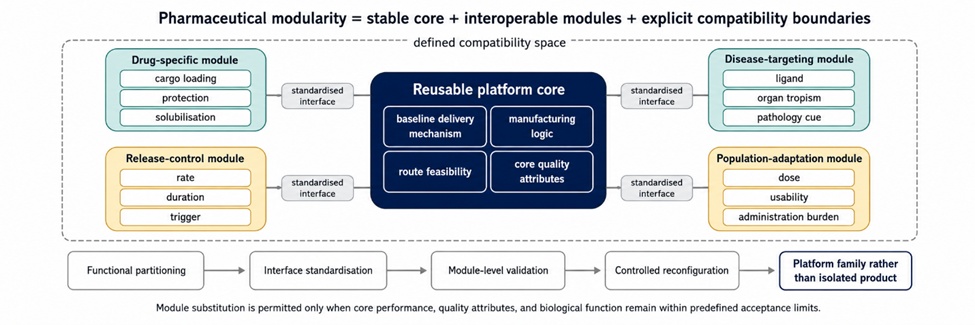
Figure 2. Conceptual Architecture of the Pharmaceutical Modularity Principle: Stable Platform Core, Interoperable Modules, and Standardised Interfaces
Molecule-level reconfiguration concerns the ability to change the therapeutic cargo while preserving the same underlying delivery architecture. Nucleic acid delivery provides the clearest example because messenger RNA, small interfering RNA, and genome-editing systems impose different payload constraints but often rely on related carrier functions such as protection, cellular uptake, endosomal escape, and intracellular release [4, 15]. CRISPR-Cas9 delivery using targeted lipid nanoparticles shows how a platform can be adapted toward a distinct therapeutic mechanism while retaining the broader logic of nanoparticle-mediated intracellular delivery [25]. In modular terms, the cargo module changes while the platform core remains recognisable.
Disease-level reconfiguration concerns the ability to redirect a delivery platform toward a different tissue, pathology, or biological microenvironment. Lung-selective mRNA delivery with synthetic lipid nanoparticles demonstrates that organ context can be treated as a design variable rather than a fixed property of the payload [26]. Oxidised cholesterol-containing nanoparticles also show that lipid composition can influence delivery to the liver microenvironment, supporting the idea that disease or organ tropism may be approached through a reconfigurable targeting module [27]. Such examples do not prove universal modularity, but they show that disease adaptation can sometimes be achieved without abandoning the entire platform concept.
Population-level reconfiguration extends modularity from molecular and disease differences to patient-specific or group-specific requirements. Three-dimensional printed medicines are especially relevant because dose, geometry, release profile, and acceptability can be modified within a shared manufacturing logic [13, 14]. Patient acceptability studies show that delivery design must account not only for pharmacological performance but also for usability, preferences, and administration context [14]. Table 2 maps how modularity enables reconfiguration across molecules, diseases, and populations.
Table 2. Reconfiguration Potential of Modular Delivery Platforms: Examples of Molecular, Disease, and Population Adaptations
Reconfiguration level | What is changed | What remains stable | Design purpose | Example from current delivery science | Main risk requiring validation |
Molecule-level reconfiguration | Drug cargo, nucleic acid type, molecular loading strategy, or solubilisation domain | Platform core, manufacturing logic, administration route, and baseline carrier architecture | Adapt one platform to different therapeutic molecules | Lipid nanoparticle adaptation across RNA cargoes or polymeric micelles for different hydrophobic drugs | Cargo change may alter stability, encapsulation, release, immunogenicity, or intracellular performance |
Disease-level reconfiguration | Targeting ligand, organ-tropic composition, disease-triggered release cue, or tissue affinity | Core scaffold and core process parameters | Redirect the same platform toward different tissues or pathologies | Organ-selective lipid nanoparticles or targeted nanomedicine strategies | Targeting change may alter biodistribution, safety, off-target exposure, or clinical relevance |
Population-level reconfiguration | Dose strength, release duration, dosage geometry, administration aid, or usability feature | Platform manufacturing method and material family | Adapt the platform to paediatric, geriatric, adherence-limited, or risk-defined groups | Three-dimensional printed medicines and implantable long-acting systems | Patient adaptation may alter performance, acceptability, dose accuracy, or regulatory comparability |
Release-profile reconfiguration | Degradation rate, matrix density, diffusion path length, or printed geometry | Platform material class and route of administration | Adjust therapeutic exposure without inventing a new system | Implantable polymeric devices and printed dosage forms | Release change may disrupt local tolerability, dose proportionality, or therapeutic window |
Targeting reconfiguration | Surface ligand, lipid composition, or biological recognition element | Carrier assembly logic and payload class | Match delivery to disease biology or tissue access | Targeted RNA platforms and cancer nanomedicine systems | New targeting module may create new safety or manufacturing concerns |
Manufacturing reconfiguration | Process window, modular assembly step, or digital design file | Quality system and platform control strategy | Produce product families through controlled variation | Printable medicines or nanoparticle library development | Process changes may affect critical quality attributes and batch comparability |
Reconfiguration across these three levels does not imply that one universal platform can serve every molecule, disease, and population. Cancer immunotherapy delivery technologies illustrate that immune context, cell type, route, payload, and safety constraints may require substantial product-specific adaptation [28]. The modularity claim is narrower and more defensible: within a defined platform family, some functions can be decoupled and substituted more efficiently than a bespoke redesign would allow. This makes modularity a strategy for disciplined adaptability rather than a promise of limitless interchangeability.
The first design rule is functional partitioning, which requires the delivery system to be divided conceptually into a core platform and defined modules. This rule is supported by polymeric micelle architecture, where the hydrophobic core, hydrophilic shell, drug-loading region, stabilising features, and targeting possibilities can be analysed as separable functions even when embodied in a single nanosystem [5]. Smart cancer nanomedicine similarly depends on distinguishing circulation, accumulation, penetration, release, and biological response as design functions rather than treating the nanoparticle as an indivisible object [7]. Functional partitioning is therefore the analytical foundation of modular platform design.
The second design rule is interface standardisation, because reconfiguration becomes unreliable if the connection between core and module is undefined. In RNA delivery, the interface between payload chemistry and carrier chemistry strongly affects encapsulation, expression, tolerability, and intracellular performance [15]. In targeted delivery, the interface between surface chemistry and biological recognition can reshape pharmacokinetics and tissue interaction, meaning that ligand substitution must be treated as a controlled interface event rather than a cosmetic modification [19]. Standardisation does not mean identical chemistry across all products; it means predefined compatibility criteria.
The third design rule is validation independence, which means that each module should have critical quality attributes that can be characterised before full-system integration. Nanoparticle library screening supports this rule because systematic comparison of formulation variants can reveal how specific design variables influence delivery behaviour [21]. Emerging frontiers in drug delivery also emphasise that translation depends on understanding the relationship between material design, biological barriers, manufacturability, and clinical need [29]. Table 3 lists the platform design rules derived for pharmaceutical modularity.
Table 3. Platform Design Rules for Modular Pharmaceutical Delivery Systems: Functional Partitioning, Interface Standardisation, and Validation Independence
Design rule | Definition | Operational requirement | What must be documented | Failure mode if ignored |
Functional partitioning | Separate the platform into core delivery functions and reconfigurable modules | Identify which functions remain stable and which can be substituted | Core architecture, module categories, functional boundaries, and dependency map | The system becomes a bespoke formulation with no reusable platform logic |
Interface standardisation | Define how each module connects chemically, physically, spatially, or digitally to the core | Establish compatibility windows for cargo, targeting, release, and dose modules | Interface chemistry, loading limits, geometry constraints, surface density, and process conditions | Module substitution causes unpredictable changes in stability, release, targeting, or manufacturability |
Validation independence | Characterise each module’s critical quality attributes before and after integration | Separate module-level tests from integrated product tests where scientifically justified | Module identity, potency contribution, purity, stability, release effect, and comparability criteria | Every change triggers full redevelopment because no module-level evidence exists |
Reconfiguration protocol | Define the process for replacing one module with another | Use predefined steps for module selection, compatibility testing, integration, and bridging | Decision tree, acceptance criteria, bridging tests, and risk controls | Reconfiguration becomes ad hoc and cannot support regulatory or industrial scale-up |
Boundary definition | Specify where modularity no longer applies | Identify coupled functions that cannot be safely separated | Non-interchangeable components, high-risk dependencies, and exclusion criteria | The platform overclaims flexibility and creates unsafe or scientifically weak substitutions |
Platform learning loop | Capture data from each variant to improve future reconfiguration | Treat each product as evidence for the platform family | Variant performance, failure patterns, manufacturing deviations, and clinical feedback | Knowledge remains product-specific and does not accumulate at platform level |
The fourth design rule is the reconfiguration protocol, which converts modularity from an abstract design preference into a disciplined development pathway. This protocol should define how a new cargo, targeting module, release controller, dose geometry, or population-specific feature is selected, integrated, tested, and compared against prior platform variants. Three-dimensional printing demonstrates the importance of such protocolisation because digital design flexibility is valuable only when linked to pharmaceutical controls over dose accuracy, mechanical properties, release behaviour, and patient use [11, 30]. A modular platform without a reconfiguration protocol is therefore only a flexible technology, not a mature platform architecture.
The Pharmaceutical Modularity Principle may be stated as follows: a reconfigurable drug delivery platform shall be architected such that its core delivery functions, drug-specific components, disease-targeting elements, and population-adaptation features are decoupled into interoperable modules with standardised interfaces, enabling independent development, validation, and substitution. This principle is not a claim that all pharmaceutical systems should become modular. Rather, it defines the conditions under which a platform may be considered modular in a meaningful theoretical and translational sense. The principle draws support from targeted RNA platforms, lipid nanoparticle adaptation, polymeric micelle architecture, implantable systems, and printed dosage technologies [2, 5, 8, 9, 13].
The first implication is that platform identity must be defined independently of a single product. A lipid nanoparticle platform, for example, should not be defined only by one authorised formulation or one payload, but by a bounded architecture of materials, assembly logic, payload compatibility, and biological performance criteria [3]. Similarly, implantable delivery systems should be understood through material class, release mechanism, geometry, and administration context rather than through a single drug-device pairing [8]. This reframing allows platform development to accumulate knowledge across related products.
The second implication is that modularity requires explicit boundaries. Some delivery functions are deeply coupled, and changing one material or structural component may alter biodistribution, immune response, release kinetics, and manufacturability at the same time [23]. The Modularity Principle therefore does not permit arbitrary swapping; it requires that every substitution occur within a defined compatibility space. Table 4 presents the formal statement of the Pharmaceutical Modularity Principle.
Table 4. The Pharmaceutical Modularity Principle: Formal Statement, Architecture, and Operational Logic
Element of the principle | Formal meaning | Practical interpretation | Required evidence in future validation |
Core delivery functions | Stable functions that define the platform family | Structural integrity, route suitability, manufacturability, baseline delivery mechanism, and quality control logic | Demonstration that these functions remain within predefined limits across variants |
Drug-specific components | Modules that adapt the platform to a molecule | Cargo loading, solubilisation, protection, release compatibility, or intracellular availability | Evidence that cargo substitution does not destabilise the platform beyond acceptable limits |
Disease-targeting elements | Modules that adapt the platform to pathology or tissue | Ligand, organ-tropic composition, biological trigger, or microenvironment-responsive element | Evidence that targeting changes improve or redirect delivery without unacceptable safety trade-offs |
Population-adaptation features | Modules that adapt use and exposure to patient groups | Dose strength, release duration, dosage geometry, administration aid, or acceptability feature | Evidence that adaptation improves suitability while preserving dose accuracy and performance |
Decoupled architecture | Functional separation between core and modules | Changes are localised where possible rather than forcing whole-system redesign | Dependency mapping and demonstration of controlled module substitution |
Standardised interfaces | Defined compatibility rules between components | Chemical, physical, spatial, analytical, and process interfaces are specified | Interface tests, acceptance criteria, and comparability thresholds |
Independent development and validation | Module evidence can be generated before integration | Module-level data support but do not replace integrated product assessment | Bridging data showing when module-level validation predicts whole-system performance |
Substitution logic | A controlled pathway for replacing one module | Reconfiguration follows a predefined protocol rather than ad hoc reformulation | Prospective studies comparing redevelopment versus modular substitution |
The third implication is regulatory and industrial: modular platforms should be developed as product families rather than as isolated products. The United States Food and Drug Administration’s platform technology designation discussion indicates that regulators are beginning to recognise the value of platform knowledge in accelerating development, although specific requirements for modular drug delivery platforms remain emergent [31]. The Modularity Principle therefore offers a conceptual language for future regulatory dialogue around platform validation, module-specific bridging, and controlled product-family expansion. Its value lies in making platform claims testable rather than rhetorical.
The Pharmaceutical Modularity Principle can be tested retrospectively by comparing delivery technologies that behaved like reusable platforms with those that required repeated bespoke redevelopment. Lipid nanoparticles, targeted RNA systems, and polymeric micelles provide suitable cases because they contain recurring architectural elements across different payloads and disease applications [2, 4, 5]. A retrospective test would ask whether successful translation correlated with identifiable modular features such as functional partitioning, controlled interfaces, and reusable manufacturing knowledge. Such work would not prove the principle universally, but it would establish whether modularity has predictive explanatory value.
Prospective validation would require designing a platform explicitly according to the principle and then testing controlled module substitutions. For example, a nanoparticle core could be developed with a defined cargo-loading interface and swappable targeting elements, followed by systematic assessment of whether each substitution preserves core quality attributes while changing the intended biological function [10, 22]. Similar prospective tests could be performed with printed dosage forms by altering dose geometry or release features while preserving a common material and manufacturing architecture [11]. The key question would be whether reconfiguration is faster, more predictable, and less resource-intensive than bespoke redevelopment.
Metrics for success should include development time, module interchange success, preservation of critical quality attributes, manufacturability, biological performance, patient suitability, and regulatory interpretability. High-throughput nanoparticle screening suggests that platform learning can be quantified through systematic design spaces rather than anecdotal formulation comparison [21]. Patient-centred dosage technologies also imply that modularity should be judged by usability and acceptability, not only by technical substitution [14]. A future validation agenda should therefore combine physicochemical, biological, manufacturing, clinical, and regulatory metrics.
The translation pathway for pharmaceutical modularity requires a shift from product-by-product validation to platform-informed development. Platform validation could define the core architecture, manufacturing process, material specifications, and acceptable interface ranges, while module-specific supplements could justify changes in cargo, targeting, release profile, or population adaptation [31]. This approach would not remove the need for integrated product evidence, but it could reduce duplication when prior platform knowledge is scientifically relevant. Nucleic acid therapeutics show why this is important, because related delivery questions recur across many products in the same therapeutic class [4].
Manufacturing flexibility is another major translational advantage of modularity. A platform family based on shared materials, equipment, process parameters, and analytical methods can support faster adaptation than a sequence of unrelated bespoke systems. Three-dimensional printing and implantable devices are especially informative because both can support controlled variation in dose, geometry, release duration, or material configuration within a wider platform logic [8, 13, 30]. For industry, modularity could therefore create product families that are easier to scale, compare, and maintain.
The main barriers are regulatory uncertainty, interface standardisation, intellectual property fragmentation, and the need for investment in platform-level development before a single product is fully defined. Cancer immunotherapy delivery and smart nanomedicine show that biological complexity can limit generalisability, especially when immune activation, tumour heterogeneity, penetration, and safety are tightly coupled [7, 28]. Modular platforms must therefore be presented to regulators and clinicians with clear boundaries, not with universal claims. The realistic translation pathway is incremental: define a platform family, validate its interfaces, test limited module substitutions, and expand only where comparability remains scientifically defensible.
Figure 3 shows the proposed pathway for testing, validating, and translating modular pharmaceutical platforms from theoretical principle to regulated product-family development.
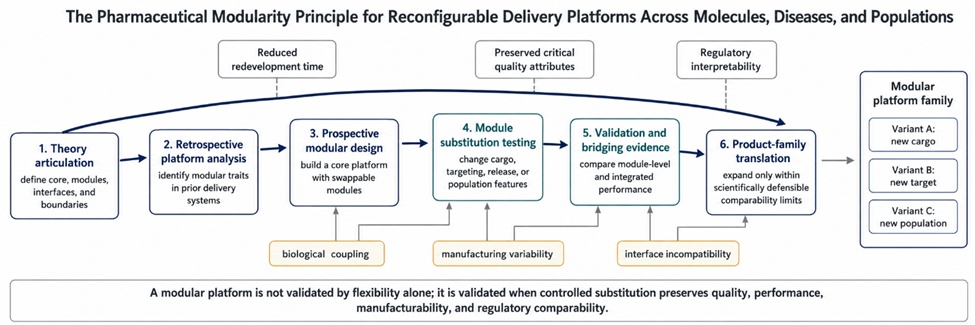
Figure 3. Translation and Validation Pathway for Modular Pharmaceutical Delivery Platforms: From Principle Definition to Product-Family Expansion
The Pharmaceutical Modularity Principle offers a formal design logic for shifting drug delivery development from bespoke system construction toward configurable platform architecture. It defines modularity as the deliberate decoupling of core delivery functions from drug-specific, disease-targeting, release-modulating, and population-adaptation modules. This reframing gives pharmaceutical scientists a systematic vocabulary for distinguishing genuine platform reconfiguration from ordinary formulation modification.
The principle does not claim that all delivery systems can or should be modular. Some systems are too tightly integrated, biologically context-dependent, or clinically specialised to permit safe substitution of components without extensive redevelopment. Modularity should therefore be understood as a strategic option for platform families in which functional partitioning, interface control, and module-level validation can be scientifically justified.
The next task for the field is to test, refine, and eventually codify this principle through retrospective analysis, prospective platform design, and regulatory dialogue. If validated, pharmaceutical modularity could reduce unnecessary reinvention, accelerate product-family development, and improve responsiveness to diverse therapeutic and population needs. Its broader contribution is to make adaptability a planned feature of pharmaceutical technology rather than an accidental property of successful platforms.
None
None
None
None
Open Access The author(s) retain copyright. This article is licensed under the Creative Commons Attribution-NonCommercial-ShareAlike 4.0 International License. It may be shared and adapted for non-commercial purposes with appropriate attribution, an indication of changes, and distribution of adaptations under the same license. Third-party material may be subject to separate terms identified in its credit line. View the license at https://creativecommons.org/licenses/by-nc-sa/4.0/.
 Publication System