Digital twin technology is increasingly used across pharmaceutical science, pharmaceutical manufacturing, precision medicine, and regulatory science. However, the same term is now applied to systems with very different simulated objects, including drug products, manufacturing processes, patients, and regulatory workflows. This semantic expansion has created a need for clearer conceptual organisation. The central problem addressed in this article is that pharmaceutical digital twin research has developed faster than its classification language. A tablet dissolution model, a continuous manufacturing simulator, a virtual patient population, and a compliance-monitoring model may all be described as digital twins, even though they support different decisions and require different validation logics. Without classification, comparison across studies becomes imprecise. This article proposes a four-category taxonomy of pharmaceutical digital twin systems. The categories are Product Twins, Process Twins, Patient Twins, and Regulatory Twins. The classification is grounded in the primary object of simulation and the principal decision function supported by the twin. The proposed taxonomy shows that digital twins should not be treated as a single technological class. Product Twins primarily simulate drug-product behaviour, Process Twins simulate manufacturing operations, Patient Twins simulate therapeutic response in individuals or populations, and Regulatory Twins simulate or support regulatory evaluation and oversight. Distinguishing these categories is a necessary step toward mature pharmaceutical digital twin science.
Digital twin technology has moved from engineering and cyber-physical systems into pharmaceutical development, manufacturing, and healthcare, where it is increasingly presented as a tool for prediction, optimisation, control, and lifecycle learning. General digital twin literature defines the concept as a dynamic virtual representation linked to a physical or operational counterpart, but pharmaceutical applications vary substantially in what they simulate and how closely they are connected to real-time data [1, 2]. This variability is visible in pharmaceutical reviews that describe digital twins across product development, biomanufacturing, continuous production, and patient-centred therapeutic modelling [3, 4].
The difficulty is that the term “digital twin” is now used for heterogeneous systems that differ in object, scale, purpose, and evidence requirement. In one context, a twin may represent a tablet and its dissolution behaviour; in another, it may represent a continuous direct compression line; in another, it may simulate a patient’s likely drug response [5-7]. These systems share a language of virtual replication, but they do not share the same scientific object or validation pathway.
This conceptual ambiguity matters because pharmaceutical digital twins are increasingly expected to support high-consequence decisions. Manufacturing twins may inform process control and quality assurance, while patient twins may support therapeutic individualisation or in silico clinical trial design [8-10]. If all such systems are treated as equivalent, the field risks applying the wrong validation standards to the wrong category of twin.
The objective of this article is therefore to develop a classification that organises pharmaceutical digital twin systems into coherent and non-overlapping primary categories. The proposed taxonomy distinguishes Product Twins, Process Twins, Patient Twins, and Regulatory Twins according to the primary object simulated and the main decision supported. This approach builds on digital twin classification principles from engineering while adapting them to pharmaceutical product quality, manufacturing control, clinical response, and regulatory oversight [1, 2, 11].
A shared classification is needed because pharmaceutical digital twin systems are emerging from multiple disciplinary traditions. Process engineers often understand digital twins through real-time manufacturing simulation and control, while formulation scientists may emphasise product behaviour, critical quality attributes, dissolution, and stability [6, 12, 13]. Clinical pharmacologists and pharmacometricians, by contrast, often approach patient-level twins through PBPK, virtual populations, and quantitative systems pharmacology [14-16].
Without classification, communication across these communities becomes unstable. A “validated digital twin” in continuous manufacturing may refer to an integrated process model linked to process analytical technology, whereas a “validated digital twin” in precision medicine may refer to a mechanistic patient model calibrated against physiological and pharmacological data [8, 17, 18]. These differences are not merely semantic; they determine the type of evidence required to establish credibility.
Classification also precedes standardisation because validation cannot be meaningfully standardised until the class of system is clear. Model risk frameworks in pharmaceutical manufacturing already show that intended use, model complexity, and decision consequence should shape validation expectations [9]. A classification based on the primary simulated object and intended function therefore provides a foundation for category-specific validation, comparison, and regulatory evaluation.
The classification proposed here uses a deductive logic rather than a purely descriptive catalogue. Each digital twin is assigned to a category according to the entity it primarily simulates and the dominant decision it is designed to support. This method follows the broader digital twin principle that a twin must be defined not only by modelling technique but by the relationship between the virtual representation, its referent object, and its operational purpose [1, 2].
The four categories are mutually exclusive at the level of primary object, although they may be technically coupled in advanced systems. A Product Twin primarily simulates the drug product, a Process Twin primarily simulates the manufacturing system, a Patient Twin primarily simulates drug behaviour in a biological subject or population, and a Regulatory Twin primarily simulates or supports regulatory evaluation and compliance oversight. This boundary logic is necessary because integrated systems, such as continuous manufacturing platforms, may connect product quality predictions to process control while still retaining analytically distinct product and process components [5, 19].
The proposed taxonomy also recognises that digital twins differ in maturity. Process Twins are currently the most developed pharmaceutical category, supported by continuous manufacturing, PAT, hybrid modelling, and bioprocess examples [8, 20, 21]. Product Twins are emerging through dissolution, formulation, and product-quality modelling; Patient Twins are advancing through PBPK and virtual patient methods; Regulatory Twins remain the least mature but conceptually important as artificial intelligence and model-based regulatory science expand [6, 7, 10, 22, 23].
Figure 1 presents the proposed four-category taxonomy of pharmaceutical digital twin systems, distinguishing Product Twins, Process Twins, Patient Twins, and Regulatory Twins by their primary simulated object, decision function, evidence requirement, and possible lifecycle coupling.
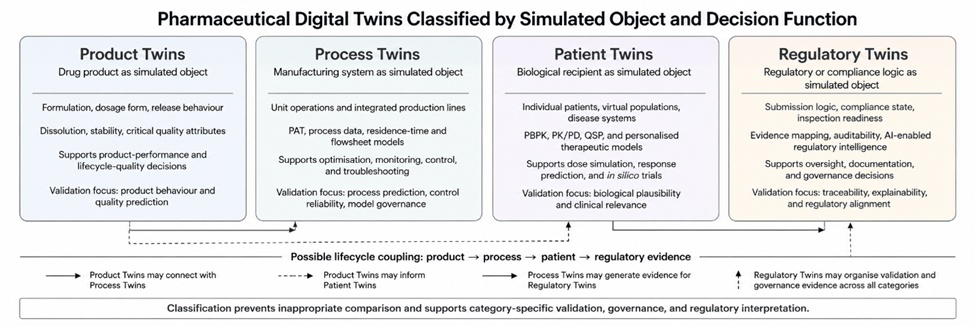
Figure 1. Four-category taxonomy of pharmaceutical digital twin systems across product, process, patient, and regulatory decision domains.
Product Twins are digital representations of the drug product itself. Their primary simulated object is the formulation, dosage form, product structure, release behaviour, stability profile, or set of critical quality attributes that define product performance. This differentiates Product Twins from Process Twins because the main question is not how the product is manufactured, but how the product behaves as a pharmaceutical entity across development, use, and lifecycle change [6, 11].
A Product Twin may simulate dissolution, disintegration, microstructure, release kinetics, or interactions between formulation design and in vivo or biorelevant performance. The tablet digital twin described by Schütt, Stamatopoulos, Batchelor, Simmons, and Alexiadis illustrates this category because the simulated object is a solid dosage form and the key output is a dissolution profile under different testing environments [6]. Such examples show that a Product Twin can support formulation understanding without necessarily functioning as a real-time manufacturing control system.
The Product Twin category also includes product-quality representations embedded within broader manufacturing models. Hybrid flowsheet modelling of a continuous direct compression line can predict drug product and process behaviour, but its product-twin component is the representation of how formulation and material attributes translate into final dosage-form quality [5]. Similarly, broader reviews of pharmaceutical modelling show that mathematical models can support product development by linking formulation decisions to performance and quality outcomes [11].
Table 1 defines and characterises Product Twins in pharmaceutical digital twin systems. This category is important because pharmaceutical products have lifecycles that extend beyond manufacture, including release testing, storage, distribution, administration, and post-approval change management [3, 4]. By making the product itself the primary simulated object, Product Twins provide a classification space for models that are neither purely manufacturing twins nor patient-specific therapeutic twins.
Table 1. Product Twins: Definition, Core Attributes, Simulation Purposes, and Key Examples in Pharmaceutical Applications
Product Twin domain | Simulated pharmaceutical object | Main modelling purpose | Typical evidence and application examples |
Formulation-performance twin | Dosage-form composition, formulation structure, excipient behaviour, and drug loading | Predict how formulation choices influence release, dissolution, stability, and product quality | Formulation-performance models, product-quality simulations, and lifecycle product understanding [6, 11] |
Dissolution and release twin | Tablet, capsule, or solid dosage form under compendial or biorelevant dissolution conditions | Simulate dissolution curves, release kinetics, and environment-dependent product behaviour | Tablet dissolution digital twins and biorelevant product-performance simulations [6] |
Critical quality attribute twin | Product attributes such as assay, content uniformity, dissolution, stability, and physical performance | Estimate or monitor critical quality attributes across development, release, and lifecycle change | Product-quality modules within continuous direct compression and hybrid modelling systems [5] |
Product lifecycle twin | Product behaviour across development, manufacturing transfer, storage, distribution, and post-approval change | Support quality-risk assessment, product understanding, and possible post-approval change justification | Lifecycle product modelling, model-informed product development, and quality-risk management [3, 4, 11] |
Boundary condition | Drug product is the primary object, not the manufacturing line or patient receiving the medicine | Separate product behaviour from process operation and therapeutic response | Useful when the decision concerns formulation performance, product quality, or product lifecycle behaviour [5, 6] |
Process Twins are virtual replicas of pharmaceutical manufacturing operations, production lines, or biomanufacturing systems. Their primary simulated object is the process rather than the product alone, and their main function is to support process understanding, optimisation, control, fault detection, and operational decision-making [3, 8]. In pharmaceutical manufacturing, this category is strongly associated with continuous manufacturing, process analytical technology, residence-time modelling, hybrid flowsheet simulation, and model-based control [19, 24].
The Process Twin category includes both unit-operation twins and integrated-line twins. Continuous powder blending, direct compression, residence-time distribution modelling, and discrete element simulation all illustrate how a process can be represented dynamically to understand material flow, variability propagation, and control behaviour [13, 25, 26]. Biopharmaceutical examples extend the same logic to cell-based antibody manufacturing, virus-like particle production, and autonomous bioprocess control using dynamic metabolic or process models [20, 21, 27, 28].
Table 2 defines and characterises Process Twins in pharmaceutical digital twin systems. Process Twins are currently the most mature pharmaceutical digital twin category because manufacturing systems already generate dense sensor data and are governed by established quality, control, and model-risk frameworks [8, 9]. Their value lies in connecting process data, process models, and operational decisions in ways that can reduce trial-and-error development and support more adaptive manufacturing control [5, 12].
Table 2. Process Twins: Definition, Model Architectures, Integration with PAT, and Industrial Use Cases
Process Twin domain | Simulated manufacturing object | Main model architecture | Typical use and validation focus |
Unit-operation twin | Individual operations such as blending, granulation, drying, compression, or bioreactor operation | Mechanistic process models, residence-time distribution models, discrete element models, and surrogate models | Unit-operation optimisation, material-flow prediction, process-state estimation, and comparison with process measurements [13, 25, 26] |
Integrated-line twin | Continuous manufacturing train or linked process sequence | Hybrid flowsheet models, dynamic process models, and end-to-end simulation architectures | Line-level prediction, control-strategy testing, deviation analysis, and continuous process verification [5, 19] |
PAT-enabled twin | Manufacturing system connected to sensor and process analytical technology data | Real-time or near-real-time process models updated by spectroscopic, sensor, or process data streams | Process monitoring, quality prediction, fault detection, and model-based operational decision-making [8, 24] |
Bioprocess twin | Cell-culture, antibody, virus-like particle, or biological production system | Dynamic metabolic models, bioprocess models, hybrid models, and control-oriented simulations | Autonomous bioprocess control, production optimisation, process-state prediction, and biological process understanding [20, 21, 27, 28] |
Governance and model-risk layer | Model used to support manufacturing decisions with different levels of consequence | Risk-based model frameworks, intended-use definitions, model maintenance plans, and lifecycle monitoring | Validation proportional to decision risk, robustness across operating space, and documented model governance [9] |
Patient Twins are digital representations of drug behaviour in a biological subject, virtual patient cohort, or clinically defined population. Their primary simulated object is the patient or patient population, and their purpose is to predict pharmacokinetics, pharmacodynamics, therapeutic response, safety risk, or treatment individualisation [7, 14]. This category includes PBPK-informed twins, quantitative systems pharmacology models, virtual patient populations, and emerging personalised models that link physiological, clinical, and pharmacological information [10, 15].
Patient Twins should be distinguished from ordinary static pharmacokinetic models by their intended use as dynamic, patient-linked or population-linked representations. The digital twin of glimepiride for diabetes treatment and the virtual twin approach for apixaban or rivaroxaban in hospitalised patients illustrate how patient-level simulation can support personalised or stratified therapeutic reasoning [16, 18]. The defining feature is not simply that the model predicts drug exposure, but that it represents a patient-relevant biological system for decision support.
Table 3 defines and characterises Patient Twins in pharmaceutical digital twin systems. Patient Twins are especially important for pharmaceutical digital twin classification because they connect drug development to therapeutic use, clinical simulation, and personalised medicine [10, 17]. They also raise distinct validation questions because credibility depends not only on model fit but also on biological plausibility, representativeness of virtual populations, clinical relevance, and safe interpretation of individualised predictions [14, 15, 29].
Table 3. Patient Twins: Modelling Paradigms, Data Sources, Personalisation Strategies, and Clinical Applications
Patient Twin domain | Simulated biological object | Main data and modelling paradigm | Typical clinical or development application |
PBPK-based patient twin | Individual or population-level physiology relevant to drug absorption, distribution, metabolism, and excretion | Physiological parameters, organ function, drug properties, dosing history, and PBPK model structures | Exposure prediction, dose adjustment, drug-interaction assessment, and personalised therapeutic simulation [16, 18] |
Virtual patient population twin | Simulated cohort representing variability across patient groups | Population distributions, demographic variables, disease characteristics, pharmacological parameters, and virtual trial assumptions | In silico clinical trials, subgroup exploration, risk stratification, and model-informed development [10, 14] |
Quantitative systems pharmacology twin | Disease pathway, immune response, organ system, or mechanistic therapeutic-response network | Mechanistic disease biology, pharmacodynamic pathways, biomarker data, and systems-level response models | Immuno-oncology simulation, causal disease modelling, response prediction, and translational pharmacology [10, 15] |
Personalised therapeutic twin | Patient-specific therapeutic profile linked to clinical or physiological data | Clinical observations, laboratory measurements, patient characteristics, treatment history, and dynamic updating | Precision dosing, personalised treatment selection, therapeutic monitoring, and individualised risk estimation [7, 17] |
Validation and safety layer | Patient-relevant biological representation used for clinical or development decisions | External validation, biological plausibility checks, uncertainty analysis, representativeness assessment, and clinical relevance testing | Safe interpretation of patient-level predictions and responsible translation into therapeutic decision support [14, 15, 29] |
Regulatory Twins are proposed here as an emerging category of pharmaceutical digital twin systems whose primary simulated object is regulatory evaluation, compliance status, submission logic, or inspection-readiness behaviour. This category is less mature than Product, Process, or Patient Twins, but it is conceptually justified because pharmaceutical digitalisation increasingly affects regulatory decision-making, quality oversight, and evidence review [22, 23]. A Regulatory Twin would not replace regulators; rather, it would represent a regulatory process or compliance state to support preparation, monitoring, training, and risk-based oversight.
The idea of a Regulatory Twin can be grounded in existing developments even though the term itself is not yet widely standardised. Artificial intelligence in regulatory affairs is already being discussed in relation to dossier preparation, document management, review support, compliance intelligence, and regulatory decision workflows [22]. Similarly, regulatory perspectives on AI and machine learning in GMP environments point toward the need for model governance, traceability, validation, and lifecycle oversight, all of which could become functions of a regulatory-facing twin [23].
Regulatory Twins remain an emerging and conceptually underdeveloped category, but they are important for clarifying how digital twin logic may eventually support review preparation, compliance monitoring, inspection readiness, and model-governance oversight. Their inclusion in the taxonomy is forward-looking because regulatory systems are increasingly exposed to digital submissions, model-informed development, continuous manufacturing data streams, and AI-enabled compliance tools [9, 11, 22, 23]. The category remains speculative, but it provides a language for systems that simulate regulatory pathways, anticipate inspection vulnerabilities, monitor compliance states, or train organisations in evidence expectations [22, 23].
The four categories can be compared most clearly by identifying the primary object of simulation. Product Twins simulate the pharmaceutical product, Process Twins simulate the manufacturing system, Patient Twins simulate the biological recipient, and Regulatory Twins simulate regulatory or compliance logic [1, 3, 7]. This distinction prevents the digital twin concept from becoming a loose label for any advanced model.
The categories also differ in data requirements and temporal resolution. Product Twins may rely on formulation, dissolution, stability, and quality-attribute data; Process Twins often require high-frequency process and PAT data; Patient Twins require physiological, clinical, pharmacological, and population data; Regulatory Twins require structured evidence, compliance records, and regulatory knowledge [6, 8, 16, 24]. These differences explain why validation cannot be identical across categories.
Coupling among the categories is possible and may become increasingly important. A Process Twin can feed predicted process states into a Product Twin, a Product Twin can inform expected patient exposure, and a Regulatory Twin can organise the evidence needed to justify model-informed product or process decisions [5, 9, 10]. Such coupling creates a pharmaceutical digital thread, but classification remains necessary because each component still has a distinct primary object and validation burden.
Table 4 presents the full comparative classification matrix across the four twin categories. The matrix clarifies that the taxonomy is not a hierarchy from simple to complex, but a functional classification based on what the twin represents and what decision it supports [2, 4, 17]. This structure enables researchers and regulators to compare like with like while still recognising the possibility of integrated, lifecycle-spanning twin systems [11, 12].
Table 4. Comparative Classification Matrix of Pharmaceutical Digital Twin Systems: Purposes, Inputs, Outputs, Validation Methods, and Regulatory Implications
Classification dimension | Product Twins | Process Twins | Patient Twins | Regulatory Twins |
Primary object | Drug product, dosage form, formulation, release behaviour, stability, or quality attributes. | Manufacturing unit operation, integrated production line, continuous process, or bioprocess. | Individual patient, virtual patient population, disease state, organ system, or therapeutic-response profile. | Regulatory review process, compliance state, submission logic, inspection pathway, or quality-system oversight. |
Primary purpose | Predict product performance and quality behaviour across the product lifecycle. | Optimise, monitor, control, and troubleshoot manufacturing performance. | Predict exposure, response, safety, and patient-specific therapeutic outcomes. | Support regulatory preparation, compliance monitoring, inspection readiness, and evidence governance. |
Typical inputs | Formulation composition, product structure, dissolution conditions, stability data, and quality measurements. | Process parameters, PAT data, raw-material attributes, equipment settings, and operating histories. | Physiological, clinical, demographic, disease, dosing, and drug-specific data. | Regulatory requirements, submission documents, validation evidence, quality records, deviations, and inspection data. |
Typical outputs | Dissolution profiles, release predictions, stability forecasts, product-risk indicators, and quality-attribute estimates. | Process-state estimates, quality predictions, alarms, optimisation scenarios, and control recommendations. | Exposure predictions, response trajectories, dose scenarios, safety-risk estimates, and virtual trial outputs. | Evidence-gap maps, compliance-risk indicators, inspection-readiness outputs, and governance alerts. |
Common model forms | Mechanistic product-performance models, dissolution models, hybrid quality models, and microstructure simulations. | Mechanistic process models, flowsheet models, residence-time models, DEM models, neural networks, and dynamic bioprocess models. | PBPK models, PK/PD models, QSP models, causal disease models, and virtual population simulations. | Rule-based systems, workflow models, AI-assisted regulatory intelligence tools, compliance-risk models, and governance dashboards. |
Validation emphasis | Product-performance prediction, relevance of experimental conditions, robustness across formulation variation, and lifecycle applicability. | Process prediction accuracy, control reliability, sensor-model integration, model maintenance, and risk-based model governance. | Biological plausibility, patient representativeness, clinical relevance, uncertainty, and external predictive performance. | Traceability, auditability, explainability, consistency with regulatory expectations, and reliability of compliance-risk outputs. |
Coupling potential | Can connect to Process Twins for manufacturing-to-quality prediction and to Patient Twins for product-to-response modelling. | Can connect to Product Twins for quality prediction and to Regulatory Twins for lifecycle manufacturing evidence. | Can connect to Product Twins for dosage-form-to-response translation and to Regulatory Twins for model-informed evidence. | Can connect to all other categories by organising evidence, model governance, and compliance implications. |
Regulatory implication | Supports product understanding, post-approval change justification, and quality-risk assessment. | Supports continuous manufacturing, real-time release, process validation, and lifecycle verification. | Supports precision dosing, in silico trials, model-informed development, and clinical decision support. | Supports digital regulatory science, inspection readiness, compliance intelligence, and model-governance oversight. |
The practical value of the taxonomy is that it helps organisations select the right type of digital twin for the problem being addressed. A formulation challenge should not automatically be framed as a process-control problem, and a patient-response simulation should not be validated as if it were a manufacturing flowsheet model [6, 15]. By first identifying whether the primary object is product, process, patient, or regulation, developers can define the intended use, evidence requirement, data architecture, and governance pathway more precisely [1, 9].
The taxonomy also supports category-specific validation planning. Product Twins require product-performance and quality-attribute evidence, Process Twins require process-prediction and control evidence, Patient Twins require biological and clinical credibility, and Regulatory Twins require traceability, auditability, and alignment with oversight expectations [11, 14, 23]. This distinction is especially important because digital twin credibility depends on the consequence of the decision supported, not only on mathematical sophistication [9].
A translation pathway can therefore begin with classification, proceed to intended-use definition, then move to data mapping, model selection, validation design, governance planning, and regulatory communication. Existing pharmaceutical modelling, PAT, continuous manufacturing, and AI governance discussions provide building blocks for such a pathway [8, 19, 22, 24]. Over time, category-specific guidance could be developed so that Product, Process, Patient, and Regulatory Twins are evaluated according to their distinct risk profiles and decision contexts [4, 12].
The first limitation of this article is that the proposed classification is conceptual and has not yet been empirically validated across a large corpus of pharmaceutical digital twin systems. Although the taxonomy is grounded in peer-reviewed examples from product modelling, process simulation, patient modelling, and regulatory digitalisation, the boundaries were developed through critical synthesis rather than formal consensus methods [2, 3, 7]. Future work should test whether the categories are consistently interpretable by formulation scientists, process engineers, clinical pharmacologists, regulators, and digital-health researchers.
The second limitation is that some systems deliberately blur the boundary between Product Twins and Process Twins. Hybrid continuous manufacturing models may simultaneously represent process states, material transformations, and final product quality, making classification difficult unless the primary simulated object and decision function are explicitly stated [5, 25, 26]. The taxonomy therefore classifies by dominant purpose rather than by every model component contained within a complex system.
The third limitation concerns the Regulatory Twin category. Compared with Process Twins and Patient Twins, Regulatory Twins are less developed in peer-reviewed pharmaceutical literature and currently rely more heavily on extrapolation from AI in regulatory affairs, GMP model governance, and model-risk discussions [22, 23]. The category is nevertheless included because regulatory simulation and compliance intelligence are likely to become more important as pharmaceutical digital twins become more connected to submissions, inspections, and lifecycle oversight [9].
Pharmaceutical digital twin systems require clearer classification if they are to mature as scientific, technical, and regulatory tools. The term “digital twin” is now used across diverse pharmaceutical contexts, but not all twins simulate the same object or support the same type of decision. A taxonomy is therefore not a cosmetic exercise; it is a foundation for communication, comparison, validation, and governance.
This article proposed four primary categories: Product Twins, Process Twins, Patient Twins, and Regulatory Twins. Product Twins simulate the drug product and its quality behaviour, Process Twins simulate manufacturing operations and production systems, Patient Twins simulate biological response and therapeutic outcomes, and Regulatory Twins simulate or support regulatory evaluation and compliance oversight. These categories are distinct at the level of primary object, even though they may be coupled in future end-to-end pharmaceutical digital threads.
The next step is consensus-building among pharmaceutical scientists, engineers, clinicians, model developers, and regulators. Such consensus should refine the proposed taxonomy, test its usability, and translate it into category-specific validation and reporting standards. Clear classification can help the field move from enthusiastic adoption of digital twin language toward credible, transparent, and governable pharmaceutical digital twin systems.
None
None
None
None
Open Access The author(s) retain copyright. This article is licensed under the Creative Commons Attribution-NonCommercial-ShareAlike 4.0 International License. It may be shared and adapted for non-commercial purposes with appropriate attribution, an indication of changes, and distribution of adaptations under the same license. Third-party material may be subject to separate terms identified in its credit line. View the license at https://creativecommons.org/licenses/by-nc-sa/4.0/.
 Publication System