Algorithmic tools are becoming embedded in pharmaceutical technology development, from formulation screening and excipient selection to process modelling, scale-up prediction, analytical method optimisation, and manufacturing control. These tools increasingly influence decisions that were historically made through human expert judgement, experimental iteration, and quality-system review. This shift creates a governance challenge because algorithmic recommendations may affect product quality, process robustness, patient safety, and regulatory compliance. Yet accountability for such decisions is often distributed ambiguously across data scientists, formulation scientists, process engineers, quality assurance units, regulatory teams, software vendors, and corporate management. The objective of this article is to construct an original governance framework for accountable algorithmic decision-making in pharmaceutical technology development. The framework is designed for settings where artificial intelligence, machine learning, and related computational decision-support tools influence formulation, process, analytical, or quality decisions. The proposed framework argues that accountability must be designed into algorithmic pharmaceutical development rather than retrofitted after model deployment. It defines algorithmic decision types, clarifies accountability triggers, and positions governance as part of the pharmaceutical quality system rather than as a separate digital compliance layer.
Artificial intelligence and machine learning have moved from peripheral computational tools to increasingly influential components of pharmaceutical research and development, with applications spanning drug discovery, candidate prioritisation, formulation design, manufacturing optimisation, and lifecycle decision support [1]. In pharmaceutical technology development, this transition is especially consequential because algorithmic outputs may shape not only scientific hypotheses but also material selection, process parameters, quality predictions, and control strategies [2]. Reviews of machine learning in pharmaceutical development show that algorithmic tools can accelerate decision cycles and reduce experimental burden, but they also introduce new dependencies on data quality, model assumptions, and validation logic [3]. The governance question is therefore no longer whether algorithms can support pharmaceutical development, but how their decision influence should be made accountable.
The emergence of machine learning directed formulation development illustrates this shift clearly because formulation decisions are increasingly framed as optimisation problems involving multidimensional relationships among drug substance properties, excipients, process variables, and target product profiles [4]. Recent work on formulation development emphasises that machine learning can reshape how candidate formulations are selected and refined, yet the same capability creates uncertainty about who is responsible when an algorithmically preferred formulation later proves unstable, unscalable, or clinically unsuitable [5]. In this setting, accountability cannot be reduced to technical model performance because the algorithmic output enters a regulated chain of scientific and quality decisions. Pharmaceutical technology therefore requires a governance model that connects computational recommendation, expert review, documentation, and quality-system responsibility.
The broader pharmaceutical AI literature has highlighted opportunities in drug delivery design, manufacturing, quality control, and post-market surveillance, but governance frameworks for decision accountability remain less developed than technical applications [6]. Industry 4.0 approaches further intensify this gap because smart manufacturing systems may integrate sensors, predictive models, automation, and control loops into decision environments where human review becomes less direct [7]. As AI adoption expands across pharmaceutical operations, speed and scalability may outpace the institutional capacity to explain, validate, and assign responsibility for algorithmic outputs [8]. This tension creates an accountability vacuum in which decisions are made through complex socio-technical systems but evaluated using quality structures designed for more transparent human-led processes.
This article proposes an original governance framework for accountable algorithmic decision-making in pharmaceutical technology development. The framework builds from pharmaceutical AI literature, explainability research, accountability theory, and healthcare AI governance to define decision types, assign stakeholder responsibilities, specify transparency requirements, and integrate algorithmic risk oversight into quality systems [9]. It treats accountability as a design property of the algorithmic decision process rather than as a retrospective search for fault after failure. The aim is to provide a practical governance logic that can be aligned with pharmaceutical quality systems, regulatory expectations, and the ethical demand that consequential technical decisions remain traceable to accountable human institutions.
The governance problem arises because algorithms can now recommend, rank, optimise, or control decisions that affect pharmaceutical product and process development while accountability remains distributed across multiple actors. In drug development more broadly, machine learning systems can support decisions from early discovery to development planning, creating complex chains of dependence between computational outputs and subsequent scientific choices [10]. In pharmaceutical technology, the same issue appears when algorithms influence formulation composition, process scale-up, analytical interpretation, or manufacturing control, because each output may shape downstream quality evidence. When responsibility is dispersed among model developers, domain scientists, validators, and decision owners, accountability becomes diluted rather than clarified.
The black-box problem deepens this dilution because high-performing models may generate outputs that are difficult for scientists, quality reviewers, or regulators to interpret in mechanistic terms. Explainable AI research has shown that opacity is especially problematic when models are used in high-stakes contexts, since users need to understand not only what a system predicts but also why the prediction is credible for the decision at hand [9]. Rudin argues that interpretable models should be preferred over opaque black boxes in high-stakes decisions when possible, a principle that is highly relevant to pharmaceutical quality decisions involving patient safety and regulatory compliance [11]. If an algorithmic recommendation cannot be interrogated, challenged, or connected to pharmaceutical rationale, it weakens the defensibility of the development decision.
Automation bias creates a second governance weakness because human experts may over-rely on algorithmic outputs when the model appears technically sophisticated or statistically superior. Clinical decision-support literature has shown that artificial intelligence can reshape the interaction between human judgement and computational recommendation, creating risks when users accept outputs without adequate critical appraisal [12]. Similar risks arise in pharmaceutical technology when formulation scientists, process engineers, or analysts treat model rankings as neutral evidence rather than as outputs shaped by training data, assumptions, and objective functions. Governance must therefore ensure that human oversight is not merely symbolic but sufficiently informed, authorised, and documented to challenge algorithmic recommendations.
A third weakness is the lack of mature standards for algorithmic decision logs, review records, and responsibility assignment in pharmaceutical development. Algorithmic accountability scholarship emphasises that accountability requires more than technical transparency; it also requires institutional procedures through which decisions can be justified, contested, and audited [13]. Kroll’s critique of inscrutability similarly shows that opacity is not an unavoidable excuse for weak oversight, because governance can require systems to generate evidence adequate for review even when full internal interpretability is limited [14]. Pharmaceutical quality governance must therefore move from informal trust in algorithmic tools toward explicit accountability structures that record who authorised the model, who reviewed the output, who accepted the decision, and under what risk rationale.
Figure 1 illustrates how algorithmic decision-making creates an accountability vacuum when model development, scientific judgement, quality oversight, and regulatory responsibility are not connected through a documented governance pathway.
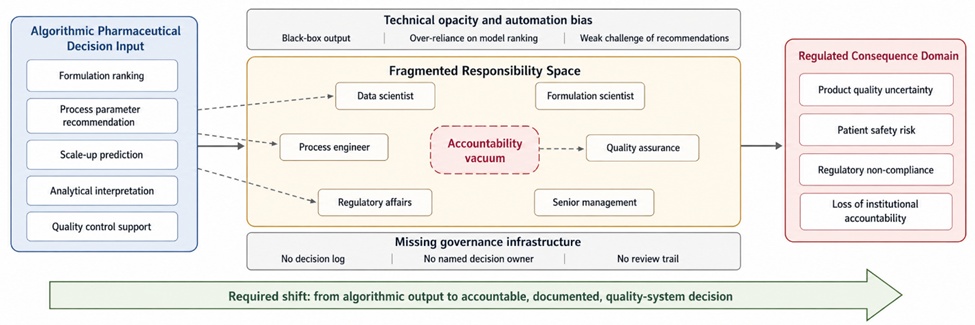
Figure 1. Accountability Vacuum in Algorithmic Pharmaceutical Technology Development: Fragmented Responsibility across Model Development, Scientific Decision-Making, Quality Oversight, and Regulatory Justification
Algorithmic decisions in pharmaceutical technology development can be understood along a spectrum from advisory to shared to autonomous decision logic. Advisory decisions occur when an algorithm ranks formulation candidates, predicts excipient compatibility, suggests design-space regions, or prioritises experiments while humans retain full authority for interpretation and action [4]. Shared decisions occur when algorithms recommend process parameters, analytical thresholds, or scale-up strategies that are expected to be reviewed but are practically influential in determining the chosen development path [3]. Autonomous decisions occur when algorithms directly adjust control settings, trigger process interventions, or execute closed-loop optimisation with limited real-time human intervention, as anticipated in smart manufacturing environments [7].
Each decision type carries different accountability demands because the algorithm’s role in the final action varies. In advisory use, accountability focuses on whether the model is fit for purpose, whether its limitations are disclosed, and whether scientists document why a recommendation was accepted or rejected [5]. In shared decision-making, accountability becomes more demanding because model output and human judgement jointly determine the selected development or control decision, requiring clearer evidence of review, challenge, and authorisation [15]. In autonomous use, accountability must extend to system validation, boundary conditions, fail-safe logic, monitoring, escalation criteria, and governance of model updates.
The risk profile also depends on the consequence of the decision rather than on the sophistication of the algorithm alone. A simple predictive model that determines a critical process parameter may require stronger oversight than a complex deep learning model used only for exploratory hypothesis generation [16]. Explainable AI literature supports this risk-proportionate logic by distinguishing between explanations that are useful for developers, explanations that support user trust, and explanations that enable external accountability [15]. Pharmaceutical governance should therefore classify algorithmic decisions according to decision consequence, human override capacity, quality impact, and regulatory relevance.
Table 1 categorises the types of algorithmic decisions in pharmaceutical technology development and their associated accountability demands. This categorisation is necessary because accountability cannot be assigned uniformly across all AI uses; it must reflect the degree to which algorithmic output influences product design, process control, quality evidence, or regulatory justification [6]. A governance framework should therefore begin by classifying the algorithmic decision before specifying documentation, review, validation, and oversight requirements. This approach prevents low-risk exploratory models from being overburdened while ensuring that consequential algorithmic decisions are not treated as ordinary computational support tools.
Table 1. Algorithmic Decision Types in Pharmaceutical Technology Development: Logic, Use Cases, and Accountability Triggers
Algorithmic decision type | Decision logic | Typical pharmaceutical technology use cases | Human role | Primary accountability trigger | Minimum governance expectation |
Advisory algorithmic decision | The algorithm generates rankings, predictions, or options, but a human expert decides whether and how to act. | Formulation candidate ranking, excipient screening, early process feasibility prediction, analytical method suggestion, experimental prioritisation. | Human-in-the-loop; expert retains decision authority and must interpret the output. | The output influences scientific prioritisation, experimental resource allocation, or early design direction. | Document model purpose, dataset origin, known limits, scientific rationale for accepting or rejecting output, and responsible decision owner. |
Shared algorithmic decision | The algorithm recommends a specific design, parameter, threshold, or action that is reviewed by humans before implementation. | Process parameter recommendation, scale-up setting selection, quality attribute prediction, design-space refinement, method robustness assessment. | Human-in-the-loop with formal review; expert can override but must justify the final decision. | The recommendation materially shapes formulation, process, analytical, or quality decisions. | Require fit-for-purpose validation, explainability appropriate to risk, documented expert challenge, approval record, and change-control linkage. |
Semi-autonomous algorithmic decision | The algorithm performs defined actions within pre-approved boundaries while humans supervise performance and intervene when needed. | Adaptive process optimisation, PAT-based process adjustment, automated batch trend interpretation, real-time release support. | Human-on-the-loop; expert monitors and intervenes according to predefined escalation rules. | The system changes or guides operating conditions within a controlled design space. | Require boundary-condition validation, audit trails, exception handling, escalation procedures, periodic review, and model performance monitoring. |
Autonomous algorithmic decision | The algorithm executes control or optimisation actions with limited immediate human review. | Closed-loop process control, automated manufacturing adjustment, self-optimising process platforms, autonomous quality classification. | Human governance before and after operation; real-time human intervention may be limited. | The algorithm directly affects product or process quality without contemporaneous expert approval. | Require full lifecycle governance, fail-safe design, independent validation, deviation linkage, continuous monitoring, management review, and regulatory justification. |
Regulatory-facing algorithmic decision support | The algorithm generates evidence, analysis, or justification used in regulatory submissions or inspection contexts. | Model-supported control strategy justification, stability prediction, process validation evidence, quality risk documentation. | Human accountable owner must verify that algorithmic evidence is scientifically and regulatorily defensible. | The output supports claims about quality, safety, manufacturability, control, or lifecycle management. | Require traceable data lineage, reproducible model outputs, version control, audit-ready documentation, reviewer accountability, and explicit uncertainty communication. |
Figure 2 presents the escalation of accountability requirements as algorithmic decision logic moves from advisory recommendation to shared decision-making, semi-autonomous operation, autonomous control, and regulatory-facing justification.
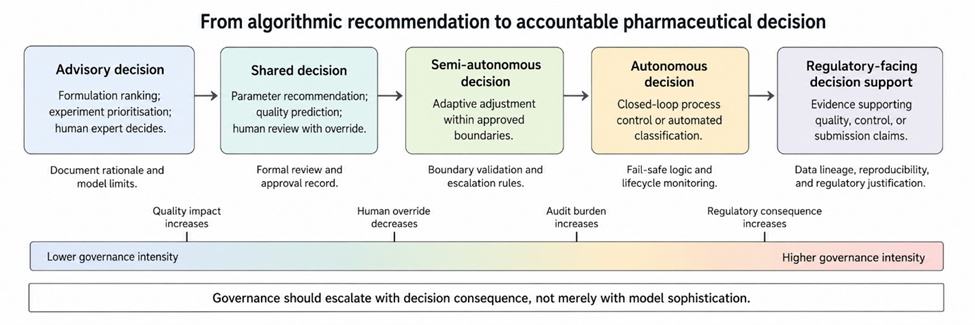
Figure 2. Risk-Proportionate Accountability Spectrum for Algorithmic Decisions in Pharmaceutical Technology Development
Accountability for algorithmic decision-making in pharmaceutical technology cannot rest solely on data scientists or software developers because algorithmic outputs become consequential only when they enter scientific, technical, quality, or regulatory decisions. Data engineers and model developers are responsible for data curation, preprocessing logic, feature selection, model training, version control, and documentation of known limitations, but they do not independently own the pharmaceutical meaning of the output [3]. Formulation scientists and process engineers must evaluate whether the output is scientifically plausible, mechanistically defensible, and appropriate for the product or process context [4]. This division of responsibility requires a documented interface between computational design and pharmaceutical judgement.
Formulation scientists carry a specific accountability burden when algorithms recommend excipient combinations, dosage-form architectures, release profiles, or candidate formulations. Machine learning directed formulation development can reduce experimental search space, but it cannot replace expert evaluation of manufacturability, stability, patient use, and quality target product profile alignment [5]. When algorithmic formulation recommendations are accepted, the responsible scientist should document the scientific rationale, the alternative options considered, and the limitations of the model output. This converts algorithmic recommendation into accountable pharmaceutical reasoning rather than passive acceptance of a computational result.
Quality assurance has a distinct governance role because algorithmic decisions must be embedded into controlled pharmaceutical quality systems rather than treated as informal digital tools. In smart manufacturing and Industry 4.0 contexts, algorithmic systems may influence process monitoring, deviation detection, control strategies, and release-support decisions, making QA oversight essential for change control, deviation linkage, CAPA integration, and periodic review [7]. QA should not be expected to understand every mathematical feature of a model, but it must ensure that the decision process is documented, approved, auditable, and proportionate to product-quality risk. This role is especially important when models are updated, retrained, or transferred across products, sites, or processes.
Senior management and regulatory affairs provide the institutional layer of accountability because they determine whether algorithmic governance has sufficient authority, resources, and visibility. AI ethics translation work shows that principles become meaningful only when they are converted into operational tools, review procedures, and organisational responsibilities [17]. Regulatory affairs should ensure that algorithm-supported claims are defensible in submissions, inspections, and lifecycle interactions, while management should ensure that accountability is not fragmented across technical teams. In accountable pharmaceutical AI governance, the responsible organisation remains answerable for the decision even when the immediate recommendation is generated by an algorithm.
Transparency in pharmaceutical algorithmic decision-making should be defined according to the decision’s risk, not as a generic demand for full disclosure of every computational detail. Explainable AI literature demonstrates that different users require different forms of explanation: developers need diagnostic insight, scientific users need decision rationale, quality reviewers need traceability, and external assessors need auditability [15]. In pharmaceutical technology, transparency should therefore include model purpose, training-data relevance, assumptions, validation boundaries, uncertainty communication, and the decision context in which the model may be used. A transparent model is not merely one that can be visualised, but one whose output can be justified within a regulated development decision.
Accountability requires documentation that links input data, model version, output, expert review, final decision, and responsible decision owner. The fallacy of treating complex systems as inherently inscrutable is that institutions can still require procedures that make decisions reviewable and contestable, even when model internals remain technically complex [14]. For pharmaceutical technology development, algorithmic decision logs should record the dataset used, model version, parameter settings, output generated, reviewer interpretation, acceptance or rejection rationale, and any downstream action. This creates a decision record that can be audited after deviations, quality failures, regulatory questions, or lifecycle changes.
Table 2 specifies transparency and accountability requirements mapped to decision types and stakeholders. This mapping is necessary because a formulation-screening model, a process-control algorithm, and a regulatory-facing predictive model do not require identical disclosures, but each requires sufficient evidence for accountable use [9]. The table also distinguishes between transparency for scientific interpretation, traceability for quality-system review, and auditability for regulatory or independent assessment. Without this distinction, organisations may either over-document low-risk exploratory models or under-document high-consequence decision systems.
Table 2. Transparency and Accountability Requirements for Algorithmic Decision-Making: Information Disclosures, Traceability, and Auditability
Decision type | Required information disclosure | Traceability requirement | Accountability mechanism | Primary stakeholder responsibility | Auditability expectation |
Advisory algorithmic decision | Model purpose, input data type, intended use, known limitations, and uncertainty description. | Link recommendation to dataset, model version, and expert interpretation. | Scientific rationale for accepting, modifying, or rejecting the recommendation. | Formulation scientist or process scientist, supported by data scientist. | Reviewable development record showing that the output informed but did not replace expert judgement. |
Shared algorithmic decision | Validation summary, model assumptions, applicability domain, explanation method, and decision boundary. | Link output to final design or process decision, reviewer comments, and approval record. | Formal decision review with documented override option and responsible owner. | Process engineer, formulation scientist, QA, and model owner. | Audit-ready record suitable for deviation investigation, change control, or regulatory question. |
Semi-autonomous algorithmic decision | Operating limits, control logic, model update status, alarm thresholds, escalation rules, and failure modes. | Link real-time data streams, algorithm actions, operator review, and process outcomes. | Supervisory review, exception handling, and periodic performance assessment. | Process engineering, manufacturing science, QA, and automation owner. | Continuous audit trail capable of reconstructing decisions, interventions, and boundary excursions. |
Autonomous algorithmic decision | Full lifecycle documentation, validation package, fail-safe rationale, human oversight model, and approved use conditions. | Link model action to process state, product-quality impact, deviation triggers, and lifecycle monitoring. | Independent validation, management approval, predefined intervention criteria, and CAPA linkage. | Senior management, QA, process owner, and model governance board. | Inspection-ready evidence showing control, monitoring, accountability, and change governance. |
Regulatory-facing algorithmic decision support | Data lineage, model reproducibility, validation basis, uncertainty treatment, assumptions, and submission relevance. | Link algorithmic evidence to regulatory claim, source data, model version, reviewer approval, and lifecycle commitment. | Regulatory sign-off and accountable scientific justification. | Regulatory affairs, QA, technical subject-matter experts, and senior sponsor. | Reproducible, reviewable documentation that supports regulatory dialogue and post-approval lifecycle management. |
Independent review is also essential because transparency without challenge can become a documentary formality. Healthcare AI governance literature shows that algorithmic systems require multidisciplinary scrutiny to address performance, bias, generalisability, and user interaction risks [18]. Pharmaceutical organisations should therefore require review by both technical and domain experts before high-consequence algorithmic decisions are implemented. The review should evaluate whether the model is fit for the decision, whether the human reviewer understood the output, and whether the documented rationale is sufficient for future accountability.
Algorithmic decision-making should be integrated into pharmaceutical risk oversight as a specific source of process, product, data, and governance risk. In pharmaceutical AI applications, model performance depends on the representativeness and integrity of underlying data, the relevance of training contexts, and the appropriateness of the intended decision use [6]. Data quality risks include missing values, biased experimental designs, batch-to-batch variability, uncontrolled preprocessing, and hidden shifts between development and manufacturing environments. These risks should be recorded as part of product and process risk registers rather than managed only by technical model owners.
Model drift is a central lifecycle risk because algorithmic performance may degrade when materials, equipment, sites, operators, analytical methods, or process conditions change. Reviews of AI in pharmaceutical manufacturing and quality control emphasise that post-deployment monitoring is necessary when models are used beyond exploratory research [8]. Drift oversight should include predefined performance indicators, review intervals, retraining criteria, and rules for suspending or restricting model use. A model that was valid during development should not remain trusted indefinitely without lifecycle evidence.
Edge-case failure modes also require explicit attention because algorithms may perform well on common cases while failing under rare but quality-critical conditions. AI systems in healthcare have shown that impressive aggregate performance can obscure weaknesses in generalisability, reporting quality, and real-world deployment conditions [19]. Pharmaceutical technology faces comparable risks when models are trained on limited formulation spaces, historical process data, or controlled laboratory datasets but then applied to new materials, sites, or manufacturing scales. Risk oversight must therefore test not only average predictive performance but also boundary conditions, extrapolation behaviour, and failure consequences.
Algorithmic risk files should become part of the pharmaceutical quality system and should be periodically reviewed alongside process risk assessments, validation status, deviations, and CAPA trends. Responsible machine learning literature emphasises that safe deployment requires monitoring, accountability, and governance after implementation, not merely validation before use [18]. Each algorithmic risk file should define intended use, decision consequence, data risks, model risks, human oversight controls, monitoring metrics, and escalation pathways. This converts algorithmic governance from a one-time technical assessment into a lifecycle quality activity.
The proposed governance framework rests on three pillars: Accountability Architecture, Transparency and Traceability, and Risk-Based Oversight. Accountability Architecture assigns decision ownership across the algorithmic lifecycle, from data preparation and model development to scientific review, quality approval, regulatory justification, and management oversight [17]. Transparency and Traceability require that algorithmic outputs can be linked to data, model version, assumptions, reviewer interpretation, and final action [14]. Risk-Based Oversight ensures that documentation, validation, explanation, and monitoring intensity increase with decision consequence rather than algorithmic novelty alone.
The first pillar, Accountability Architecture, requires every algorithmic decision system to have a named model owner, scientific decision owner, quality-system owner, and escalation pathway. Responsibility attribution research shows that accountability becomes weak when responsibility is treated as a property of the technology rather than of the human and organisational relationships surrounding it [20]. In pharmaceutical development, the model owner should maintain the technical system, the scientific owner should justify the decision, QA should control the governed process, and management should ensure resources and authority. This makes accountability distributed but not diffuse.
The second pillar, Transparency and Traceability, requires documentation that is proportionate, reproducible, and suitable for review by different stakeholders. Explainability in healthcare AI has been described as multidisciplinary because clinicians, patients, developers, and regulators require different levels of understanding for different purposes [21]. Pharmaceutical technology has a similar plurality of users: data scientists need technical diagnostics, formulation scientists need scientific plausibility, QA needs controlled records, and regulators need defensible evidence. The governance framework therefore treats transparency as a structured information flow rather than as a single explanation method.
Table 3 presents the proposed governance framework with roles, processes, and oversight mechanisms. The framework is designed to map directly onto familiar quality-system elements, including change control, deviation management, CAPA, validation review, management review, and regulatory documentation [7]. By aligning algorithmic governance with existing quality infrastructure, the framework avoids creating a parallel compliance system that is disconnected from pharmaceutical accountability. It also enables organisations to govern exploratory, shared, semi-autonomous, and autonomous algorithmic tools according to a common but risk-proportionate logic.
Table 3. Proposed Governance Framework for Accountable Algorithmic Decision-Making in Pharmaceutical Technology: Pillars, Responsibilities, and Implementation Steps
Governance pillar | Core purpose | Required roles | Required processes | Documentation outputs | Quality-system linkage | Implementation steps |
Accountability Architecture | Assign clear responsibility for algorithmic decisions across technical, scientific, quality, regulatory, and management functions. | Model owner, data owner, scientific decision owner, QA representative, regulatory representative, senior sponsor. | Role assignment, decision authority mapping, escalation pathway definition, approval workflow, periodic governance review. | Responsibility matrix, model ownership record, decision authority log, review and approval record. | Management review, quality governance board, deviation ownership, CAPA responsibility. | Classify algorithmic use; assign owners; define approval authority; document escalation rules; review ownership periodically. |
Transparency and Traceability | Ensure algorithmic outputs can be understood, reconstructed, justified, and audited. | Data engineer, model developer, formulation/process expert, QA reviewer, regulatory reviewer. | Data lineage control, version control, model documentation, decision logging, explanation review, reproducibility checks. | Model development report, algorithmic decision log, version history, explanation summary, audit trail. | Document control, data integrity programme, validation documentation, inspection readiness. | Define required disclosures; implement decision logs; control model versions; document expert interpretation; preserve audit-ready records. |
Risk-Based Oversight | Align governance intensity with decision consequence, quality impact, and regulatory relevance. | Risk owner, QA, process owner, technical subject-matter experts, model monitoring team. | Risk classification, applicability-domain assessment, drift monitoring, boundary testing, exception handling, periodic review. | Algorithmic risk file, monitoring report, drift assessment, boundary-condition review, mitigation plan. | ICH-style quality risk management, process risk register, deviation management, CAPA, change control. | Classify decision risk; create risk file; define monitoring metrics; set retraining triggers; link failures to deviation and CAPA systems. |
Lifecycle Change Control | Govern model updates, retraining, transfer, and changes in intended use. | Model owner, QA, regulatory affairs, process owner, validation lead. | Change impact assessment, retraining review, validation update, transfer assessment, approval before deployment. | Change-control record, validation addendum, model comparison report, deployment approval. | Pharmaceutical change control, lifecycle management, regulatory commitment tracking. | Define major and minor model changes; assess quality impact; approve retraining; document implementation; communicate regulatory relevance. |
Independent Review and Challenge | Prevent automation bias and ensure that algorithmic recommendations are critically evaluated before use. | Independent reviewer, domain expert, QA, governance committee. | Independent scientific challenge, review of assumptions, review of uncertainty, override documentation, decision justification. | Independent review memo, challenge-response log, override rationale, approval decision. | Quality review, technical governance, deviation prevention, management review. | Identify high-consequence decisions; appoint independent reviewers; document challenges; track unresolved concerns; escalate when needed. |
Figure 3 visualises the proposed three-pillar governance framework and shows how accountability architecture, transparency and traceability, and risk-based oversight are embedded into the pharmaceutical quality system.
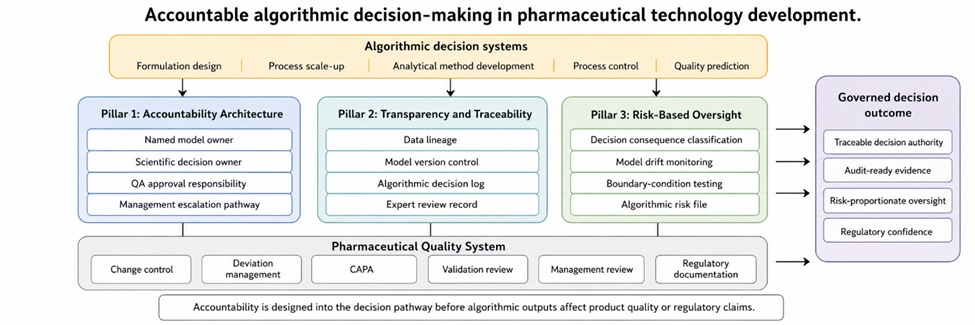
Figure 3. Three-Pillar Governance Framework for Accountable Algorithmic Decision-Making Embedded in the Pharmaceutical Quality System
A regulatory pathway for accountable algorithmic decision-making should begin from the recognition that pharmaceutical AI cannot be assessed only through model accuracy. Recent regulatory-oriented discussion in pharmaceutical AI emphasises that AI and machine learning may support development and manufacturing, but regulatory confidence depends on validation, transparency, intended use, and lifecycle control [22]. A governance framework can therefore help organisations demonstrate that algorithmic outputs are not uncontrolled technical artefacts but managed components of development and quality decision-making. This is especially important when algorithmic evidence supports formulation justification, process control, analytical interpretation, or quality-risk conclusions.
The framework also supports regulatory dialogue by making the role of the algorithm explicit. If a model is advisory, the submission or inspection record can explain how expert judgement reviewed and contextualised the output [4]. If a model is shared or semi-autonomous, the organisation can provide stronger evidence of validation, oversight, audit trails, and boundary conditions [7]. If a model is regulatory-facing, the organisation should be prepared to show reproducibility, data lineage, uncertainty treatment, and decision accountability.
Adaptive algorithms present the most difficult regulatory challenge because model behaviour may change after initial validation. Rethinking drug design in the AI era has highlighted the need to reconsider how AI systems are evaluated when they operate across complex scientific and development contexts [16]. For pharmaceutical technology, adaptive model governance should distinguish between locked models, periodically retrained models, and continuously learning systems. Each category requires different change-control expectations, monitoring commitments, and evidence that changes do not undermine product quality or regulatory commitments.
Remaining regulatory gaps include the absence of pharmaceutical-specific standards for algorithmic impact assessment, model decision logs, human oversight adequacy, and acceptable explainability thresholds. Algorithmic accountability theory suggests that governance must provide mechanisms for justification, contestation, and responsibility assignment, not only technical validation [13]. Pharmaceutical regulators and industry consortia should therefore collaborate on pilot programmes that define practical expectations for algorithmic decision records, risk files, and lifecycle governance. Such work would allow innovation in pharmaceutical AI while preserving the central regulatory principle that product quality decisions must remain scientifically justified and institutionally accountable.
Accountable algorithmic decision-making is becoming a necessary condition for trustworthy pharmaceutical technology development. As algorithms increasingly influence formulation, process, analytical, quality, and regulatory decisions, pharmaceutical organisations must ensure that decision authority remains traceable, reviewable, and institutionally owned.
The governance framework proposed in this article argues that accountability must be designed into algorithmic systems before they become embedded in development and manufacturing decisions. By classifying algorithmic decision types, assigning stakeholder responsibilities, specifying transparency requirements, and integrating risk oversight into the pharmaceutical quality system, the framework provides a practical pathway for responsible implementation.
Future progress will require collaboration among pharmaceutical companies, regulators, standards bodies, technology developers, and academic researchers. Pilot programmes should test and refine the framework across real development settings so that algorithmic innovation strengthens, rather than weakens, regulatory confidence, product quality, and public trust.
None
None
None
None
Open Access The author(s) retain copyright. This article is licensed under the Creative Commons Attribution-NonCommercial-ShareAlike 4.0 International License. It may be shared and adapted for non-commercial purposes with appropriate attribution, an indication of changes, and distribution of adaptations under the same license. Third-party material may be subject to separate terms identified in its credit line. View the license at https://creativecommons.org/licenses/by-nc-sa/4.0/.
 Publication System