Adaptive drug delivery has often been imagined as a technologically advanced system in which sensors, software, power sources, and feedback algorithms continuously monitor biological conditions and adjust therapy. This vision has stimulated important innovation, but it has also encouraged the assumption that adaptation requires electronic intelligence. In many pharmaceutical contexts, this assumption may unnecessarily increase complexity, cost, and technical fragility. A different design logic is possible. Dosage forms can respond to physiological environments through the intrinsic behavior of materials rather than through real-time electronic sensing. Such systems do not measure, calculate, or transmit information digitally; instead, they translate local biological conditions into physical or chemical changes that modulate drug release. This article develops a theory-driven framework for passive adaptive dosage forms. It distinguishes passive responsiveness from active sensor-driven feedback and defines adaptation as an emergent property of material–environment interaction. The framework is intended for non-electronic dosage forms that use physiological cues such as pH, enzymes, glucose, redox gradients, temperature, or mechanical stress to regulate release. The article synthesizes evidence and concepts from stimuli-responsive polymers, hydrogels, molecularly imprinted polymers, shape-memory systems, glucose-responsive platforms, and self-oscillating gels. It does not present new empirical data. Instead, it uses existing literature to clarify the design principles needed to treat passive responsiveness as a deliberate pharmaceutical strategy. Passive adaptive dosage forms offer a simpler and potentially more translatable route to adaptive therapy. Their promise lies not in replacing all electronic systems, but in expanding the adaptive delivery paradigm beyond sensors and circuits. By foregrounding material-based triggering and release behavior design, the article positions passive responsiveness as a distinct and underdeveloped class of pharmaceutical system design.
Adaptive drug delivery has become one of the most compelling ambitions in pharmaceutical technology because it promises to move therapy beyond fixed dosing and static release profiles. Much of this ambition has been shaped by the broader language of “smart” systems, in which responsiveness is often associated with sensing, computation, and electronically mediated feedback. Yet stimuli-responsive drug delivery research shows that pharmaceutical materials can already respond to biological conditions such as pH, redox state, temperature, enzymes, and other endogenous signals without relying on electronics [1, 2]. This creates a conceptual opening for dosage forms that are adaptive by material design rather than by digital control.
The dominant technological trajectory can make sensor-enabled devices appear to be the most advanced form of adaptive delivery. However, adding sensors, processors, batteries, and data infrastructure may not always improve therapeutic value, particularly when the relevant physiological trigger is already chemically or physically accessible to the dosage form. Glucose-responsive insulin delivery systems illustrate how release can be coupled to a disease-relevant signal through material chemistry rather than electronic monitoring [3, 4]. This suggests that adaptation should be judged by the quality of the therapeutic response, not by the presence of digital components.
Passive adaptation is therefore proposed here as the capacity of a dosage form to alter release through its own interaction with the physiological environment. The key idea is that the material itself performs a sensing-and-actuation function, even though it does not process information in the electronic sense. Hydrogels, nanogels, cyclodextrin-based systems, and molecularly imprinted polymers all demonstrate forms of environment-sensitive behavior that can be interpreted as pharmaceutical responsiveness when connected to drug release outcomes [5-7]. The central challenge is to move from describing these systems as isolated material examples to theorising them as a coherent design class.
The aim of this article is to articulate a theoretical framework for passive adaptive dosage forms without real-time sensors. The article defines passive responsiveness, identifies material-based triggering mechanisms, and frames release behavior as an engineered output of material–environment interaction. This perspective builds on the growing literature on stimuli-responsive platforms while challenging the assumption that adaptiveness must depend on electronics or active closed-loop devices [8, 9]. The goal is not to reject sensor-enabled systems, but to establish passive adaptive dosage forms as a legitimate and strategically important alternative.
The theoretical foundation of passive adaptive dosage forms begins with the idea that feedback does not always require electronic measurement or computational decision-making. In a material-based system, the environment acts directly on the dosage form, and the dosage form responds through swelling, degradation, conformational change, binding, rupture, or phase transition. Self-regulating chemical systems and glucose-responsive hydrogels show how a biological input can produce a proportional or threshold-dependent release output without a digital controller [10, 11]. In this sense, the feedback loop is embedded in matter rather than imposed by a device.
Stimuli-responsive polymers provide the clearest materials-science basis for this theory. Their behavior depends on reversible or irreversible changes in polymer structure, hydration, solubility, network density, or intermolecular interaction when exposed to physiological cues. pH-responsive systems, for example, exploit ionisable groups that change swelling or dissolution behavior across biological compartments, while enzyme-responsive hydrogels can degrade selectively in environments where particular catalytic activities are elevated [12, 13]. These systems demonstrate that biological signals can be converted into release modulation through material chemistry.
A second theoretical basis comes from supramolecular and recognition-based materials. Cyclodextrin systems, molecularly imprinted polymers, and glucose-binding platforms show that release behavior can be governed by selective host–guest interaction, analyte binding, or competitive displacement [5, 7, 14]. Such mechanisms are important because they introduce specificity into passive responsiveness, allowing the material to react not merely to generic environmental change but to particular molecular conditions. This specificity is conceptually analogous to sensing, although the “sensor” is a binding architecture rather than an electronic component.
A third foundation lies in the distinction between active and passive control. Active feedback systems require a separate measurement component, a decision rule, an energy source, and an actuator, whereas passive systems combine signal recognition and actuation within the material structure itself. Shape-memory polymers and self-oscillating gels further expand this view by showing that materials can store mechanical or chemical potential and release it as movement, structural recovery, or rhythmic change [15, 16]. Passive adaptive dosage forms therefore belong to a broader class of responsive systems in which control is distributed through material properties rather than centralized in electronics.
The central problem is that pharmaceutical discourse has often conflated adaptation with electronic smartness. This conflation narrows the field’s imagination by implying that a dosage form becomes adaptive only when it contains a sensor, microprocessor, app, or real-time feedback loop. Yet the drug delivery literature already contains numerous examples of systems that alter release behavior in response to internal physiological conditions, including intracellular microenvironments, tumor-associated signals, and disease-related biochemical gradients [17, 18]. The problem is therefore not the absence of passive adaptive systems, but the absence of a framework that names and organizes them.
Passive adaptive dosage forms should be reframed as material systems that embody signal recognition, transduction, and release control. Glucose-responsive insulin systems are especially instructive because they aim to increase insulin release when glucose is high and reduce release as glucose normalizes, achieving a therapeutically meaningful form of feedback without electronics [4, 11]. Molecularly imprinted systems similarly show how recognition sites can be built into polymer matrices to influence loading, retention, and release in response to molecular interactions [19, 20]. These examples make it possible to define adaptation through functional responsiveness rather than through technological complexity.
This reframing also has translational significance because passive systems may avoid some burdens associated with electronic drug delivery devices. Sensor-dependent systems introduce concerns around power supply, calibration, data handling, cybersecurity, device failure, and software validation, whereas passive systems shift the burden toward material reproducibility, stability, and predictable trigger-response behavior. Stimulus-responsive platforms are not automatically simple, but their adaptive function can be achieved through composition and architecture rather than electronic infrastructure [2, 8]. Table 1 contrasts passive adaptive dosage forms with active sensor-driven systems.
Table 1. Passive versus Active Adaptive Dosage Forms: Design Philosophy, Components, and Fundamental Differences
Comparison dimension | Passive adaptive dosage forms | Active sensor-driven systems | Theoretical significance |
Core design philosophy | Adaptation emerges from material–environment interaction | Adaptation is mediated by measurement, computation, and actuation | Defines adaptation as material behavior rather than device intelligence |
Sensing mechanism | Chemical, physical, or biological cue interacts directly with the dosage form | Electronic sensor detects a variable and generates data | Replaces digital sensing with material-based recognition |
Actuation mechanism | Swelling, degradation, phase transition, rupture, binding, or conformational change | Pumping, valve opening, electrical stimulation, or algorithm-controlled release | Embeds actuation within the material architecture |
Energy source | Physiological environment, chemical gradients, hydration, mechanical stress, or stored material energy | Battery, external power, or electronic control system | Reduces dependency on external or onboard power |
Information processing | No digital computation; response is governed by material properties | Digital or electronic interpretation of sensor data | Makes responsiveness analog, local, and environment-coupled |
Main design risk | Variability in material response, trigger specificity, and in vivo predictability | Sensor failure, calibration drift, software error, power loss, and data-system complexity | Shifts the reliability problem from electronics to material performance |
Translational burden | Requires proof of reproducible trigger-dependent release | Requires proof of device reliability, software control, sensor accuracy, and release performance | May reduce some regulatory burdens while creating new material-testing needs |
Best suited applications | Local, threshold-based, sustained, pulsatile, or biomarker-coupled release | Situations requiring precise monitoring, programmable control, or remote adjustment | Clarifies complementary rather than competing design domains |
The first assumption of the framework is that the physiological environment provides usable information for dosage form adaptation. pH gradients across the gastrointestinal tract, enzyme expression in diseased tissue, intracellular redox gradients, thermal variation, glucose concentration, and mechanical forces can all function as input signals for material change [1, 12, 18]. This assumption does not mean that every physiological cue is reliable or specific enough for drug delivery. It means that passive design begins by identifying which environmental signal is sufficiently robust to support a meaningful release decision.
The second assumption is that passive systems can generate diverse temporal release behaviors. Passive responsiveness is not limited to simple sustained release, because material architectures can produce delayed, pulsatile, self-regulating, sequential, or graded profiles depending on their composition and structure. Sequential release systems and injectable hydrogels demonstrate that timing can be designed through degradation, diffusion, swelling, and matrix transformation rather than through electronic programming [8, 21]. In this framework, release behavior is treated as an emergent dynamic output of the material system.
The third assumption is that design simplicity can enhance robustness and translatability when it is achieved without sacrificing therapeutic function. Passive systems may be manufactured as oral, injectable, implantable, or topical dosage forms, provided that the adaptive mechanism is material-based and does not depend on electronic sensing, microprocessors, external power, or real-time data transmission. Shape-memory delivery platforms, thermoresponsive systems, responsive nanogels, and molecularly imprinted materials show that non-electronic responsiveness can be distributed across multiple pharmaceutical routes and architectures [6, 22, 23]. The framework is therefore delimited to dosage forms in which adaptation is produced by material-based triggering and release behavior design.
Passive responsiveness can be defined as the capacity of a dosage form to change its release rate, release location, or release sequence in direct response to a physiological signal without external control, electronic sensing, or computation. This definition shifts attention from device intelligence to material intelligence, where the dosage form itself contains the responsive logic. Stimuli-responsive polymeric nanocarriers and endogenous trigger-sensitive systems demonstrate that pH, enzymes, temperature, redox conditions, and other biological inputs can alter release through material transformation rather than active control [2, 9]. Passive responsiveness is therefore not the absence of control, but a different form of control embedded in material behavior.
The first category of passive responsiveness involves chemical triggers that are spatially or pathologically distributed in the body. Gastrointestinal pH changes, intracellular redox gradients, tumor acidity, and glucose concentration can all serve as environmental cues for release modulation [12, 18]. In these systems, the dosage form does not interpret a signal through electronics; it undergoes a chemical or physicochemical transition when exposed to the relevant condition. This makes the trigger-response relationship local, analog, and directly coupled to the biological environment.
The second category involves biochemical and mechanical triggers that arise from disease activity or tissue function. Enzyme-responsive hydrogels use catalytic degradation to transform biological activity into matrix erosion, while shape-memory and mechanically responsive systems can translate deformation, hydration, or stress into structural recovery or release activation [13, 16]. Such systems are especially important because they suggest that passive adaptation can be linked not only to location but also to disease intensity. Table 2 categorises passive responsiveness mechanisms and their physiological triggers.
Table 2. Passive Responsiveness Mechanisms in Adaptive Dosage Forms: Triggers, Material Responses, and Resulting Release Modulation
Passive responsiveness mechanism | Physiological trigger | Material response | Resulting release modulation | Representative design implication |
pH-sensitive swelling or dissolution | Gastrointestinal pH shifts, tumor acidity, endosomal acidity | Ionisation, swelling, solubility change, or polymer relaxation | Site-specific, delayed, accelerated, or intracellular release | Useful when the target environment has a reproducible pH difference |
Enzyme-mediated degradation | Elevated proteases, esterases, hyaluronidase, matrix metalloproteinases, or disease-associated enzymes | Cleavage of crosslinks, matrix erosion, linker degradation | Disease-activity-dependent release | Useful when enzyme expression correlates with pathology |
Redox-responsive cleavage | Intracellular glutathione gradients or oxidative microenvironments | Disulfide cleavage, oxidation-sensitive bond cleavage, or network destabilisation | Intracellular or inflammation-associated release | Useful for cytosolic delivery or redox-stratified tissues |
Thermoresponsive phase transition | Local temperature variation, inflammation-associated heating, or externally induced mild thermal change without electronics in the dosage form | Sol–gel transition, collapse, expansion, or altered permeability | Depot formation, retention, or temperature-coupled release | Useful for injectable depots and localised release platforms |
Glucose-responsive binding or matrix change | Increased glucose concentration | Competitive binding, phenylboronic acid interaction, concanavalin A displacement, or hydrogel swelling | Self-regulating insulin release | Useful for biomarker-coupled therapy when the analyte is directly related to dose need |
Mechanical rupture or structural recovery | Peristalsis, compression, tissue movement, capsule expansion, or swelling pressure | Rupture, unfolding, expansion, or shape recovery | Pulsatile, delayed, or retention-associated release | Useful where mechanical exposure is predictable enough to serve as a trigger |
Molecular recognition or imprinting | Presence of a target molecule, drug, metabolite, or biomarker | Selective binding, rebinding, displacement, or affinity-controlled diffusion | Selective retention or trigger-associated release | Useful when specificity is more important than broad environmental sensitivity |
Self-oscillating material response | Coupled chemical reaction and polymer network transition | Periodic swelling–deswelling or rhythmic structural change | Oscillatory or pulsatile release | Useful for theoretical exploration of autonomous temporal dosing |
The third category involves recognition-based or internally dynamic systems. Molecularly imprinted polymers can create selective binding environments that influence retention and release, while self-oscillating gels suggest that rhythmic material behavior may generate autonomous temporal patterns [5, 15]. These mechanisms broaden passive responsiveness beyond simple “triggered release” and toward adaptive release profiles shaped by material memory, affinity, and internal dynamics. Passive responsiveness should therefore be understood as a spectrum ranging from one-time activation to reversible, graded, or oscillatory modulation.
Material-based triggering begins with the selection of a physiological cue that can be converted into a material transition. pH-sensitive polymers are among the most established examples because ionisable groups can regulate swelling, dissolution, permeability, or matrix relaxation as the dosage form moves through different biological compartments [12]. In oral systems, this principle can support gastric protection, intestinal targeting, or colon-directed release, while in intracellular delivery it can support endosomal escape or lysosomal activation. The theoretical importance of pH triggering is that a simple environmental gradient can replace external timing or electronic localization.
Enzyme-responsive materials extend this logic by linking drug release to biological activity rather than anatomical location alone. Enzyme-responsive hydrogels can use degradable crosslinks, peptide sequences, or enzyme-labile bonds to couple matrix breakdown to protease or disease-associated catalytic activity [13]. This creates the possibility of pathology-sensitive release, where higher enzyme activity produces faster release and lower activity preserves the matrix. The limitation is that enzyme expression can vary across patients and tissues, making reproducibility and specificity central design challenges.
Redox-responsive, thermoresponsive, glucose-responsive, and mechanically responsive systems further expand the material-triggering landscape. Redox gradients can destabilise disulfide-containing systems, thermoresponsive polymers can shift between hydrated and collapsed states, glucose-binding chemistries can modulate insulin release, and shape-memory platforms can use stored mechanical energy to alter dosage form geometry [4, 10, 16]. These mechanisms show that passive adaptation can be driven by chemical potential, thermal transition, analyte binding, or mechanical stress. In each case, the material is not merely a carrier but a transducer that converts a physiological input into a release-relevant change.
More sophisticated passive systems can combine multiple material triggers into logic-gate-like behavior without electronics. For example, a material may require both acidic pH and high reductive potential before rapid release occurs, or it may respond to either enzyme degradation or swelling pressure depending on the target environment [8, 18]. Such architectures resemble AND and OR logic in functional terms, although the logic is executed through chemistry, diffusion, and structural transformation rather than code. This creates a path toward higher selectivity while preserving the sensorless character of passive adaptive dosage forms.
Release behavior design asks how the dosage form should translate a trigger into a therapeutic output. In conventional controlled release, timing is often designed as a fixed profile, but in passive adaptive systems timing emerges from the interaction between material properties and local physiological conditions. Injectable hydrogels and in situ forming systems demonstrate that depot formation, matrix hydration, degradation, and diffusion can be tuned to produce sustained or environment-sensitive release [21]. The design problem is therefore not only what material responds, but what release function the response should generate.
Passive adaptive release can be delayed, pulsatile, sustained, graded, self-limiting, or sequential. Layered structures can produce delayed-then-rapid release, degradable matrices can support disease-activity-dependent acceleration, and responsive nanogels can alter permeability or stability under specific intracellular conditions [8, 17]. Glucose-responsive platforms provide the clearest theoretical model of self-regulating release because the therapeutic need and the trigger are directly linked through the same biomarker [11, 14]. This establishes a design principle: the closer the trigger is to the therapeutic requirement, the stronger the adaptive rationale.
Release behavior also depends on whether the material response is reversible or irreversible. pH swelling, glucose binding, and supramolecular interactions may permit reversible modulation, whereas enzyme degradation, mechanical rupture, or bond cleavage may produce one-directional release activation [7, 13]. Molecularly imprinted systems add another layer because release may be governed by recognition, rebinding, or competitive displacement rather than simple erosion [19, 24]. These differences matter because reversibility determines whether the dosage form can adjust continuously, respond once, or produce a staged therapeutic sequence.
The phrase “passive” should not be mistaken for “uncontrolled.” Passive systems can be designed with thresholds, delays, gradients, saturation effects, and feedback-like constraints if the material architecture is matched to the desired therapeutic output. Smart insulin delivery systems and glucose-responsive material platforms show how dose, timing, and duration can be coupled to analyte concentration without electronic control [10, 25]. Release behavior design therefore becomes the central bridge between material responsiveness and pharmaceutical function.
The proposed framework consists of three integrated design elements: trigger specification, material transducer design, and release function mapping. Trigger specification identifies the physiological cue that is sufficiently relevant, reproducible, and accessible to the dosage form, whether it is pH, enzyme activity, redox state, glucose concentration, temperature, or mechanical stress [1, 2]. Material transducer design then selects the polymer, hydrogel, supramolecular system, imprinted matrix, or shape-memory architecture capable of converting that cue into a physical or chemical change [5, 16]. Release function mapping defines how that material change should translate into dose, timing, location, or duration.
The framework is iterative because each design element constrains the others. A glucose-responsive insulin platform, for example, is theoretically strong when the trigger directly reflects therapeutic demand, whereas a pH-responsive oral platform is strong when the trigger reliably distinguishes anatomical compartments [3, 12]. A self-oscillating or shape-memory system may be valuable when temporal patterning or mechanical transformation is desired, but it requires careful assessment of whether the resulting release behavior is therapeutically meaningful [15, 22]. Table 3 presents the proposed framework for designing passive adaptive dosage forms.
Table 3. Proposed Framework for Passive Adaptive Dosage Forms: Design Elements, Material Selection Logic, and Release Behavior Integration
Framework element | Core design question | Material selection logic | Release behavior integration | Key evaluation criterion |
Trigger specification | Which physiological cue should drive adaptation? | Select cues that are disease-relevant, route-accessible, and sufficiently reproducible | Define whether the cue should activate, accelerate, delay, sustain, or terminate release | Strength of relationship between trigger intensity and therapeutic need |
Trigger validation | Is the cue stable enough to support pharmaceutical decision-making? | Assess interpatient variability, local concentration range, and competing biological signals | Establish the trigger window required for meaningful release modulation | Reliability of cue exposure in the intended use environment |
Material transducer design | Which material can convert the cue into structural or chemical change? | Choose pH-sensitive, enzyme-degradable, redox-cleavable, thermoresponsive, glucose-binding, imprinted, or shape-memory materials | Match swelling, degradation, binding, rupture, or phase transition to release requirements | Specificity and reproducibility of material response |
Architecture design | How should the responsive material be organized within the dosage form? | Use matrices, coatings, layers, depots, nanogels, hydrogels, or hybrid structures | Control diffusion path length, erosion sequence, barrier opening, or depot persistence | Consistency of structure–response relationship |
Release function mapping | What output should the material response produce? | Link trigger intensity to release rate, dose fraction, onset time, or duration | Create sustained, pulsatile, delayed, graded, self-limiting, or sequential release | Alignment between release profile and therapeutic objective |
Robustness design | How can adaptation remain reliable under real physiological variability? | Avoid overly fragile chemistries, excessive trigger dependence, or complex multi-step responses | Build tolerance to moderate variation in pH, enzymes, hydration, or tissue conditions | Maintenance of performance across realistic biological ranges |
Translation assessment | Can the system be manufactured, stored, tested, and regulated reproducibly? | Prefer scalable materials, stable chemistries, and measurable trigger-response relationships | Develop in vitro and in vivo tests that demonstrate adaptive behavior | Evidence that passive adaptation is predictable, safe, and manufacturable |
The framework positions passive adaptive dosage forms as a design class rather than a collection of unrelated technologies. It allows pH-sensitive tablets, enzyme-degradable hydrogels, glucose-responsive depots, molecularly imprinted matrices, shape-memory systems, and self-oscillating gels to be evaluated through a common logic of trigger, transducer, and release function [6, 20, 23]. It also clarifies why passive adaptation is not inherently inferior to electronic feedback; it is better suited to contexts where the biological cue is local, the desired response is material-compatible, and therapeutic control can be achieved without continuous digital supervision. The resulting theory supports a broader adaptive delivery paradigm in which simplicity can itself be an advanced design principle.
Figure 1 presents the proposed passive adaptive dosage form framework, showing how physiological triggers are translated by responsive materials into therapeutically meaningful release behaviors without real-time sensors.
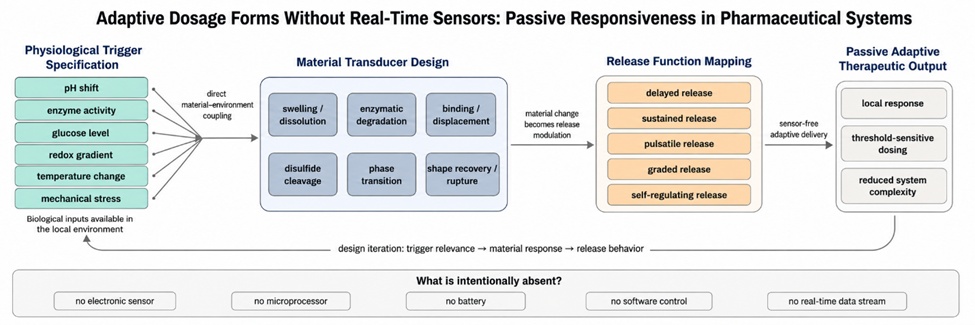
Figure 1. Sensor-Free Passive Adaptive Dosage Form Framework: Translating Physiological Cues into Material Responses and Release Behavior without Electronic Feedback
The translation pathway for passive adaptive dosage forms begins with the recognition that fewer electronic components may reduce certain development burdens. Passive systems do not require power sources, wireless communication, software validation, cybersecurity management, or sensor calibration, which can make them attractive for oral, injectable, implantable, and topical applications. However, this does not make them automatically easy to translate, because responsive polymers, nanogels, and hydrogels still require rigorous control of composition, architecture, and performance [9, 17]. The translational advantage is therefore conditional on whether material responsiveness can be made reproducible at pharmaceutical scale.
Manufacturing and stability are central challenges for this class of systems. Responsive materials may be sensitive to polymer molecular weight, crosslink density, residual monomer, hydration state, storage conditions, sterilisation, and batch-to-batch variation. Shape-memory dosage forms and expandable delivery systems illustrate how mechanical properties, coating behavior, recovery performance, and release characteristics must be co-validated rather than treated as separate attributes [22]. For passive adaptive systems, quality control must measure not only drug content and release rate, but also the reliability of the trigger-response relationship.
A practical preclinical testing cascade should begin with mechanistic in vitro studies that quantify release as a function of trigger intensity, trigger duration, and physiologically realistic variability. It should then move to biorelevant models that include dynamic pH, enzyme gradients, redox conditions, tissue barriers, or glucose changes, followed by relevant animal models only when the adaptive mechanism has been sufficiently characterized. Recent work on responsive biomaterials reinforces the need to connect material performance to biological function rather than treating responsiveness as a standalone material property [26]. Translation will depend on proving that passive adaptation is predictable, reproducible, safe, and therapeutically useful under the conditions in which the dosage form will actually operate.
Adaptive drug delivery does not always require sensors, chips, batteries, software, or real-time algorithms. Many physiological environments already contain the information needed to guide release, and many pharmaceutical materials can convert that information into useful changes in drug delivery behavior. The challenge is to recognise this capability as a design principle rather than as a secondary feature of stimuli-responsive materials.
This article has proposed passive responsiveness as the defining concept for adaptive dosage forms without real-time sensors. It has reframed adaptation as a material–environment relationship, classified the major triggering mechanisms, and introduced a framework based on trigger specification, material transducer design, and release function mapping. The resulting theory makes it possible to compare diverse systems through a shared design language.
The future of adaptive drug delivery should not be divided between simple conventional dosage forms and complex electronic devices. A third design space exists in which materials themselves provide local, responsive, and therapeutically meaningful control. Developing this space may support adaptive therapies that are simpler, more robust, more scalable, and more accessible than many sensor-dependent alternatives.
None
None
None
None
Open Access The author(s) retain copyright. This article is licensed under the Creative Commons Attribution-NonCommercial-ShareAlike 4.0 International License. It may be shared and adapted for non-commercial purposes with appropriate attribution, an indication of changes, and distribution of adaptations under the same license. Third-party material may be subject to separate terms identified in its credit line. View the license at https://creativecommons.org/licenses/by-nc-sa/4.0/.
 Publication System