The pharmaceutical industry is a significant contributor to environmental pollution, yet the sustainability of pharmaceutical technologies themselves has received less sustained attention than clinical efficacy, quality assurance, manufacturability, and cost. Pharmaceutical products are commonly evaluated through therapeutic performance and regulatory compliance, while the material, energy, solvent, water, packaging, and waste implications of their production and disposal remain secondary. This imbalance is no longer defensible as medicines become embedded within wider debates on planetary health, industrial decarbonisation, chemical pollution, and responsible innovation. Current pharmaceutical technology paradigms often depend on linear manufacturing models in which raw materials, solvents, excipients, packaging components, and delivery devices move through production and use before entering waste streams. This model is particularly problematic where complex formulations, multi-material packaging, single-use components, and persistent active substances create environmental burdens that are difficult to recover or neutralise. The problem is not only the presence of pharmaceuticals in the environment, but also the technological logic that normalises excess material throughput as an acceptable cost of product performance. This critical review examines sustainable pharmaceutical technologies through three connected lenses: green manufacturing, excipient burden, and circular design principles. Green manufacturing addresses how pharmaceutical products are synthesised, processed, purified, and scaled. Excipient burden focuses on the hidden environmental and functional load created by supposedly inactive formulation ingredients. Circular design principles extend the discussion beyond production efficiency toward products, packaging, and delivery systems designed for reduction, recovery, reuse, and responsible end-of-life management. The review identifies that continuous manufacturing, flow chemistry, process intensification, biocatalysis, solvent reduction, process mass intensity, and life-cycle assessment provide important but incomplete routes toward greener pharmaceutical production. It also shows that excipients, packaging, and drug delivery systems remain under-theorised in sustainability debates despite their cumulative contribution to material intensity, environmental persistence, and disposal complexity. Five tables present green manufacturing technologies, excipient burden data, circular design principles, environmental risks, and implementation barriers. The central conclusion is that sustainable pharmaceutical technology requires a systems-level transition rather than a collection of isolated green substitutions. Genuine sustainability will depend on integrating green manufacturing with excipient stewardship, circular product design, environmental risk reduction, regulatory adaptation, and cross-sector accountability. The field must therefore move from sustainability as a supplementary efficiency concern toward sustainability as a core design principle of pharmaceutical innovation.
Pharmaceutical technologies have historically been optimised around efficacy, safety, quality, stability, and manufacturability, while environmental performance has remained peripheral to the dominant innovation model. This priority structure has produced highly effective medicines, but it has also embedded pharmaceutical production within solvent-intensive synthesis, energy-demanding purification, complex supply chains, and waste-generating product systems. Environmental reviews increasingly show that pharmaceutical residues, manufacturing emissions, and post-consumer disposal create persistent pressures on aquatic and terrestrial ecosystems, making sustainability a technological rather than merely corporate concern [1, 2].
The linear model of pharmaceutical production is increasingly misaligned with contemporary expectations for resource efficiency and pollution prevention. Conventional pharmaceutical manufacturing often follows a take-make-dispose pattern in which raw materials and solvents are consumed at high intensity, products are distributed through globally dispersed chains, and unused or excreted compounds later enter environmental compartments. Green chemistry metrics such as process mass intensity and E-factor have exposed the scale of material inefficiency in chemical and pharmaceutical production, while newer assessments show that these metrics must be linked to broader life-cycle and systems-level thinking [3-5].
The current literature remains fragmented across green chemistry, pharmaceutical manufacturing, environmental toxicology, excipient science, packaging studies, and circular economy research. Continuous manufacturing and flow chemistry are often discussed as technical improvements, whereas excipient burden, packaging recovery, and product end-of-life are less frequently integrated into a unified pharmaceutical technology framework [6-8]. This fragmentation makes it difficult to evaluate whether the sector is undergoing a genuine sustainability transition or simply adding greener processes to an otherwise linear technological paradigm.
This review critically examines the transformation of pharmaceutical technologies toward sustainability by connecting green manufacturing, excipient burden, circular design, environmental risk, implementation barriers, and translation pathways. It does not present new empirical data, but synthesises peer-reviewed literature to clarify the conceptual and practical conditions under which pharmaceutical technologies can become more sustainable. The purpose is to argue that sustainability must be designed into pharmaceutical systems from synthesis and formulation through packaging, delivery, use, disposal, and lifecycle governance [5, 9].
The literature base for this critical review was identified through a structured but non-systematic search strategy using PubMed, Scopus, and Web of Science. Search terms combined phrases such as “green manufacturing,” “sustainable pharmaceutical,” “pharmaceutical manufacturing,” “process mass intensity,” “life cycle assessment,” “excipient sustainability,” “pharmaceutical packaging,” “circular economy,” “pharmaceutical environmental risk,” and “ecotoxicity.” The search logic was designed to capture studies linking pharmaceutical technology to environmental performance, rather than general corporate sustainability or healthcare management [5, 9, 10].
Inclusion criteria prioritised peer-reviewed journal articles published between 2017 and 2026 that addressed pharmaceutical manufacturing, green chemistry metrics, flow or continuous processing, life-cycle assessment, excipient or packaging sustainability, circular design, pharmaceutical pollution, ecotoxicity, or implementation barriers. Reviews, critical assessments, case studies, and methodological articles were included where they contributed to conceptual synthesis or practical evaluation. Articles were excluded when they focused only on clinical outcomes, general environmental policy, non-pharmaceutical chemistry, conference proceedings, reports, books, websites, or non-peer-reviewed outputs [2, 11, 12].
The final set comprised 33 articles selected for relevance to sustainable pharmaceutical technology as a field of design, production, formulation, packaging, and environmental accountability. Because the aim was critical synthesis rather than systematic evidence grading, the selection process emphasised conceptual coverage, disciplinary diversity, methodological relevance, and direct connection to pharmaceutical technology. This approach allowed the review to integrate manufacturing metrics, environmental fate, circular packaging, and sustainability assessment into a single interpretive framework [13-15].
Sustainable pharmaceutical technology can be understood as a shift from optimising isolated product performance toward governing the environmental consequences of the entire product–process–system relationship. In this view, a medicine is not only an active compound in a dosage form, but also a material system involving synthesis routes, solvents, excipients, packaging, logistics, administration devices, patient use, excretion, waste management, and environmental fate. Life-cycle assessment studies increasingly show that focusing only on the final product obscures upstream and downstream burdens distributed across manufacturing, formulation, packaging, and disposal [5, 11].
The first pillar of sustainable pharmaceutical technology is green manufacturing, which seeks to reduce solvent use, waste generation, energy demand, hazardous reagents, and batch inefficiency. Continuous processing, flow chemistry, biocatalysis, and process intensification can reduce material losses and improve process control, but they should not be treated as automatically sustainable simply because they are technologically advanced [6, 7, 16]. Their sustainability depends on measured improvements in process mass intensity, E-factor, energy use, cleaning burden, solvent recovery, scalability, and lifecycle impacts [3, 4].
The second pillar is excipient stewardship, which challenges the assumption that inactive ingredients are environmentally neutral because they do not produce the primary pharmacological effect. Excipients can dominate dosage-form mass, influence manufacturing steps, affect packaging needs, and contribute to waste streams after production and use. Although the current literature on pharmaceutical environmental risk gives more attention to active pharmaceutical ingredients than excipients, the broader logic of sustainability assessment implies that excipient selection, simplification, biodegradability, and supply-chain footprint must become part of formulation design [1, 2, 9].
The third pillar is circular design, which moves beyond cleaner production toward rethinking product and packaging systems so that resources remain in use for longer and waste is reduced at the design stage. In pharmaceutical settings, circularity is constrained by sterility, contamination control, regulatory traceability, tamper evidence, stability, patient safety, and the complexity of multi-material delivery systems. Packaging studies show that circular economy principles can be applied to pharmaceutical cardboard, material recovery, and sustainable packaging innovation, but they also reveal that circularity in pharma requires stricter safety governance than in ordinary consumer goods [8, 15, 17].
These three pillars are interdependent rather than sequential. A green synthesis route may reduce solvent burden but still produce a dosage form with excessive excipient mass, non-recyclable packaging, or environmentally persistent residues. Conversely, circular packaging may reduce post-consumer waste while leaving upstream synthesis and formulation impacts unchanged. Sustainable pharmaceutical technology therefore requires integrated assessment across process design, formulation architecture, product function, environmental fate, and regulatory feasibility [5, 9, 14].
Figure 1 presents the integrated systems logic through which sustainable pharmaceutical technologies align green manufacturing, excipient stewardship, circular design, environmental risk reduction, and translation governance.
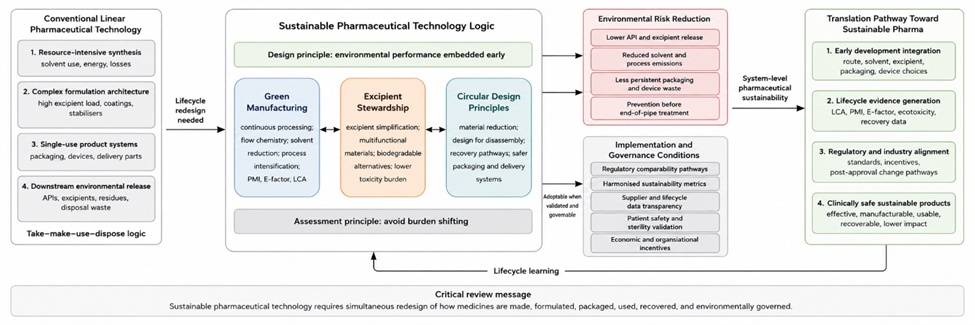
Figure 1. Integrated Systems Framework for Sustainable Pharmaceutical Technologies: Linking Green Manufacturing, Excipient Burden Reduction, Circular Design, Environmental Risk Control, and Translation Pathways
Green manufacturing is the most developed domain within sustainable pharmaceutical technology because it aligns environmental improvement with long-standing industry goals of process efficiency, quality control, and cost reduction. Continuous manufacturing has attracted particular attention because it can reduce hold times, improve heat and mass transfer, enhance process monitoring, and potentially decrease waste compared with conventional batch processing [16, 18]. However, the environmental superiority of continuous manufacturing cannot be assumed in every case; it must be demonstrated through comparable metrics that include cleaning, solvent use, equipment utilisation, rejection rates, and lifecycle energy demand [4, 19].
Flow chemistry provides a practical bridge between green chemistry principles and pharmaceutical process design. It can improve reaction control, reduce hazardous intermediate accumulation, support telescoped multistep synthesis, and enable more efficient use of reagents and solvents [7, 20]. Critical reviews of continuous one-flow synthesis and asymmetric flow synthesis show strong potential for active pharmaceutical ingredient production, but they also indicate that complex process integration, regulatory transfer, and scale-up validation remain persistent challenges [12, 21].
Process intensification and biocatalytic approaches broaden the green manufacturing agenda by reducing the number of steps, lowering temperature or pressure requirements, improving selectivity, and decreasing waste from protection, deprotection, and purification operations. These strategies are especially important because pharmaceutical synthesis often involves complex molecules with high material intensity and demanding purity specifications. Yet implementation is uneven because greener routes must satisfy not only environmental expectations but also yield, impurity control, reproducibility, intellectual property constraints, and compatibility with existing manufacturing infrastructure [10, 22].
Sustainability metrics are essential because qualitative claims of “green” production can conceal burden shifting. E-factor and process mass intensity reveal material efficiency, while life-cycle assessment can capture broader impacts across raw material sourcing, energy, solvent recovery, emissions, packaging, and disposal [3, 5]. For biologics, additional metrics are needed because manufacturing mass intensity, water use, buffer preparation, cleaning, cold-chain requirements, and single-use systems may dominate the environmental profile rather than classical small-molecule synthesis metrics [23].
The critical challenge is to turn green manufacturing from a process improvement option into a design requirement across pharmaceutical development. Early-phase route selection, solvent choice, reactor design, analytical control, and scale-up strategy should all be evaluated through sustainability metrics before commercial lock-in occurs. Table 1 summarises the key green manufacturing technologies and their sustainability metrics. The table also indicates why adoption depends on regulatory confidence, economic feasibility, and demonstrated lifecycle benefit rather than technical novelty alone [13, 19, 24].
Table 1. Green Manufacturing Technologies in Pharmaceutical Production: Processes, Environmental Metrics, and Adoption Status
Green manufacturing technology | Main pharmaceutical application | Sustainability contribution | Key metrics used | Adoption status and critical limitations |
Continuous manufacturing | Integrated production of intermediates, active pharmaceutical ingredients, and solid dosage forms | Reduces hold times, improves process control, may lower waste and energy intensity | Process mass intensity, E-factor, yield, rejection rate, energy demand, lifecycle impact | Increasingly adopted, but implementation depends on regulatory acceptance, equipment investment, and product-specific process validation |
Flow chemistry | Controlled synthesis of intermediates and active pharmaceutical ingredients | Improves heat and mass transfer, reduces hazardous intermediate accumulation, supports telescoped synthesis | Solvent intensity, reagent efficiency, conversion, selectivity, process mass intensity | Technically mature in selected cases, but broader adoption is limited by route compatibility and scale-up complexity |
Process intensification | Step reduction, solvent reduction, integrated reaction and separation | Decreases material throughput, shortens processing time, and can reduce purification burden | Number of steps, solvent use, yield, energy use, waste mass | Promising but must be balanced against impurity control, robustness, and regulatory comparability |
Biocatalysis | Selective synthesis of chiral intermediates and complex molecules | Improves selectivity and may reduce hazardous reagents or harsh conditions | Selectivity, catalyst productivity, solvent demand, waste generation | Strong potential, but enzyme stability, substrate scope, and supply-chain constraints can limit use |
Solvent selection and recycling | Reaction, crystallisation, extraction, purification, and cleaning | Reduces hazardous solvent use and supports resource recovery | Solvent mass, solvent recovery rate, toxicity score, process mass intensity | Widely recognised, but constrained by solubility, impurity profile, regulatory limits, and cleaning validation |
Life-cycle assessment integration | Comparative assessment of manufacturing routes and product systems | Identifies burden shifting across raw materials, energy, packaging, and disposal | Global warming potential, water use, energy use, toxicity indicators, resource depletion | Increasingly important, but data availability and methodological harmonisation remain barriers |
Excipient burden is one of the least visible dimensions of sustainable pharmaceutical technology because excipients are conventionally framed as inactive, supportive, and pharmaceutically necessary materials rather than environmental actors. Yet excipients can constitute most of the physical mass of tablets, capsules, suspensions, semisolids, inhaled products, implants, and controlled-release systems, thereby shaping production volume, transport weight, packaging size, waste generation, and disposal behaviour. A sustainability framework that focuses only on active pharmaceutical ingredients therefore underestimates the material intensity of finished medicines and obscures opportunities for formulation-level reduction [5, 9].
The environmental relevance of excipients begins upstream, where plant-derived, mineral, synthetic polymeric, surfactant, plasticising, coating, and stabilising agents require cultivation, extraction, chemical modification, purification, drying, transport, and quality testing. These processes can generate solvent use, water demand, energy consumption, land-use pressure, and supply-chain emissions, even when the excipient itself is pharmacologically inert. Life-cycle assessment literature in pharmaceuticals shows that environmental burden often arises from distributed material and process inputs rather than from the final product alone, making excipient stewardship a logical extension of green manufacturing [11, 14].
The concept of excipient simplification is therefore not merely a minimalist formulation preference, but a sustainability strategy aimed at reducing non-essential material throughput while preserving safety, stability, manufacturability, and patient acceptability. Simplification may involve lowering excipient load, selecting multifunctional excipients, avoiding redundant coatings, reducing overengineering, and designing dosage forms with fewer persistent or difficult-to-recover materials. However, simplification must be critical rather than simplistic, because excipients also prevent degradation, improve bioavailability, enable controlled release, support manufacturing robustness, and reduce therapeutic failure [9, 23].
Biodegradable, plant-based, and renewable excipients offer potential sustainability benefits, but they should not be treated as automatically superior alternatives. A plant-based polymer may reduce dependence on petrochemical inputs while creating land-use, water-use, fertiliser, transport, or batch-variability challenges. Similarly, biodegradable materials may reduce persistence but still require careful evaluation of degradation products, interaction with active ingredients, stability under storage, compatibility with manufacturing, and environmental fate after disposal [1, 2].
Future excipient sustainability must therefore be governed through comparative evidence rather than green labelling. Formulators need decision tools that connect excipient function, dose contribution, environmental footprint, supply-chain resilience, biodegradability, and regulatory acceptability. Table 2 quantifies the environmental burden of common excipients and outlines reduction strategies. The purpose of the table is not to rank excipients universally, but to show how sustainability assessment can become part of formulation design choices [5, 11, 25].
Table 2. Excipient Burden: Environmental Footprint of Major Excipient Classes and Opportunities for Mitigation
Excipient class | Common pharmaceutical function | Main sustainability concern | Potential mitigation strategy | Critical qualification required |
Fillers and diluents | Increase tablet or capsule mass and support dose uniformity | High cumulative material volume across large-scale production | Reduce unnecessary overfill, use multifunctional materials, optimise tablet size | Must preserve content uniformity, compressibility, stability, and patient usability |
Binders and disintegrants | Maintain mechanical integrity and enable dosage-form breakup | Additional material load and manufacturing dependency | Use lower effective concentrations or multifunctional excipients | Must maintain dissolution, mechanical strength, and process robustness |
Coating polymers | Protect drug, mask taste, modify release, or improve appearance | Polymer persistence, solvent use, and added processing steps | Use aqueous coatings, thinner coatings, biodegradable polymers, or avoid cosmetic coating | Must preserve stability, release profile, swallowability, and regulatory specifications |
Surfactants and solubilisers | Improve solubility, wetting, dispersion, or bioavailability | Aquatic toxicity potential and environmental persistence | Select less persistent alternatives and reduce concentration through formulation optimisation | Must preserve bioavailability, physical stability, and safety margin |
Plasticisers and stabilisers | Improve flexibility, processability, or shelf-life | Chemical persistence and disposal uncertainty | Use lower-toxicity alternatives and assess degradation products | Must preserve mechanical behaviour and product stability |
Packaging-associated excipient systems | Desiccants, stabilising layers, or formulation–packaging interactions | Added waste streams and difficult material separation | Integrate formulation stability with simplified packaging design | Must maintain moisture, oxygen, light, and contamination protection |
Circular design principles challenge pharmaceutical technology to move beyond cleaner production and address what happens to materials after manufacture, distribution, patient use, expiry, and disposal. In ordinary consumer sectors, circularity can involve reuse, repair, remanufacturing, and recycling, but pharmaceutical products face stricter constraints because safety, sterility, authentication, stability, and contamination control cannot be compromised. The task is therefore not to import circular economy models uncritically, but to adapt them to pharmaceutical risk, traceability, and quality systems [8, 15].
Packaging is the most immediate site for circular design because it often involves large volumes of cardboard, plastics, aluminium, glass, labels, inserts, blister materials, and secondary containers. Sustainable packaging research indicates that circular strategies can include reducing unnecessary secondary packaging, designing mono-material components, improving recyclability, increasing recycled content where acceptable, and creating clearer recovery pathways [8, 17]. However, pharmaceutical packaging also performs essential functions, including barrier protection, tamper evidence, information delivery, child resistance, anti-counterfeiting, and dose organisation, which means circularity must be evaluated against product safety and regulatory compliance [15].
Drug delivery systems present a more complex circularity problem because advanced devices may combine polymers, metals, electronics, sensors, reservoirs, coatings, adhesives, and biological interfaces. These multi-material systems are difficult to disassemble and may become single-use by default because of contamination, sterility, or performance concerns. Circular design in this context may require modular architectures, separable non-contaminated components, take-back schemes, standardised materials, reusable external hardware, and disposable drug-contact modules, but each option must be validated against patient safety and product performance [9, 17].
Circular pharmaceutical design should therefore be understood as a hierarchy of reduction, redesign, recovery, and responsible end-of-life management rather than a simple demand for reuse. The most sustainable option may sometimes be a smaller, lighter, simpler, and safer single-use system rather than a theoretically reusable but energy-intensive or contamination-prone product. Table 3 maps circular design principles to pharmaceutical product and packaging applications. The table highlights that circularity becomes credible only when material recovery is compatible with sterility, stability, traceability, and patient protection [8, 15, 26].
Table 3. Circular Design Principles in Pharma: Re-Design, Material Recovery, and Re-Use Strategies
Circular design principle | Pharmaceutical application | Sustainability contribution | Main safety or regulatory constraint | Practical design implication |
Material reduction | Smaller packs, reduced inserts, lighter components, lower excipient mass | Lowers resource use, transport burden, and waste generation | Must preserve information access, stability, and usability | Remove non-essential material before adding recovery complexity |
Mono-material design | Packaging or device components made from fewer material types | Improves sorting and recycling potential | Barrier performance and tamper evidence may require mixed materials | Use mono-materials only where protection and authentication remain adequate |
Design for disassembly | Separable packaging layers or device modules | Enables recovery of non-contaminated components | Drug-contact and patient-contact parts may require special disposal | Separate contaminated from non-contaminated elements at design stage |
Reusable external components | Reusable inhaler bodies, electronic controllers, or delivery accessories | Reduces repeated material production | Cleaning, calibration, and infection control must be validated | Make drug-contact units replaceable and external units durable |
Take-back and recovery systems | Collection of expired medicines, packaging, or devices | Reduces uncontrolled disposal and supports material recovery | Requires traceability, patient participation, and logistics infrastructure | Link product design to pharmacy or manufacturer recovery pathways |
Recycled or renewable materials | Secondary packaging or selected non-contact components | Reduces virgin resource demand | Must avoid contamination, variability, and performance loss | Restrict use to components where quality standards can be guaranteed |
Environmental risk provides the strongest argument for integrating sustainability into pharmaceutical technology rather than treating it as optional operational improvement. Pharmaceuticals and related chemicals have been detected in freshwater environments, wastewater streams, sediments, and aquatic organisms, reflecting emissions from manufacturing, hospital use, household disposal, excretion, and incomplete removal during wastewater treatment [1, 27]. The concern is not limited to acute toxicity; chronic low-dose exposure, mixture effects, bioaccumulation, endocrine disruption, behavioural changes, and ecosystem-level impacts complicate risk assessment [2, 28].
Active pharmaceutical ingredients remain central to environmental risk because they are designed to produce biological effects at low concentrations. Reviews of pharmaceutical pollution highlight substances such as analgesics, antiepileptics, antibiotics, hormones, and psychiatric medicines as recurring contaminants of concern in aquatic environments [2, 29]. Their persistence and biological activity challenge conventional wastewater systems, which were not originally designed to remove complex pharmaceutical mixtures or transformation products [30, 31].
Excipients, formulation aids, packaging residues, and degradation products also require more attention in environmental assessment. Although active ingredients dominate ecotoxicology research, finished pharmaceutical technologies include surfactants, polymers, coatings, preservatives, solvents, and delivery-system materials that may alter environmental mobility, degradation, toxicity, or exposure profiles. A sustainable technology framework must therefore assess not only whether the active ingredient is hazardous, but whether formulation and delivery choices amplify persistence, dispersal, or treatment resistance [25, 32].
Green design can mitigate environmental risk by reducing hazardous inputs, improving degradability, lowering solvent and reagent residues, simplifying formulations, and designing packaging or devices that are less likely to enter uncontrolled waste streams. However, remediation and advanced oxidation technologies cannot substitute for upstream design because removal after environmental release is technically difficult, costly, and often incomplete [30, 33]. Table 4 outlines the key environmental risks associated with pharmaceutical technologies and current mitigation approaches. The table emphasises that sustainable pharmaceutical technology should prioritise prevention, not only end-of-pipe treatment [1, 31].
Table 4. Environmental Risks of Pharmaceutical Manufacturing and Disposal: APIs, Excipients, and Ecotoxicity
Environmental risk | Main source within pharmaceutical technology | Potential ecological or public-health concern | Current mitigation approach | Critical limitation |
Active pharmaceutical ingredient residues | Manufacturing emissions, patient excretion, unused medicine disposal | Chronic aquatic exposure, bioactivity in non-target organisms, mixture toxicity | Wastewater treatment, take-back schemes, greener synthesis, risk assessment | Many compounds are incompletely removed by conventional treatment |
Antibiotic residues | Manufacturing discharge, clinical use, agricultural and household disposal | Selection pressure for antimicrobial resistance | Improved effluent control, stewardship, advanced treatment | Resistance risk is difficult to manage once residues enter ecosystems |
Excipients and formulation aids | Surfactants, polymers, coatings, preservatives, stabilisers | Persistence, toxicity, altered mobility of active substances | Excipient selection, simplification, biodegradability assessment | Limited ecotoxicity data compared with active ingredients |
Solvents and process chemicals | Synthesis, purification, cleaning, crystallisation | Toxic emissions, resource depletion, wastewater burden | Solvent substitution, recovery, process intensification | Recovery systems require validation and may shift energy burden |
Packaging and device waste | Blisters, bottles, cartons, injectors, inhalers, applicators | Material accumulation, microplastic generation, disposal complexity | Circular packaging design, take-back schemes, mono-material components | Safety and contamination requirements restrict recycling options |
Transformation products | Degradation during treatment, storage, or environmental exposure | Unknown or underestimated toxicity | Advanced analytical monitoring and degradation studies | Transformation products are often less studied than parent compounds |
The implementation of sustainable pharmaceutical technologies is constrained by the structure of pharmaceutical innovation itself. Once a synthesis route, formulation, excipient system, container closure, or delivery device has been validated and approved, firms are reluctant to modify it because even beneficial environmental changes can trigger comparability studies, regulatory review, supply-chain qualification, and quality-risk reassessment. This creates a lock-in effect in which sustainability improvements are easiest before approval but most visible after large-scale commercialisation [16, 19].
Capital cost is another major barrier, particularly for continuous manufacturing, advanced process analytical technology, solvent recovery systems, greener route redesign, and lifecycle data infrastructure. Although green manufacturing may reduce waste and long-term operating costs, firms may hesitate when the return on investment is uncertain or when existing batch facilities are already depreciated. Continuous manufacturing case studies suggest that sustainability benefits are strongest when technical integration, quality control, and business incentives align, but this alignment is not automatic [18, 24].
A further barrier is the lack of harmonised sustainability metrics across pharmaceutical product classes. Process mass intensity, E-factor, solvent scores, carbon footprint, water use, ecotoxicity indicators, packaging recyclability, and lifecycle assessment each capture different dimensions of sustainability, but no single metric can define a sustainable pharmaceutical technology. Holistic assessment frameworks have therefore been proposed, yet they remain difficult to implement when data are proprietary, supply chains are opaque, and methodological boundaries differ between studies [3, 4, 9].
The most difficult barrier is the perceived trade-off between sustainability and patient safety, even when the two goals need not conflict. Reusable packaging, biodegradable delivery systems, excipient reduction, recycled materials, and formulation simplification may appear attractive environmentally, but each must satisfy stability, sterility, dose accuracy, manufacturability, usability, and regulatory expectations. Table 5 identifies the implementation barriers and proposed solutions for sustainable pharmaceutical technology adoption. The table shows that adoption requires governance mechanisms as well as technical innovation [11 ,17, 23].
Table 5. Barriers to Sustainable Pharmaceutical Technology Implementation and Potential Solutions
Implementation barrier | How it limits sustainable pharmaceutical technology | Affected domain | Potential solution | Remaining risk |
Regulatory inertia | Approved processes and formulations are difficult to change without comparability evidence | Manufacturing, formulation, packaging | Create regulatory pathways for sustainability-driven post-approval changes | Evidence requirements may still be costly and slow |
High capital cost | New equipment, continuous systems, and recovery infrastructure require major investment | Manufacturing and analytics | Use phased adoption, shared facilities, and lifecycle cost models | Short-term financial pressures may override long-term savings |
Metric fragmentation | Different tools measure different sustainability dimensions | Route selection, formulation, packaging, lifecycle assessment | Harmonise core sustainability indicators across development stages | Oversimplified metrics may conceal burden shifting |
Supply-chain complexity | Raw materials, excipients, packaging, and solvents are globally distributed | Procurement and quality assurance | Require supplier sustainability data and dual-source greener materials | Data reliability and supplier qualification remain difficult |
Safety and sterility constraints | Reuse or recycling may introduce contamination or performance risks | Packaging and delivery systems | Design separable, validated, non-contaminated recovery streams | Some products may remain unsuitable for reuse |
Cultural and organisational lock-in | Sustainability is often treated as secondary to speed, cost, and compliance | Corporate and development strategy | Integrate sustainability into quality-by-design and early development decisions | Incentives may remain weak without regulatory or market pressure |
A credible translation pathway begins by embedding sustainability metrics into early pharmaceutical development, not by attempting to retrofit products after approval. Route selection, solvent choice, excipient architecture, dosage-form design, packaging configuration, and delivery-system material selection should be evaluated together before technical lock-in occurs. Life-cycle assessment and integrated sustainability frameworks can help development teams compare alternatives, but they must be adapted to pharmaceutical data constraints and linked to quality-by-design decision points [5, 9, 11].
Regulators can accelerate sustainable pharmaceutical technology by creating clearer expectations for green manufacturing evidence, sustainability-driven post-approval changes, and lifecycle-based product improvement. Such incentives should not reduce quality standards, but they could make it easier for firms to adopt greener solvents, lower-waste processes, simplified packaging, or improved recovery systems when equivalence and safety are demonstrated. The future challenge is to make sustainability a recognised dimension of pharmaceutical quality without turning it into a vague marketing claim [13, 19, 24].
Pre-competitive collaboration will be essential because many sustainability barriers are shared across firms and product classes. Standardised process mass intensity reporting, solvent-recovery benchmarks, excipient footprint databases, packaging recyclability standards, and environmental risk datasets would reduce duplication and improve comparability. Green chemistry and biologics manufacturing literature already show that sector-level metrics can shape decision-making, but broader collaboration is needed to extend these metrics from synthesis to formulation, packaging, delivery systems, and disposal [4, 10, 23].
Future research should prioritise biodegradable excipient systems, lower-burden controlled-release platforms, circular packaging compatible with pharmaceutical safety, predictive ecotoxicity tools, and AI-supported formulation design that incorporates environmental constraints. Environmental studies show that pharmaceutical residues and mixtures remain difficult to manage once released, so upstream design should be treated as a primary prevention strategy [28, 32, 33]. Sustainable pharmaceutical technology will mature only when environmental performance, therapeutic performance, manufacturability, patient usability, and regulatory confidence are treated as coequal design criteria [26, 31].
Sustainable pharmaceutical technology requires a paradigm shift from isolated efficiency gains to integrated product–process–system design. Green manufacturing can reduce waste, solvent use, and material intensity, but it cannot by itself make medicines sustainable if formulations remain materially excessive, packaging remains non-recoverable, and environmental risks are displaced downstream. The field therefore needs a broader logic that joins manufacturing innovation with excipient stewardship, circular design, and environmental accountability.
The critical review shows that the sustainability challenge is not simply technical, but also conceptual and institutional. Pharmaceutical technologies have been designed primarily to satisfy efficacy, safety, stability, manufacturability, and compliance, while environmental performance has often been treated as secondary. Future innovation must change this hierarchy by making sustainability part of the definition of responsible pharmaceutical technology rather than a late-stage optimisation exercise.
The transition will require collaboration among formulation scientists, process chemists, engineers, toxicologists, packaging specialists, regulators, manufacturers, healthcare systems, and patients. Sustainable pharmaceutical technologies must be validated, measurable, safe, scalable, and clinically legitimate, but they must also reduce unnecessary material throughput and environmental harm. The sector’s next challenge is to ensure that medicines remain not only effective for patients, but also compatible with the ecological systems on which public health ultimately depends.
None
None
None
None
Open Access The author(s) retain copyright. This article is licensed under the Creative Commons Attribution-NonCommercial-ShareAlike 4.0 International License. It may be shared and adapted for non-commercial purposes with appropriate attribution, an indication of changes, and distribution of adaptations under the same license. Third-party material may be subject to separate terms identified in its credit line. View the license at https://creativecommons.org/licenses/by-nc-sa/4.0/.
 Publication System