Pharmaceutical quality is often operationalized through stability testing, in which products are exposed to defined temperature and humidity conditions to support shelf-life assignment. This practice is indispensable, but it can create a narrow interpretation of quality when stability under controlled chamber conditions is treated as evidence of real-world performance. Products do not move through idealized chambers; they move through development uncertainty, manufacturing variability, distribution stress, and patient-level handling. This article argues that the dominant stability paradigm has encouraged a conceptual conflation between stability and robustness. Stability testing primarily asks whether a product remains within specification under predefined storage conditions for a defined period. Robustness, by contrast, asks whether the product–process–use system can continue to deliver acceptable quality when exposed to interacting stresses across the full lifecycle. The objective of this article is to develop an Integrated Robustness Theory for pharmaceutical products. The theory frames robustness as a system-level property spanning development, manufacturing, storage, and administration. It proposes that quality should be understood not only as shelf-life survival but also as resilient performance under realistic and combined stress conditions. The article critiques the limits of stability testing, defines robustness dimensions across lifecycle phases, and develops a systems-based framework for translating robustness into development strategy, manufacturing control, storage evaluation, and administration design. Three tables are used to map lifecycle robustness dimensions, storage stress gaps, and the integrated theory. The central conclusion is that pharmaceutical quality assurance must move beyond shelf-life thinking toward lifecycle robustness thinking.
A pharmaceutical product can pass formal stability testing and still fail at the moment it matters most: when it is manufactured from variable raw materials, shipped through unstable distribution conditions, prepared in a hospital, or administered by a patient. This irony is not a failure of stability testing itself but a failure of overinterpretation, because chamber-based stability protocols are often treated as if they represent the full operational world of the product. Contemporary discussions of pharmaceutical quality increasingly emphasize lifecycle thinking and patient-oriented quality, yet the conceptual vocabulary of robustness remains underdeveloped when compared with the vocabulary of stability [1]. A product that survives a stability chamber is therefore not necessarily a product that is robust across development, manufacturing, storage, and administration.
The central problem is that the industry has often conflated stability with robustness. Stability describes the ability of a product to remain within predefined quality specifications under specified conditions, whereas robustness describes the ability of a product–process–use system to absorb variability without losing acceptable performance. Quality-by-design has already shifted pharmaceutical development toward understanding design space, critical material attributes, critical process parameters, and control strategies, but this shift has not fully displaced the narrower habit of equating quality with end-point testing [2, 3]. This article argues that robustness must be theorized as a broader systems property rather than as an implicit by-product of stability success.
The need for a systems-based view becomes clearer when the product lifecycle is considered as a chain of coupled vulnerabilities. Formulation choices made during development shape sensitivity to excipient variation, process settings, and degradation pathways; manufacturing decisions shape batch-to-batch reproducibility; storage and distribution expose the product to temperature cycling, shock, and handling; and administration introduces compatibility, dilution, device, and patient-use risks [4, 5]. These phases are usually studied in separate technical domains, but patients experience the final result as a single quality outcome. A systems theory of robustness must therefore connect technical performance across phases that are usually separated by organizational boundaries.
The aim of this article is to deconstruct the conflation between stability and robustness and to build an Integrated Robustness Theory for pharmaceutical products. The proposed theory treats robustness as the capacity of the product–process–use system to maintain quality across a multidimensional stress space rather than only across a predefined storage interval. It uses the logic of lifecycle quality, process control, real-world storage stress, and in-use compatibility to argue that robustness must be designed, demonstrated, and maintained across development, manufacturing, storage, and administration [6, 7]. In this framing, stability testing remains essential, but it becomes one component of a wider architecture of pharmaceutical resilience.
Formal stability testing is necessary because pharmaceutical products must demonstrate that critical quality attributes remain acceptable over time under defined conditions. However, the stability paradigm becomes limited when fixed temperature and humidity settings are assumed to represent the wider and more complex stress environment encountered by products after development and approval. Temperature excursions, transport shocks, and patient-level handling demonstrate that real-world exposure is often discontinuous, multidirectional, and operationally contingent rather than stable and chamber-like [8, 9]. Stability testing therefore provides an essential but partial view of pharmaceutical quality.
The limitation is not simply that stability chambers are artificial; all testing systems are artificial to some degree. The deeper limitation is that the chamber paradigm isolates stress factors that may interact in practice, such as temperature cycling combined with vibration, dilution, light exposure, or device contact. Studies of postproduction handling and hospital administration show that protein products and biologics may be vulnerable to instability risks after formal manufacturing and storage stages have been completed [5, 10]. These findings support a critical distinction between controlled-condition stability and real-world robustness.
A further limitation is that stability testing tends to be organized around product survival rather than system resilience. A product may remain within specification during long-term storage but later encounter a short, intense excursion during parcel shipment, home delivery, or hospital pneumatic-tube transport. Evidence on transport-related shock, temperature monitoring, and IV bag handling shows that stress episodes may occur outside the assumptions embedded in formal storage protocols [9, 11, 12]. Stability testing can therefore certify shelf-life while leaving unresolved whether the product can tolerate the operational stresses that occur within that shelf life.
The administration phase exposes the most visible gap between stability and robustness. In-use stability and compatibility studies show that quality may be affected by dilution, infusion systems, closed system transfer devices, container contact, and preparation practices that occur after the product has already passed stability requirements [13, 14]. If a product is stable in its original container but vulnerable during preparation or delivery, then stability has not guaranteed therapeutic robustness. This is why a lifecycle theory of robustness must expand the quality question from “Does the product remain stable?” to “Does the product remain fit for use across the conditions under which it is actually developed, made, moved, prepared, and administered?”
A systems-based rationale begins from the proposition that robustness is not a single analytical result but an emergent property of a designed product–process–use system. In pharmaceutical quality, this means that the formulation, process, control strategy, packaging, distribution pathway, preparation method, and administration interface jointly determine whether the product can maintain acceptable performance. The future of pharmaceutical quality has been linked to integrated quality systems, lifecycle management, and more proactive uses of process knowledge rather than reliance on late-stage verification alone [1]. Robustness therefore belongs to the architecture of the system, not merely to the output of a stability protocol.
Quality-by-design provides the conceptual foundation for this transition because it emphasizes prior knowledge, risk assessment, experimental design, design space, and control strategy. The QbD literature positions development as an opportunity to understand how material and process variables influence critical quality attributes, thereby reducing dependence on end-product testing [2, 3]. In a systems theory of robustness, QbD is not limited to optimizing a formulation for stability but extends to designing tolerance against variability across the lifecycle. Robustness becomes a design intention rather than a retrospective claim.
The integration of QbD, risk management, and pharmaceutical quality systems supports a broader theory in which product quality is continuously maintained rather than episodically confirmed. Continuous manufacturing and regulatory discussions show that process understanding, control strategies, and quality risk assessment can support more dynamic assurance models than traditional batch-end testing [6, 7, 15]. These models suggest that robustness should be evaluated through the system’s ability to detect, absorb, and respond to variability. From this perspective, stability testing is one evidence stream within a larger lifecycle assurance system.
Figure 1 illustrates why pharmaceutical robustness must be understood as an integrated lifecycle system rather than as an extension of stability testing alone.
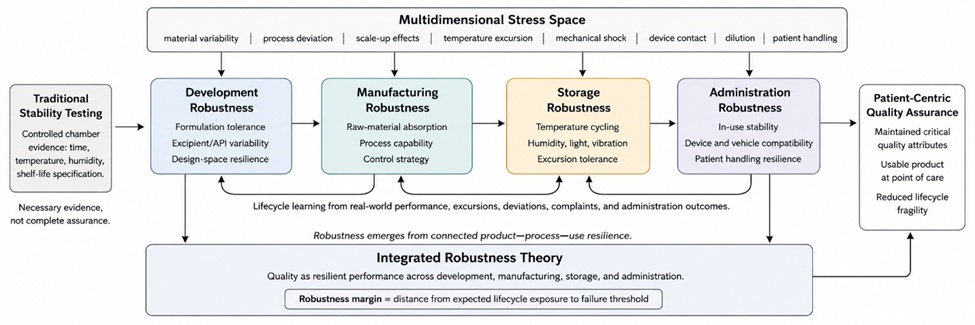
Figure 1. Integrated Lifecycle Robustness Architecture for Pharmaceutical Products across Development, Manufacturing, Storage, and Administration
Development robustness refers to the intentional design of formulations and processes that are inherently tolerant to variability. It includes excipient selection, formulation composition, process pathway design, and design-space establishment in ways that reduce sensitivity to material differences, process deviations, and interaction effects. QbD-oriented development has emphasized that robustness requires identifying how formulation variables and process parameters influence critical quality attributes before routine production begins [2, 4]. The objective is not merely to create a product that passes stability testing but to create a product whose quality is less fragile under plausible lifecycle variation.
The development phase is especially important because later robustness is often constrained by early formulation and process decisions. A formulation that is highly sensitive to excipient grade, moisture content, mixing energy, container contact, or administration dilution may remain manageable under controlled development conditions but become vulnerable during scale-up, distribution, or use. The pharmaceutical development literature on QbD and dry powder inhalers illustrates how formulation and device-related variables must be considered together when robustness is designed rather than assumed [4]. Development robustness therefore requires anticipating how downstream manufacturing, storage, and administration conditions will interact with formulation properties.
Development robustness also requires moving beyond the minimum logic of compliance. A product can meet formal requirements and still have a narrow robustness margin if small shifts in material properties or processing conditions produce disproportionate effects on quality. Work on active pharmaceutical ingredient raw material variability shows that material attributes can affect downstream processability, especially in continuous and secondary manufacturing contexts [16]. This means that development should define not only acceptable conditions but also the degree of tolerance around those conditions.
Table 1 defines the dimensions of robustness across the four lifecycle phases and their relationship to traditional stability testing. This table positions stability testing as a necessary but limited subset of lifecycle robustness, while development robustness is framed as the upstream design of tolerance that conditions every later phase. The table also shows that robustness cannot be reduced to one endpoint because each phase introduces a different stress domain, failure mode, and design response [1, 2, 16]. In this theory, development robustness is the phase in which the future resilience of the product–process–use system is first architected.
Table 1. Robustness Dimensions across the Pharmaceutical Lifecycle: Development, Manufacturing, Storage, and Administration Versus Stability Testing Scope
Lifecycle phase | Robustness dimension | Main variability or stress domain | Typical failure mode if robustness is weak | Relationship to traditional stability testing | Robustness-oriented design response |
Development | Formulation and process tolerance | Excipient grade, API attributes, process interactions, design-space uncertainty | Narrow formulation tolerance, sensitivity to small material or process changes, unstable scale-up behavior | Stability testing may confirm shelf-life but may not reveal sensitivity to formulation or process variability | Use QbD, mechanistic understanding, design-space mapping, and risk-based formulation selection |
Manufacturing | Process absorption capacity | Raw material variability, equipment differences, operator shifts, scale-up, continuous-process disturbances | Batch inconsistency, drifting critical quality attributes, process interruptions, excessive reliance on end testing | Stability testing does not directly assess process capability or real-time process resilience | Establish robust control strategies, process capability monitoring, continuous verification, and material attribute controls |
Storage | Environmental tolerance | Temperature cycling, humidity excursions, light exposure, vibration, shock, handling, parcel shipment | Degradation, aggregation, particle formation, container stress, loss of potency or usability during distribution | ICH stability chambers simplify and standardize storage exposure but do not reproduce all real logistics stresses | Add real-world stress simulations, excursion studies, packaging robustness, transport qualification, and distribution monitoring |
Administration | Point-of-use resilience | Dilution, device contact, closed system transfer devices, infusion systems, dosing vehicles, patient handling | In-use degradation, incompatibility, dosing error, device-related quality loss, reduced therapeutic performance | Traditional stability testing often ends before preparation and administration risks appear | Conduct in-use compatibility studies, administration-device testing, patient-use risk assessment, and handling-tolerant product design |
Manufacturing robustness is the capacity of a pharmaceutical process to absorb variability in materials, equipment, scale, environment, and human operation while continuing to deliver consistent critical quality attributes. Unlike stability testing, which primarily evaluates product behavior after manufacture, manufacturing robustness evaluates whether the process itself can repeatedly create a product with sufficient quality margin. Continuous manufacturing research has shown that raw material properties can influence blend feeding, granulation, and downstream performance in ways that require systematic process understanding rather than simple endpoint confirmation [17, 18]. A robust manufacturing system therefore does not merely detect failure after it occurs; it reduces the probability that ordinary variability will become quality failure.
Raw material variability is one of the most important challenges for manufacturing robustness because materials that meet incoming specifications may still behave differently during processing. Studies on active pharmaceutical ingredient variability in continuous manufacturing lines show that differences in material attributes can affect feeding behavior, granulation response, and process stability [17-19]. This demonstrates that specification compliance is not identical to process suitability, especially when the process is sensitive to powder flow, particle size, moisture, compressibility, or other material properties. Manufacturing robustness requires linking material characterization to process behavior and critical quality outcomes.
Scale-up further complicates manufacturing robustness because process relationships established at development scale may not transfer linearly into commercial production. Continuous manufacturing has been proposed as a route toward better control, but it also requires integrated models, control strategies, and real-time process understanding to manage dynamic disturbances [15, 20, 21]. Process capability indices and design space verification can support this transition, but only if they are interpreted as evidence of system performance rather than isolated statistical targets. The central question is whether the process maintains quality when interacting sources of variability appear simultaneously.
Manufacturing robustness therefore shifts the quality logic from batch release to process assurance. Control strategies for continuous manufacturing emphasize material controls, process monitoring, feedback control, diversion logic, and quality risk assessment as parts of an integrated assurance architecture [6, 15]. This architecture aligns with the broader argument that robustness must be maintained throughout the product lifecycle rather than inferred from final testing. A product that is stable in storage but inconsistently manufactured lacks true pharmaceutical robustness because its quality is fragile before it ever enters the supply chain.
Storage robustness is the capacity of a pharmaceutical product to tolerate the environmental and handling stresses that occur between release and use. Traditional stability studies are indispensable for defining shelf life, but storage in the real world includes temperature cycling, humidity excursions, light exposure, freezing risk, vibration, impact, stacking pressure, and variable last-mile handling. Industry work on temperature cycling and regulatory temperature-excursion support shows that distribution stress is not a rare anomaly but a foreseeable part of pharmaceutical product life [8]. Storage robustness therefore asks whether the product can remain fit for use across realistic logistics conditions, not only under controlled chamber exposure.
The gap between stability testing and storage robustness is especially visible for biologics and protein products. Protein formulations may be affected by agitation, shock, freezing, thawing, container interaction, and transport conditions that are not fully represented by long-term or accelerated chamber protocols [5, 9]. Evidence from parcel shipment studies shows that transport can expose protein solutions to unexpected physical stresses, while monitoring of home delivery of immunoglobulins shows that temperature and shock events can occur during patient-directed logistics [9, 12]. These examples indicate that real-world storage is a dynamic stress environment.
Hospital and clinical logistics also challenge assumptions of storage robustness. Studies of IV bags transported through pneumatic tube systems show that protein formulations can experience particle-related risks under hospital handling conditions [11]. Postproduction handling studies further indicate that quality risks may emerge after formal manufacturing has ended but before the product reaches the patient [5, 10]. This suggests that storage robustness must include local handling pathways, hospital transport, pharmacy preparation, and home-care distribution rather than only warehouse storage.
Table 2 maps the gap between ICH stability conditions and real-world storage stresses. The table shows that storage robustness requires identifying stress factors, plausible failure modes, and design strategies that extend beyond standardized temperature and humidity chambers. It also clarifies that the purpose is not to replace stability testing but to supplement it with logistics-relevant evidence that better reflects product movement through actual supply chains [8, 9, 11, 12]. In the Integrated Robustness Theory, storage is treated as an active stress phase rather than a passive waiting period.
Table 2. Storage Robustness beyond ICH Stability Testing: Real-World Stress Factors, Failure Modes, and Robustness Design Strategies
Real-world storage stress factor | Why it may exceed traditional stability scope | Potential failure mode | Robustness design or evaluation strategy |
Temperature cycling | Products may experience repeated transitions between controlled and uncontrolled environments during shipping, customs, pharmacy storage, and home delivery | Degradation, aggregation, precipitation, container stress, loss of potency | Conduct temperature-cycling studies, define excursion tolerances, and link excursion data to quality risk assessment |
Freezing and thawing | Cold-chain products may be exposed to accidental freezing during transport or storage | Protein aggregation, particle formation, container damage, irreversible formulation change | Evaluate freeze–thaw tolerance, improve packaging insulation, and specify route-level cold-chain controls |
Humidity excursions | Packaging may encounter humid environments, damaged seals, or variable warehouse conditions | Moisture uptake, hydrolysis, altered dissolution, microbial or physical instability | Use moisture-protective packaging, desiccants, humidity stress testing, and moisture-sensitive design limits |
Light exposure | Products may encounter uncontrolled light during handling, dispensing, or patient storage | Photodegradation, discoloration, potency loss, formation of degradants | Evaluate light-protection needs, use protective containers, and include handling instructions for light-sensitive products |
Vibration and shock | Parcel shipment, pneumatic tubes, road transport, and last-mile delivery can expose products to repeated mechanical stress | Particle formation, aggregation, foaming, device malfunction, container closure stress | Conduct agitation, vibration, drop, and transport simulation studies relevant to actual distribution routes |
Handling and stacking pressure | Product cartons and containers may be compressed, dropped, tilted, or mishandled during logistics | Package deformation, leakage, device damage, breakage, altered usability | Qualify secondary packaging, simulate handling stresses, and integrate packaging robustness into lifecycle quality planning |
Administration robustness is the capacity of a pharmaceutical product to remain safe, effective, and usable during preparation, handling, and delivery to the patient. This phase includes in-use stability after opening, dilution, transfer, infusion, compatibility with devices, and interaction with dosing vehicles. Industry perspectives on in-use stability and compatibility for biological products show that administration conditions can introduce risks that are distinct from long-term storage risks [13, 14]. Administration robustness is therefore not a minor extension of stability; it is the final transformation of product quality into therapeutic use.
The point of use is especially vulnerable because it often occurs outside the controlled environment of development laboratories and manufacturing facilities. Products may be prepared by pharmacists, nurses, caregivers, or patients, and each actor may introduce variation in timing, mixing, dilution, transfer method, device choice, or storage after preparation. Compatibility assessments for biologics and risk-based in-use tools emphasize that quality can be affected by the product’s interaction with containers, infusion systems, tubing, filters, syringes, and preparation procedures [14, 22]. A robust product must therefore tolerate not only physical and chemical stress but also procedural variability.
Closed system transfer devices illustrate how administration robustness can be undermined by well-intended safety practices if compatibility is not adequately evaluated. Several industry studies have examined the challenges of using these devices with biologics, including potential concerns related to material compatibility, particulates, silicone oil, hold-up volume, and product-device interaction [23-25]. These issues show that an administration device cannot be treated as a neutral accessory. It becomes part of the pharmaceutical system and must be included in robustness assessment.
Administration robustness is the most neglected dimension because it occurs after the product has already passed the most visible quality gates. Yet this phase is closest to the patient and therefore has direct consequences for dose delivery, usability, therapeutic outcome, and confidence in treatment. Recent work on postproduction handling and minimal essential quality attributes for antibody stability supports the need to define quality attributes that are meaningful for real handling and administration contexts [5, 26]. A systems-based quality theory must therefore treat administration not as an afterthought but as a decisive phase in which pharmaceutical robustness is either preserved or lost.
Integrated Robustness Theory defines pharmaceutical robustness as the capacity of a product–process–use system to maintain acceptable quality across a multidimensional stress space spanning development, manufacturing, storage, and administration. This definition intentionally differs from stability because it includes interacting stresses, operational variability, and downstream use conditions rather than only time-dependent behavior under defined storage conditions. Lifecycle quality perspectives, continuous manufacturing frameworks, and postproduction handling studies all point toward the need for an integrated assurance model rather than isolated phase-specific testing [1, 5, 7]. Robustness is therefore a system property created by the relationship among formulation design, process control, logistics protection, and administration compatibility.
The key concept within this theory is the robustness margin. Robustness margin refers to the distance between expected lifecycle exposure and the point at which product quality, usability, or therapeutic performance becomes unacceptable under worst-case combined stresses. In development, the margin is created through formulation and design-space tolerance; in manufacturing, it is preserved through process capability and control strategy; in storage, it is protected through packaging, excursion tolerance, and logistics qualification; and in administration, it is realized through in-use stability and compatibility [4, 8, 19, 22]. A product with a wide robustness margin is not merely stable in a chamber but resilient across the conditions under which it actually exists.
Table 3 presents the Integrated Robustness Theory as a systems-based framework. The table translates the theory into elements, metrics, and resilience properties that can guide development programs, manufacturing strategies, storage evaluations, and administration studies. It also incorporates recent discussions on biologic handling, administration-device compatibility, and the contested value of closed system transfer devices, showing that robustness theory must remain sensitive to real clinical workflows rather than only technical specifications [13, 23, 27]. The framework is intended to make robustness visible as a distinct and measurable quality dimension.
Table 3. Integrated Robustness Theory for Pharmaceutical Products: Elements, Metrics, and System-Level Resilience Properties
Theory element | Lifecycle meaning | Possible robustness metric | System-level resilience property |
Multidimensional stress space | The combined set of development, manufacturing, storage, and administration stresses that the product may experience | Number and severity of tested combined-stress scenarios; mapped stress domains; defined acceptable exposure ranges | Recognizes that quality risk emerges from interacting stresses rather than isolated conditions |
Robustness margin | Distance between expected lifecycle exposure and the point of unacceptable quality or usability failure | Difference between tested failure threshold and realistic worst-case exposure; acceptable margin around critical quality attributes | Creates tolerance before failure rather than merely detecting failure after exposure |
Development tolerance | Capacity of formulation and process design to accommodate material and process variability | Design-space width; sensitivity coefficients; excipient and API variability tolerance | Reduces downstream fragility by building resilience into the product concept |
Manufacturing absorption capacity | Ability of the process to handle raw material, equipment, and operational variation | Process capability indices; control-limit stability; disturbance recovery time; deviation frequency | Maintains critical quality attributes despite routine production variability |
Storage stress tolerance | Ability to remain fit for use under real distribution and handling conditions | Excursion tolerance; aggregation or degradation change after cycling; transport simulation outcomes | Protects quality during movement through supply chains and care settings |
Administration resilience | Ability to remain compatible, stable, and usable during preparation and delivery | In-use stability duration; device compatibility outcomes; preparation error tolerance; dose-delivery consistency | Preserves quality at the point where the product becomes therapy |
Lifecycle feedback learning | Use of development, manufacturing, logistics, and administration data to revise controls | Post-approval robustness trend reports; deviation learning; complaint and excursion integration | Converts real-world performance into continuous improvement of the quality system |
Figure 2 presents the proposed robustness margin model for assessing how far a pharmaceutical product remains from quality failure under combined lifecycle stresses.
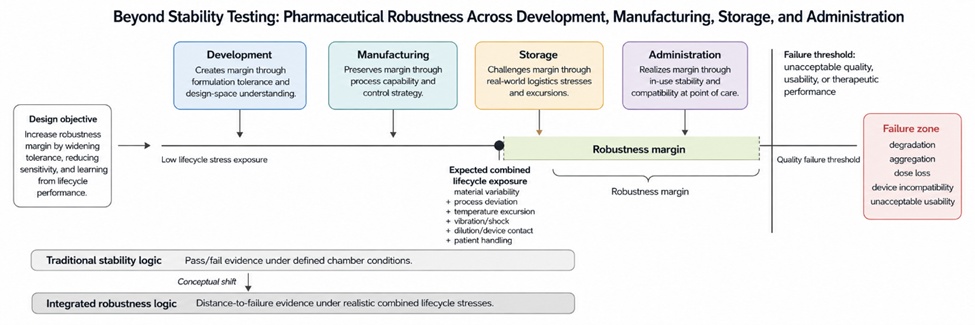
Figure 2. Robustness Margin Model for Pharmaceutical Quality under Combined Lifecycle Stress Exposure
The translation pathway begins by supplementing conventional stability studies with robustness stress-testing protocols that simulate realistic combined extremes. These protocols should not be arbitrary stress experiments; they should be risk-based, product-specific, and linked to known vulnerabilities in formulation, process, package, route, and administration method. Temperature cycling, transport shock, device contact, dilution, and postproduction handling evidence suggest that robustness studies should be designed around plausible lifecycle exposure rather than only compendial or chamber-based conditions [8, 9, 11, 13]. Such studies would help distinguish products that merely pass stability requirements from products that retain quality under realistic use pathways.
The second step is to incorporate robustness metrics into the pharmaceutical quality system. Continuous manufacturing and control strategy literature already show how risk assessment, process modeling, monitoring, and lifecycle verification can support a more dynamic quality model [6, 15, 21]. Integrated robustness metrics could include robustness margin, stress-space coverage, disturbance recovery, material variability tolerance, excursion tolerance, and in-use compatibility margin. These metrics would allow robustness to be governed as an explicit quality dimension rather than treated as an informal expectation.
The third step is regulatory and organizational translation. Regulators and industry could co-develop guidance that recognizes lifecycle robustness as distinct from stability, while still preserving stability testing as a core evidence requirement. Recent roadmap and best-practice discussions in biologics development and in-use compatibility indicate that industry already faces the practical need to connect development decisions, manufacturing strategy, postproduction handling, and administration evaluation [13, 14, 28]. The systems-based theory proposed here provides a conceptual structure for that connection by redefining quality as resilient performance across development, manufacturing, storage, and administration.
Stability testing is a necessary foundation of pharmaceutical quality, but it is not sufficient to demonstrate real-world robustness. A product may survive formal storage conditions and still remain vulnerable to manufacturing variability, distribution excursions, clinical preparation, device interaction, or patient handling. The central argument of this article is that stability should be treated as one component of lifecycle quality rather than as a proxy for the whole of product performance.
Integrated Robustness Theory reframes pharmaceutical quality as resilient performance across development, manufacturing, storage, and administration. It defines robustness as a system-level property and introduces robustness margin as a way to conceptualize the distance between expected lifecycle exposure and the point of unacceptable failure. This shift moves pharmaceutical thinking beyond shelf-life survival toward the design, demonstration, and maintenance of quality under realistic combined stresses.
The practical implication is that industry and regulators should jointly develop robustness standards that complement existing stability requirements. Such standards should encourage real-world stress simulation, lifecycle feedback, administration-focused compatibility evidence, and transparent reporting of performance under distribution and use conditions. Pharmaceutical quality will become more patient-centered when robustness is treated not as an assumption after stability testing but as a deliberately engineered property of the full product–process–use system.
None
None
None
None
Open Access The author(s) retain copyright. This article is licensed under the Creative Commons Attribution-NonCommercial-ShareAlike 4.0 International License. It may be shared and adapted for non-commercial purposes with appropriate attribution, an indication of changes, and distribution of adaptations under the same license. Third-party material may be subject to separate terms identified in its credit line. View the license at https://creativecommons.org/licenses/by-nc-sa/4.0/.
 Publication System