Scalable drug delivery platforms are increasingly central to pharmaceutical innovation because they can shorten development timelines, support repeated product generation, and enable broader access when manufacturing and regulatory pathways are sufficiently stable. Yet the term “platform” is often applied before a technology has demonstrated repeatable transfer across products, indications, and production environments. This creates uncertainty about whether a delivery technology is truly mature or simply promising. Existing maturity concepts offer useful starting points but do not fully capture the pharmaceutical specificity of drug delivery platforms. Generic technology readiness models tend to emphasise proof of concept, whereas manufacturing readiness frameworks focus on production capability. Pharmaceutical platform maturity requires a broader view that also includes formulation robustness, patient-facing performance, quality system integration, regulatory precedent, and lifecycle adaptability. This article develops a conceptual model for defining and assessing pharmaceutical platform maturity in scalable drug delivery technologies. The proposed Pharmaceutical Platform Maturity Model integrates product-level, process-level, and regulatory-level maturity into a single interpretive framework. The model is designed to distinguish early innovation from repeatable platform capability. The model defines scalable delivery technology criteria, identifies maturity indicators across three interdependent dimensions, and proposes a five-level maturity scale ranging from concept to commoditised platform. Four tables support the argument by contrasting existing assessment frameworks, defining scalability criteria, summarising maturity indicators, and presenting the integrated maturity rubric. The model is intended as a strategic, analytical, and communicative tool. The article concludes that platform maturity should not be inferred from clinical success, manufacturing feasibility, or regulatory approval alone. A drug delivery platform becomes mature only when product performance, process control, and regulatory confidence co-evolve into a repeatable system. This integrated perspective can help developers, investors, regulators, and technology assessors evaluate scalable delivery technologies more consistently.
Drug delivery platforms have become central to modern therapeutic development because they can transform difficult drug substances into clinically usable products, support new therapeutic modalities, and enable repeated product development across related applications. Lipid nanoparticles, polymeric carriers, long-acting injectables, microneedle systems, and implantable technologies illustrate how delivery design now shapes therapeutic feasibility rather than simply modifying administration route [1-4]. The growing importance of RNA therapeutics and precision nanoparticles further demonstrates that drug delivery platforms increasingly function as enabling infrastructures for whole therapeutic classes [5, 6].
The appeal of a platform lies in its promise of transferability: once a formulation architecture, manufacturing process, analytical package, and regulatory logic are established, future products may be developed more efficiently. This promise is visible in lipid nanoparticle systems for mRNA delivery, where shared formulation principles and production methods helped accelerate vaccine development and stimulated broader interest in nucleic acid medicines [7, 8]. However, the existence of shared components does not automatically mean that a technology has achieved platform maturity.
A delivery technology may perform well in a single product yet remain immature as a platform if it lacks robustness across drug substances, indications, manufacturing scales, or regulatory contexts. Nanomedicine translation has repeatedly shown that laboratory performance does not guarantee manufacturability, reproducibility, or commercial viability [9, 10]. Similarly, long-acting injectables and implantable systems require sustained alignment among formulation behaviour, patient acceptability, process control, and lifecycle quality management before they can be considered scalable platforms [11, 12].
This article therefore proposes a conceptual model for defining pharmaceutical platform maturity in scalable drug delivery technologies. The model integrates lessons from pharmaceutical quality, nanomedicine translation, RNA delivery, long-acting systems, microneedle technologies, technology readiness, and biomanufacturing readiness [13-16]. Its objective is to provide a structured vocabulary and assessment logic that can distinguish a promising delivery technology from a mature pharmaceutical platform.
Technology readiness levels offer a useful general language for describing movement from concept to deployment, but they were not designed to capture the full complexity of pharmaceutical platform technologies. Adaptations of readiness logic in health and implementation contexts show the value of staged assessment, yet these approaches often remain too generic to explain how delivery performance, manufacturing capability, and regulatory acceptance interact [14, 17, 18]. In drug delivery, readiness is not simply a question of whether a technology works, but whether it works reproducibly, manufacturably, and acceptably across relevant use contexts.
Manufacturing readiness frameworks add an important process dimension, especially for technologies that require scale-up, quality system integration, and reliable supply chains. Biomanufacturing readiness levels demonstrate the need for a shared vocabulary linking development progress to commercialisation capability [15]. Yet pharmaceutical platform maturity also depends on regulatory precedent, comparability expectations, post-approval flexibility, and the credibility of evidence packages, which are not fully captured by manufacturing readiness alone.
Table 1 contrasts existing technology assessment tools with the multi-dimensional platform maturity model proposed here. The table highlights that existing tools are valuable but partial, because they tend to privilege either technical proof, manufacturing preparedness, or implementation progress, whereas pharmaceutical platform maturity requires simultaneous interpretation of product, process, and regulatory readiness [9, 13, 19].
Table 1. Existing Assessment Frameworks versus the Proposed Platform Maturity Model: Gaps and Multi-Dimensional Requirements
Assessment approach | Primary assessment focus | Key limitation for scalable drug delivery platforms | Requirement addressed by the proposed model |
Technology readiness levels | Technical development from concept to operational use | Insufficient attention to formulation robustness, pharmaceutical quality, and regulatory precedent | Adds product-specific and regulatory maturity dimensions |
Manufacturing readiness levels | Production capability, scale-up, and manufacturing preparedness | May treat product performance and regulatory confidence as external to maturity | Integrates process maturity with product evidence and regulatory acceptance |
Implementation readiness frameworks | Translation into real-world use and adoption settings | Often too broad to distinguish platform technology from individual product implementation | Connects platform design to repeatable pharmaceutical development |
Quality-by-design and pharmaceutical quality frameworks | Critical quality attributes, process control, and lifecycle management | Strong for individual products but less explicit about cross-product platform transferability | Extends quality logic toward multi-product platform repeatability |
Regulatory precedent analysis | Prior approvals, guidance alignment, and agency expectations | Can be descriptive rather than predictive of future platform maturity | Converts precedent into one dimension of a structured maturity profile |
Proposed Pharmaceutical Platform Maturity Model | Product, process, and regulatory co-maturity | Requires future operational validation and consensus scoring | Provides an integrated rubric for assessing scalable platform readiness |
The purpose of the Pharmaceutical Platform Maturity Model is to define maturity as a composite property of a delivery platform rather than as a label attached to a single successful product. This is necessary because drug delivery systems can mature unevenly: a lipid nanoparticle may have strong clinical precedent but unresolved comparability issues for new cargos, while a polymeric micelle may have established formulation principles but limited broad regulatory transferability [2, 3, 5]. The model therefore treats maturity as a profile across dimensions instead of a single binary judgement.
For platform developers, the model can serve as a strategic planning tool that clarifies which forms of evidence are needed before a technology can support repeated product development. Precision nanoparticle engineering, long-acting injectable design, and microneedle delivery each require coordinated choices about materials, drug compatibility, release behaviour, user experience, and manufacturing route [4, 20, 21]. By making these requirements explicit, the model helps developers identify whether investment should prioritise product optimisation, process control, analytical translation, or regulatory engagement.
For investors, evaluators, and regulatory dialogue, the model provides a due-diligence language that separates platform claims from platform evidence. Nanomedicine and RNA delivery fields show that commercial value depends not only on innovation novelty but also on reliable translation, scale-up, supply resilience, and evidence continuity [9, 22, 23]. A structured maturity model can therefore support more transparent decisions about technology risk, development sequencing, and the plausibility of broad platform deployment.
Platform maturity begins with the recognition that a drug delivery platform is not merely a formulation template or device architecture. It is a repeatable system of product design, manufacturing control, analytical understanding, clinical evidence, and regulatory interpretation that can support more than one product without restarting development logic from zero [4, 13]. This distinction is crucial because many delivery technologies are modular in appearance but remain bespoke in development practice.
Product-level maturity refers to the evidence that a delivery platform can generate safe, effective, stable, and acceptable products across relevant drug substances and use contexts. Lipid nanoparticle systems demonstrate how product maturity depends on cargo compatibility, particle structure, stability, biodistribution, and immunological behaviour rather than on lipid composition alone [5-7]. Similarly, long-acting injectable and implantable systems require release control, tolerability, usability, and sustained therapeutic performance before platform claims become credible [11, 12].
Process-level maturity refers to the ability to manufacture the platform reproducibly at relevant scales while maintaining critical quality attributes. Microfluidic and throughput-scalable manufacturing approaches for mRNA-loaded lipid nanoparticles illustrate how process design, mixing control, and scale-up architecture can become decisive determinants of platform viability [23, 24]. Polymeric long-acting systems also show that formulation design and manufacturing variables must be linked to release behaviour and quality consistency before repeated platform use becomes reliable [25].
Regulatory-level maturity refers to the degree to which a platform is supported by guidance alignment, approved precedents, recognised evidence standards, and manageable lifecycle change pathways. The emergence of platform technology designation discussions in drug development reflects the growing need to define when prior knowledge from one product can inform another [26]. However, regulatory maturity is not equivalent to approval of a single product, because regulators must still evaluate whether platform knowledge is transferable to new active substances, indications, patient groups, and manufacturing conditions.
The logic of the proposed model is therefore co-evolutionary rather than linear: product, process, and regulatory maturity develop together, but not always at the same speed. A technology may be clinically promising yet process-fragile, manufacturable yet under-validated in patients, or supported by precedent yet uncertain for new therapeutic modalities [9, 10, 27]. Platform maturity is achieved when these dimensions become mutually reinforcing, allowing developers to make credible claims about scalability, transferability, and repeatable pharmaceutical value.
Figure 1 illustrates the core logic of pharmaceutical platform maturity as the co-evolution of product, process, and regulatory readiness rather than a single linear readiness pathway.
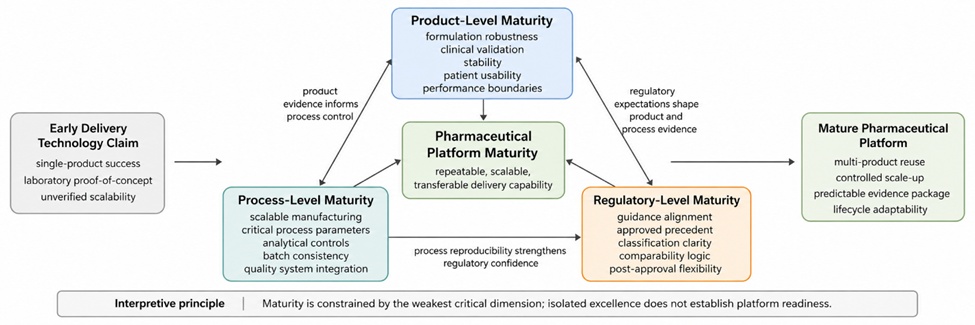
Figure 1. Co-Evolutionary Logic of Pharmaceutical Platform Maturity across Product, Process, and Regulatory Readiness Dimensions
A scalable drug delivery platform must be distinguished from a successful single-product formulation by its capacity for repeatable adaptation. Modularity is the first criterion because platform technologies require design elements that can be recombined or adjusted without destabilising the entire system. This logic is visible in lipid nanoparticle systems, where ionisable lipids, helper lipids, cholesterol, PEG-lipids, cargo properties, and manufacturing conditions jointly define performance, and in polymeric nanoparticles, where material choice and architecture determine drug loading, release, and stability [5, 28, 29].
Multi-drug compatibility is the second criterion because a platform cannot be considered mature if each new active substance requires a fundamentally new delivery logic. Polymeric micelles, long-acting injectables, microneedle patches, and RNA lipid nanoparticles all show that compatibility depends on physicochemical properties, dose requirements, release duration, route of administration, and patient-facing usability [3, 11, 20, 30]. A scalable platform must therefore demonstrate a bounded but meaningful range of applicability rather than unlimited universality.
Manufacturing robustness is the third criterion because platform value collapses if laboratory performance cannot be reproduced at development, clinical, and commercial scales. Scalable manufacturing requires controlled input materials, stable process parameters, validated analytical methods, and quality systems capable of detecting variability before it becomes product failure [13, 15, 23]. In this sense, scalable delivery technology is not defined only by therapeutic effect but also by the ability to preserve critical quality attributes through repeated production cycles.
Regulatory pathway clarity is the fourth criterion because platforms mature through evidence that can be interpreted consistently by developers and agencies. Table 2 defines the essential and desirable criteria that characterise a scalable drug delivery platform. These criteria are especially important for technologies such as microneedles, long-acting systems, and RNA delivery platforms, where regulatory confidence depends on the integration of product performance, manufacturing control, safety monitoring, and precedent [16, 21, 26].
Table 2. Scalable Delivery Technology Criteria: Design, Manufacturing, and Regulatory Prerequisites
Criterion | Essential requirement | Desirable maturity feature | Relevance to platform assessment |
Modular design | Core components can be adjusted without redesigning the full system | Defined design rules for substituting materials, cargos, doses, or release profiles | Indicates whether the technology can support repeated product development |
Multi-drug compatibility | Platform can accommodate more than one drug substance or therapeutic class within defined boundaries | Predictive compatibility rules based on physicochemical, biological, and clinical constraints | Distinguishes platform capability from single-product optimisation |
Manufacturing robustness | Process can reproduce critical quality attributes at relevant batch sizes | Automated, monitored, and scalable production with validated analytical controls | Links platform claims to commercial feasibility |
Quality consistency | Batch-to-batch variability is measured, controlled, and justified | Established control strategy with lifecycle monitoring and comparability logic | Supports confidence in repeated production and post-approval change |
Supply chain simplicity | Materials, equipment, and process inputs are available and manageable | Multiple qualified suppliers and resilient sourcing strategy | Reduces dependence on fragile or bespoke inputs |
Regulatory pathway clarity | Evidence requirements and classification logic are reasonably predictable | Prior approvals, agency feedback, or platform designation support transferability | Indicates whether future products can use accumulated knowledge |
Patient and clinical usability | Delivery route, dosing frequency, administration burden, and safety profile are acceptable | Demonstrated adherence, preference, or implementation advantages | Ensures that scalability includes real clinical adoption, not only manufacturing scale |
Product-level maturity concerns the ability of a platform to generate clinically credible products with reproducible performance. Indicators include formulation stability, dose accuracy, release control, biodistribution, safety margin, therapeutic effect, and patient acceptability. Nanoparticle translation studies show that early technical promise often weakens when biological complexity, safety expectations, and clinical practicality are introduced [9, 10].
For lipid nanoparticles, product maturity depends on the relationship between cargo type, particle composition, structure, stability, immune response, tissue distribution, and therapeutic objective. mRNA delivery has demonstrated strong platform potential, but different cargos and indications may require new evidence for potency, durability, tolerability, and storage stability [5, 6, 8, 27]. Product maturity is therefore strongest when prior knowledge can reasonably predict performance without eliminating the need for product-specific validation.
Process-level maturity concerns the ability to manufacture the delivery platform reproducibly and economically while maintaining predefined quality attributes. For RNA lipid nanoparticles, microfluidic production and throughput-scalable manufacturing demonstrate how process architecture can either enable or constrain platform expansion [23, 24]. For PLGA particles and long-acting systems, process parameters, polymer properties, and release kinetics must be controlled together because small manufacturing changes can alter therapeutic performance [25, 31].
Regulatory-level maturity concerns the degree to which evidence standards, classification pathways, prior approvals, and lifecycle management expectations are sufficiently established. Regulatory maturity may arise from approved products, agency experience, formal designation mechanisms, or accumulated comparability evidence [17, 26]. However, a platform may still have low regulatory maturity if each new product raises unresolved questions about mechanism, safety, substitutability, or manufacturing change.
Table 3 summarises the indicators for maturity at the product, process, and regulatory levels. The table treats maturity as a diagnostic profile rather than a simple score, because strong performance in one dimension does not compensate automatically for weakness in another [14, 15, 19]. This approach is intended to prevent premature platform claims based only on technical novelty, single-product approval, or successful scale-up.
Table 3. Indicators of Platform Maturity across Product, Process, and Regulatory Dimensions
Maturity dimension | Core question | Indicative maturity markers | Signs of immaturity |
Product-level maturity | Can the platform generate safe, effective, stable, and usable products? | Clinical validation, formulation robustness, stability data, acceptable safety profile, patient usability evidence, defined performance limits | Single-product evidence only, unstable formulation, uncertain release behaviour, limited patient acceptability data |
Process-level maturity | Can the platform be manufactured reproducibly and scaled without losing quality? | Controlled critical process parameters, validated analytical methods, scalable equipment, batch consistency, automation, quality system integration | Manual or fragile production, poor batch comparability, uncertain scale-up, limited process monitoring |
Regulatory-level maturity | Can the platform be evaluated through predictable evidence standards? | Prior approvals, agency feedback, guidance alignment, platform designation potential, comparability pathway, post-approval change logic | Unclear classification, limited precedent, uncertain evidence expectations, weak lifecycle control |
Cross-dimensional maturity | Do product, process, and regulatory evidence support each other? | Coherent evidence package, transferable prior knowledge, defined risk boundaries, transparent residual uncertainty | Mature product but fragile process, robust process but limited clinical evidence, precedent without transferability |
Platform-level conclusion | Is repeatable multi-product development credible? | Demonstrated adaptability across products, indications, or manufacturing contexts within defined limits | Bespoke optimisation for each product, undefined design space, overstated transferability |
The Pharmaceutical Platform Maturity Model defines five maturity levels: Concept, Proof-of-Concept, Validated, Industrialised, and Commoditised. The Concept level captures technologies with plausible scientific logic but limited integrated evidence, while Proof-of-Concept describes platforms with early demonstration of product function and preliminary manufacturability. These lower levels are common in nanomedicine and advanced delivery research, where promising laboratory data may precede scalable production and regulatory clarity [4, 9, 10].
The Validated level describes a platform with credible product evidence, defined process controls, and an emerging regulatory pathway. At this stage, the technology is no longer only experimental, but it may still require product-specific evidence and careful risk management before broad platform use can be claimed. Many RNA delivery systems, polymeric carriers, microneedle systems, and long-acting technologies occupy transitional positions because their scientific foundations are strong but their transferability varies by cargo, indication, route, and manufacturing process [7, 21, 27, 30].
The Industrialised level describes a platform that can support repeated development under controlled manufacturing and quality systems. At this level, platform knowledge is embedded in process design, analytical methods, supplier qualification, comparability logic, and lifecycle management. The experience of mRNA lipid nanoparticle manufacturing shows that industrialisation requires more than formulation success; it requires production throughput, process reproducibility, stability management, and quality infrastructure [8, 23, 24].
The Commoditised level represents the highest degree of maturity, where the platform is widely understood, supported by repeated precedent, governed by predictable evidence standards, and usable by multiple organisations under established design rules. Few advanced drug delivery systems fully reach this level because biological performance, material complexity, regulatory expectations, and product-specific risks often remain substantial [18, 26, 29]. Commoditisation should therefore be treated as a high threshold rather than a marketing label.
Table 4 presents the integrated Pharmaceutical Platform Maturity Model with maturity levels, criteria, and scoring logic. The model can be applied by assigning separate maturity judgements for product, process, and regulatory dimensions, then interpreting the overall platform profile according to the weakest critical dimension rather than averaging away major gaps [14, 15]. This scoring logic preserves the central principle that platform maturity requires alignment, not isolated excellence.
Table 4. Pharmaceutical Platform Maturity Model: Levels, Cross-Dimensional Criteria, and Assessment Rubric
Maturity level | Product maturity descriptor | Process maturity descriptor | Regulatory maturity descriptor | Assessment interpretation |
Level 1: Concept | Scientific rationale and preliminary design logic exist, but product performance is unproven | Manufacturing route is hypothetical, manual, or exploratory | Regulatory pathway is unclear or assumed | Platform claim is speculative and requires foundational evidence |
Level 2: Proof-of-Concept | Early formulation or device performance is demonstrated in limited models or early studies | Small-scale process can produce test materials but lacks robust control | Initial regulatory considerations are identified but not tested | Platform claim is plausible but not yet development-ready |
Level 3: Validated | Product performance, stability, safety, or usability is supported by meaningful evidence | Critical process parameters and analytical controls are defined | Regulatory classification and evidence expectations are emerging | Platform can support focused development within defined boundaries |
Level 4: Industrialised | Multiple product-relevant applications are supported by robust performance evidence | Scalable, reproducible, quality-controlled manufacturing is established | Prior feedback, approvals, or comparability logic support development planning | Platform can support repeated product development under controlled conditions |
Level 5: Commoditised | Product design rules are widely transferable across defined drug or indication classes | Manufacturing and quality systems are standardised, resilient, and broadly deployable | Regulatory expectations are predictable and supported by repeated precedent | Platform functions as a mature pharmaceutical infrastructure |
Scoring logic | Score each dimension separately from 1 to 5 | Identify the weakest dimension as the primary maturity constraint | Record uncertainty and evidence gaps explicitly | Use the profile to guide development priorities rather than to produce a simplistic ranking |
Figure 2 presents the Pharmaceutical Platform Maturity Model as a five-level maturity ladder in which each stage must be interpreted across product, process, and regulatory dimensions.
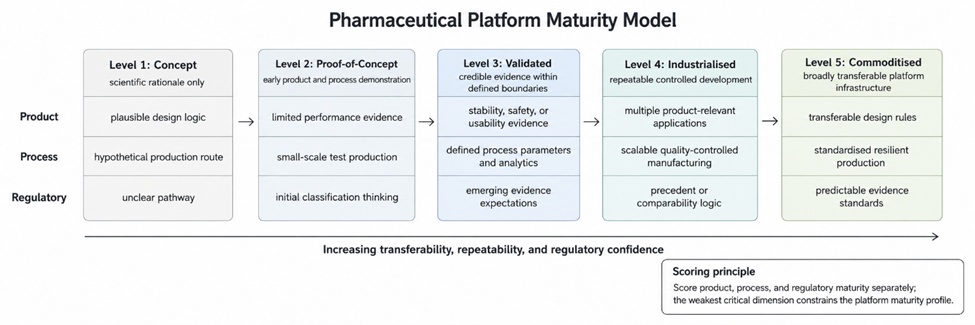
Figure 2. Five-Level Pharmaceutical Platform Maturity Model from Concept to Commoditised Platform Across Three Assessment Dimensions
The mRNA lipid nanoparticle platform illustrates why maturity must be interpreted across product, process, and regulatory dimensions simultaneously. The COVID-19 vaccine experience demonstrated strong product and industrialisation potential, but broader use for different RNA cargos, tissues, diseases, and dosing schedules still requires careful evaluation of formulation transferability, immune effects, biodistribution, and stability [5-8]. Under the proposed model, mRNA-LNPs would not be treated as universally commoditised; instead, their maturity would be high within validated application boundaries and lower where biological or regulatory uncertainty remains.
Long-acting injectable and implantable systems illustrate a different maturity pattern. Some long-acting technologies have substantial clinical and commercial experience, but platform transferability is limited by drug loading, polymer degradation, release kinetics, injection volume, local tolerability, and patient preference [11, 12, 30]. Under the model, these systems may show strong product maturity in specific therapeutic areas and strong process maturity for established materials, while regulatory maturity depends on how clearly prior knowledge applies to new molecules and dosing objectives.
Oral peptide delivery and other difficult delivery technologies demonstrate that high clinical need does not automatically equal platform maturity. A technology may offer transformative value if it can solve permeability, stability, absorption variability, and dosing burden, but its maturity remains limited until product performance, manufacturing reproducibility, and regulatory interpretation are sufficiently predictable. The same caution applies to microneedle platforms, where promising usability and delivery advantages must be matched by manufacturing control, dose uniformity, mechanical reliability, and regulatory clarity [16, 20, 21].
The model could be validated prospectively through expert elicitation and retrospectively through structured case analysis. Expert panels could score selected platforms across the three dimensions, compare maturity profiles, and test whether the model improves agreement among developers, investors, and regulatory scientists [19, 18]. Retrospective analysis could examine whether platforms that later achieved broader deployment showed earlier alignment among product evidence, process control, and regulatory precedent than technologies that remained confined to single-product or experimental use.
Figure 3 maps how the proposed maturity model can be applied to representative delivery-platform use cases and validated through expert elicitation and retrospective case analysis.
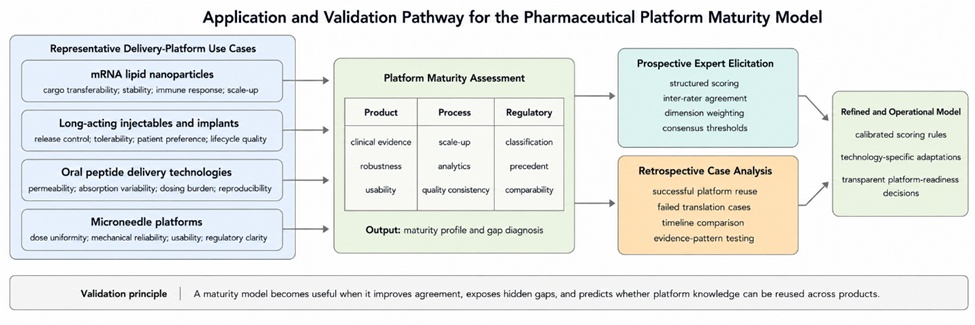
Figure 3. Application and Validation Pathway for the Pharmaceutical Platform Maturity Model across Representative Drug Delivery Use Cases
The first limitation is that the proposed model is qualitative and conceptual rather than empirically validated. It organises evidence from pharmaceutical technology, technology readiness, manufacturing readiness, and regulatory science, but it does not yet provide statistically derived weights or validated scoring thresholds. Future work would need to test whether maturity scores correlate with development timelines, approval probability, manufacturing success, or platform reuse.
The second limitation is that scoring may be subjective, especially when evidence is incomplete or when platform boundaries are disputed. Developers may overestimate transferability, investors may emphasise commercial scalability, and regulators may focus on uncertainty that is invisible in technical maturity claims. To reduce this risk, the model should be used as a structured deliberation tool rather than as a purely numerical ranking system.
The third limitation is that rapidly evolving technologies may require adaptation of the framework. Lipid nanoparticle systems, polymeric carriers, microneedle patches, long-acting injectables, and RNA delivery platforms are changing quickly as new materials, manufacturing methods, analytics, and regulatory mechanisms emerge. The model should therefore be treated as a living conceptual framework that can incorporate new evidence and platform categories without abandoning its central product-process-regulatory logic.
This article proposed the Pharmaceutical Platform Maturity Model as a conceptual framework for defining and assessing maturity in scalable drug delivery technologies. Its central contribution is to shift platform assessment away from single-axis readiness and toward an integrated interpretation of product, process, and regulatory maturity. This approach clarifies why a technology can be promising, clinically successful, manufacturable, or approved without yet being a mature platform.
The model provides a common language for developers, investors, regulators, and researchers who need to evaluate whether a drug delivery technology can support repeated development beyond a single product. By defining scalability criteria, maturity indicators, and a five-level assessment rubric, it offers a structured way to identify gaps, prioritise evidence generation, and communicate platform risk. Its value lies not in replacing expert judgement but in making that judgement more transparent and comparable.
Future work should operationalise the model through expert consensus, retrospective case studies, and prospective application to emerging delivery platforms. Quantitative scoring systems, evidence-weighting rules, and technology-specific adaptations may strengthen its practical utility. As pharmaceutical innovation increasingly depends on reusable delivery infrastructures, a more disciplined language of platform maturity will become essential for responsible translation, investment, and regulation.
None
None
None
None
Open Access The author(s) retain copyright. This article is licensed under the Creative Commons Attribution-NonCommercial-ShareAlike 4.0 International License. It may be shared and adapted for non-commercial purposes with appropriate attribution, an indication of changes, and distribution of adaptations under the same license. Third-party material may be subject to separate terms identified in its credit line. View the license at https://creativecommons.org/licenses/by-nc-sa/4.0/.
 Publication System