The pharmaceutical industry is entering a period of accelerated digital transformation, driven by real-time sensing, automation, digital twins, advanced analytics, and connected healthcare technologies. Yet this transformation remains uneven across the pharmaceutical value chain. Manufacturing systems, quality systems, distribution infrastructures, and patient-facing technologies often evolve as separate digital domains rather than as components of one connected cyber-physical enterprise. This fragmentation limits the capacity of pharmaceutical organizations to use data as a continuous operational resource. A manufacturing line may generate rich process data, a quality system may generate release decisions, a distribution network may generate environmental and traceability records, and a connected device may generate adherence or use data, but these signals are rarely integrated into a unified architecture. As a result, the industry remains only partially able to close the loop between product design, production, delivery, use, and real-world performance. The objective of this article is to propose an integrated cyber-physical system architecture that links pharmaceutical manufacturing, quality control, distribution, and patient use into a coherent technical framework. The proposed architecture treats the pharmaceutical product not only as a manufactured physical object but also as a data-linked therapeutic system. In this view, quality, traceability, and patient performance are co-produced through connected material, digital, and process flows. The article develops a systems-architecture perspective rather than an empirical study. It synthesises peer-reviewed literature on Pharma 4.0, continuous manufacturing, process analytical technology, digital twins, real-time release, blockchain traceability, cold-chain monitoring, smart packaging, connected drug delivery devices, and digital adherence monitoring. These domains are integrated into a four-layer architecture that connects factory operations to patient-facing use environments. The proposed framework defines four architectural layers: manufacturing, quality control, distribution, and patient use. It then specifies the data, material, and process flows required to connect these layers into a continuous cyber-physical loop. Five tables are used to clarify the architecture problem, the manufacturing layer, the patient-use layer, the end-to-end flows, and the proposed integrated architecture. A pharmaceutical cyber-physical system spanning from raw material to patient outcome represents a potential next frontier in drug product quality, supply chain resilience, and personalised therapy. Such a system would require coordinated action across manufacturers, technology providers, healthcare systems, regulators, and patients. Its value lies not only in automation, but in the creation of a connected pharmaceutical enterprise capable of learning from every stage of the product lifecycle.
Pharmaceutical digitalisation has increasingly been framed through the language of Pharma 4.0, which extends Industry 4.0 concepts into regulated drug development, manufacturing, and quality environments. Ding describes Pharma Industry 4.0 as a shift toward sustainable, digitally connected pharmaceutical supply chains, while Reinhardt, Oliveira, and Ring position the pharmaceutical sector within a broader industrial transition toward integrated data, automation, and intelligent systems [1, 2]. In this context, the cyber-physical system is not merely an information technology layer placed above production, but a coordinated architecture in which physical operations and digital models continuously inform each other.
The pharmaceutical relevance of cyber-physical systems becomes especially clear in continuous manufacturing and digitally enabled production environments. Digital twins, advanced process control, residence time distribution modelling, and real-time material tracking have shown how physical unit operations can be represented, monitored, and controlled through computational structures [3-5]. These developments suggest that the factory floor can become a continuously sensed and computationally interpretable environment rather than a sequence of isolated equipment operations.
However, current pharmaceutical digitalisation remains largely segmented across operational domains. Manufacturing digital twins may be developed independently of quality decision systems, distribution traceability platforms may be separated from production records, and patient-facing connected devices may generate data that rarely informs upstream product or process learning [3, 6]. This separation creates a gap between the promise of Pharma 4.0 and the reality of an end-to-end pharmaceutical cyber-physical enterprise.
The objective of this article is to propose a systems architecture for a pharmaceutical cyber-physical system that connects manufacturing, quality control, distribution, and patient use. The framework builds on literature concerning digital twins in pharmaceutical manufacturing, PAT-enabled monitoring, continuous process verification, material tracking, supply chain traceability, and connected drug delivery technologies [3, 4, 6, 7]. It argues that the next architectural step is not simply to digitise each layer separately, but to connect the layers through interoperable data, material identity, quality, and patient-use feedback loops.
The central architecture problem is that pharmaceutical systems are often digitally advanced within individual functions but poorly connected across the full value chain. Manufacturing lines may contain in-line sensors and automated controls, yet their data may not be structurally connected to distribution records or patient-use feedback [6, 7]. Ding’s analysis of pharmaceutical supply chains highlights the need for sustainability and integration, while Reinhardt, Oliveira, and Ring show that Industry 4.0 adoption in pharma remains a complex organisational and technical transition rather than a simple technology upgrade [1, 2].
This fragmentation creates quality blind spots because product performance is shaped by events that occur across multiple stages, not only at release testing. For example, continuous manufacturing studies show that residence time distribution and material tracking are essential for connecting process history to product identity, yet those signals may lose value if they are not linked to downstream quality and logistics data [4, 5, 8]. In a fragmented architecture, the digital thread is interrupted precisely where systemic interpretation is needed.
Distribution adds another layer of architectural discontinuity. Blockchain-enabled pharmaceutical supply chain studies and Internet-of-Things-based monitoring systems show that traceability, temperature monitoring, and counterfeit prevention can strengthen supply chain integrity [9, 10]. Yet these systems are often implemented as logistics or anti-counterfeiting tools rather than as components of a broader pharmaceutical CPS that also includes manufacturing history, quality status, and patient-facing performance.
Patient use represents the most distant but potentially most informative layer of the pharmaceutical lifecycle. Connected inhalers, ingestible sensors, and adherence monitoring systems can reveal whether a product is being used correctly and whether therapeutic delivery is occurring as intended [11, 12]. Table 1 summarises the current fragmentation across manufacturing, quality, distribution, and patient use, and the resulting systemic risks.
Table 1. Architecture Problem: Fragmentation in the Pharmaceutical Cyber-Physical Value Chain
Value-chain domain | Typical digital capability | Main fragmentation point | Resulting systemic risk | CPS architecture requirement |
Manufacturing | Sensors, automated equipment, digital twins, material tracking | Process data often remain inside production and engineering systems | Weak linkage between process history, product identity, and downstream performance | Persistent digital thread from raw material to finished product |
Quality control | PAT, in-line monitoring, real-time release tools, statistical control | Quality decisions may be disconnected from distribution and patient-use data | Release decisions remain product-centred rather than lifecycle-centred | Quality data fabric linking process, release, stability, logistics, and use |
Distribution | Serialisation, blockchain traceability, cold-chain monitoring, smart packaging | Traceability systems often operate separately from manufacturing and clinical-use feedback | Counterfeit, temperature, and handling risks are detected late or not linked to product history | Integrated logistics layer connected to product genealogy and quality status |
Patient use | Smart inhalers, connected injectors, ingestible sensors, adherence platforms | Real-world use data rarely flow back into manufacturing and quality systems | Missed opportunity to learn from adherence, misuse, device behaviour, and outcome signals | Patient feedback loop linked to product lifecycle management |
Enterprise governance | Data platforms, quality management systems, cybersecurity controls | Governance is usually function-specific rather than architecture-wide | Inconsistent data integrity, validation, ownership, and interoperability | End-to-end governance across material, data, process, and patient interfaces |
A pharmaceutical cyber-physical system can be understood as a regulated technical architecture in which physical processes, digital representations, control logic, and decision systems are continuously coupled. Digital twins in pharmaceutical and biopharmaceutical manufacturing exemplify this logic by using computational representations to mirror and support real physical processes [3]. In the CPS view, data do not merely document production after the fact; they participate in monitoring, prediction, control, and continuous improvement.
The physical side of the pharmaceutical CPS includes raw materials, unit operations, equipment states, environmental conditions, packaging states, distribution conditions, and patient-use events. The digital side includes sensor data, process models, residence time distributions, quality attributes, traceability records, device-use logs, and feedback analytics [4, 5]. The architectural challenge is to ensure that these physical and digital elements are not connected only locally, but are linked through a coherent end-to-end structure.
The control logic of the CPS depends on the conversion of real-time measurements into actionable decisions. PAT tools and continuous process verification make this possible by transforming process signals into quality-relevant knowledge during manufacturing rather than after completion [6, 7]. Digital real-time release testing extends this logic by treating quality as a continuously evaluated state rather than a delayed laboratory verdict [13].
The systems logic also requires feedback across layers and timescales. Short-cycle feedback may adjust a blending, drying, granulation, tableting, or capsule-filling process, while longer-cycle feedback may update models, specifications, distribution controls, device design, or patient support pathways [14-16]. A pharmaceutical CPS therefore functions as both an operational control system and a lifecycle learning system.
Figure 1 presents the core cyber-physical logic by showing how physical pharmaceutical operations, digital representations, control decisions, and lifecycle feedback form a closed system from manufacturing to patient use.
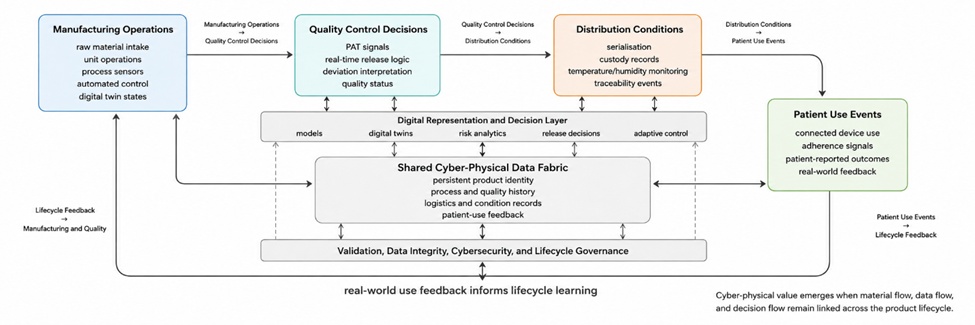
Figure 1. Cyber-Physical System Logic for a Connected Pharmaceutical Value Chain
The manufacturing layer is the physical and computational foundation of the pharmaceutical CPS because it generates the product, the process history, and the first structured data objects in the lifecycle. In digitally enabled pharmaceutical manufacturing, sensors, automated equipment, material tracking systems, and model-based control tools convert unit operations into monitored and interpretable cyber-physical processes [4, 6]. This layer must therefore capture not only whether a product was made, but how material moved, transformed, and acquired its quality attributes.
Digital twins provide one of the most important architectural mechanisms within the manufacturing layer. Chen and colleagues frame digital twins as computational counterparts for pharmaceutical and biopharmaceutical manufacturing, while later work extends the concept into adjuvant manufacturing, lyophilisation, and broader pharmaceutical process development [3, 14, 16]. These examples show that digital twins can support process understanding, prediction, optimisation, and control when they are connected to reliable process measurements.
Material tracking is equally important because pharmaceutical production requires traceability between material identity, process exposure, and final product state. Studies on residence time distribution and material tracking in continuous manufacturing and capsule-filling processes show how flow history can be linked to product genealogy and quality interpretation [4, 5, 8]. Without such tracking, the CPS would sense equipment and process states but remain unable to assign those states precisely to product units or lots.
Automated control completes the manufacturing layer by translating sensed states and model predictions into process interventions. Data-driven model predictive control and advanced digital twin strategies indicate how pharmaceutical manufacturing can move from monitoring toward adaptive and predictive operation [15, 17]. Table 2 outlines the key cyber-physical components and data flows within the manufacturing layer.
Table 2. Manufacturing Layer Architecture: Sensors, Actuators, Control Systems, and Digital Twin Integration
Manufacturing component | Physical function | Digital function | Primary data produced | CPS role |
Raw material intake and dispensing | Receives, weighs, and stages active ingredients and excipients | Creates material identity and genealogy records | Supplier identity, batch identity, quantity, environmental exposure, dispensing record | Initiates the digital thread and material genealogy |
Process sensors and PAT instruments | Measure process and product attributes during unit operations | Convert physical states into quality-relevant signals | Spectral data, moisture, particle size, content uniformity, temperature, pressure, torque | Enables real-time monitoring and process understanding |
Automated equipment and actuators | Executes mixing, granulation, drying, compression, coating, filling, or lyophilisation | Receives control instructions and records equipment state | Set-points, actuator positions, alarms, equipment status, intervention history | Provides the physical control surface of the CPS |
Residence time and material tracking systems | Track material movement through continuous or semi-continuous processes | Links process history to product identity | Flow history, residence time distribution, material-location mapping | Connects process exposure to product genealogy |
Digital twin models | Represent manufacturing processes computationally | Predict process behaviour, quality outcomes, and intervention effects | Model states, predictions, deviations, updated parameters | Supports simulation, optimisation, control, and lifecycle learning |
Supervisory control and model predictive control | Coordinates process control decisions | Translates sensor and model outputs into control actions | Control decisions, predicted trajectories, deviation responses | Closes the cyber-physical loop at the manufacturing layer |
The quality control layer converts manufacturing signals into product assurance decisions and therefore occupies a central position in the pharmaceutical CPS. In a conventional architecture, quality control is often treated as a separate evaluative function that verifies product acceptability after manufacturing. In a cyber-physical architecture, PAT, continuous process verification, and model-based quality assessment allow quality to be interpreted during production rather than only after product completion [6, 7].
Real-time release testing is the most direct expression of this quality-control transformation. Celikovic and colleagues describe digital real-time release testing in continuous tablet manufacturing as a strategy that depends on real-time data, process understanding, and digitally structured quality decisions [13]. In the proposed CPS, real-time release is not only a testing method but an architectural interface between manufacturing execution, digital quality systems, and downstream distribution readiness.
The quality control layer also depends on multivariate interpretation because pharmaceutical quality attributes emerge from interactions among material properties, process parameters, equipment behaviour, and environmental conditions. PAT implementation for advanced process control illustrates how analytical tools must be embedded within control strategies rather than treated as isolated measurement devices [7]. This means that the quality layer must maintain traceable links between sensor readings, models, specifications, alarms, deviations, and release decisions.
Automated quality decisions must remain governable, explainable, and auditable within regulated pharmaceutical systems. Digital twin approaches and predictive control can improve quality prediction, but they also create a need for model lifecycle management, data integrity controls, and validated decision pathways [3, 15, 17]. The quality control layer therefore acts as both a decision engine and a regulatory memory system, preserving the evidence that connects process behaviour to product acceptability.
The distribution layer extends the CPS beyond the factory by preserving product identity, environmental integrity, and traceability during movement through the supply chain. Blockchain-enabled pharmaceutical cold-chain studies show that distributed ledgers and sensor-linked records can support product authentication, temperature monitoring, and supply-chain transparency [9]. In an integrated architecture, these functions must be linked to upstream manufacturing genealogy and quality status rather than treated as separate logistics records.
Serialisation, track-and-trace systems, and Internet-of-Things monitoring provide the basic digital infrastructure for connecting physical products to distribution data. Singh, Dwivedi, and Srivastava describe an IoT-based blockchain approach for temperature monitoring and counterfeit prevention, while Sim, Zhang, and Chang focus on end-to-end traceability and supply-chain resilience [10, 18]. These approaches show that distribution data can become part of the pharmaceutical product’s cyber-physical history when identity, location, custody, and environmental exposure are persistently recorded.
The distribution layer should also support adaptive supply-chain decisions when risk signals emerge. Systematic work on blockchain-enabled supply-chain traceability and secure pharmaceutical supply chains suggests that transparency, interoperability, and trust are central to resilient distribution systems [19, 20]. In the proposed CPS, a temperature excursion, suspected counterfeit event, delayed shipment, or abnormal handling pattern should not remain a logistics exception only; it should update quality risk assessment and downstream patient-use guidance.
The patient use layer is the final physical interface of the pharmaceutical CPS and the first point at which product performance can be observed in real-world use. Connected inhalers, digital adherence platforms, ingestible sensors, and smart drug delivery systems demonstrate that patient-facing technologies can generate clinically relevant signals about medication use, timing, technique, and persistence [11, 12]. This layer transforms the patient environment from an informational endpoint into a feedback-generating component of the pharmaceutical architecture.
Smart inhalers illustrate the architectural importance of patient-use data because they can record use events that are invisible to manufacturing and distribution systems. Zabczyk and Blakey discuss the effect of connected smart inhalers on medication adherence, while Garin and colleagues evaluate the clinical impact of electronic monitoring devices for inhalers in adults with asthma or chronic obstructive pulmonary disease [11, 21]. These studies indicate that adherence and device-use data can provide evidence about whether product availability actually translates into correct therapeutic use.
Digital patient-use systems must be interpreted carefully because adherence, device activation, and patient-reported outcomes are not equivalent to pharmacological efficacy. Aung and colleagues describe digital remote maintenance inhaler adherence interventions, and Chai and colleagues review ingestible electronic sensors for instantaneous medication adherence measurement [12, 22]. In the proposed CPS, patient-use data should therefore be treated as structured feedback for lifecycle learning, not as a simplistic proxy for therapeutic success.
The patient use layer closes the pharmaceutical CPS by generating signals that can flow back to product design, manufacturing control, quality strategy, and distribution planning. Ingestible sensors and smart drug delivery systems show how adherence evidence, device behaviour, and use-context data may reveal mismatches between manufactured product design and real-world use [23, 24]. Table 3 maps the patient-use layer components and their feedback connections to the broader CPS.
Table 3. Patient Use Layer Architecture: Connected Devices, Adherence Monitoring, and Feedback Loops
Patient-use component | Physical or behavioural event captured | Digital signal generated | Feedback destination | Architectural value |
Connected inhalers | Dose actuation, inhalation timing, use frequency, possible technique-related events | Time-stamped device-use records and adherence patterns | Clinical support systems, product lifecycle teams, quality risk review | Links drug availability to real-world medication-taking behaviour |
Smart injectors and connected pumps | Dose delivery, injection timing, device status, delivery completion | Delivery confirmation, missed-dose alerts, device performance logs | Device engineering, pharmacovigilance, patient support systems | Connects device function to therapy execution |
Ingestible sensors | Medication ingestion event or sensor-triggered confirmation | Ingestion confirmation, timing record, adherence trend | Digital health platform, clinical monitoring, lifecycle analytics | Provides direct evidence of medication-taking events |
Patient-facing applications | Reminders, symptom entries, patient-reported outcomes, education interactions | Reported outcomes, engagement data, symptom trajectories | Care teams, product-support programmes, real-world evidence systems | Adds patient context to device and adherence data |
Feedback analytics | Pattern recognition across use, non-use, misuse, and outcomes | Aggregated behavioural and outcome signals | Manufacturing strategy, quality review, distribution planning, formulation redesign | Enables patient-informed CPS learning |
Privacy and consent controls | Patient authorization and data-sharing preferences | Consent status, access rights, use limitations | Governance layer, cybersecurity layer, data platform | Protects patient trust and lawful data use |
The pharmaceutical CPS depends on the alignment of three flows: material flow, data flow, and process-decision flow. Material flow begins with raw ingredients and continues through manufacturing, packaging, distribution, dispensing, and patient use, while data flow records the identity, condition, quality status, and use history of the product [4, 5]. Process-decision flow connects these records to control actions, release decisions, logistics interventions, and lifecycle improvements.
A key architectural principle is that material identity should remain linked to quality evidence throughout the value chain. Residence time distribution studies and material tracking methods show how manufacturing history can be connected to product units in continuous processes [4, 5, 8]. When this identity is extended through serialisation, blockchain traceability, and environmental monitoring, the product becomes a cyber-physical object with a persistent quality and custody history [9, 10, 18].
The return flow from patient use to enterprise learning is what distinguishes a fully integrated pharmaceutical CPS from a digitally enhanced supply chain. Connected devices, electronic monitoring, ingestible sensors, and digital adherence systems can generate feedback about whether products reach patients, are used correctly, and fit real-world routines [11, 12, 21-24]. Table 4 defines the data, material, and process flows across all four layers.
Table 4. End-to-End Data, Material, and Process Flows in the Pharmaceutical CPS
Flow type | Origin | Direction across layers | Main information or material carried | CPS function |
Raw material flow | Suppliers and material intake | Manufacturing to quality control | Active ingredients, excipients, material certificates, intake records | Establishes material identity and starting conditions |
Process material flow | Manufacturing unit operations | Manufacturing to packaging and release | Intermediate and final product units with process exposure history | Links physical transformation to product genealogy |
Quality data flow | PAT, in-line sensors, laboratory systems, release models | Manufacturing to quality control and distribution | Critical quality attributes, deviations, model predictions, release status | Supports real-time assurance and release readiness |
Distribution data flow | Serialisation, logistics systems, environmental sensors | Distribution to quality and patient-use layers | Location, custody, temperature, humidity, handling, delivery status | Preserves product integrity and traceability after release |
Patient-use data flow | Connected devices, apps, ingestible sensors, adherence platforms | Patient use back to quality, manufacturing, and lifecycle teams | Dose events, adherence patterns, device behaviour, reported outcomes | Enables real-world feedback and lifecycle learning |
Governance flow | Enterprise data platform and quality systems | Across all layers | Access rights, audit trails, validation status, cybersecurity controls | Maintains integrity, accountability, and regulatory confidence |
Adaptive process-decision flow | Analytics, digital twins, quality review, supply-chain risk systems | Backward and forward across the architecture | Control recommendations, risk updates, model changes, improvement actions | Converts data into controlled CPS adaptation |
The proposed architecture consists of four interdependent layers connected by a shared data fabric, persistent product identity, and governed cyber-physical interfaces. The manufacturing layer generates the product and its process history, the quality control layer interprets quality status, the distribution layer preserves identity and condition, and the patient use layer generates real-world use feedback [1, 3, 9, 11]. The architecture is therefore not a linear pipeline, but a connected lifecycle system.
The central data fabric is the main integrative mechanism of the proposed CPS. It should connect manufacturing execution data, PAT outputs, digital twin states, release decisions, serialisation records, environmental logistics data, device-use records, and patient-facing signals [3, 6, 7, 10, 12]. This does not require every system to be merged into one monolithic platform; it requires interoperable data structures, controlled interfaces, common identifiers, and validated data exchange.
Closed-loop quality emerges when signals from one layer can update risk interpretation in another layer. For example, a manufacturing deviation may affect distribution release conditions, a cold-chain excursion may trigger quality reassessment, and patient-use anomalies may inform device design or product-support strategies [9, 13, 22]. In this architecture, quality is not confined to the moment of batch release but is maintained as a continuously updated lifecycle state.
Governance must be embedded within the architecture rather than added after technical integration. The CPS must define who can access data, how models are validated, how digital twins are updated, how cybersecurity risks are controlled, and how patient privacy is protected [2, 15, 20]. Table 5 presents the proposed integrated architecture with its layers, interfaces, and governance.
Table 5. Proposed Integrated Cyber-Physical Architecture for Pharmaceutical Manufacturing, Quality, Distribution, and Patient Use
Architecture layer | Core physical components | Core digital components | Interfaces with other layers | Governance requirement |
Manufacturing layer | Raw material systems, unit operations, equipment, actuators, packaging lines | PAT data, equipment states, residence time models, digital twins, control algorithms | Sends process history and product genealogy to quality and distribution layers | Validated models, equipment data integrity, change control, audit trails |
Quality control layer | In-line testing points, laboratory confirmation systems, inspection systems | Real-time release models, quality dashboards, deviation records, release decisions | Receives manufacturing data and sends quality status to distribution and lifecycle systems | Quality decision traceability, model validation, release accountability |
Distribution layer | Packaging, serialised product units, warehouses, transport systems, cold-chain equipment | Track-and-trace records, blockchain ledgers, environmental monitoring, custody logs | Receives release status and sends logistics risk signals to quality and patient-use systems | Chain-of-custody integrity, anti-counterfeit controls, environmental data reliability |
Patient use layer | Connected inhalers, injectors, pumps, ingestible sensors, patient interfaces | Adherence records, device-use logs, patient-reported outcomes, engagement data | Sends real-world use feedback to lifecycle, quality, and manufacturing systems | Consent, privacy, cybersecurity, ethical data use |
Enterprise data fabric | Product identifiers, master data, data lakes or platforms, interoperability services | Common identifiers, APIs, analytics, model repositories, access controls | Connects all layers without erasing local system functions | Data integrity, interoperability validation, role-based access, lifecycle governance |
Adaptive governance layer | Quality management, regulatory affairs, cybersecurity, clinical safety, supply-chain governance | Audit trails, validation evidence, model-change records, risk dashboards | Controls how signals become decisions across the CPS | Regulatory readiness, accountability, predetermined change logic, continuous assurance |
Figure 2 illustrates the proposed integrated pharmaceutical cyber-physical architecture by mapping the four operational layers, their shared data fabric, and the governance mechanisms required to connect manufacturing, quality, distribution, and patient use.
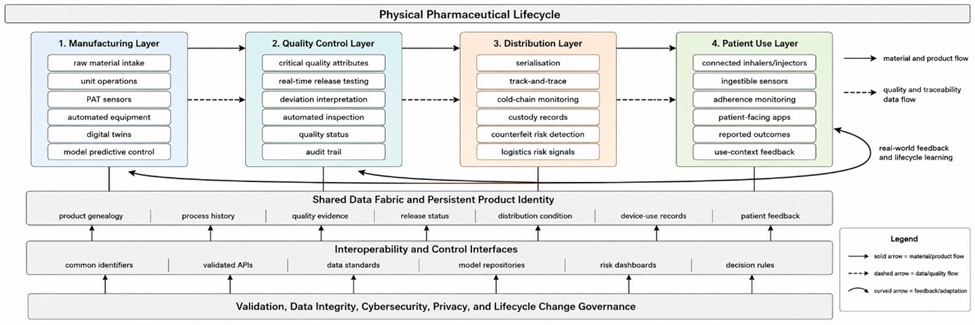
Figure 2. Integrated Pharmaceutical Cyber-Physical Architecture Linking Manufacturing, Quality Control, Distribution, and Patient Use
Implementation should proceed as a phased architecture programme rather than as a collection of disconnected digital projects. Early phases may focus on manufacturing data capture, PAT maturity, material tracking, and digital twin development, because these capabilities establish the data foundation for later quality and distribution integration [3, 4, 6, 7]. Subsequent phases should connect release decisions, serialisation data, environmental monitoring, and patient-use feedback into the broader data fabric [9-11].
Workforce capability is a major implementation requirement because a pharmaceutical CPS crosses disciplinary boundaries. Engineers, quality scientists, formulation specialists, supply-chain professionals, data scientists, cybersecurity teams, clinicians, and regulatory experts must work within shared architectural concepts rather than separate functional vocabularies [1, 2, 25]. Phiri and colleagues’ discussion of enterprise-wide Pharma 4.0 adoption reinforces the point that CPS implementation is an organisational transformation as much as a technology deployment [25].
Regulatory implications are particularly important because connected systems create dynamic relationships among models, data, quality decisions, and product lifecycle changes. Real-time release testing, digital twins, and model predictive control can strengthen assurance, but they also require clear validation strategies for models that may be updated, extended, or recalibrated over time [13, 15, 17]. The regulatory question is therefore not whether digital systems can support quality, but how continuously connected and adaptive systems can remain validated, explainable, and inspection-ready.
Sustainability and resilience also become regulatory and strategic dimensions of the pharmaceutical CPS. Industry 4.0 studies in the pharmaceutical sector link digitalisation to sustainable development, operational efficiency, and broader system transformation [26, 27]. When manufacturing intelligence, supply-chain transparency, and patient-use feedback are connected, the pharmaceutical enterprise can move toward more adaptive inventory management, better risk detection, reduced waste, improved adherence support, and more evidence-informed lifecycle management.
A pharmaceutical cyber-physical system linking manufacturing, quality control, distribution, and patient use offers a systems-level path beyond fragmented digitalisation. Its central contribution is the creation of an integrated architecture in which physical products, process data, quality evidence, logistics records, and patient-use signals are connected through a governed digital thread. Such an architecture reframes pharmaceutical quality as a lifecycle property rather than a factory-bounded decision.
The proposed framework shows that manufacturing, quality control, distribution, and patient use should not be treated as isolated operational domains. Manufacturing generates the product and its process memory, quality control interprets acceptability, distribution preserves identity and condition, and patient use reveals real-world interaction with the therapy. When these layers are connected, the pharmaceutical system becomes capable of learning from its own operations and from patient-facing evidence.
The future of connected pharma will depend on cross-sector collaboration among pharmaceutical manufacturers, technology providers, healthcare systems, regulators, and patients. Technical integration must be matched by governance, validation, cybersecurity, interoperability, and ethical data-use practices. A fully realised pharmaceutical CPS will not simply automate existing workflows; it will redefine the pharmaceutical value chain as an adaptive, accountable, and patient-informed system.
None
None
None
None
Open Access The author(s) retain copyright. This article is licensed under the Creative Commons Attribution-NonCommercial-ShareAlike 4.0 International License. It may be shared and adapted for non-commercial purposes with appropriate attribution, an indication of changes, and distribution of adaptations under the same license. Third-party material may be subject to separate terms identified in its credit line. View the license at https://creativecommons.org/licenses/by-nc-sa/4.0/.
 Publication System