Drug delivery has become one of the most technically inventive areas of pharmaceutical science, producing increasingly elaborate platforms such as multifunctional nanoparticles, long-acting depots, 3D-printed dosage forms, implantable systems, and responsive materials. Yet the number of delivery technologies that successfully become routine clinical and commercial products remains small compared with the volume of experimental innovation. This mismatch creates a translational paradox at the centre of the field. This article argues that the paradox cannot be explained only by external barriers such as regulation, investment scarcity, or clinical conservatism. It also reflects an internal innovation logic that equates sophistication with value. In this logic, the most admired systems are often those with the most components, functions, triggers, layers, and claims of precision. The article develops an original critical theory of over-engineering in drug delivery. Over-engineering is defined as the addition of technical features, materials, control mechanisms, or architectural complexity beyond what is necessary for therapeutic function, manufacturability, usability, and economic viability. The central claim is that excessive complexity can reduce, rather than increase, translational probability. Through a critical theoretical synthesis of recent drug delivery and translational literature, the paper identifies mechanisms through which over-engineered systems become difficult to manufacture, characterise, regulate, finance, prescribe, and use. It argues that translational failure is not merely an unfortunate downstream event but is often designed into systems at the earliest conceptual stage. Complexity therefore becomes a hidden liability disguised as innovation. The article proposes a counter-logic of design simplification. This counter-logic does not reject sophisticated science, but it demands that sophistication be justified by translational necessity rather than aesthetic or academic appeal. The conclusion calls for a simplicity revolution in drug delivery, where the field learns to value robustness, manufacturability, usability, and patient access as highly as novelty.
Drug delivery research has produced a remarkable catalogue of technologies, yet the field continues to confront a persistent gap between laboratory promise and clinical normalisation. Reviews of nanomedicine translation repeatedly show that elegant carrier design does not automatically become scalable, approved, reimbursed, or widely adopted therapy [1]. The central problem is therefore not whether the field is scientifically creative, because it clearly is, but whether its dominant forms of creativity improve the probability that technologies reach patients.
The translational difficulty is often framed as a problem of external friction: regulatory conservatism, insufficient investment, limited industrial appetite, or the long path from proof of concept to clinical product. These factors matter, but they do not fully explain why many delivery systems enter development already burdened by difficult materials, fragile processes, complex characterisation demands, and unclear clinical advantages [2]. A critical theory of drug delivery must therefore examine not only the barriers that technologies encounter, but also the design assumptions that make those barriers predictable.
The recent literature on nanoparticulate medicines, long-acting formulations, and advanced delivery platforms shows that translation depends on more than biological targeting or release control. It depends on reproducible manufacture, meaningful quality attributes, regulatory intelligibility, health-economic plausibility, and practical use in clinical systems [3]. When these conditions are treated as secondary to novelty, technical sophistication can become a source of translational weakness rather than strength.
This article interrogates the innovation logic that rewards increasingly elaborate drug delivery architectures and asks whether the field has mistaken complexity for progress. The objective is to theorise over-engineering as a systemic pattern, identify the mechanisms through which it reduces translational probability, and propose a counter-logic of purposeful simplification. In doing so, the article positions translation not as a late-stage hurdle but as a design criterion that must discipline drug delivery innovation from the beginning [4].
The dominant innovation logic in drug delivery privileges novelty, multifunctionality, and technical sophistication as signs of scientific value. Leroux’s critique of the “novelty bubble” captured a central tension in the field: systems may become publishable because they are new, not because they are likely to become useful products [5]. This logic encourages researchers to add functions, triggers, ligands, layers, imaging capabilities, and responsive mechanisms in order to differentiate their work within a crowded literature.
Nanomedicine provides the clearest example of this escalation. Targeted delivery platforms have been engineered to circulate longer, evade clearance, recognise diseased tissue, release cargo in response to stimuli, combine therapy and diagnostics, and sometimes integrate multiple therapeutic agents within one carrier [6]. These features can be scientifically rational, but when accumulated without disciplined translational justification, they create architectures whose complexity exceeds the practical requirements of clinical benefit.
A similar dynamic is visible in 3D-printed dosage forms, where the ability to produce customised geometries, multi-compartment structures, and programmed release profiles creates powerful opportunities but also invites unnecessary technical elaboration. Pharmaceutical 3D printing has been promoted as a disruptive solution for personalisation, decentralised manufacturing, and point-of-care production, yet its translation depends on quality control, reproducibility, regulatory clarity, and manufacturing practicality [7]. The mere capacity to fabricate complex structures does not mean that every therapeutic problem requires a complex printed object.
Long-acting formulations and implantable or depot systems also illustrate the dual nature of sophistication. Long-acting drug delivery can transform adherence and therapeutic continuity, but successful translation requires formulations that are manufacturable, stable, acceptable to users, and compatible with clinical workflows [8]. The dominant innovation logic becomes dangerous when it treats each added function as progress while underestimating the cumulative burden that each added component imposes on development.
Over-engineering in drug delivery can be defined as the addition of features, materials, components, or control mechanisms beyond what is necessary to achieve a clinically meaningful and manufacturable therapeutic function. This definition does not condemn complexity itself, because some diseases and delivery routes genuinely require sophisticated systems. It instead challenges unjustified complexity, especially when design elaboration increases development burden without a proportional increase in translational value [9].
The risk of over-engineering is particularly acute because early-stage research often evaluates delivery systems under conditions that reward mechanism demonstration rather than product realism. A nanoparticle may show enhanced uptake, a printed dosage form may show an intricate release curve, or a depot may maintain prolonged exposure, yet these achievements do not resolve the questions of scale-up, batch reproducibility, sterilisation, storage, cost, and clinical implementation [10]. Translation fails when these downstream conditions are treated as later engineering details rather than as core design constraints.
Over-engineering is not a random mistake made by individual researchers; it is a predictable outcome of the incentive structure surrounding drug delivery science. Publication systems reward visible novelty, grant systems reward ambitious differentiation, and academic prestige often attaches to technically dense platforms rather than simple formulations that solve a real translational problem. The response to the novelty-bubble critique acknowledged that the field must think beyond materials alone, precisely because translation requires an ecosystem of design, development, and implementation decisions [11].
The critical claim of this article is that complexity is translational risk unless it is justified by necessity. Each additional material, functional layer, manufacturing step, analytical method, regulatory question, and usability demand increases the probability that a delivery system will fail before reaching patients [12]. Sophistication may therefore become a paradoxical liability: the more impressive a system appears in the laboratory, the less likely it may be to survive the harsher tests of manufacturing, regulation, reimbursement, and everyday clinical use [13].
Figure 1 illustrates the translational paradox through which increasing technical sophistication in drug delivery systems may reduce, rather than improve, the probability of clinical and commercial translation.
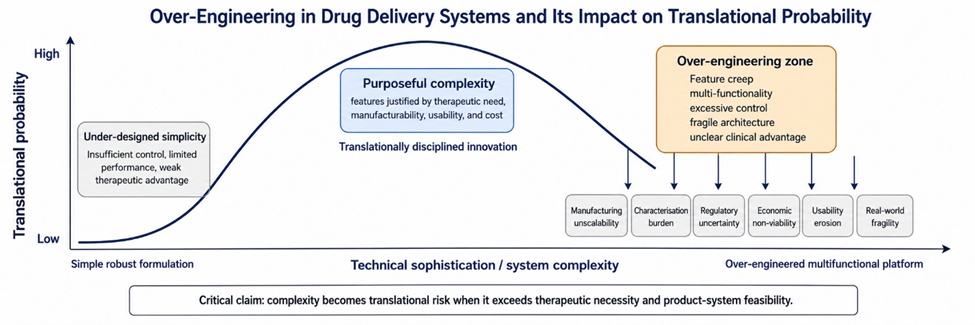
Figure 1. The Translational Paradox of Over-Engineering in Drug Delivery Systems: How Increasing Technical Sophistication Can Reduce Manufacturing, Regulatory, Economic, and Clinical Viability
The theoretical lens for this article begins with the translational “valley of death,” where promising laboratory systems fail to become products because they cannot cross the institutional, financial, regulatory, and manufacturing gap between discovery and use. Drug delivery systems are especially vulnerable because they are not merely molecules; they are integrated product-process systems whose performance depends on materials, formulation, device compatibility, analytical control, and user context [3]. From this perspective, translational probability is shaped long before clinical testing, because early design choices determine whether the system can later be scaled, characterised, and governed.
Complexity theory strengthens this argument by showing that each additional component, interface, trigger, or process step increases the number of possible failure modes. In nanomedicine, the challenge is not only whether a carrier works biologically, but whether its critical quality attributes can be defined, measured, reproduced, and controlled across development and manufacturing [14]. A highly engineered platform may therefore generate scientific value in one experimental setting while simultaneously multiplying uncertainty across the wider translational system.
The minimal viable product concept offers a counter-theory to the culture of maximal sophistication. In drug delivery, the equivalent principle is not minimal therapeutic ambition but minimal necessary complexity: the simplest delivery architecture capable of achieving the intended clinical function with acceptable quality, usability, and cost. This logic is visible in long-acting injectable development, where the decisive question is not how many functions a formulation contains, but whether it can sustain exposure, remain stable, be manufactured reliably, and fit real clinical administration pathways [15].
The first mechanism by which over-engineering reduces translational probability is manufacturing unscalability. A delivery system that depends on sequential assembly, narrow process windows, difficult sterilisation, rare materials, or delicate surface modification may perform well in the laboratory but resist industrial reproduction [4]. This is why clinical nanomedicine translation increasingly emphasises controllable manufacturing and product characterisation rather than only biological targeting claims [16].
The second mechanism is analytical and regulatory overload. Complex systems require more extensive characterisation because each material attribute, particle property, release behaviour, degradation profile, and interaction with biological media may become a critical quality concern [17]. Regulatory uncertainty grows when a platform is unprecedented, multi-component, or difficult to classify, because the evidentiary burden becomes broader and less predictable than for simpler formulations.
The third mechanism is economic and operational implausibility. A platform may be scientifically impressive but commercially weak if its manufacturing cost, quality-control burden, cold-chain requirement, clinical administration procedure, or intellectual-property landscape makes adoption unattractive [18]. Table 1 catalogues the mechanisms by which over-engineering reduces translational probability in drug delivery systems.
Table 1. Mechanisms of Over-Engineering in Drug Delivery Systems: How Excessive Complexity Undermines Manufacturing, Regulatory, Clinical, and Economic Translation
Translational mechanism | How over-engineering appears in drug delivery design | Translational consequence | Simplification implication |
Manufacturing unscalability | Excessive process steps, fragile assembly sequences, narrow operating windows, or difficult sterilisation requirements | Laboratory reproducibility does not convert into industrial-scale batch consistency | Design the formulation around scalable unit operations from the earliest stage |
Analytical characterisation burden | Multiple materials, surfaces, release triggers, particle attributes, degradation pathways, or device-formulation interfaces | Chemistry, manufacturing, and controls development becomes slower, more expensive, and less predictable | Reduce the number of critical quality attributes that must be controlled |
Regulatory uncertainty | Novel classifications, unprecedented combinations, unclear comparators, or ambiguous safety questions | Approval pathways become harder to define and more difficult to de-risk | Prefer architectures whose risks and evidence requirements are legible to regulators |
Economic non-viability | Costly materials, low-yield production, complex quality testing, special storage, or burdensome administration | Even clinically promising systems may fail reimbursement or commercial adoption | Treat cost and implementation burden as design constraints, not late-stage calculations |
Usability erosion | Difficult administration, specialist handling, poor patient acceptability, or demanding clinical workflows | Physicians and patients may avoid technologies that are technically advanced but practically inconvenient | Design around real users, settings, training limits, and adherence conditions |
Real-world fragility | Sensitivity to temperature, agitation, storage variation, administration errors, or biological heterogeneity | Performance observed in controlled studies may not survive ordinary distribution and use | Build robustness against lifecycle stress rather than responsiveness to idealised triggers |
Intellectual-property and integration tangles | Multi-component systems requiring overlapping patents, licensing agreements, or supplier dependencies | Development becomes legally, financially, and organisationally difficult | Keep platform ownership, supply chains, and integration pathways manageable |
The fourth mechanism is usability erosion, which is often ignored when the technology is evaluated primarily by physicochemical or pharmacokinetic performance. Advanced systems that require specialised handling, complicated administration, demanding storage, or unfamiliar clinical procedures may fail because patients and physicians do not experience them as usable improvements [19]. Over-engineering therefore reduces translational probability not only by making products harder to build, but also by making them harder to prescribe, administer, accept, and sustain in routine care [20].
Design simplification begins with the discipline of therapeutic sufficiency. Instead of asking how many functions can be added to a delivery system, researchers should ask what minimum set of features is necessary to produce a clinically meaningful advantage over existing options [5]. This does not mean lowering scientific standards; it means replacing the prestige of complexity with a stricter test of necessity.
A second principle is design for manufacturability from day one. Quality-by-design thinking already provides a language for linking material attributes, process parameters, and product performance, but over-engineered systems often apply this logic too late, after complexity has already been locked into the architecture [14]. A translational design ethos would require every added feature to justify itself against its effect on scale-up, reproducibility, release testing, storage, and cost.
A third principle is modularity without proliferation. Modularity can manage complexity by separating functions into controllable units, but it becomes counterproductive when it simply legitimises endless feature accumulation [21]. In precision nanoparticle engineering, the translational question should therefore shift from whether a platform can be made more intelligent to whether its modular elements reduce uncertainty, improve manufacturability, and strengthen clinical value.
A fourth principle is purposeful minimalism, or “less but better.” This is especially important for platform areas such as global infectious disease delivery, where practical technologies must operate across constrained health systems and cannot depend on fragile or expensive infrastructure [19]. Purposeful minimalism reframes simplicity as an ethical and translational virtue because it increases the chance that delivery technologies become accessible products rather than elegant prototypes.
The Critical Theory Model of Over-Engineering proposes that drug delivery failure is not only caused by downstream barriers but by upstream cultural and institutional forces that select for excessive complexity. Its antecedents include publication incentives, novelty-seeking grant cultures, disciplinary prestige around smart systems, and weak early attention to manufacturing or usability [11]. These forces produce manifestations such as feature creep, multi-functionality, sensitivity to idealised stimuli, layered architectures, and excessive control mechanisms.
The model then links these manifestations to seven translational consequences: unscalable manufacturing, excessive characterisation burden, regulatory uncertainty, economic non-viability, usability erosion, real-world fragility, and integration or intellectual-property complexity. Recent translational frameworks for nanomedicine increasingly argue that movement to the clinic requires coordinated attention to design, evidence, logistics, regulation, and implementation rather than isolated material invention [20]. Table 2 presents the proposed critical theory model linking over-engineering to translational failure and its counter-logic.
Table 2. Proposed Critical Theory Model of Over-Engineering in Drug Delivery: Antecedents, Manifestations, Translational Consequences, and Simplification Pathways
Model domain | Core elements | Critical interpretation | Counter-logic |
Antecedents | Publication pressure, novelty bias, grant incentives, prestige of technical sophistication, weak translational filtering | The field rewards visible complexity before it tests whether complexity improves patient-relevant value | Reward translational probability, manufacturability, usability, and justified simplicity |
Manifestations | Multi-stimuli responsiveness, excessive targeting layers, multi-component carriers, intricate release architectures, difficult device-formulation integration | Complexity becomes a symbolic marker of innovation even when its therapeutic necessity is uncertain | Require every feature to pass a necessity, manufacturability, and usability test |
Translational mechanisms | Scale-up failure, analytical burden, regulatory ambiguity, high cost, usability barriers, lifecycle fragility, intellectual-property tangles | Failure is often designed into the system by choices made at the conceptual stage | Treat translation as an upstream design property rather than a downstream rescue task |
Translational consequences | Delayed development, abandoned platforms, weak commercial adoption, limited clinical uptake, reduced patient access | Sophistication may increase scientific recognition while decreasing probability of patient impact | Measure success by clinical reach, robustness, affordability, and real-world implementation |
Simplification pathways | Design for manufacturability, quality-by-design, modular restraint, frugal innovation, robust formulation, minimal necessary complexity | Simplification is not anti-innovation; it is disciplined innovation under translational constraints | Build simpler systems that are easier to make, regulate, pay for, prescribe, and use |
The model is critical because it treats over-engineering as a form of hidden power within scientific culture. It asks whose values are embedded in drug delivery design: the values of publication novelty, technological spectacle, and disciplinary competition, or the values of clinical usefulness, manufacturability, affordability, and patient access [1]. The counter-logic therefore does not merely advise researchers to simplify; it demands that the field change what it recognises as valuable innovation.
Figure 2 presents the proposed Critical Theory Model of Over-Engineering, linking innovation incentives to excessive design complexity, reduced translational probability, and the counter-logic of purposeful simplification.
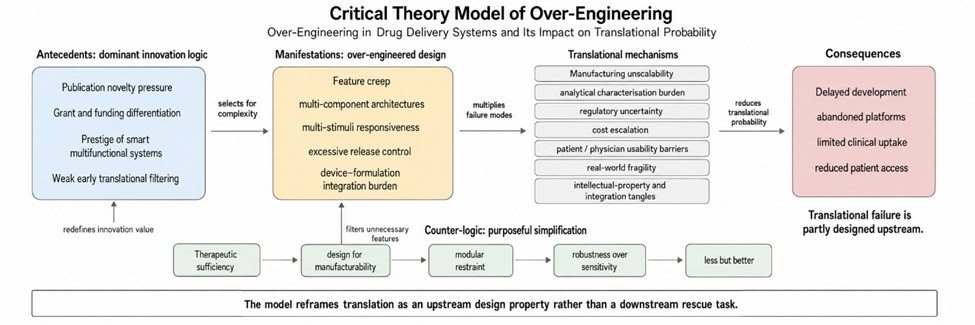
Figure 2. Critical Theory Model of Over-Engineering in Drug Delivery: From Innovation Incentives and Feature Creep to Translational Failure and Design Simplification
The first future direction is to realign academic incentives so that simplicity and translatability are treated as achievements rather than compromises. Journals, reviewers, funders, and promotion committees should ask whether added complexity improves a credible translational endpoint or merely intensifies technical display [9]. The most valuable drug delivery paper should not automatically be the one with the most elaborate architecture, but the one that most convincingly advances a product toward clinical use.
The second pathway is to embed translational probability assessment into early-stage design review. Before developing a complex platform, teams should evaluate manufacturing scale, analytical burden, regulatory route, cost structure, storage conditions, administration workflow, and patient acceptability [22]. Such assessment would not eliminate ambitious technologies, but it would force ambition to be disciplined by product logic rather than driven by novelty alone.
The third pathway is to create funding and development streams for appropriate technology in drug delivery. Additive manufacturing, microneedles, and point-of-care production may offer real benefits, but their translation will depend on quality systems, reproducibility, validated processes, and context-sensitive implementation rather than technological enthusiasm alone [23]. Funding mechanisms should therefore support simplification studies, manufacturability optimisation, and comparative translational evaluation, not only new platform invention.
The fourth pathway is regulatory-cultural: simplification should be recognised as a quality enhancer. Emerging discussions of pharmaceutical 3D printing and polymer-based nanotherapeutics show that advanced systems require regulatory frameworks able to evaluate quality attributes, process control, and risk across new manufacturing models [24, 25]. If regulators, industry, and academia treat well-justified simplicity as evidence of maturity, drug delivery innovation can move from spectacular prototypes toward robust products that actually reach patients.
The romance with complexity has become one of the central liabilities of modern drug delivery science. The field has built magnificent experimental systems, but too often it has treated technical sophistication as a substitute for translational discipline. The result is a paradox in which platforms become more impressive while their probability of becoming usable clinical products remains limited.
This article has argued that over-engineering is not an accidental excess but a systemic outcome of the dominant innovation logic. When novelty, multifunctionality, and architectural elaboration are rewarded more strongly than manufacturability, usability, affordability, and robustness, translational failure is not surprising. It is the predictable consequence of designing for scientific recognition before designing for patient use.
A simplicity revolution is therefore needed in drug delivery. Such a revolution would not reject advanced science, but it would insist that every layer of sophistication earn its place through clear translational value. The future of the field depends on putting patients rather than publications at the centre of innovation.
None
None
None
None
Open Access The author(s) retain copyright. This article is licensed under the Creative Commons Attribution-NonCommercial-ShareAlike 4.0 International License. It may be shared and adapted for non-commercial purposes with appropriate attribution, an indication of changes, and distribution of adaptations under the same license. Third-party material may be subject to separate terms identified in its credit line. View the license at https://creativecommons.org/licenses/by-nc-sa/4.0/.
 Publication System