Advanced drug delivery systems have long promised to transform therapy by improving biodistribution, reducing toxicity, enabling intracellular delivery, extending exposure, and opening therapeutic spaces that conventional dosage forms cannot reach. Yet the field remains marked by a persistent translation paradox: thousands of sophisticated carrier systems are reported in the literature, while only a small fraction progress into durable clinical products. This gap is usually explained through biological complexity, manufacturing difficulty, regulatory uncertainty, or inadequate preclinical models. This critical perspective proposes that these explanations, although important, are incomplete. A deeper systemic factor is technological lock-in, defined here as the self-reinforcing dominance of specific drug delivery platforms that shape what researchers, funders, manufacturers, regulators, and companies consider technically feasible and translationally credible. Once a platform accumulates expertise, protocols, supply chains, regulatory familiarity, and publication momentum, alternatives may struggle to compete even when they offer potentially superior solutions. The central argument is that technological lock-in contributes to translational failure by narrowing the drug delivery imagination. Instead of asking which delivery architecture is best suited to a given biological, clinical, manufacturing, and regulatory problem, the field often asks how an incumbent platform can be modified to fit yet another therapeutic challenge. This platform-first logic can lead to repeated optimisation of familiar systems while more disruptive or simpler design spaces remain underexplored. The article critically examines the assumptions that sustain dominant platforms in advanced drug delivery. These assumptions include beliefs that increasing carrier complexity necessarily improves therapeutic performance, that certain materials possess broad translational privilege, that murine and in vitro models can adequately predict human outcomes, and that incremental optimisation is less risky than platform diversification. The perspective argues that these assumptions are not merely technical claims but institutional habits that stabilise lock-in. The proposed conceptual model links critical assumptions, technological lock-in, platform dependency, innovation constraint, and translational failure in a self-reinforcing cycle. In this model, failure does not necessarily disrupt dominant platforms; paradoxically, it may intensify dependence on them because they remain the most familiar, fundable, publishable, manufacturable, and regulatable options. Five tables structure the analysis by summarising translational failure evidence, critical assumptions, failure mechanisms, lock-in case examples, and the proposed model. Breaking technological lock-in requires more than improving individual formulations. It requires deliberate diversification of platform portfolios, stronger interrogation of inherited assumptions, translational assessment that rewards fit-for-purpose simplicity, and innovation policies that lower the cost of exploring alternative delivery architectures. A more resilient advanced drug delivery ecosystem should treat platform diversity not as inefficiency, but as insurance against repeated translational failure.
Advanced drug delivery systems occupy a privileged position in pharmaceutical innovation because they promise to alter not only where a drug goes, but also how it behaves over time, how it interacts with biological barriers, and how its therapeutic index is expressed. Nanoparticles, liposomes, polymeric carriers, lipid nanoparticles, implants, and targeted systems have been promoted as solutions to long-standing problems of solubility, toxicity, biodistribution, intracellular delivery, and patient adherence. Yet the clinical record remains uneven, with translation concentrated in a limited number of delivery classes rather than distributed across the broad experimental diversity reported in the literature [1]. This mismatch between technological ambition and clinical adoption creates the starting point for a critical re-examination of how the field defines progress.
The usual explanations for weak translation are persuasive but incomplete. Biological heterogeneity, weak animal-to-human predictability, poor reporting quality, manufacturing barriers, scale-up uncertainty, and regulatory complexity all contribute to failure [2]. Minimum information standards and more disciplined translational frameworks have been proposed precisely because inconsistent experimental reporting and fragmented development logic make it difficult to compare systems or reproduce promising claims [3]. However, a field can improve reporting, scale-up, and preclinical testing while still remaining trapped inside the same restricted set of technological possibilities.
The under-recognised issue is that drug delivery innovation is not only a scientific process but also a path-dependent technological system. Once certain platforms acquire regulatory precedent, manufacturing familiarity, industrial investment, supplier infrastructure, and academic legitimacy, they become easier to justify than unfamiliar alternatives [4]. Clinical translation then becomes biased toward systems that resemble previous successes, even when those systems carry known biological or technical limitations. In this sense, translational failure may be shaped not only by what individual platforms cannot do, but also by the field’s dependence on platforms it already knows how to study.
This article develops a critical perspective and conceptual model of technological lock-in in advanced drug delivery systems. It argues that platform dominance can produce a self-reinforcing cycle in which familiar technologies attract more optimisation, more funding, more regulatory learning, and more scientific labour, while alternative designs are treated as speculative or impractical. The aim is not to dismiss successful incumbent platforms, since liposomes and lipid nanoparticles have produced important clinical advances [5]. Rather, the purpose is to show how the dominance of a few platforms may simultaneously enable translation in some areas and constrain innovation in others.
The problem of translational failure in advanced drug delivery is visible in the disproportion between publication activity and clinical conversion. Nanomedicine and related delivery fields have generated extensive experimental output, but the number of products reaching routine clinical use remains comparatively modest [6]. This imbalance has been described as a persistent gap between laboratory promise and patient benefit, particularly in oncology, where carrier sophistication has often exceeded clinically demonstrated advantage [7]. The problem is therefore not a lack of invention, but a weak conversion of invention into robust therapeutic systems.
A second dimension of the problem is concentration: clinical successes are not evenly distributed across the full range of proposed delivery architectures. Instead, they cluster around a limited number of platform types, including liposomes, lipid nanoparticles, albumin-based systems, polymer-drug conjugates, and selected long-circulating nanoparticle formulations [4]. This concentration can be interpreted positively as evidence that some platforms have genuine translational strength, but it also signals a narrowing of the clinical delivery repertoire. When a field repeatedly returns to a small set of familiar platforms, translational success may come at the cost of technological diversity.
A third dimension is the persistence of investment in platforms whose assumptions remain contested. The enhanced permeability and retention effect, for example, has shaped decades of tumour-targeted nanomedicine, yet its reliability in human tumours remains variable and clinically difficult to exploit [8]. Similarly, PEGylation has been treated as a standard solution for circulation extension, although anti-PEG antibodies and immune reactions complicate its universal use [9]. Table 1 illustrates the evidence of translational failure in advanced drug delivery systems.
Table 1. Translational Failure in Advanced Drug Delivery: Key Metrics and Landmark Examples
Translational signal | What it shows | Landmark example or recurring pattern | Lock-in relevance |
High publication volume with limited product conversion | Experimental productivity does not automatically translate into clinical adoption | Thousands of reported nanocarriers contrast with a much smaller number of approved nanomedicines | Encourages repeated optimisation of publishable systems rather than translation-ready redesign |
Concentration of approved products in few platform families | Clinical success is clustered rather than technologically diverse | Liposomes, lipid nanoparticles, albumin-bound nanoparticles, and selected polymer-based systems dominate approved examples | Regulatory and manufacturing familiarity reinforces platform preference |
Weak animal-to-human predictability | Preclinical efficacy often fails to anticipate human performance | Murine tumour models frequently overstate delivery efficiency and therapeutic response | Familiar preclinical workflows protect incumbent assumptions |
Variable clinical relevance of EPR-based targeting | Passive tumour accumulation is inconsistent across patients and tumour types | Human tumour delivery is shaped by vascular, stromal, immunological, and anatomical heterogeneity | A central assumption remains influential despite limited universality |
Immunological complications of stealth strategies | Platform-enabling materials can introduce new risks | PEGylated systems may trigger anti-PEG antibodies, accelerated blood clearance, or hypersensitivity | Standard materials retain dominance despite known limitations |
Manufacturing and scale-up barriers | Complex carriers may be difficult to reproduce, control, and commercialise | Multi-component nanocarriers often face batch consistency and characterisation challenges | Complex incumbent platforms accumulate specialised infrastructure that raises switching costs |
Regulatory familiarity as a selection filter | Systems resembling prior products can appear more developable | Incremental variants of known platforms may be favoured over unfamiliar architectures | Precedent can reduce uncertainty while narrowing innovation pathways |
The problem, therefore, is not simply that advanced drug delivery systems fail too often. It is that failure occurs within a technological culture that may not learn broadly enough from failure because it remains attached to familiar platform logics. Translational frameworks increasingly emphasise manufacturability, safety, reproducibility, and clinical relevance [10]. Yet unless these frameworks also ask whether the field is over-dependent on particular platforms, they may improve execution while leaving the deeper pattern of lock-in intact.
Advanced drug delivery is sustained by a powerful but rarely stated assumption: greater technological sophistication is presumed to represent therapeutic progress. Precision nanoparticles, multifunctional carriers, and engineered delivery architectures are often framed as inherently superior because they can combine targeting, protection, release control, and biological responsiveness within a single system [11]. The problem is that each added function can also introduce new sources of variability, characterisation burden, manufacturing fragility, and regulatory uncertainty. A critical lock-in begins when complexity becomes a sign of scientific seriousness rather than a hypothesis that must justify itself against simpler alternatives.
A second assumption is that certain materials possess broad translational privilege across diseases, cargos, and biological contexts. Lipids, PEG, PLGA-like polymers, and clinically familiar excipients often appear more credible because they are already embedded in prior products, supplier networks, and regulatory conversations [12]. Lipid nanoparticles, for example, have become a dominant reference point for nucleic acid delivery because their clinical achievements are undeniable, yet their success can encourage premature generalisation across therapeutic areas and cargo types [13]. In lock-in terms, the material becomes not only a component of design but also a filter through which feasibility is judged.
A third assumption is that standard preclinical systems can reliably identify delivery platforms suitable for human translation. Concerns about murine tumour models, incomplete reporting, and weak comparability across nanomedicine studies show that preclinical success may reflect model convenience rather than clinical readiness [3]. The EPR effect illustrates this problem especially clearly because tumour accumulation observed in experimental systems does not always translate into predictable patient-level performance [14]. Table 2 catalogues the unexamined assumptions that sustain technological lock-in in drug delivery platforms.
Table 2. Critical Assumptions Underlying Dominant Drug Delivery Platforms
Critical assumption | How it sustains lock-in | Why it is problematic | Implication for translation |
More complex carriers are more advanced | Rewards multifunctional designs and incremental feature addition | Complexity can increase variability, cost, and regulatory burden | Simpler systems may be undervalued despite stronger translational potential |
Clinically familiar materials are broadly optimal | Encourages reuse of lipids, PEG, and polymeric materials across unrelated problems | Material performance is context-specific and may introduce immune or stability liabilities | Platform selection may be driven by precedent rather than fit |
EPR-based tumour accumulation is generally reliable | Keeps passive targeting central to cancer nanomedicine design | Human tumour heterogeneity limits predictable accumulation | Clinical failure may be misread as inadequate optimisation rather than flawed targeting logic |
PEGylation is a default stealth solution | Preserves PEG as a routine circulation-enhancing modification | Anti-PEG antibodies and hypersensitivity challenge universality | Immune-risk screening becomes essential rather than optional |
Murine efficacy predicts human delivery performance | Sustains familiar animal models and experimental workflows | Model artefacts may overstate biodistribution or therapeutic advantage | Translation requires stronger human-relevant evidence earlier |
Incremental platform optimisation is safer than platform diversification | Channels funding and publications toward familiar systems | Incrementalism may delay exploration of better-suited alternatives | Innovation portfolios become narrow and path-dependent |
Regulatory precedent equals technological superiority | Makes familiar platforms appear inherently more developable | Precedent reduces uncertainty but does not prove best fit | Regulatory learning can unintentionally favour incumbents |
A fourth assumption is that incremental improvement of incumbent platforms is less risky than exploration of unfamiliar systems. This is understandable because translational drug delivery requires safety, quality control, reproducibility, and manufacturability, not merely novelty [15]. However, the same risk logic can become conservative when it treats deviation from established platforms as a liability before alternative designs are given serious translational development. The result is an innovation culture in which radical platform questioning is rhetorically welcomed but structurally disadvantaged.
Technological lock-in contributes to translational failure first by concentrating resources around incumbent platforms. Once a platform has established methods, trained specialists, analytical assays, manufacturing know-how, and clinical narratives, it becomes easier to fund and publish additional variants [16]. This resource concentration can create a false sense of progress because many studies may refine the same design grammar without expanding the range of delivery solutions available to patients. Translation then fails not because the field lacks activity, but because activity is disproportionately invested in familiar trajectories.
A second mechanism is neglect of alternative design space. Drug delivery problems are diverse: nucleic acids, proteins, small molecules, immune modulators, brain-targeted agents, and local therapies each impose different biological and engineering constraints [17]. Yet platform dependency can encourage researchers to adapt the cargo to the platform rather than selecting or inventing a platform around the cargo’s translational requirements. When dominant systems define what counts as a plausible solution, unexplored alternatives may remain invisible until incumbent approaches repeatedly disappoint.
A third mechanism is regulatory and manufacturing inertia. Platforms with precedent are easier to discuss because their characterisation methods, quality attributes, toxicity concerns, and production routes are at least partly familiar [18]. This familiarity can accelerate development, but it can also bias decision-making toward technologies that look manageable rather than technologies that are best matched to the clinical problem. Table 3 summarises the mechanisms by which lock-in drives translational failure.
Table 3. Mechanisms Linking Technological Lock-In to Translational Failure in Drug Delivery
Lock-in mechanism | Immediate effect | Translational consequence | Critical interpretation |
Resource concentration | Funding, expertise, and infrastructure accumulate around dominant platforms | Alternative platforms struggle to mature | Failure becomes concentrated within familiar technological families |
Design-space narrowing | Researchers optimise known carriers instead of exploring divergent architectures | Potentially better solutions remain underdeveloped | The field mistakes optimisation depth for innovation breadth |
Regulatory inertia | Prior precedent favours familiar quality and safety questions | Novel systems face higher uncertainty and slower development | Precedent becomes a pathway advantage for incumbents |
Manufacturing path dependence | Existing equipment and process knowledge shape platform selection | Designs are chosen partly because they fit available infrastructure | Industrial feasibility can override therapeutic fit |
Publication reinforcement | Familiar platforms are easier to position, compare, and justify | Academic incentives reward incremental variants | Scientific culture stabilises dominant assumptions |
Failure reinterpretation | Poor outcomes are attributed to insufficient optimisation | The platform itself is rarely questioned | Negative translation can paradoxically strengthen lock-in |
Supplier and protocol ecosystems | Reagents, assays, and standard methods become platform-specific | Switching costs increase over time | Platform choice becomes institutional rather than purely scientific |
A fourth mechanism is interpretive resilience after failure. When a familiar platform fails, the dominant response is often to improve targeting ligands, alter particle size, change surface chemistry, or refine dosing rather than ask whether the platform class is appropriate for the indication [19]. This pattern is visible in cancer nanomedicine, where repeated disappointment has often produced more elaborate formulations rather than a fundamental reconsideration of disease biology, patient selection, and delivery-route logic [20]. Lock-in therefore turns failure into an argument for further optimisation of the incumbent rather than exploration beyond it.
Technological lock-in in drug delivery can be defined as the process by which a platform becomes dominant because previous investments make it increasingly attractive, not necessarily because it remains objectively superior for each new therapeutic problem. In practical terms, lock-in emerges when prior success, accumulated knowledge, regulatory comfort, manufacturing infrastructure, and scientific reputation converge around a platform [21]. This convergence lowers the perceived risk of using the incumbent system while raising the perceived risk of alternatives. The central danger is that feasibility becomes historically inherited rather than critically assessed.
Liposomes illustrate the ambivalence of lock-in. Their clinical record demonstrates that platform maturity can generate real therapeutic value, especially when formulation control, circulation behaviour, and drug encapsulation are well matched to clinical need [22]. At the same time, the long dominance of liposomal thinking has helped preserve assumptions about passive targeting, nanocarrier accumulation, and tumour delivery that remain variable in humans [23]. The platform is therefore both a success story and a cautionary example of how success can shape subsequent imagination.
Lipid nanoparticles provide a more recent example of accelerated platform consolidation. Their role in siRNA therapeutics and mRNA delivery has made them one of the most consequential delivery technologies of the past decade [24]. Yet the same success may produce a new lock-in if LNPs become the default solution for nucleic acids regardless of cargo biology, tissue target, dosing schedule, tolerability, or manufacturing context [13]. Table 4 presents case studies of platform lock-in and its consequences.
Table 4. Platform Lock-In in Advanced Drug Delivery: Dominant Technologies and Their Path-Dependent Trajectories
Dominant platform | Sources of dominance | Known limitations | Lock-in consequence |
Liposomes | Long clinical history, regulatory familiarity, manufacturing precedent, oncology experience | Variable tumour accumulation, stability constraints, limited penetration into some tissues | Success legitimises continued optimisation even when disease fit is uncertain |
Lipid nanoparticles | Major success in nucleic acid delivery, scalable manufacturing, strong industrial investment | Tissue tropism limitations, reactogenicity concerns, cargo-specific constraints | May crowd out alternative nucleic acid carrier architectures |
PEGylated nanocarriers | Circulation extension, established stealth concept, broad use in nanomedicine | Anti-PEG antibodies, hypersensitivity, accelerated clearance | PEG remains a default solution despite immunological complications |
PLGA-like polymeric particles | Familiar degradable materials, established formulation literature, perceived safety | Scale-up complexity, burst release, heterogeneous cargo loading | Material familiarity may be confused with translational superiority |
EPR-driven tumour nanomedicine | Strong conceptual simplicity, extensive preclinical literature, oncology demand | Human tumour heterogeneity and inconsistent accumulation | Passive targeting remains influential beyond its reliable clinical range |
Albumin-bound and biomimetic systems | Biological familiarity, improved solubilisation, clinical examples | Mechanistic ambiguity and indication-specific benefit | Biological plausibility can substitute for rigorous platform comparison |
Local depot and implantable systems | Sustained exposure, adherence advantage, precedent in selected indications | Device dependence, removal issues, patient acceptability, manufacturing control | Long-acting logic may dominate even when reversibility is needed |
Polymeric systems reveal another lock-in pattern: the persistence of materials perceived as safe, degradable, and technically familiar despite repeated translation barriers. The issue is not that polymeric platforms lack value, since they may be well suited for depot, vaccine, and local delivery applications [25]. Rather, their familiarity can create a default design reflex in which formulation scientists begin from available polymers rather than from the full therapeutic system required. Lock-in begins when the platform becomes the starting assumption rather than one candidate among many.
Platform dependency constrains innovation by creating high switching costs across the research and development ecosystem. Laboratories invest in specific synthesis methods, characterisation tools, stability assays, animal models, and analytical routines that are often optimised for familiar carriers [26]. Companies build supplier relationships, production capabilities, intellectual property strategies, and regulatory narratives around platform families. Once these investments accumulate, moving to an alternative platform becomes scientifically, economically, and institutionally expensive.
This dependency also affects training and expertise. Researchers who are trained within a dominant platform ecosystem learn not only technical methods but also implicit judgments about what counts as a promising formulation, a convincing biodistribution result, or a publishable optimisation strategy [27]. These judgments can become conservative because they reflect the standards of existing platforms rather than the requirements of future therapeutic problems. Innovation is then constrained not by lack of creativity, but by the invisible boundaries of platform literacy.
Platform dependency further shapes how risk is allocated. A familiar platform with known weaknesses may be treated as less risky than an unfamiliar system with uncertain but potentially superior advantages [28]. This asymmetry matters because advanced drug delivery already faces high translational uncertainty, making decision-makers sensitive to anything that appears to reduce development risk. The paradox is that a conservative platform choice can reduce short-term uncertainty while increasing long-term failure if the platform is poorly matched to the biological problem.
The strongest form of innovation constraint occurs when platform dependency becomes self-confirming. More research on a dominant platform produces more protocols, more data, more trained personnel, and more regulatory experience, which then justify still more research on the same platform [29]. Conversely, alternative systems appear underdeveloped partly because they have not received the same cumulative investment. This is the structural unfairness of lock-in: incumbents are judged by their maturity, while alternatives are judged by their immaturity.
The proposed critical model links five elements in sequence: critical assumptions, technological lock-in, platform dependency, innovation constraint, and translational failure. Critical assumptions define what the field believes to be rational, such as the superiority of complex nanocarriers, the broad utility of PEGylation, or the reliability of EPR-driven tumour targeting [30]. These assumptions support technological lock-in by making dominant platforms appear not merely familiar but scientifically natural. Lock-in then converts assumptions into infrastructure, expertise, funding patterns, and regulatory precedent.
Platform dependency is the model’s central mediating condition. It explains why dominant technologies continue to attract investment even when their clinical performance is mixed or indication-specific [31]. Dependency is not irrational; it reflects real advantages in manufacturing experience, quality control, formulation know-how, and regulatory familiarity. The critical point is that these advantages can become so powerful that they distort platform selection away from fit-for-purpose design.
Innovation constraint emerges when platform dependency narrows the range of technologies considered worthy of serious translation. This constraint appears as incrementalism, over-optimisation, underinvestment in alternatives, and reluctance to challenge foundational assumptions [32]. It also appears when problems caused by an incumbent platform are treated as technical details to be solved within that same platform rather than evidence that another design logic may be needed. Table 5 outlines the proposed critical model and its components.
Table 5. Proposed Critical Model of Technological Lock-In and Translational Failure in Drug Delivery
Model component | Definition | Operational expression | Translational consequence |
Critical assumptions | Unexamined beliefs that make dominant platforms appear naturally superior | Complexity as progress, EPR reliability, PEG default use, material familiarity | Weak interrogation of platform fit |
Technological lock-in | Self-reinforcing dominance of a platform due to accumulated prior investment | Repeated funding, publication, regulation, and optimisation of familiar systems | Alternatives face higher entry barriers |
Platform dependency | Dependence on established methods, suppliers, expertise, and regulatory precedent | Standard assays, trained personnel, scalable processes, known quality attributes | Switching costs discourage diversification |
Innovation constraint | Narrowing of explored design space and preference for incremental variants | Platform-first formulation, conservative development strategies | Potentially superior architectures remain immature |
Translational failure | Failure to convert experimental promise into durable clinical products | Attrition, limited approvals, weak patient-level benefit | Failure is normalised rather than structurally analysed |
Feedback loop | Failure reinforces dependence on familiar platforms | More optimisation of incumbents after disappointing outcomes | Lock-in persists despite repeated underperformance |
Breakout condition | Deliberate disruption of platform-first logic | Comparative platform portfolios, assumption testing, regulatory support for novelty | More resilient and diverse translation ecosystem |
The model includes a feedback loop in which translational failure can paradoxically reinforce lock-in. When a familiar platform fails, the ecosystem often concludes that more optimisation, better characterisation, or more refined patient selection is needed [33]. These responses may be appropriate in some cases, but they can also preserve the incumbent platform as the unquestioned centre of future work. The model therefore reframes failure as a diagnostic event that should trigger platform comparison, not only platform refinement.
Figure 1 presents the proposed critical model showing how unexamined assumptions, technological lock-in, platform dependency, and innovation constraint interact to reinforce translational failure in advanced drug delivery systems.
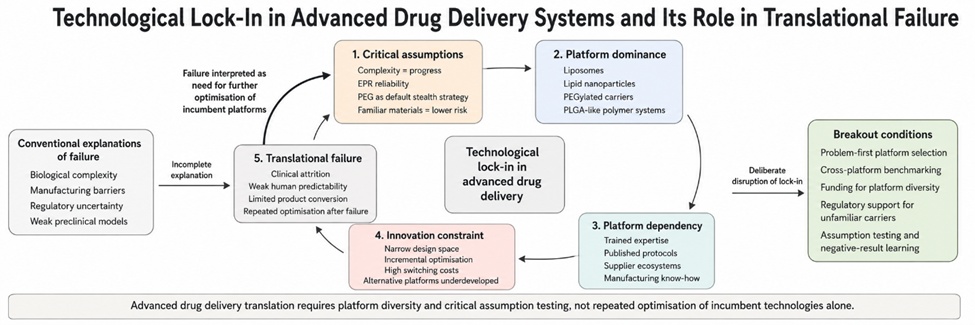
Figure 1. Critical Model of Technological Lock-In as a Self-Reinforcing Driver of Translational Failure in Advanced Drug Delivery Systems
The first implication is that advanced drug delivery design should begin with therapeutic-system fit rather than platform availability. A delivery system should be selected or invented by asking what the cargo, disease biology, route of administration, patient population, dosing logic, manufacturing pathway, and safety profile require [11]. This shifts evaluation away from whether a platform can be modified to work and toward whether it is the most appropriate architecture for the problem. Such a shift would make simplicity, controllability, and scalability stronger design virtues than novelty alone.
The second implication concerns funding and portfolio management. Funding agencies and translational programmes should support platform diversity rather than rewarding repeated incremental improvement of already dominant technologies [18]. This does not mean abandoning successful platforms; it means preventing success from becoming monopoly. Comparative funding mechanisms could require explicit justification for platform choice and encourage parallel development of divergent delivery architectures for the same therapeutic challenge.
The third implication is regulatory. Regulatory familiarity is valuable because it lowers uncertainty, but it should not become a hidden mechanism of technological conservatism [12]. Agencies and developers could work through pre-competitive initiatives to define quality, safety, and comparability expectations for emerging delivery classes before they are fully mature. By lowering the regulatory cost of unfamiliar platforms, the field can reduce one of the strongest structural advantages held by incumbents.
The fourth implication is cultural and methodological. Researchers should treat dominant assumptions as testable claims rather than inherited truths, especially when dealing with EPR-based targeting, PEGylation, animal-model predictivity, and platform generalisability [23]. Reporting standards, negative-result publication, and cross-platform benchmarking would make it harder for weak assumptions to survive through repetition alone. The goal is not anti-platform novelty, but disciplined pluralism in which platforms compete on translational fit rather than historical momentum.
This critical model should not be read as a complete explanation of translational failure. Advanced drug delivery systems fail for many reasons, including biological heterogeneity, inadequate safety margins, weak clinical endpoints, poor manufacturability, insufficient pharmacokinetic advantage, and commercial misalignment [2]. Technological lock-in interacts with these factors rather than replacing them. The model is therefore best understood as a systems-level lens for interpreting failure patterns that are otherwise attributed only to technical difficulty.
A second limitation is that the model is conceptual and requires empirical validation. Future studies could test whether platform dominance correlates with funding concentration, publication volume, clinical trial patterns, regulatory precedent, or reduced exploration of alternative design classes [16]. Such work would require bibliometric, patent, funding, clinical trial, and regulatory datasets rather than narrative synthesis alone. The present article provides the conceptual architecture, not the quantitative proof.
A third limitation is that incumbent platforms have produced important clinical successes and should not be caricatured as obstacles. Lipid nanoparticles, liposomes, PEGylated systems, and other established technologies have enabled therapies that would otherwise have been difficult or impossible to deliver [27]. The argument is not that dominant platforms are intrinsically flawed, but that dominance without critical comparison can become harmful. A mature field should be able to preserve platform strengths while resisting platform dependency.
Technological lock-in offers a necessary critical vocabulary for understanding why advanced drug delivery produces so much invention yet comparatively little durable clinical translation. The field has often interpreted translational failure as a problem of insufficient optimisation, when it may also reflect overdependence on a narrow set of incumbent platform logics. Recognising this pattern does not diminish the achievements of established technologies; it clarifies the conditions under which their success can become constraining.
The proposed model shows how critical assumptions stabilise dominant platforms, how platform dependency raises switching costs, and how innovation constraint contributes to translational failure. It also explains why failure may not automatically disrupt incumbents, because failed translation can generate calls for further refinement of the same platform rather than a broader reconsideration of design space. This feedback loop is the core danger of lock-in in advanced drug delivery.
A more resilient drug delivery ecosystem will require conscious platform diversification, stronger cross-platform comparison, regulatory support for unfamiliar technologies, and a cultural shift from platform-first formulation to problem-first translation. The future of the field should not be defined by abandoning successful platforms, but by preventing their success from narrowing the imagination of what delivery can become. Breaking lock-in is therefore not an anti-innovation critique; it is a condition for more serious, more diverse, and more clinically accountable innovation.
None
None
None
None
Open Access The author(s) retain copyright. This article is licensed under the Creative Commons Attribution-NonCommercial-ShareAlike 4.0 International License. It may be shared and adapted for non-commercial purposes with appropriate attribution, an indication of changes, and distribution of adaptations under the same license. Third-party material may be subject to separate terms identified in its credit line. View the license at https://creativecommons.org/licenses/by-nc-sa/4.0/.
 Publication System