Parkinson’s disease (PD) is a chronic and progressive neurodegenerative condition characterized by motor impairments such as tremors and stiffness, along with non-motor symptoms including cognitive decline and depression. While current dopaminergic therapies help manage symptoms, they do not halt the progression of the disease, underscoring the urgent need for treatments that can modify its course. This review explores the potential of repurposing drugs from diverse therapeutic categories—such as immunomodulators, cardiometabolic agents, and anti-infectives—to treat PD. Immunomodulatory compounds such as c-Abl inhibitors (e.g., imatinib and nilotinib) and sargramostim have shown potential to reduce α-synuclein buildup and brain inflammation, though clinical outcomes have been inconsistent. Among cardiometabolic drugs, glucagon-like peptide-1 (GLP-1) receptor agonists, such as exenatide, have shown promising results in improving motor and cognitive function, with phase III trials currently investigating their ability to slow disease progression. Some anti-infective agents, including doxycycline and rifampicin, offer neuroprotective benefits through anti-inflammatory and anti-aggregation mechanisms. Despite ongoing concerns regarding their effectiveness and potential side effects, these repurposed drugs represent promising avenues for PD treatment. Moreover, emerging strategies such as gene therapy, enzyme replacement therapy, and advanced drug-delivery technologies aim to target the underlying disease mechanisms directly. Although no definitive disease-modifying treatment exists yet, the investigation of repurposed and novel therapies provides optimism for future advancements. Further large-scale clinical studies are essential to confirm their safety and therapeutic value.
Parkinson’s disease (PD) is a progressive neurodegenerative disorder primarily caused by the degeneration of dopaminergic neurons in the substantia nigra (SN). These neurons are essential for producing dopamine, a neurotransmitter that regulates motor control, coordination, and several cognitive functions. As dopamine levels decline, individuals with PD experience classic motor symptoms (MS) such as tremors, muscle rigidity, slowed movement (bradykinesia), and postural instability, often leading to balance and gait issues. The rate of PD progression can vary significantly between individuals, though it typically worsens over time. While current research efforts are extensive, no cure or treatment can modify disease progression. Nevertheless, symptomatic therapies can provide significant relief and help improve patients’ quality of life (QoL) [1, 2].
Beyond the motor symptoms, PD is frequently accompanied by a wide range of non-motor symptoms (NMS), which can be just as disabling. These include speech and swallowing difficulties (dysarthria and dysphagia), mood disorders like depression and anxiety, sleep problems, and cognitive issues such as memory loss and impaired executive function. Other common NMS involve autonomic disturbances, including constipation and skin conditions like seborrhea [3–6]. The types and severity of symptoms vary widely among patients, complicating clinical care and adversely affecting overall outcomes.
In the United States, PD affects approximately 1 million people, with an average age of onset around 60 years [7]. The incidence rate is approximately 60,000 new cases per year [8]. Age is a significant risk factor, with prevalence affecting 1%–2% of people over 60 years and up to 4% in those over 80 years [9]. The disease is more common in men, with a male-to-female ratio of about 1.5:1 [10], and is seen more frequently in white individuals compared to other racial or ethnic groups [11]. With global life expectancy increasing, the number of PD cases is expected to rise, posing a growing public health concern [12, 13].
Considering the limitations of current treatments and the projected rise in PD prevalence, there is a critical need to identify new therapeutic strategies. One promising direction is drug repurposing—leveraging existing medications from fields such as cardiology and immunology for PD treatment. This strategy focuses on targeting novel biological pathways that may reduce symptoms or potentially alter disease progression. In this review, we examine recent advances in repurposing drugs, such as immunosuppressants and cardiovascular agents, for PD. Our goal is to shed light on these emerging therapies and their potential to transform PD care, ultimately improving patient outcomes and QoL.
At the molecular level, Parkinson’s disease (PD) is characterized by a complex interplay of factors, including abnormal protein accumulation, neuroinflammation, and oxidative stress driven by reactive oxygen species (ROS), all of which contribute to the degeneration of dopaminergic neurons in the substantia nigra (SN) (Figure 1). A defining pathological feature of PD is the presence of Lewy bodies (LBs), intracellular inclusions primarily composed of misfolded alpha-synuclein protein. These aggregates disrupt normal neuronal function, ultimately leading to cell death [14]. Notably, LBs are not unique to PD—they are also found in other neurodegenerative diseases such as multiple system atrophy (MSA) and dementia with Lewy bodies, where they are linked to both motor and cognitive deficits [15].
Alpha-synuclein, a 140 kDa protein encoded by the SNCA gene, is believed to play a role in synaptic function, including neurotransmitter release, vesicle transport, and maintenance of the presynaptic cytoskeleton [16–18]. Although its full physiological role remains unclear, it is thought to help preserve neuronal stability and regulate ion channels [18]. Research also implicates alpha-synuclein in managing oxidative stress and initiating apoptosis, particularly through its interactions with mitochondria—organelles essential for energy production and programmed cell death [19–22]. In rare familial forms of PD, mutations in the SNCA gene and other related genes increase disease risk by enhancing the formation of alpha-synuclein aggregates, suggesting a genetic susceptibility component in a condition mostly considered sporadic [23, 24].
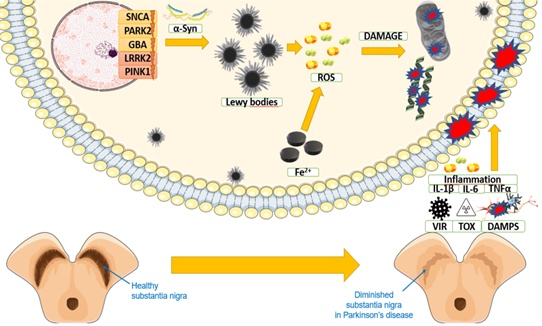
Figure 1. The complex molecular mechanisms involved in PD include genetic factors (e.g., SNCA, PARK2, LRRK2, PINK1, GBA), inflammatory cytokines (IL-1β, IL-6, TNFα), environmental toxins, and oxidative stress (ROS), all of which contribute to disease progression.
Importantly, Lewy bodies are not confined to the SN. They can also be detected in other brain regions such as the hippocampus, amygdala, hypothalamus, and several brainstem nuclei, including the locus coeruleus and the dorsal motor nucleus of the vagus nerve. In some patients, they extend into the neocortex and peripheral nervous systems, supporting the hypothesis proposed by Braak and Tredici—that PD pathology may begin outside the central nervous system and spread centrally.
Besides alpha-synuclein, Lewy bodies contain other proteins, such as tau, ubiquitin, neurofilaments, and potentially functional proteins, including 14-3-3, DJ-1, parkin, and LRRK2. The roles of these proteins in LB formation and stability remain incompletely understood but are believed to contribute to disease pathogenesis, making them potential therapeutic targets [25, 26].
Abelson tyrosine kinase (c-Abl) is a non-receptor protein tyrosine kinase involved in cellular responses to stress. Preclinical studies using PD animal models have shown that c-Abl activation contributes to the accumulation of misfolded alpha-synuclein and subsequent neuronal loss. These findings have identified c-Abl as a promising therapeutic target for slowing or potentially modifying disease progression [27].
Initially developed for treating chronic myeloid leukemia (CML) and gastrointestinal stromal tumors, imatinib was the first identified inhibitor of c-Abl tyrosine kinase. In preclinical studies using MPTP-induced mouse models of PD, imatinib exhibited significant neuroprotective effects. Specifically, administering 30 mg/kg of the drug reduced c-Abl phosphorylation levels and prevented dopaminergic neuronal degeneration [28].
A second-generation c-Abl inhibitor, nilotinib, offers improved selectivity and enhanced penetration across the blood-brain barrier. Clinical investigations into its use for PD have produced mixed results. A phase 2, placebo-controlled, double-blind study involving 63 participants found that nilotinib was safe and well-tolerated, with no significant adverse effects reported [29, 30]. However, the trial did not reveal any significant improvements in motor symptoms. A separate study echoed these safety findings but similarly failed to demonstrate any notable clinical benefits in motor or non-motor outcomes [31]. Despite the lack of symptom improvement, nilotinib was found to influence dopamine metabolism by increasing levels of dopamine metabolites, such as DOPAC and HVA, suggesting a possible biochemical effect that warrants further investigation [31].
Sargramostim is a recombinant form of granulocyte-macrophage colony-stimulating factor (GM-CSF) that stimulates the immune system by activating neutrophils, macrophages, and dendritic cells. Considering the role of immune dysfunction and mitochondrial impairment in PD, sargramostim has been explored as a potential long-term therapy [32, 33]. A phase 1 randomized, placebo-controlled trial showed that sargramostim was well tolerated, with mild side effects such as injection-site irritation and minor bone pain [34]. The treatment also led to an increase in regulatory T-cell (Treg) populations and improved MDS-UPDRS Part III motor scores after 6–8 weeks. A follow-up phase 1b study using a lower dose (3 mg/kg/day) reported fewer adverse effects without worsening of motor symptoms. However, larger trials are necessary to validate its therapeutic potential [35].
Rapamycin, an mTOR inhibitor commonly used to prevent organ transplant rejection, has shown potential in PD models. By inhibiting mTOR, rapamycin promotes autophagy, thereby facilitating the clearance of α-synuclein aggregates and reducing oxidative stress. These actions protect dopaminergic neurons from damage [36]. Studies using mice with mutations in the parkin and PINK1 genes indicate that rapamycin mitigates both muscle and mitochondrial deterioration associated with PD pathology [37]. Despite promising preclinical results, more robust clinical studies in humans are needed to assess its applicability in PD treatment.
Isoalantolactone is a naturally occurring sesquiterpene lactone known for its anti-inflammatory and anticancer effects. In experimental PD models, IAL has been shown to counteract amyloid beta-induced neurotoxicity and alleviate MPTP-induced PD-like symptoms [38, 39]. Its neuroprotective activity appears to be linked to the activation of antioxidant defenses, particularly via the Nrf2 signaling pathway [40]. IAL has also been observed to reduce neuroinflammation and preserve dopaminergic neurons. Although these findings are promising, further research is needed to fully clarify the mechanism of action and the potential therapeutic role in PD.
Commonly prescribed for relapsing forms of multiple sclerosis (MS), interferon beta (IFN-β) has also shown neuroprotective properties in PD models. It appears to reduce neuroinflammation and support the degradation of alpha-synuclein. IFN-β exerts its effects by influencing mitochondrial dynamics through the STAT5-PGAM5-Drp1 pathway, thereby protecting neurons from oxidative damage and apoptosis [41, 42]. Although preclinical studies demonstrate its potential to prevent dopaminergic neuron loss, further investigation is needed to fully understand its mechanisms and confirm its efficacy in clinical settings.
Exenatide, a glucagon-like peptide-1 (GLP-1) receptor agonist, is among the most extensively studied repurposed agents for PD. In an open-label trial, patients with moderate PD who received exenatide experienced a clinically relevant improvement in motor and cognitive symptoms, with a mean MDS-UPDRS score improvement of 2.7. At the same time, the control group showed a mean decline of 2.2 (P = 0.037) [43, 44]. Weight loss was the most frequently observed adverse effect. Another clinical study found that exenatide slowed disease progression, with participants exhibiting a mean improvement of 1.0 in MDS-UPDRS scores after 60 weeks of treatment (95% CI: -2.6 to 0.7) [45, 46]. The drug is currently in phase III trials, and ongoing studies are exploring its anti-inflammatory, antioxidant, anti-apoptotic, and neuroprotective effects [47]. Other GLP-1 agonists such as liraglutide and lixisenatide are in phase II development [48]. In preclinical models, semaglutide has shown encouraging results by reducing alpha-synuclein aggregation, improving motor function, and upregulating glial cell line-derived neurotrophic factor (GDNF) [43].
The connection between Parkinson’s disease and type 2 diabetes mellitus (T2DM) has been known since the 1960s. A meta-analysis of seven population studies found that individuals with T2DM had a 38% increased risk of developing PD [49, 50]. Research indicates that insulin resistance and disrupted insulin signaling are common in the brains of PD patients [47]. Observational findings show that people with PD tend to have reduced fasting insulin levels and a higher fasting plasma amylin/insulin ratio (FPAIR), the latter correlating modestly with non-motor symptoms (measured by the NMSS) [51]. Insulin supports neuronal health through the PI3K pathway, potentially protecting dopamine-producing neurons from glucose-related damage [52]. In animal studies, intranasal insulin promoted neurogenesis and decreased inflammation and oxidative stress [53]. However, phase II/III clinical trials in Alzheimer’s disease and mild cognitive impairment did not demonstrate significant functional or cognitive benefits from intranasal insulin treatment [54].
Simvastatin, due to its ability to cross the blood-brain barrier more effectively than other statins (e.g., pravastatin, rosuvastatin), has received particular interest for PD. Preclinical studies using 6-OHDA and MPTP-induced mouse models have shown that simvastatin provides neuroprotection [55]. While some cohort studies have associated simvastatin use with a reduced PD risk, other retrospective studies have yielded inconsistent results [56]. A large randomized controlled trial in the UK enrolled 235 PD patients to assess simvastatin’s potential as a disease-modifying treatment. Despite a robust study design, the results showed no benefit, leading to the discontinuation of further simvastatin trials for PD [57].
Metformin, a first-line drug for T2DM, has shown neuroprotective properties in laboratory and animal studies. These include reducing alpha-synuclein phosphorylation and aggregation, mitigating oxidative stress, preventing mitochondrial damage, enhancing autophagy via the AMPK pathway, and dampening glial cell activation [58, 59]. Despite these promising mechanisms, clinical meta-analyses have not consistently demonstrated a protective effect in humans, and in some cases, metformin monotherapy was associated with an increased PD risk [60]. Challenges such as poor brain bioavailability and potential long-term side effects may underlie these discrepancies. Researchers are currently exploring ways to stratify PD patients who may benefit from metformin, including those with idiopathic REM sleep behavior disorder, a known prodromal stage of PD [61, 62].
Sodium-glucose cotransporter-2 (SGLT2) inhibitors, also known as “flozins,” are antidiabetic agents that promote glucose excretion and may have neuroprotective effects through reducing oxidative stress and inflammation. Their mechanisms include inhibiting NADPH oxidase to lower ROS production, preserving mitochondrial function, and improving metabolic homeostasis [63]. In mouse models of PD, dapagliflozin was shown to improve motor symptoms, reduce oxidative stress, and decrease ROS-mediated apoptosis [64]. A population-based study comparing SGLT2 inhibitors to dipeptidyl peptidase-4 inhibitors (DPP4is) revealed that SGLT2 inhibitors were associated with a significantly lower risk of developing PD (HR = 0.28; 95% CI: 0.09–0.91; P = 0.0349) [65].
Ferroptosis, a form of cell death driven by iron accumulation, is increasingly recognized as a contributor to PD pathology. Elevated iron levels have been observed in the brains of PD patients. Deferiprone, an iron-chelating agent, has demonstrated neuroprotective effects in animal models by decreasing oxidative stress, improving motor performance, and maintaining dopamine concentrations [55, 66]. These promising preclinical and small-scale clinical results led to larger trials, such as the FAIR PARK II study, which involved 372 participants. However, subsequent findings indicated that deferiprone worsened motor symptoms in PD patients who had not yet begun dopaminergic therapy, casting doubt on its suitability as a viable treatment option [67, 68].
Epidemiological research has indicated a potential protective effect of CCBs—particularly isradipine—against PD. Despite this, the large STEADY-PD phase III trial, which enrolled 336 participants, did not find evidence that isradipine slows disease progression [56, 69]. While a slight delay in the need for antiparkinsonian medications was observed, issues such as insufficient dosage were noted as limitations [70]. Computational tools such as IBM Watson have highlighted nifedipine as another candidate; however, isolated case reports suggest it may induce Parkinsonism in specific individuals [71, 72].
The renin-angiotensin system (RAS) has been implicated in promoting neuroinflammation and oxidative stress in PD, making RAS-modulating drugs, such as ACE inhibitors and ARBs, potential candidates for disease-modifying therapy. Preclinical and observational data support the idea that agents like captopril and losartan not only reduce PD risk but also enhance L-DOPA efficacy without increasing dyskinesia [56, 73–77]. However, the current body of clinical evidence remains limited in both quantity and quality, underscoring the need for further controlled studies [72].
Minocycline, a second-generation tetracycline antibiotic, possesses excellent central nervous system (CNS) penetration due to its lipophilic nature, allowing it to accumulate in cerebrospinal fluid and brain tissue. It has demonstrated neuroprotective properties in PD by inhibiting inflammatory cytokines, limiting mitochondrial dysfunction, and suppressing microglial activation—key pathological features of PD [78]. In rodent models of PD induced by rotenone, minocycline provided minor motor benefits, but clinical trials in early-stage PD patients failed to demonstrate significant motor improvements [79].
Doxycycline, another second-generation tetracycline, is widely used to treat infections. Recent preclinical work shows that it can inhibit alpha-synuclein aggregation and reduce mitochondrial ROS production [80]. In studies involving transgenic mice expressing the human A53T variant of alpha-synuclein, daily treatment with doxycycline (10 mg/kg) for 30 days improved motor function, including gait and strength [81]. These findings highlight its potential in treating both motor symptoms and neurodegenerative changes in PD. A randomized, double-blind, placebo-controlled clinical trial (NCT05492019) is currently underway to investigate the drug’s effects on motor and cognitive function in levodopa-treated PD patients.
Geldanamycin, initially introduced as an anticancer agent, acts by inhibiting Heat Shock Protein 90 (Hsp90), which, in turn, induces the expression of Heat Shock Protein 70 (Hsp70). Hsp70 plays a crucial role in counteracting the misfolding and aggregation of α-synuclein, a key pathological hallmark in Parkinson’s disease (PD) [82]. In experimental PD models, particularly those involving MPTP-induced neurotoxicity, geldanamycin demonstrated a capacity to shield dopaminergic neurons by mitigating mitochondrial stress through Hsp70 upregulation [83]. Despite these neuroprotective properties, its clinical translation is limited by concerns about toxicity. Consequently, less toxic analogs such as 17-AAG, 17-DMAG, IPI-493, and retaspimycin are currently being evaluated in clinical trials for their therapeutic potential in PD [84].
Rifampicin, a well-established antibiotic used in the treatment of mycobacterial infections, has emerged as a candidate for the treatment of neurodegenerative diseases due to its anti-inflammatory, antioxidant, and anti-aggregative properties [84]. Preclinical research has shown that rifampicin can mitigate the neurodegenerative effects triggered by fibrillar α-synuclein aggregates [85]. In zebrafish models exposed to rotenone, rifampicin administration decreased neuronal apoptosis, attributed to reduced expression of pro-inflammatory cytokines such as IL-1β and IL-6, as well as attenuation of mitochondrial oxidative stress [86].
Ceftriaxone, a third-generation cephalosporin that crosses the blood-brain barrier, has shown neuroprotective effects in various CNS conditions. These effects are primarily linked to its ability to upregulate excitatory amino acid transporter 2 (GLT-1), which helps modulate glutamate homeostasis and reduce excitotoxicity [87]. In MPTP-induced rat models of PD, prolonged administration of ceftriaxone (200 mg/kg) significantly enhanced motor performance and lowered oxidative stress markers. Additionally, it suppressed neuroinflammation by downregulating glial fibrillary acidic protein (GFAP), Toll-like receptor 4 (TLR4), and pro-inflammatory cytokines, including IL-1β, TNF-α, and IL-6 [88]. A phase II double-blind, placebo-controlled clinical trial is currently assessing its safety and efficacy in patients with PD dementia (NCT03413384).
Niclosamide, widely used as an anthelmintic, has shown considerable potential to modulate neurodegenerative pathways. It influences mitochondrial function and key signaling axes such as mTOR and JAK/STAT3 [89]. Notably, niclosamide activates PTEN-induced kinase 1 (PINK1), which plays a protective role in autosomal recessive forms of PD by maintaining mitochondrial quality control [90]. Additionally, it has been shown to promote neurite growth in dopaminergic neurons and confer resistance to α-synuclein-induced degeneration by activating the BMP-Smad signaling cascade [91]. Despite these promising findings, further studies in animal models are necessary to evaluate its in vivo efficacy and safety profile.
In conclusion, repurposing existing pharmacological agents offers a promising avenue for Parkinson’s disease therapy, especially given the time and cost constraints of novel drug development. Immunomodulatory agents, such as c-Abl inhibitors (e.g., imatinib and nilotinib), target α-synuclein aggregation and cellular stress, although their clinical benefits remain uncertain. Cardiometabolic drugs, particularly GLP-1 receptor agonists such as exenatide, have demonstrated robust effects on both motor and cognitive symptoms and may hold disease-modifying potential. Meanwhile, several anti-infective drugs—including minocycline, doxycycline, and rifampicin—exhibit neuroprotective effects by modulating inflammation and protein aggregation pathways. However, clinical translation remains challenging due to inconsistent efficacy data and concerns about toxicity. Therefore, comprehensive clinical trials and mechanistic investigations are essential to validate the therapeutic roles of these repurposed agents and develop targeted treatment strategies for PD.
None
None
None
None
Open Access The author(s) retain copyright. This article is licensed under the Creative Commons Attribution-NonCommercial-ShareAlike 4.0 International License. It may be shared and adapted for non-commercial purposes with appropriate attribution, an indication of changes, and distribution of adaptations under the same license. Third-party material may be subject to separate terms identified in its credit line. View the license at https://creativecommons.org/licenses/by-nc-sa/4.0/.
 Publication System