Most pharmaceutical manufacturing technologies are conceived in environments where electricity, purified water, skilled operators, calibrated instruments, and validated supply chains are treated as stable background conditions. These assumptions shape equipment selection, process control, formulation strategy, packaging design, and quality assurance architecture. When such technologies are transferred unchanged into low-resource environments, the hidden dependence on high-resource infrastructure becomes visible. The central problem is not simply scarcity but design-context mismatch. Technologies that require continuous utilities, specialist maintenance, narrow environmental control, or complex analytical confirmation may produce avoidable quality deviations, production interruptions, and inequitable access. Low-resource manufacturing therefore requires a design logic that begins with constraints rather than adapting to them after failure. The proposed approach translates infrastructure, workforce, supply-chain, and quality-system constraints into design requirements. It argues for simple, robust, modular, maintainable, and environmentally tolerant technologies that preserve critical quality attributes without requiring fragile operating conditions. Three tables support the framework by cataloguing constraints, technology principles, and decision logic. Frugal pharmaceutical design is not a lowering of standards. It is a disciplined method for building quality into technologies that must function where conventional manufacturing assumptions do not hold. Its wider adoption requires pharmaceutical scientists, regulators, global health practitioners, and local manufacturers to treat low-resource design as a legitimate and necessary branch of pharmaceutical technology.
Pharmaceutical access in many low- and middle-income countries depends on supply systems that are vulnerable to import dependence, fragile logistics, weak regulatory capacity, and uneven local production capability. Studies of medicine quality and procurement in resource-constrained settings show that access failures are not only commercial or political but also technological, because products and processes often presuppose industrial ecosystems that are absent or unreliable [1]. Mackintosh and colleagues describe health-sector procurement in East Africa as a potential developmental linkage, yet such linkage requires production technologies that local firms can realistically operate and sustain [2]. A framework for pharmaceutical technology in these settings must therefore address manufacturing feasibility and public-health equity together.
Conventional technology transfer often treats the receiving environment as a smaller version of the originating high-resource site. This is a flawed assumption because electricity interruptions, humidity excursions, limited maintenance capacity, erratic excipient supply, and constrained analytical infrastructure can convert otherwise validated technologies into fragile systems. Evidence from medicine quality studies shows that substandard and falsified medicines impose a substantial burden in low- and middle-income countries, making manufacturing reliability and quality oversight inseparable from access policy [3]. The relevant question is not whether global standards should be relaxed, but how technologies can be designed so that meeting standards is possible under constrained operating conditions.
Frugal innovation provides a useful conceptual entry point because it treats scarcity as a design parameter rather than a defect of the user environment. Bianchi and colleagues define healthcare frugal innovation as a problem-solving logic under scarcity, while Bhatti and colleagues describe how resource-constrained healthcare solutions can generate reverse innovation for high-income systems [4, 5]. Later reviews emphasise that frugality is not merely cost reduction, but a disciplined focus on essential function, affordability, simplicity, and contextual fit [6, 7]. Pharmaceutical technology has not yet fully translated these principles into a dedicated design framework for low-resource manufacturing.
This article aims to construct a frugal system design framework for pharmaceutical technologies in low-resource manufacturing environments. The framework draws on literature concerning frugal healthcare innovation, field medicine-quality screening, decentralised production, three-dimensional printing, and regulatory strengthening [8-11]. It is written as a conceptual framework article, not as an empirical study, and it proposes design logic that begins with constraint mapping and ends with quality-integrated implementation. The central argument is that pharmaceutical quality can be protected more reliably when technologies are designed from the outset for resource scarcity.
Low-resource pharmaceutical manufacturing environments are marked by constraints that affect both product design and process control. Intermittent electricity may interrupt mixing, compression, drying, cooling, lighting, and environmental monitoring, while limited purified water capacity may make water-intensive or sterile liquid processes especially vulnerable. Absence of skilled maintenance staff increases downtime when imported equipment requires proprietary servicing, and weak spare-parts supply chains can turn minor mechanical failures into long production stoppages. These constraints mirror broader regulatory and infrastructure weaknesses identified in global analyses of medical product systems [12].
The problem becomes sharper when technologies depend on tightly controlled environments that are expensive to maintain. Extreme heat and humidity can compromise moisture-sensitive tablets, capsules, powders, reagents, and packaging materials, while weak cold chains can undermine products that require refrigerated storage. Field studies on medicine quality screening demonstrate that real-world distribution and storage environments often require portable, resilient methods for detecting degradation or falsification rather than relying only on central laboratory confirmation [9, 13]. These findings imply that design for low-resource manufacturing must anticipate environmental stress before the product reaches patients.
Technology transfer failures are often described as failures of training or compliance, but that interpretation can obscure the design roots of the problem. If a manufacturing process requires uninterrupted utilities, high-purity inputs, complex calibration, and expert troubleshooting, then poor performance in a low-resource site may reflect inappropriate design rather than deficient operators. Work on decentralised cell and gene therapy manufacturing has similarly shown that moving production closer to patients creates new operational requirements that cannot be solved by copying centralised manufacturing models [10, 14]. Pharmaceutical technologies intended for constrained settings must therefore be evaluated by their operational tolerance, not only by their theoretical capability.
Quality lapses in resource-constrained settings also reveal the limits of end-product testing as the primary safeguard. The high prevalence and economic burden of substandard and falsified medicines in low- and middle-income countries shows that surveillance systems must function despite limited laboratory capacity [3]. Portable screening, simplified inspection, and field-deployable analytical strategies have emerged because conventional laboratory-intensive models are too slow, expensive, or geographically concentrated for many settings [15, 16]. The root cause is not the low-resource environment itself but the mismatch between pharmaceutical systems designed for stability and environments defined by instability.
The first category of constraints concerns infrastructure. Unreliable electricity, limited clean water, inadequate heating, ventilation, and air-conditioning, and weak waste-management systems directly shape which dosage forms and unit operations are feasible. A process that depends on continuous cooling, high-energy drying, or frequent water-for-injection preparation may be inappropriate where utilities are intermittent or expensive. Studies of portable medicine quality tools show that technical systems become more usable in constrained environments when they reduce dependence on centralised infrastructure and intensive laboratory support [8, 9].
The second category concerns human resources and maintenance capacity. Technologies that require expert operators, frequent calibration, imported spare parts, or vendor-dependent servicing are fragile when local technical support is limited. Frugal innovation literature repeatedly emphasises simplicity, maintainability, and contextual adaptation as core requirements rather than secondary conveniences [4, 6, 17]. For pharmaceutical manufacturing, this means designing equipment interfaces, cleaning procedures, in-process controls, and failure modes so that essential quality functions can be understood and maintained by trained non-specialists.
The third category concerns supply chains and material variability. Low-resource manufacturers may face delayed excipient shipments, variable packaging quality, limited supplier qualification options, and exposure to counterfeit or poor-quality inputs. Decentralised and personalised medicine technologies, including pharmaceutical three-dimensional printing, illustrate both the promise and the risk of more distributed production because material control, process reproducibility, and quality verification must travel with the technology [11, 18, 19]. A frugal design requirement is therefore to prefer formulations and processes that tolerate realistic input variability while still protecting critical quality attributes.
The fourth category concerns regulatory and quality oversight, where limited laboratory capacity and fragmented post-market surveillance can delay detection of quality defects. Simplified visual inspection, portable screening devices, and field evaluation studies show how quality systems can be strengthened when analytical strategies are adapted to context rather than confined to central laboratories [15, 20-22]. Table 1 catalogues the typical constraints in low-resource manufacturing environments and their direct implications for pharmaceutical design. These constraints should be treated as starting specifications for pharmaceutical development, not as implementation problems discovered after technology transfer.
Table 1. Constraints in Low-Resource Pharmaceutical Manufacturing Environments: Infrastructure, Human Resources, Supply Chain, and Regulatory Limitations
Constraint domain | Typical low-resource constraint | Pharmaceutical design risk | Positive design requirement |
Electricity and utilities | Intermittent power, voltage fluctuation, limited backup generation | Interrupted mixing, drying, compression, cooling, and monitoring | Select low-energy unit operations, tolerate short interruptions, and use manual or battery-supported critical controls |
Water and sanitation | Limited purified water generation, unreliable water quality, constrained cleaning infrastructure | Microbial contamination, cleaning failure, process interruption, excessive validation burden | Prefer dry or low-water processes, simplify cleaning, minimise water-intensive operations, and design closed or easy-clean equipment |
Climate and storage | High heat, humidity, dust, and weak cold-chain control | Degradation, moisture uptake, packaging failure, reduced shelf life | Prioritise ambient-stable formulations, moisture-protective packaging, desiccants, and stability-indicating controls |
Workforce and maintenance | Limited skilled operators, scarce engineers, weak vendor support | Operator error, prolonged downtime, calibration failure, inconsistent batch records | Use intuitive equipment, robust operating ranges, modular parts, local repairability, and simple training materials |
Supply chain | Delayed excipients, unreliable spare parts, fragmented distribution, variable packaging inputs | Batch delays, reformulation pressure, substitution risks, quality variability | Use locally available materials where suitable, qualify alternative suppliers, reduce proprietary dependencies, and build formulation tolerance |
Analytical capacity | Few laboratories, limited instruments, delayed confirmatory testing | Slow release decisions, weak deviation investigation, delayed defect detection | Combine in-process controls, simplified tests, portable screening, and risk-based confirmatory testing |
Regulatory oversight | Limited inspection resources, uneven dossier review capacity, fragmented surveillance | Inconsistent GMP enforcement, delayed approvals, weak post-market control | Use transparent quality-by-design dossiers, reliance pathways, regional harmonisation, and practical post-market surveillance tools |
Financial resources | Restricted capital expenditure and operating budgets | Under-maintained equipment, unaffordable consumables, interrupted quality systems | Reduce lifecycle cost, avoid consumable-heavy designs, prioritise essential functions, and design for scalable investment |
Frugal innovation begins by separating essential pharmaceutical function from inherited technological complexity. In healthcare, frugal design has been characterised as problem solving under scarcity, not as inferior substitution, because it asks which functions are indispensable and which resource demands are avoidable [4]. This distinction is critical for pharmaceutical technologies, where simplification must never remove controls that protect identity, strength, purity, stability, and performance. The design task is therefore to simplify the route to quality rather than simplify quality itself.
A frugal pharmaceutical technology should use locally serviceable equipment, locally obtainable non-critical materials where scientifically justified, and operating procedures that can be mastered without a large expert workforce. The medical-device literature shows that resource-constrained innovation often succeeds when products are repairable, understandable, and embedded in the user environment rather than dependent on distant technical ecosystems [17, 23]. In pharmaceutical settings, this means designing with maintenance, calibration, cleaning, documentation, and operator training as primary design variables. The aim is a technology that remains safe and reproducible after the external support team has left.
Frugal design aligns naturally with Quality-by-Design when the design space is defined by scarcity rather than by idealised plant capability. Reviews of frugal innovation emphasise affordability, robustness, focus on core function, and contextual fit, while pharmaceutical development requires systematic understanding of how material attributes and process parameters affect product quality [6, 7]. The constrained design space should therefore identify not only acceptable process ranges but also acceptable infrastructure ranges, operator skill ranges, and supply-chain variation. In this view, frugality becomes a disciplined extension of pharmaceutical development science.
Robust technology selection should favour unit operations with wide operating windows, low utility dependence, and clear failure signals. Direct compression, dry blending, simple encapsulation, non-sterile liquids where appropriate, and ambient-stable dry powders are often more compatible with constrained settings than processes requiring prolonged wet massing, precision drying, aseptic filling, or continuous cold storage. Pharmaceutical three-dimensional printing illustrates how novel production platforms can decentralise medicine production, but it also shows that material control, process validation, and reproducibility must be built into the platform rather than assumed [11, 18]. Frugal technology selection is therefore not anti-innovation; it is selective innovation.
Scalability in low-resource environments should be horizontal as well as vertical. A technology that can be replicated in multiple small modules may be more resilient than a single high-throughput line that fails completely when one critical component breaks. Decentralised manufacturing studies in advanced therapies have shown that moving production closer to patients requires careful rethinking of equipment, quality systems, logistics, and operator roles [10, 16, 24]. For conventional pharmaceuticals, modularity can support regional resilience by allowing production to continue despite localised power, staffing, or supply interruptions.
Figure 1 illustrates how low-resource manufacturing constraints should be redistributed into robust product, process, packaging, equipment, analytical, and governance design choices rather than treated as external implementation problems.
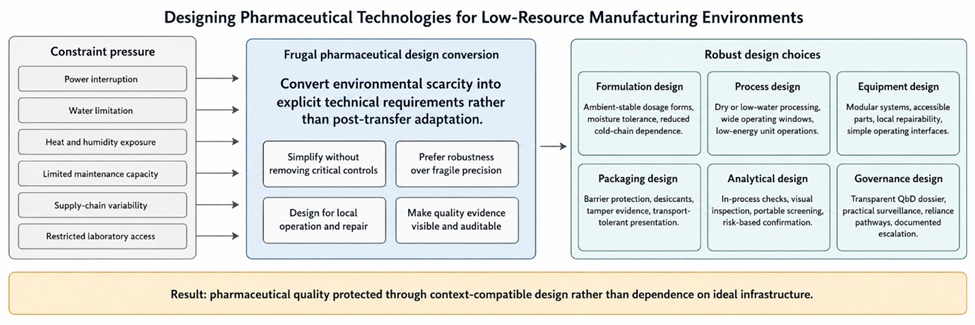
Figure 1. Redistribution of Low-Resource Manufacturing Constraints into Robust Pharmaceutical Design Choices
Packaging and formulation must carry part of the burden normally assigned to infrastructure. Ambient-stable dosage forms, desiccant-supported packs, moisture barriers, simple tamper evidence, and transport-tolerant presentations can reduce dependence on cold chains and tightly controlled warehouses. Case studies of printed medicines and capsule-filling approaches show that compact, simplified production systems can be designed around specific product formats, but quality control must remain integrated with the manufacturing concept [25, 26]. Table 2 maps robust and scalable technology principles to specific pharmaceutical unit operations and product types.
Table 2. Robust and Scalable Technology Principles for Low-Resource Pharmaceutical Manufacturing: Unit Operations, Equipment, and Formulation Strategies
Technology principle | Preferred low-resource expression | Suitable pharmaceutical applications | Quality protection logic |
Low utility dependence | Manual, semi-automatic, or low-energy mixing, filling, compression, and packaging | Oral solids, powders, non-sterile liquids, topical preparations | Reduces exposure to power interruption and lowers infrastructure burden |
Wide operating window | Processes tolerant of moderate variation in temperature, humidity, and operator timing | Direct compression tablets, hard capsules, sachets, dry blends | Protects reproducibility when environmental control is imperfect |
Dry or low-water processing | Dry blending, direct compression, capsule filling, dry granulation where justified | Moisture-sensitive products and facilities with limited purified water | Reduces microbial risk, cleaning burden, and dependence on water systems |
Modular scale-out | Replicable small production modules instead of a single complex high-capacity line | Regional essential medicine production and decentralised compounding models | Allows capacity expansion without catastrophic single-point failure |
Local maintainability | Simple drives, accessible parts, replaceable modules, and transparent operating interfaces | Mixers, tablet presses, capsule fillers, packaging devices | Shortens downtime and reduces dependence on imported service contracts |
Passive stability support | Barrier packaging, desiccants, light protection, tamper evidence, and robust closures | Tablets, capsules, powders, dry oral reconstitution products | Transfers environmental protection from active infrastructure to product-package design |
Integrated in-process control | Weight checks, blend uniformity surrogates, visual inspection, simple identity tests | Small-batch solids, liquids, and decentralised production platforms | Detects drift during production rather than relying only on delayed end-product testing |
Platform standardisation | Reusable formulation and equipment platforms for multiple essential medicines | Fixed-dose combinations, paediatric strengths, local essential medicine lists | Reduces training burden, validation duplication, and procurement complexity |
Quality assurance in low-resource environments must be risk-based because exhaustive central laboratory testing may be slow, expensive, or unavailable. Field evaluations of medicine quality screening devices show that portable technologies can support triage, surveillance, and rapid decision-making, but they should be interpreted as part of a layered system rather than as full replacements for confirmatory testing [9, 13, 16]. A pragmatic quality model should combine strong process understanding, simple in-process controls, field screening, and selective laboratory confirmation. This approach protects patients while recognising the real limits of infrastructure.
Visual inspection, simplified checklists, portable spectroscopy, and compact analytical devices can strengthen quality systems when they are matched to local skills and decision needs. Schiavetti and colleagues showed that a simplified checklist can empower frontline workers to identify suspicious finished products, while subsequent studies have explored the usefulness and field performance of screening tools for post-market surveillance [15, 21]. White analytical chemistry evaluations further show that medicine quality tools should be judged not only by analytical performance but also by environmental impact, cost, usability, and operational feasibility [22]. These criteria are directly relevant to low-resource manufacturing quality control.
Regulatory oversight also needs frugal system design because weak regulatory capacity cannot be solved by adding paperwork alone. Global analyses of regulatory systems argue that sustainable strengthening requires investment priorities, reliance models, workforce development, and practical tools that match national capacity [12]. For manufacturers, this means that dossiers should make process understanding visible, justify simplified control strategies, and specify when portable or reduced testing is scientifically acceptable. Quality assurance under constraint should be transparent, evidence-based, and auditable, not informal or improvised.
The proposed Frugal System Design Framework begins with context mapping and constraint analysis. Before selecting a dosage form, equipment train, or packaging system, developers should document utility reliability, water availability, workforce capability, spare-parts access, excipient supply, climate exposure, analytical capacity, and regulatory pathways. This step draws from frugal innovation theory, which treats scarcity as a source of design information, and from global medicine-quality literature, which shows that weak systems create predictable risks when ignored [1, 3, 4]. The output is a constraint profile that becomes part of the pharmaceutical development brief.
The second step is design requirement translation. Each constraint must be converted into a positive technical requirement, such as ambient stability where cold chains are weak, low-water processing where purified water is limited, or modular repairability where technical maintenance is scarce. Decentralised manufacturing research demonstrates that production models must be redesigned when the site of manufacture changes, because quality, logistics, workforce, and equipment interactions change together [10, 24]. A frugal pharmaceutical requirement is therefore not merely a lower-cost version of a conventional requirement; it is a context-specific route to the same quality objective.
The third and fourth steps are frugal technology selection and integrated quality planning. Developers should compare candidate technologies using criteria such as utility demand, skill burden, environmental tolerance, local maintainability, supply-chain resilience, validation complexity, and analytical feasibility. Evidence from pharmaceutical three-dimensional printing, print-and-fill capsules, and personalised medicine production shows that compact technologies can support flexible manufacturing, but only when control of materials, process parameters, and final product performance is deliberately engineered [18, 19, 25-27]. Table 3 presents the proposed Frugal System Design Framework with its core components and decision logic.
Table 3. Frugal System Design Framework for Pharmaceutical Technologies in Low-Resource Settings: Steps, Decision Criteria, and Quality Integration Points
Framework step | Core activity | Decision criteria | Quality integration point |
Context mapping | Characterise infrastructure, workforce, supply chains, climate, analytical capacity, and regulatory setting | Is the technology compatible with real operating conditions rather than ideal plant assumptions? | Define site-specific risk profile and critical contextual variables |
Constraint-to-requirement translation | Convert each limitation into a positive product, process, or packaging requirement | Does each design requirement directly answer a documented constraint? | Link constraints to critical quality attributes and critical process parameters |
Frugal technology selection | Compare formulation platforms, unit operations, equipment, and packaging options | Which option provides essential function with the lowest avoidable complexity and highest robustness? | Use a decision matrix incorporating utility demand, skill burden, validation burden, and failure detectability |
Quality-by-design adaptation | Establish constrained design space, control strategy, and acceptable operating ranges | Can quality be maintained despite realistic variation in utilities, materials, operators, and environment? | Integrate material attributes, process parameters, in-process controls, and simplified release tests |
Analytical strategy design | Combine in-process checks, portable screening, visual inspection, and confirmatory laboratory testing | Which tests are essential locally, and which require referral or periodic confirmation? | Define tiered testing rules, escalation triggers, and documentation requirements |
Implementation and training | Prepare operator procedures, maintenance routines, deviation pathways, and spare-parts plans | Can trained non-experts operate and maintain the system safely? | Validate training effectiveness and document human-factor risks |
Iterative field validation | Pilot under real low-resource conditions and revise the design | Does the system remain robust during power fluctuation, climate stress, supply delays, and staff turnover? | Feed field deviations into risk review, control strategy updates, and regulatory communication |
The final step is iterative field validation. Rather than assuming that laboratory or pilot-plant success predicts performance in constrained settings, developers should test the system under realistic operating stress and revise the design accordingly. Field detection studies, including work on falsified chloroquine during the COVID-19 pandemic, show that quality risks evolve rapidly when supply chains are disrupted and surveillance is weak [28]. The framework therefore treats field learning as part of pharmaceutical design, while remaining aligned with the logic of ICH Q8, Q9, and Q10 through risk management, process understanding, and continual improvement.
Figure 2 presents the Frugal System Design Framework as a sequential design logic that converts low-resource constraints into pharmaceutical technology requirements, robust technology choices, quality-by-design adaptation, tiered analytical strategy, and iterative field validation.
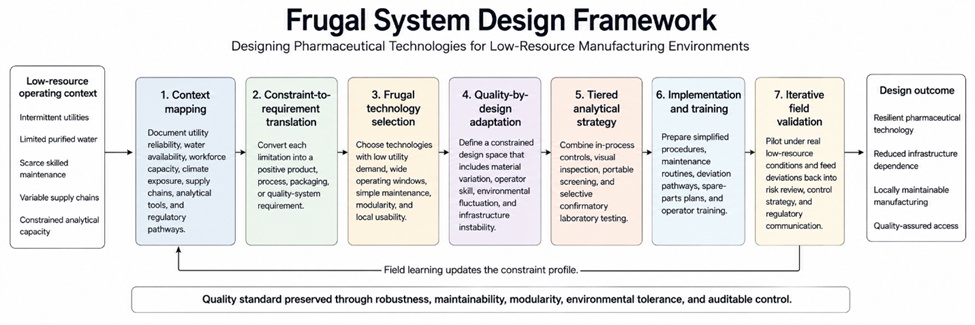
Figure 2. Frugal System Design Framework for Pharmaceutical Technologies in Low-Resource Manufacturing Environments
Translation should begin through partnerships with local manufacturers, universities, public procurement agencies, and regulators. Local production can create developmental linkages only when procurement systems recognise and reward quality-capable domestic manufacturing rather than selecting solely on short-term price [2]. Pilot programmes should therefore pair technology transfer with workforce training, maintenance planning, supplier qualification, and post-market surveillance. This creates a pathway in which frugal technologies are validated in the environments for which they are intended.
Regulatory translation requires reliance, harmonisation, and evidence packages that make frugal design scientifically credible. Regulatory strengthening literature emphasises that medical product systems need practical investment in review capacity, inspection systems, and post-market surveillance, especially in countries with constrained resources [12]. A frugal pharmaceutical dossier should explain why a simpler process, portable analytical tool, or reduced testing scheme remains adequate for the product’s risk profile. Such transparency can support accelerated or collaborative review without asking regulators to accept lower standards.
Education and funding mechanisms are also necessary for translation because most pharmaceutical science curricula still teach manufacturing as if high-resource infrastructure were universal. Frugal healthcare and medical technology scholarship shows that resource-constrained design can generate globally relevant innovations, including reverse innovations that later inform high-income settings [5, 17, 27]. Funding calls should therefore support formulation platforms, low-energy equipment, portable quality tools, and implementation research specifically designed for constrained manufacturing environments. Pharmacy, engineering, and regulatory science programmes should train graduates to design for scarcity as a normal professional competence.
Designing pharmaceutical technologies for low-resource environments is a distinct discipline, not a marginal adaptation of conventional manufacturing. It requires developers to begin with unstable electricity, limited water, scarce maintenance capacity, fragile supply chains, extreme climate exposure, and constrained regulatory oversight as design inputs. When these realities are ignored, technology transfer becomes brittle and quality becomes harder to sustain.
The Frugal System Design Framework proposed here offers a practical way to convert constraints into technical requirements, select robust technologies, and integrate quality assurance from the beginning. Its central claim is that simplicity, maintainability, modularity, and environmental tolerance can strengthen pharmaceutical quality when they are deliberately engineered. Frugal design is therefore not a compromise with poor settings but a route to resilient quality under real-world conditions.
The next stage is validation through case studies, pilot partnerships, and policy incentives that test the framework across dosage forms and manufacturing contexts. Pharmaceutical scientists, global health practitioners, local manufacturers, funders, and regulators should collaborate to build evidence for technologies that are affordable, scalable, and quality-assured. A serious commitment to equitable medicine access requires manufacturing paradigms designed for the environments where unmet need is greatest.
None
None
None
None
Open Access The author(s) retain copyright. This article is licensed under the Creative Commons Attribution-NonCommercial-ShareAlike 4.0 International License. It may be shared and adapted for non-commercial purposes with appropriate attribution, an indication of changes, and distribution of adaptations under the same license. Third-party material may be subject to separate terms identified in its credit line. View the license at https://creativecommons.org/licenses/by-nc-sa/4.0/.
 Publication System