Herbal substances have long been used as drugs of abuse, with traditional addictive substances like opium and cannabis often being derived from natural, crude plant materials. Cannabinoids and cathinones, for example, are natural derivatives. However, the safety and efficacy of these substances remain significant concerns that require attention and increased awareness. This review highlights various plants, including khat, kratom, salvia, and mandrake, to inform both experts and the general public about the potential risks associated with regular use and synthetic derivatives. Some of these “herbal plants” should be recognized as harmful substances, as prolonged use has been linked to addiction and cognitive impairments. Despite ongoing research, there is still a lack of comprehensive studies addressing these issues. This paper explores the toxicological concerns and key safety risks associated with plant-based products. Ensuring the safety and reliability of herbal remedies is of paramount importance, given ongoing concerns about their use.
The use of plant-based psychoactive substances has become increasingly prevalent, with growing interest in the ingestion of various plant parts. Historically, these substances were central to religious rituals in ancient civilizations. Today, many of these herbal products are widely available online, with few legal restrictions [1]. The use of herbal medicines and their derivatives has been rapidly expanding across the globe, especially for managing various health issues. In many developing regions, herbal remedies remain the primary source of healthcare and traditional medical practices [2]. In addition, herbal medicines have gained significant traction as part of complementary and alternative medicine, often focused on promoting healthy living. While herbal medicines are viewed as a balanced and natural approach to healing, safety concerns surrounding their use persist. Many herbal products, including extracts derived from them, remain untested and inadequately regulated. A lack of quality control measures further compromises the safety of these products, underscoring the need to assess and mitigate the risks associated with their use [3].
The exploitation of plant-based drugs has a long history, with substances like coca, opium, and cannabis being used in religious ceremonies and for pain relief purposes [4]. In modern markets, these substances are often marketed as “designer drugs” or “herbal highs.” There are numerous examples of such products, including those derived from plants like Rhizoma Corydalis, which can be used to prevent long-term drug dependence. Alkaloids from Uncaria rhynchophylla have been found effective against addiction to ketamine and methamphetamine. Radix Pueraiae and Salvia miltiorrhiza are known to inhibit alcohol consumption, and Sinomenine has therapeutic effects on opioid addiction. Alkaloid extracts from Stephania intermedia, such as l-Stepholidine, have been shown to reduce morphine-induced conditioned place preference [5]. Though many psychoactive substances are synthetic, they are often derived from natural sources. Synthetic cannabinoids, for example, are counterparts to the naturally occurring cathinone and Δ9-tetrahydrocannabinol from khat and cannabis, respectively. However, the toxicity of these plant-based substances remains insufficiently understood [6]. While some studies have begun investigating these risks, there is still a lack of comprehensive research on this topic [7]. This review aims to examine traditional plant-based drugs such as coca, opium, and cannabis, and to highlight the fact that some “herbal highs” should be considered harmful due to their potential for addiction and cognitive impairment.
Despite their potential for abuse, many herbal products are mistakenly believed to be safe and legal. This misconception is exacerbated by the growing marketing and media visibility of these products, which makes them more accessible, especially to young adults and teenagers. Health professionals must remain vigilant about this growing issue. This review will explore plant-based psychoactive substances derived from various plants and discuss their potential for abuse and related health risks (Figure 1).
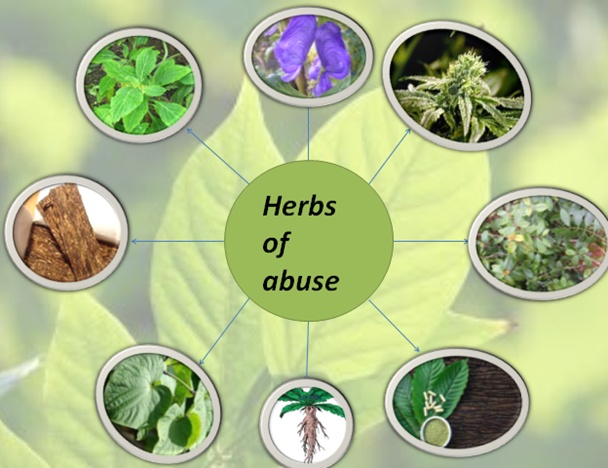
Figure 1. Plants known for drug abuse.
Salvia divinorum, a plant with short-lived psychoactive effects, is often consumed by chewing, smoking, or brewing in tea. When smoked or ingested in liquid form, its leaves contain opioid-like derivatives that induce hallucinations [8]. The active compound, Salvinorin A, is a potent hallucinogen that interacts with the κ-opioid receptor and is being researched for its potential in treating cocaine addiction [9]. At low doses, Salvinorin A induces profound hallucinations and dissociative effects [10]. It is typically consumed in doses of 200–500 micrograms, which induce immediate effects such as loss of physical control and film-like hallucinations [11-14]. When chewed, the leaves release salvinorin A, which is rapidly metabolized into its inactive form, salvinorin B [15, 16]. Short-term effects of Salvia use include uncontrollable laughter, mood swings, disorientation, and impaired speech and coordination (Table 1).
Table 1. Details of plants known for drug abuse
S. No. | Plant name | Common name | Part used | Chemical constituent | Commonly used as |
1. | Salvia divinorum | Khat | dried leaves | Salvinorin A | Hallucinogen |
2. | Cannabis sativa | Hemp | leaves | delta9-tetrahydrocannabinol and cannabidiol | Psychoactive |
3. | Mitragyna speciosa | Kratom | leaves | mitragynine and 7-hydroxy mitragynine | Stimulant |
4. | Piper methysticum | Kava | dried root and rhizome | Kava lactones | Euphoric |
5. | Aconitum carmichaeli | Aconite | Roots | Aconitine | Analgesic |
Cannabis sativa has two major compounds: delta-9-tetrahydrocannabinol (THC) and cannabidiol (CBD). THC is the primary compound responsible for cannabis addiction due to its psychoactive effects. Some studies suggest that THC may induce a lower dopamine release compared to stimulants like amphetamine or methylphenidate, but its exact mechanism in this regard remains unclear [17]. THC is the principal compound that produces the “high” sensation and is available in various forms, such as oils, edibles, tinctures, and capsules. While both THC and CBD interact with the body’s endocannabinoid system, they cause different effects. Although cannabis and its compounds are widely used for treating various medical conditions, their effectiveness in some instances is still debated [18]. Cannabis has yielded over 113 cannabinoids, with tetrahydrocannabinol being one of the most studied. The FDA has approved several medications that contain isolated cannabinoids, but has not recognized cannabis itself for any medical use. These medications are used primarily to treat side effects of chemotherapy, specific epilepsy types, and to increase appetite and prevent weight loss [19].
Kratom is a concentrated form of the leaves from Mitragyna speciosa, typically consumed in pill or powder form. It can be chewed for its stimulant effects and is sometimes brewed as tea. At higher doses, it mimics the effects of opioid drugs like heroin [12]. Due to its addictive nature, the FDA is actively monitoring kratom supplements. Side effects include nausea, dry mouth, itching, and insomnia. The active components of kratom, such as mitragynine and 7-hydroxymitragynine, bind to opioid receptors in the brain and act as partial agonists at the μ-opioid receptor. Studies suggest that 7-hydroxymitragynine has a significantly higher binding affinity for this receptor compared to mitragynine [16]. Kratom’s alkaloid content can vary by strain, and it is often mixed with other psychoactive substances to enhance its effects. Animal studies using the conditioned place preference test have suggested that kratom’s active compounds may be misused, with 7-hydroxymitragynine showing reward-like effects.
Kava, derived from the root of Piper methysticum, is used to prepare a calming beverage similar to alcohol in its liver toxicity effects. Since 2002, the FDA has issued consumer advisories about the potential dangers of kava use [17]. The dried root and rhizome of kava are processed into powder or gel capsules and marketed as nutraceuticals. Kava is primarily used for its sedative properties, helping to manage anxiety, depression, and withdrawal symptoms. The active compounds in kava, called kava lactones or kava pyrones, are responsible for its relaxing effects [19]. Kava has been shown to enhance the effects of alcohol and benzodiazepines [20, 21]. Although it is not considered addictive, excessive use can result in euphoria and relaxation, similar to the effects of alcohol or benzodiazepines. However, prolonged use can increase the risk of abdominal pain and respiratory complications.
Aconitum, particularly Aconitum carmichaeli and Aconitum kusnezoffii, is known for its analgesic properties but also for its toxicity. The toxic alkaloids in these plants, such as aconitine, hypaconitine, and mesaconitine, can cause severe poisoning [22, 23]. In China, cases of poisoning from homemade alcohol made with aconite have been documented, and its cardiac toxicity can result in tachycardia, bradycardia, and, in extreme cases, death. A case study highlighted a fatal overdose involving a combination of Aconitum carmichaeli and Aconitum kusnezoffii, which led to hypotension and bradycardia, with aconitine levels found to be dangerously high in urine and blood post-mortem [24, 25].
Khat is an indigenous plant from the Arabian Peninsula that contains the potent alkaloids cathinone and cathine. These compounds are released when leaves are chewed, producing psychoactive effects. Khat and its alkaloids are classified as controlled substances in many countries due to their stimulating and addictive properties [26, 27].
Mandrake, a member of the Mandragora genus, particularly Mandragora officinarum, is known for its hallucinogenic and medicinal properties. Its roots contain toxic alkaloids and have historically been used in various rituals for their supposed fertility-enhancing effects [28, 29].
This study evaluated plant-based psychoactive substances, particularly those used in illicit drug abuse. Naturally occurring psychoactives are readily accessible, and their chemical structures can be readily altered to create new synthetic derivatives. These plant-derived compounds often serve as the basis for the synthesis of synthetic and semi-synthetic drugs. It is therefore critical that these substances are appropriately documented and classified, as some are not yet adequately categorized in terms of their potential for abuse or addiction. The proper dosing and control of their availability are vital to prevent harmful or potentially lethal consequences. Establishing a standardized screening process for natural psychoactives is essential for regulatory oversight and early detection of misuse.
A significant number of chemicals have been isolated from medicinal plants or synthesized, offering promising avenues for future drug development. Plant-based medicines remain a key resource for creating new therapeutic agents, and this trend is expected to continue. In an age of rapidly advancing science and technology, there is a risk that traditional knowledge and the use of plant-based remedies may be overlooked. When developing new medicinal compounds, the success rate of synthetic approaches is typically low (about 1 in 10,000). Still, when searching for new therapeutic agents from medicinal plants, the success rate can be much higher, often around 1 in 4 or more. Finally, it is crucial to adhere to ecological ethics by preserving biodiversity and ensuring sustainable use of natural resources in drug discovery.
None
None
None
None
Open Access The author(s) retain copyright. This article is licensed under the Creative Commons Attribution-NonCommercial-ShareAlike 4.0 International License. It may be shared and adapted for non-commercial purposes with appropriate attribution, an indication of changes, and distribution of adaptations under the same license. Third-party material may be subject to separate terms identified in its credit line. View the license at https://creativecommons.org/licenses/by-nc-sa/4.0/.
 Publication System