Pharmaceutical innovation is often described as a linear pipeline that begins with discovery, proceeds through development, and ends with regulatory approval and market use. This image is useful for operational planning, but it underrepresents how contemporary drug products actually emerge. Many important advances depend on simultaneous changes in formulation materials, delivery devices, data infrastructures, and regulatory expectations. The limitation of the linear narrative is especially visible in complex products such as long-acting injectables, inhaled therapies, lipid nanoparticle systems, digital companions, and drug-device combinations. In these cases, the therapeutic value is not located solely in the active pharmaceutical ingredient. It is produced by coordinated interactions among excipients, engineered delivery interfaces, evidence systems, and regulatory interpretation. This article develops a conceptual systems model of pharmaceutical innovation as a co-evolving system. The model treats excipients, devices, data, and regulation as interacting subsystems that mutually enable, constrain, and redirect one another over time. Its purpose is not to report new empirical findings, but to synthesize existing evidence into a systems-oriented framework for understanding innovation dynamics. The analysis identifies feedback loops through which new excipient functions stimulate device redesign, device constraints reshape formulation strategy, data tools accelerate development learning, and regulatory frameworks influence technological search directions. It also highlights emergent properties, including innovation lock-in, adaptive learning, delayed regulatory uptake, and cross-domain acceleration. Four tables specify the core innovation logic, device integration pathways, regulatory co-evolution mechanisms, and the complete conceptual systems model. Recognising pharmaceutical innovation as a co-evolving system reframes strategy for firms, regulators, researchers, and policy-makers. It suggests that innovation can be accelerated not merely by investing in isolated technologies, but by improving the interfaces among material science, engineering, computational evidence, and regulatory science. This perspective supports more coordinated policy, earlier cross-functional design, and stronger mechanisms for learning across the pharmaceutical product lifecycle.
The conventional image of pharmaceutical innovation as a sequential pipeline obscures the interdependence of the components that make modern drug products possible. Reformulation, delivery redesign, digital measurement, and regulatory adaptation often determine whether a promising molecule becomes a usable therapy. Studies of changing pharmaceutical research models and innovation ecosystems show that value is increasingly created through distributed interactions rather than isolated organizational breakthroughs [1, 2].
This systems view is particularly relevant because the boundaries of the drug product have expanded. Excipients now contribute solubilisation, stabilization, release control, manufacturability, and biological interface functions, while devices increasingly determine dosing precision, usability, and therapeutic performance [3-5]. At the same time, machine learning and real-world data are shifting development from a purely experimental sequence toward iterative learning systems that connect formulation design, clinical evidence, and lifecycle management [6, 7].
The aim of this article is to construct a conceptual systems model that explains pharmaceutical innovation as the co-evolution of excipients, devices, data, and regulation. The model treats these four domains as mutually shaping subsystems rather than parallel workstreams. By integrating evidence from excipient science, drug-device combination research, data-driven development, regulatory science, and innovation theory, the article clarifies how feedback loops generate both acceleration and constraint [8-10].
The system boundary used here includes the product-enabling domains that most directly transform a therapeutic concept into a usable, approvable, and adaptable pharmaceutical product. Excipients, devices, data, and regulation are included because each directly affects product architecture, development evidence, patient interaction, and lifecycle change. Basic biological discovery, capital markets, payer behavior, and manufacturing supply chains remain important external forces, but they are treated as contextual pressures rather than core subsystems in this conceptual model [2, 11].
This boundary is intentionally socio-technical because pharmaceutical innovation does not occur solely inside laboratories or firms. Regulatory interpretation shapes the feasible design space for excipients and devices, while data infrastructures influence what kinds of evidence can be generated and accepted [12, 13]. Similarly, device classification and combination-product rules affect formulation choices, user-interface requirements, and postmarket evidence expectations [14, 15].
The boundary also recognizes that pharmaceutical products are increasingly systems of use, not merely dosage forms. A product may include a stabilizing excipient platform, a delivery mechanism, a digital companion, an evidence-generation plan, and a regulatory lifecycle strategy. This integrated view is consistent with complex adaptive systems thinking, in which outcomes arise from interaction patterns, feedback, and adaptation rather than from single components acting alone [10, 16].
The core logic of pharmaceutical innovation is multiplicative rather than additive. A new excipient may have limited impact if no device can deliver the formulation reliably, and a sophisticated device may fail if formulation viscosity, stability, or dose volume cannot meet its operating constraints. Functional excipient advances and drug-device combination development therefore create value when their capabilities align across material, mechanical, clinical, and regulatory interfaces [5, 17].
Co-evolutionary feedback is the engine of this system. When a formulation strategy enables a new route of administration, it can create demand for new delivery devices, which then impose new requirements for excipient compatibility, dose reproducibility, and usability. Conversely, device possibilities such as autoinjectors, inhalers, pumps, or digital monitoring tools can redirect formulation research toward lower volumes, altered rheology, improved aerosol performance, or more stable dispersions [15, 18].
Data-driven development intensifies this feedback by shortening learning cycles. Machine learning platforms can screen formulation possibilities, identify patterns in solid dispersion design, and support more efficient dosage-form development, while real-world evidence can reveal adherence, safety, and performance signals after launch [6, 7, 19]. Table 1 outlines the core logic of pharmaceutical innovation as a co-evolving system.
Table 1. Core Logic of Co-Evolving Pharmaceutical Innovation: Interacting Components, Feedback Loops, and Emergent Properties
System element | Primary innovation role | Key feedback loop | Enabling condition | Possible emergent property |
Excipients | Expand formulation functionality, stability, solubility, release control, and manufacturability | New excipient functions create new device and regulatory demands | Regulatory confidence, safety evidence, material characterization | New delivery modality or formulation platform |
Devices | Translate formulation potential into reliable use, dosing precision, and patient interaction | Device constraints reshape formulation requirements and clinical evidence needs | Human factors design, classification clarity, engineering reliability | Product-service integration and improved adherence |
Data | Accelerate design learning, lifecycle monitoring, and evidence generation | Development and real-world data refine formulation, device, and regulatory strategy | Data quality, model transparency, interoperable standards | Adaptive development and continuous improvement |
Regulation | Defines acceptable evidence, risk thresholds, and lifecycle flexibility | Regulatory expectations channel technological search and investment | Early dialogue, scientific guidance, adaptive review capacity | Acceleration, lock-in, or delayed adoption |
System interfaces | Connect material, mechanical, computational, and institutional domains | Misalignment at interfaces creates bottlenecks; alignment produces acceleration | Cross-functional governance and shared models | Co-evolutionary innovation cycles |
Regulation enters this logic not as an external gate alone, but as a design-shaping subsystem. If regulatory pathways for novel excipients, device changes, or data-driven evidence are uncertain, organizations may choose conservative designs even when more innovative options are scientifically plausible [3, 9]. The system therefore evolves through both technical capability and institutional permissiveness, with innovation emerging when materials, devices, evidence, and regulatory interpretation become mutually reinforcing.
Excipients have moved from being treated largely as inactive formulation supports to being recognized as functional contributors to therapeutic performance. They can enhance dissolution, stabilize labile molecules, control release, improve processability, and enable administration routes that would otherwise be impractical [4, 17]. This functional shift changes the role of excipient science from background formulation work to a central subsystem of pharmaceutical innovation.
Novel and co-processed excipients illustrate this transition particularly clearly. Co-processing can combine material properties in ways that support direct compression, flow, compactability, or multifunctional dosage-form performance, while surface engineering can alter excipient behavior without changing the active ingredient [20, 21]. These advances create new formulation possibilities, but they also require stronger characterization and clearer regulatory interpretation before widespread adoption.
Regulatory caution is a central feedback mechanism in excipient evolution. Because excipients may lack independent approval pathways and are often assessed within specific finished products, firms face uncertainty about the cost, timing, and evidentiary burden of using unfamiliar materials [3]. That uncertainty can create a self-reinforcing cycle in which developers avoid novel excipients, limited use restricts safety experience, and limited safety experience sustains regulatory hesitation.
The rise of lipid nanoparticle systems and other advanced delivery platforms further demonstrates how excipient innovation has become inseparable from product architecture. Nonclinical considerations for novel excipients in lipid nanoparticles show that excipient choice can affect safety, biodistribution, manufacturability, and regulatory strategy, not merely formulation convenience [22]. In the co-evolving model, excipient science is therefore both an enabler and a constraint: it opens new delivery trajectories while requiring parallel progress in toxicology, analytics, device compatibility, data interpretation, and regulatory confidence.
Devices have moved from peripheral accessories to integral components of pharmaceutical products because they shape how formulations are stored, activated, delivered, monitored, and experienced by users. Combination-product regulation reflects this integration by treating the product’s performance as dependent on both drug and device attributes rather than on the active ingredient alone [5]. Inhalers, injectors, pumps, and digitally connected companions therefore act as interfaces through which formulation science becomes clinical use.
Device integration also creates reciprocal design pressure on excipients and formulations. Autoinjectors may require specific dose volumes, viscosities, container-closure compatibility, and mechanical reliability, while inhalers require particle engineering, aerosol performance, and reproducible user-device interaction [15, 18]. This means that device innovation drives formulation innovation, but formulation limits also define what device concepts are practical, approvable, and acceptable to patients.
The co-evolutionary effect is especially visible in customized and rare-disease products, where device adaptation, user context, and regulatory classification can determine whether an otherwise promising therapy becomes deliverable. Regulatory studies of combination products show that approval pathways differ across jurisdictions, making device strategy inseparable from global development planning [14, 23, 24]. Table 2 maps the integration of devices into the pharmaceutical system and their co-evolutionary effects.
Table 2. Device Integration in the Pharmaceutical Co-Evolution System: Types, Interfaces, and Impact on Innovation Trajectories
Device category | Pharmaceutical interface | Co-evolutionary effect | Innovation opportunity | System risk |
Inhalers | Aerosol formulation, particle size, user technique, dose counters | Device mechanics and formulation performance evolve together | Improved pulmonary targeting, adherence monitoring, and usability | Technique dependence and variable delivered dose |
Autoinjectors | Viscosity, dose volume, container closure, needle design, human factors | Formulation concentration and device force requirements mutually constrain design | Home administration, biologic lifecycle extension, patient convenience | Mechanical failure, pain, incomplete dose delivery |
Infusion pumps | Stability, flow rate, reservoir compatibility, programmed dosing | Device programmability creates demand for stable, flexible formulations | Controlled delivery, titration, and chronic disease management | Software, cybersecurity, and dosing errors |
Digital companions | Sensors, apps, adherence records, feedback to clinicians and developers | Use data reshapes product lifecycle evidence and regulatory expectations | Real-world performance learning and personalized support | Data privacy, usability burden, and algorithmic opacity |
Customized combination products | Patient-specific needs, device adaptation, formulation tailoring | Clinical heterogeneity drives iterative redesign of both product and evidence strategy | Precision delivery for rare or complex conditions | Classification uncertainty and fragmented regulation |
Data-driven development changes pharmaceutical innovation by converting formulation and product design into a more iterative search process. Machine learning can guide excipient selection, predict formulation performance, and reduce the number of experimental cycles needed to identify viable dosage forms [6, 25]. In this role, data is not merely a record of past development activity; it becomes an active design resource that alters the pace and direction of technological search.
Artificial intelligence platforms for solid dispersion and solid dosage-form design show how computational tools can connect material properties, processing conditions, and performance outcomes [19, 26]. These tools matter systemically because they can reveal relationships that are difficult to detect through one-factor-at-a-time experimentation. When paired with strong domain knowledge, they allow formulation teams to explore broader design spaces while still maintaining scientific plausibility.
Real-world data extends this learning beyond development into clinical use and lifecycle management. Evidence from routine care can help evaluate effectiveness, adherence, safety, and product performance in populations that differ from trial cohorts [7, 11, 27]. In a co-evolving system, these postmarket signals can feed back into device redesign, formulation improvement, regulatory labeling, and future development programs.
The same data feedback loops also create new vulnerabilities. Artificial intelligence models may be opaque, biased, or overfitted, and real-world datasets can be incomplete, confounded, or poorly standardized [8, 28, 29]. For pharmaceutical innovation to benefit from data without becoming distorted by it, computational prediction and real-world evidence must be governed through transparent validation, clinically meaningful endpoints, and regulatory-grade data practices [9, 12].
Regulation is often described as a constraint on innovation, but a systems perspective shows that it is also a co-evolving source of direction, confidence, and selection pressure. Regulatory expectations influence which excipients firms are willing to adopt, which device configurations appear feasible, and which evidence packages are considered credible [3, 13]. As technologies change, regulators must adapt their methods, and as regulatory methods adapt, they reshape the technologies that developers pursue.
This co-evolution is visible in the growing regulatory attention to nonrandomized evidence, real-world data, digital measures, and lifecycle learning. Work on real-world evidence emphasizes that regulatory-grade use depends on transparency, prospective validation, and careful assessment of when observational evidence can support decision-making [9, 12, 27]. Digital measure development also shows that best practice and regulatory guidance can evolve together as patients, sponsors, clinicians, and regulators learn what evidence is meaningful [30].
Drug-device combinations make regulatory co-evolution particularly concrete because they require alignment among pharmaceutical, engineering, human factors, and jurisdiction-specific classification frameworks. Comparative analyses of the United States, Europe, Korea, and Japan show that different regulatory systems can produce different development incentives for similar products [15, 18]. Table 3 illustrates the regulatory co-evolution mechanisms and their feedback on innovation.
Table 3. Regulatory Co-Evolution Mechanisms: Interactions with Excipients, Devices, and Data, and the Resulting Innovation Pathways
Regulatory mechanism | Interaction with excipients | Interaction with devices | Interaction with data | Resulting innovation pathway |
Product-specific risk assessment | Encourages strong safety and functionality evidence for novel materials | Links device performance to overall benefit-risk evaluation | Requires evidence that supports intended use and patient context | Targeted innovation when evidence expectations are clear |
Combination-product classification | Determines whether excipient-enabled delivery is reviewed as part of an integrated product | Defines primary mode of action and review responsibilities | Shapes data requirements for usability, reliability, and performance | Integrated development or fragmented review |
Lifecycle change management | Influences willingness to adopt new excipients or manufacturing changes after approval | Affects device iteration, software updates, and design modifications | Enables postmarket learning to support controlled change | Adaptive improvement or postapproval lock-in |
Real-world evidence acceptance | Can reveal performance differences across formulations and populations | Can identify adherence, use errors, or device-related outcomes | Depends on data validity, transparency, and fit-for-purpose methods | Evidence-driven refinement of products and guidance |
Early scientific dialogue | Reduces uncertainty around novel excipient or platform strategies | Clarifies device evidence and human factors expectations | Aligns model validation and data standards with regulatory needs | Faster convergence between technological possibility and approvability |
Regulatory frameworks can therefore either dampen or amplify innovation cycles. When uncertainty is high, developers may converge on familiar excipients, conservative devices, and conventional trial designs even if alternative technologies could improve patient value [3, 14]. When regulatory science provides credible pathways for emerging technologies, it can stimulate investment, experimentation, and cross-sector learning rather than merely approving or rejecting completed products [13, 31].
The proposed model represents pharmaceutical innovation as a dynamic network linking four core subsystems: excipients, devices, data, and regulation. Each subsystem has internal capabilities, but system-level innovation arises from their interfaces, such as excipient-device compatibility, data-regulatory credibility, and device-generated real-world evidence [6, 7]. The model therefore replaces the image of a linear pipeline with a set of bidirectional relationships that evolve through feedback, delay, and adaptation.
In this model, excipient advances expand the feasible formulation space, while devices convert formulation possibility into reliable administration and patient interaction. Data tools accelerate learning within both domains, and regulation shapes whether the resulting evidence is sufficient for development, approval, and lifecycle change [5, 12, 22]. Because each subsystem changes the conditions under which the others operate, innovation trajectories are path-dependent rather than freely chosen.
The model also explains why bottlenecks can emerge even when individual technologies are promising. A novel excipient may be scientifically valuable but commercially unattractive if regulatory uncertainty is high, a device may be technically elegant but unusable if formulation constraints are unresolved, and a machine learning model may be powerful but irrelevant if its predictions cannot be validated for decision-making [3, 9, 25]. Table 4 presents the complete conceptual systems model of pharmaceutical innovation as a co-evolving system.
Table 4. Proposed Conceptual Systems Model of Pharmaceutical Innovation: Elements, Relationships, Co-Evolutionary Dynamics, and System-Level Properties
Model element | Relationship structure | Co-evolutionary dynamic | Time-lagged feedback | System-level property |
Excipients | Interacts with formulation design, device compatibility, safety assessment, and manufacturing | Functional materials enable new delivery strategies while creating new evidence needs | Safety experience and regulatory familiarity accumulate slowly | Platform emergence or conservative lock-in |
Devices | Interacts with formulation performance, user behavior, digital monitoring, and classification | Device capabilities expand therapeutic usability while imposing physical and usability constraints | Postmarket use reveals errors, adherence patterns, and redesign needs | Product-service integration |
Data | Interacts with experimental design, real-world evidence, model validation, and lifecycle management | Data accelerates learning and exposes hidden performance patterns | Real-world signals may appear only after broad use | Adaptive learning or misleading optimization |
Regulation | Interacts with evidence standards, product classification, risk tolerance, and change management | Regulatory interpretation channels technological search and investment | Guidance and precedent evolve after repeated cases | Acceleration, delay, or pathway dependence |
Innovation ecosystem | Connects firms, regulators, patients, suppliers, clinicians, and research communities | Distributed actors create collective learning and strategic interdependence | Institutional learning often trails technological invention | Emergence, resilience, fragmentation, or lock-in |
The model is conceptual rather than predictive in a narrow quantitative sense, but it offers a structure for interpreting historical and future innovation patterns. Innovation ecosystem theory suggests that path-breaking change depends on alignment across multiple actors and levels, not only on technical invention [2, 10]. Applied to pharmaceutical technology, this means that future bottlenecks are likely to occur at interfaces: novel excipient acceptance, device-software classification, real-world data validation, and lifecycle regulatory flexibility.
Figure 1 presents the proposed co-evolving systems model of pharmaceutical innovation, showing how excipients, devices, data, and regulation mutually shape product development through feedback loops, time lags, and emergent system-level properties.
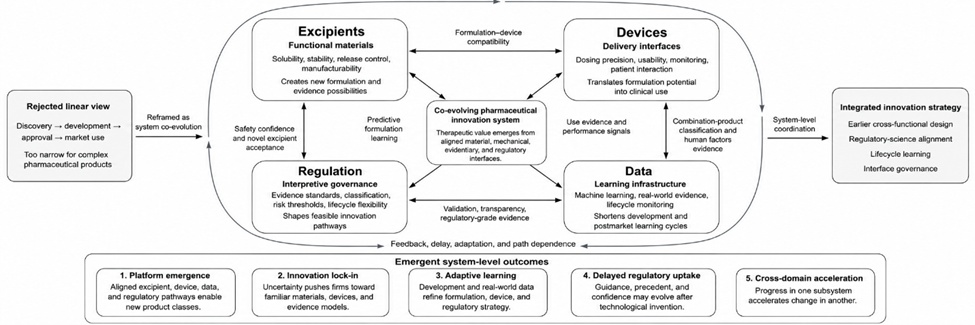
Figure 1. Co-Evolving Systems Model of Pharmaceutical Innovation Across Excipients, Devices, Data, and Regulation
The first translation implication is that pharmaceutical innovation policy should be coordinated across material science, device regulation, data standards, and lifecycle management. Treating these areas separately can generate avoidable friction, such as encouraging advanced formulations while leaving excipient acceptance uncertain or promoting digital evidence without clear validation expectations [3, 30]. A systems model encourages policy-makers and regulators to identify interface failures before they become development bottlenecks.
The second implication is organizational. Firms and public-private consortia should bring formulation scientists, device engineers, data scientists, clinicians, human factors specialists, and regulatory experts into shared design conversations early rather than sequentially [6, 14]. Open innovation and ecosystem research indicate that distributed collaboration can widen the search space, but only when participants have mechanisms for aligning incentives, evidence standards, and decision rights [2, 32].
The third implication is methodological: innovation trajectories should be modeled as evolving systems rather than as static technology roadmaps. Scenario models can examine how regulatory uncertainty, device constraints, data quality, and excipient functionality interact over time to create acceleration, delay, or lock-in [10, 16]. Such models would not replace experimental development, but they could help anticipate where evidence generation, guidance development, or cross-sector investment would produce the greatest system-level leverage.
Figure 2 translates the co-evolving systems model into a practical interface-governance map for coordinating formulation science, device engineering, data strategy, and regulatory planning across the pharmaceutical product lifecycle.
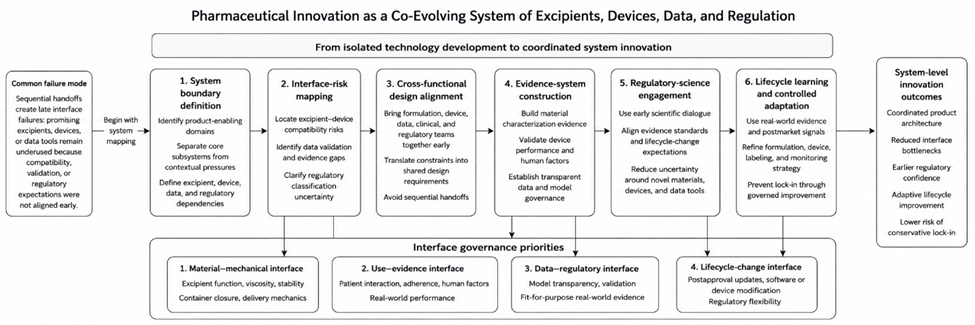
Figure 2. Practical Interface-Governance Map for Translating Co-Evolving Pharmaceutical Innovation Into Development Strategy
Pharmaceutical innovation is not best understood as a straight line from discovery to approval. It is a co-evolving system in which excipients, devices, data, and regulation continually shape one another. The therapeutic product that reaches patients is the outcome of these interactions, not simply the downstream expression of a molecule.
The conceptual systems model developed here provides a way to see the interfaces that often determine success or failure. It highlights feedback loops, time lags, path dependence, and emergent properties that are difficult to detect when innovation is divided into isolated technical or regulatory workstreams. By making these dynamics explicit, the model supports more integrated thinking across research, development, regulation, and lifecycle management.
Future work should empirically test and refine the model using case studies, comparative regulatory analysis, product lifecycle histories, and quantitative systems methods. Interdisciplinary dialogue will be essential because no single field can fully explain the interactions among materials, devices, data, and institutions. A systems perspective does not simplify pharmaceutical innovation, but it can make its complexity more actionable.
None
None
None
None
Open Access The author(s) retain copyright. This article is licensed under the Creative Commons Attribution-NonCommercial-ShareAlike 4.0 International License. It may be shared and adapted for non-commercial purposes with appropriate attribution, an indication of changes, and distribution of adaptations under the same license. Third-party material may be subject to separate terms identified in its credit line. View the license at https://creativecommons.org/licenses/by-nc-sa/4.0/.
 Publication System