Pharmaceutical technologies are commonly designed and validated under controlled assumptions about materials, processes, supply continuity, and patient use. Yet once products enter development, scale-up, manufacturing, distribution, and real-world use, they encounter variability that cannot be fully predicted or eliminated. Supply disruptions, raw-material shifts, equipment drift, environmental fluctuations, and heterogeneous patient behaviours can all disturb the intended relationship between product design and therapeutic performance. The prevailing pharmaceutical design paradigm has made important advances through quality-by-design, risk management, and process analytical technology. However, it often treats variability primarily as a deviation from a predefined optimum rather than as a persistent condition of system operation. This creates a risk that pharmaceutical technologies become highly optimised for expected conditions but brittle when exposed to unfamiliar combinations of supply, process, and patient-level stressors. This article proposes an original resilience-theoretic framework for pharmaceutical technology design. The framework argues that technologies should be designed not only to meet specifications under normal conditions, but also to absorb disturbance, adapt to changing conditions, maintain acceptable performance, and degrade gracefully when ideal operation is no longer possible. It therefore reframes resilience as a design objective rather than a post hoc recovery capability. The article contributes a conceptual structure for aligning pharmaceutical technology design with the realities of variability. It shows how resilience thinking can connect supply robustness, process adaptability, and patient-centred performance into a single design logic. Designing for resilience represents a shift from static robustness toward dynamic adaptability, offering a pathway to pharmaceutical technologies that remain reliable, usable, and therapeutically meaningful under changing conditions.
Pharmaceutical products increasingly operate within environments marked by supply instability, manufacturing complexity, and heterogeneous patient use. Drug shortages have been analysed as system-level failures in which production capacity, supply reliability, market incentives, and quality events interact rather than as isolated logistical accidents [1, 2]. Recent work on medicine shortage mitigation similarly shows that resilience depends on the capacity of pharmaceutical supply chains to anticipate disruption, maintain continuity, and recover from shocks rather than merely maximise efficiency under stable conditions [3].
At the manufacturing level, pharmaceutical technologies are exposed to variability in active pharmaceutical ingredients, excipients, processing equipment, scale-up conditions, and environmental context. Studies of raw material variability in continuous manufacturing show that apparently acceptable variation in material attributes can propagate into processability problems and critical quality attribute shifts [4, 5]. Continuous direct compression and twin-screw granulation research further indicates that batch-to-batch differences in inputs may affect flow, compaction, granulation, and drying behaviour in ways that challenge deterministic control strategies [6, 7].
At the patient level, drug product performance is shaped by physiological differences, usability constraints, adherence behaviour, and the practical realities of administration outside controlled settings. Patient-centric drug product design has shown that acceptability, dosing burden, administration route, and device interaction can strongly influence whether pharmaceutical technologies achieve their intended therapeutic effect [8, 9]. Subcutaneous delivery design research also demonstrates that patient experience and adherence cannot be treated as secondary considerations because they affect whether technically sound products are actually used as intended [10].
Quality-by-design has provided a powerful language for linking product attributes, process parameters, and quality risk, yet its operational use often remains tied to predefined design spaces and expected variability ranges. Systematic assessments of quality-by-design in pharmaceutical manufacturing recognise both its value and its limitations when uncertainty extends beyond well-characterised process factors [11]. This article therefore introduces resilience as a complementary design logic and aims to develop a formal theoretical framework for pharmaceutical technology resilience across supply, process, and patient-level variability.
Resilience engineering begins from the premise that complex systems cannot be made safe or reliable solely by eliminating every source of failure. Instead, resilient systems develop absorptive capacity to withstand disturbance, adaptive capacity to adjust under changing conditions, and restorative capacity to recover function after disruption [12]. Woods’ theory of graceful extensibility adds that systems remain viable when they can stretch performance boundaries without abrupt collapse, a concept especially relevant to pharmaceutical technologies designed around narrow specification limits [13].
Risk and reliability research has similarly moved from static probability-based assessment toward dynamic understanding of how systems respond to uncertainty, complexity, and interdependence. Zio argues that the future of risk assessment lies in modelling systems as evolving entities exposed to incomplete knowledge, changing operating conditions, and emergent interactions [14]. This view challenges pharmaceutical design models that assume variability can be fully bounded before commercialisation and supports a more adaptive understanding of quality and reliability.
In pharmaceutical technology, quality-by-design, process analytical technology, model predictive control, and continuous manufacturing already provide partial foundations for resilience thinking. Reviews and implementation studies show that continuous manufacturing can improve responsiveness, process visibility, and control, while model predictive control allows production systems to adjust to measured deviations rather than rely only on fixed settings [15-18]. However, these tools become resilience mechanisms only when they are explicitly designed to maintain acceptable performance under disturbance rather than merely optimise process efficiency.
Table 1 maps the key concepts from resilience theory onto pharmaceutical technology design. The mapping clarifies that resilience is not a metaphor imported from other sectors but a structured design logic that can be translated into pharmaceutical functions such as variability absorption, adaptive control, quality recovery, and patient-use buffering [11-13].
Table 1. Resilience Theory Constructs and Their Mapping to Pharmaceutical Technology Design: Absorptive, Adaptive, and Restorative Capacity
Resilience construct | Core theoretical meaning | Pharmaceutical technology interpretation | Example design implication | Primary variability domain addressed |
Absorptive capacity | Ability to withstand disturbance without immediate functional loss | Product, process, or interface tolerates input variation while maintaining acceptable quality | Excipient specifications and formulation margins designed to buffer raw-material variability | Supply and process |
Adaptive capacity | Ability to adjust behaviour when operating conditions change | Manufacturing control, formulation platform, or device response changes in relation to detected drift | Model predictive control adjusts process parameters when material or environmental conditions shift | Process |
Restorative capacity | Ability to recover acceptable function after disruption | Quality system, process design, or supply strategy restores validated performance after deviation or shortage | Alternative qualified material source or recovery protocol supports controlled continuation | Supply and process |
Graceful degradation | Ability to lose performance gradually rather than fail abruptly | Product or system maintains partial acceptable function under severe variability | Device or formulation design reduces risk of catastrophic misuse when patient behaviour varies | Patient and process |
System interdependence | Performance emerges from interactions among components | Product quality depends on linked supply, process, and use conditions | Development reviews evaluate material, manufacturing, and patient-use risks together | Supply, process, and patient |
Anticipatory control | Ability to identify stressors before failure occurs | Risk assessment tests plausible disturbance combinations before scale-up or launch | Stress testing combines worst-case API variability, process drift, and user error scenarios | Supply, process, and patient |
The central problem is not simply that pharmaceutical technologies encounter variability, but that many are designed as if variability were a temporary disturbance around a stable optimum. Raw material studies in continuous manufacturing show that an apparently robust formulation or process may become vulnerable when material properties shift across suppliers, batches, or particle distributions [4, 19]. A resilience framing therefore asks whether the technology can maintain acceptable quality when exposed to plausible variability, not only whether it performs well under nominal conditions.
Resilience must also be distinguished from conventional robustness. Robustness usually implies that performance remains stable within a defined range of variation, whereas resilience adds the capacity to detect change, adapt control logic, redistribute function, and degrade safely when predefined assumptions no longer hold [12, 13]. In pharmaceutical process control, this distinction is visible in the difference between fixed control strategies and adaptive or model-based approaches that respond to plant-model mismatch, start-up instability, and process drift [20-22].
The scope of pharmaceutical resilience proposed here includes three connected domains: supply-level variability, process-level variability, and patient-level variability. Supply-level variability includes raw material attributes, excipient differences, supplier changes, and disruption-driven substitutions, while process-level variability includes equipment differences, scale-up effects, operating drift, and environmental fluctuations [5-7]. Patient-level variability includes physiology, adherence behaviour, usability constraints, and administration practices that shape whether the designed product function is realised in real-world use [8, 10, 23].
Reframing pharmaceutical technology through resilience also changes the meaning of successful design. Instead of defining success as achieving a single optimum under expected conditions, the resilient design objective is to create technologies that absorb disturbance, adapt to change, sustain clinically meaningful performance, and fail in controlled rather than abrupt ways [11, 14]. This reframing prepares the ground for a framework in which quality is understood as a dynamic system property generated across material supply, manufacturing process, and patient interaction.
The first assumption of the framework is that variability is inherent to pharmaceutical technology systems and cannot be completely engineered out. Raw material, process, and patient-use variability are not exceptional disturbances but recurring conditions that shape product quality and therapeutic performance across the lifecycle [4, 5, 8]. Resilience therefore begins by rejecting the fiction that a pharmaceutical technology can be designed once for a fully stable world.
The second assumption is that resilience must be designed at the system level rather than assigned to isolated product, process, or user-interface features. Continuous manufacturing research shows that material behaviour, process control, equipment dynamics, and quality outcomes are tightly coupled, meaning that a change in one domain can alter the behaviour of the whole system [16, 24, 25]. Patient-centric design similarly shows that drug product performance depends on the interaction between formulation characteristics, delivery mode, administration context, and user behaviour [9, 23].
The third assumption is that resilience involves managed trade-offs between efficiency, redundancy, complexity, and adaptability. Highly efficient systems may reduce waste and cost under expected conditions, but they may also remove buffers that become essential during disruption or drift [1, 3]. The framework therefore does not claim that maximum redundancy is always desirable; rather, it argues that the level and location of resilience capacity should be explicitly justified in relation to quality risk, patient consequence, and lifecycle uncertainty [11, 14].
Supply-level variability begins with differences in raw material attributes, such as particle size, morphology, flowability, moisture content, and functional excipient behaviour. Studies of active pharmaceutical ingredient variability demonstrate that material differences can influence feeding, blending, compaction, and downstream quality even when materials remain within formal specifications [4, 5]. Excipients are similarly consequential because lot-to-lot or source-to-source changes can alter granulation, compression, dissolution, and manufacturability [7, 19].
Process-level variability emerges when equipment, scale, operating context, and control performance diverge from development assumptions. Continuous direct compression and continuous granulation studies show that process responses may shift when materials, residence times, drying conditions, or unit operations interact differently across settings [6, 7, 18]. Model predictive control and quality-by-control approaches address this issue by moving from fixed parameter settings toward systems capable of responding to measured process drift [15, 16, 20].
Patient-level variability is produced by physiological diversity, administration behaviour, adherence patterns, usability constraints, and real-world treatment routines. Patient-centric drug product design emphasises that age, dexterity, swallowing ability, dosing frequency, device confidence, and daily-life context influence whether a formulation or delivery system performs as intended [8, 9]. Research on subcutaneous delivery further shows that patient experience, convenience, and treatment burden are design variables rather than merely behavioural outcomes [10].
The three variability domains interact because supply changes can alter process behaviour, process drift can change product performance, and product characteristics can amplify or reduce patient-use variability. A raw-material substitution may require process adaptation, a process excursion may affect dose uniformity or delivery performance, and a poorly buffered product may become more vulnerable to missed doses or administration errors [23-25]. Table 2 categorises the primary sources of variability and their propagation pathways through the pharmaceutical value chain.
Table 2. Supply-, Process-, and Patient-Level Variability: Sources, Propagation Mechanisms, and Quality Consequences
Variability domain | Primary sources of variability | Propagation mechanism | Possible quality or performance consequence | Resilience need |
Supply-level variability | API particle properties, excipient functionality, supplier changes, geographic disruption, material shortages | Material attributes alter feeding, blending, granulation, compaction, dissolution, or stability behaviour | Critical quality attribute shift, manufacturability loss, shortage-driven substitution risk | Material buffering, qualified alternatives, broader design margins |
Process-level variability | Equipment wear, scale-up effects, operator differences, environmental fluctuations, start-up instability, control drift | Process parameters and unit-operation interactions move outside expected response patterns | Batch failure, content uniformity risk, process interruption, specification failure | Adaptive control, process monitoring, validated response logic |
Patient-level variability | Age, physiology, comorbidity, dexterity, adherence behaviour, administration setting, concurrent medications | User behaviour and biological context alter exposure, dose timing, administration success, or treatment persistence | Reduced effectiveness, misuse, discontinuation, safety risk | User-centric formulation, device support, forgiving dosing design |
Cross-domain variability | Combined material, process, and patient stressors | Variability in one domain changes sensitivity in another domain | Hidden fragility, unexpected failure modes, weak lifecycle robustness | Integrated risk anticipation and system-level resilience review |
Lifecycle variability | Supplier evolution, process learning, technology transfer, post-approval changes, changing patient populations | Initial design assumptions become less representative over time | Control strategy obsolescence, regulatory burden, quality drift | Lifecycle monitoring, review, adaptation, and documentation |
The first resilience design principle is modularity, understood as the capacity to isolate variability and permit controlled substitution without destabilising the whole technology system. In pharmaceutical manufacturing, modularity may involve platform processes, interchangeable qualified material sources, separable unit operations, or product architectures that allow changes to be assessed without redesigning the entire system [17, 18]. Modularity supports supply resilience because it reduces dependence on a single fragile pathway while preserving quality-system control.
The second principle is adaptability, which refers to the ability of a process or product system to respond to changing conditions through sensing, modelling, and controlled adjustment. Model predictive control, moving-horizon estimation, and data-driven control approaches show how continuous pharmaceutical manufacturing can respond to plant-model mismatch, drift, and uncertain operating states [22, 26, 27]. Adaptability is therefore not uncontrolled flexibility but governed responsiveness within scientifically justified limits.
The third principle is redundancy, which means that critical quality and usability functions should not depend on one unprotected mechanism when failure would have serious consequences. In supply chains, redundancy may include qualified alternative suppliers, flexible production capacity, or inventory strategies that mitigate shortage risk [1-3]. In product and process design, redundancy may involve overlapping quality controls, formulation margins, or delivery features that reduce the probability that a single variation causes unacceptable failure [11, 24].
The fourth and fifth principles are feedback and user-centric buffering. Feedback links measurement to learning and adjustment through process analytical technology, real-time monitoring, and lifecycle review, while user-centric buffering designs formulations and devices to accommodate predictable variation in patient capability, adherence, and administration context [8, 23, 25]. Table 3 defines the resilience design principles and connects them to specific variability sources.
Table 3. Technology Design Principles for Pharmaceutical Resilience: Modularity, Adaptability, Redundancy, Feedback, and User-Centric Buffering
Design principle | Definition within pharmaceutical resilience | Variability sources addressed | Practical design expression | Main resilience function |
Modularity | Structuring product, process, or supply architecture so that components can be changed or isolated without destabilising the whole system | Supplier changes, platform transfer, unit-operation differences, technology scale-up | Platform formulation, modular continuous lines, qualified interchangeable components | Absorption and containment |
Adaptability | Ability to adjust process or system behaviour in response to detected drift or changing input conditions | API variability, process drift, environmental fluctuation, plant-model mismatch | Model predictive control, adaptive process settings, dynamic design-space use | Real-time adjustment |
Redundancy | Intentional inclusion of backup, overlap, or reserve capacity for critical quality or access functions | Supply disruption, quality-control failure, process interruption, device-use uncertainty | Alternative suppliers, overlapping quality checks, formulation safety margins | Continuity under stress |
Feedback | Embedded monitoring and learning loops that connect performance signals to corrective or preventive action | Process instability, lifecycle drift, patient-use problems, post-approval change | PAT, digital monitoring, lifecycle review, deviation trend analysis | Detection and learning |
User-centric buffering | Design features that reduce the effect of patient variability on therapeutic performance | Non-adherence, dexterity limits, administration error, lifestyle variability | Forgiving dosing regimens, easier administration, device usability, patient-preference alignment | Graceful degradation and use reliability |
The proposed Resilience Framework treats pharmaceutical technologies as multi-domain systems rather than as isolated formulations, devices, or processes. Its central claim is that resilience emerges when supply-level, process-level, and patient-level variability are linked to explicit design principles during development [8, 11, 12]. This prevents resilience from being reduced to supply-chain contingency planning, manufacturing control, or patient adherence support alone.
The framework is organised as a matrix in which each variability domain is evaluated against the five design principles of modularity, adaptability, redundancy, feedback, and user-centric buffering. For supply variability, the framework asks whether the technology can tolerate source changes, material attribute shifts, and shortage pressures without uncontrolled quality consequences [1, 3, 4]. For process variability, it asks whether sensing, control, and process understanding can maintain quality under drift, scale-up, and equipment differences [15, 16, 26].
For patient-level variability, the framework asks whether pharmaceutical technologies remain usable, acceptable, and therapeutically meaningful under realistic patient conditions. Patient-centric and adherence-oriented design work indicates that product success depends not only on pharmacotechnical performance but also on the extent to which design accommodates patient routines, preferences, and limitations [9, 10, 23]. The framework therefore treats the patient interface as a resilience domain, not merely as an implementation setting.
Operationally, the framework can be used during development reviews, formulation platform selection, process design, risk assessment, technology transfer, and lifecycle management. Each design decision is assessed for whether it increases or decreases absorptive, adaptive, restorative, or graceful-degradation capacity across the three variability domains [13, 14, 24]. Table 4 presents the complete Resilience Framework with design principles, variability domains, and resilience functions.
Table 4. Proposed Resilience Framework for Pharmaceutical Technologies: Structure, Inter-Domain Linkages, and System-Level Resilience Functions
Variability domain | Modularity | Adaptability | Redundancy | Feedback | User-centric buffering | System-level resilience function |
Supply-level variability | Use platform-compatible materials and qualified alternative sources | Adjust processing logic to material attribute shifts | Maintain alternative supply routes or material options | Monitor supplier, material, and shortage signals | Reduce dependence on fragile presentation or administration components | Maintains access and quality continuity under material disruption |
Process-level variability | Separate unit operations so drift can be localised and corrected | Use adaptive control, PAT, and model-based adjustment | Build overlapping quality controls and process margins | Link process data to deviation, CAPA, and lifecycle review | Ensure process changes do not compromise usability or administration | Maintains manufacturing performance under dynamic operating conditions |
Patient-level variability | Offer product or device configurations suited to different user needs | Allow dosing, administration, or support systems to respond to user context | Include forgiving design features that reduce harm from use variation | Capture real-world use, complaints, and adherence signals | Design around dexterity, preference, routine, and comprehension | Maintains therapeutic usability under heterogeneous real-world use |
Cross-domain variability | Prevent changes in one domain from destabilising others | Use integrated models to anticipate coupled effects | Preserve buffers at critical domain interfaces | Review linked supply, process, and use signals together | Ensure patient impact is considered in supply and process decisions | Prevents hidden fragility across the pharmaceutical value chain |
Lifecycle evolution | Enable controlled post-approval adaptation | Update control strategies as knowledge accumulates | Preserve recovery options after market or process changes | Feed quality and use data into management review | Reassess patient needs as populations and contexts change | Supports long-term learning and resilience maintenance |
Figure 1 presents the proposed pharmaceutical resilience framework by showing how supply-, process-, and patient-level variability are absorbed, adapted to, and translated into resilient technology design through five interdependent design principles.
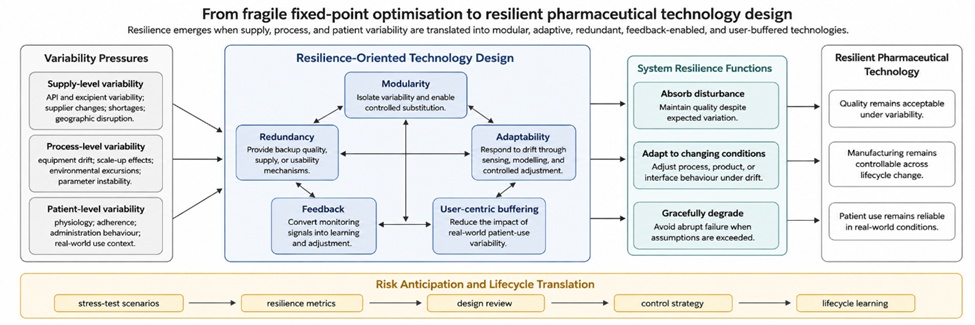
Figure 1. Pharmaceutical Resilience Framework for Designing Technologies against Supply-, Process-, and Patient-Level Variability
A resilience framework requires a risk anticipation pathway because many fragilities become visible only when multiple variability sources occur together. Conventional risk assessment may identify individual failure modes, but resilience-oriented assessment asks how supply variability, process drift, and patient-use differences combine into stress scenarios that challenge the product system [14, 24]. This approach extends pharmaceutical risk thinking from preventing known deviations toward preparing for plausible but uncertain disturbance patterns.
Stress testing can be performed conceptually through design-of-experiments, mechanistic modelling, flowsheet simulation, in silico scenario analysis, and real-world use simulation. Flowsheet modelling has already been used to evaluate quality risk and mitigation in continuous pharmaceutical manufacturing, showing how upstream changes may propagate through linked unit operations [24]. Model predictive and data-driven control studies further indicate that resilience metrics should include response to disturbance, control recovery, sensitivity to mismatch, and ability to maintain quality under dynamic conditions [26, 27].
Translation into the pharmaceutical quality system requires connecting resilience metrics to design review, control strategy, deviation management, CAPA, validation, and lifecycle change control. Regulatory perspectives on continuous manufacturing emphasise that advanced manufacturing must be supported by process understanding, control strategy justification, and lifecycle management rather than by technology adoption alone [28]. Industry 4.0 discussions similarly suggest that smart manufacturing becomes meaningful only when data, automation, and quality governance are integrated into reliable decision pathways [17].
The pathway proposed here positions resilience as an assessable quality-system attribute. Development teams should define stress scenarios, identify resilience functions, select measurable indicators, evaluate trade-offs, and document how design choices support continued quality and patient performance under variability [11, 16, 25]. Table 5 outlines a risk anticipation and translation pathway for embedding resilience into product development.
Table 5. Risk Anticipation and Translation Pathway: Stress-Testing Scenarios, Resilience Metrics, and Integration into the Pharmaceutical Quality System
Pathway stage | Main purpose | Example resilience activity | Possible resilience metric | Quality-system integration point |
Variability mapping | Identify relevant supply, process, and patient variability sources | Map material attributes, process drift routes, and patient-use scenarios | Number and severity of domain-specific variability sources | Early development risk assessment |
Stress-scenario construction | Test combined disturbance conditions rather than isolated deviations | Combine supplier change, environmental fluctuation, and high-risk use scenario | Performance under worst-case or coupled variability | Design review and control strategy development |
Resilience-function assignment | Link each risk to absorptive, adaptive, restorative, or graceful-degradation capacity | Determine whether modularity, feedback, redundancy, or buffering is required | Coverage of critical risks by resilience functions | Pharmaceutical development report |
Metric selection | Convert resilience into assessable development evidence | Measure recovery time, control sensitivity, quality drift, usability tolerance, or supply continuity | Time to recovery, CQA stability, adherence-support performance | Validation planning and continued process verification |
Translation and lifecycle learning | Embed resilience evidence into routine quality governance | Feed deviations, complaints, process trends, and supply signals into periodic review | Reduction in recurring failure modes and improved response consistency | CAPA, change control, management review, lifecycle management |
Pharmaceutical resilience is not achieved by eliminating variability, because supply conditions, process behaviour, and patient use will always change in ways that exceed initial assumptions. The more realistic design ambition is to create technologies that can absorb disturbance, adapt to emerging conditions, and maintain acceptable performance even when the operating environment is imperfect. This requires a shift from fragile optimisation toward systems that preserve quality and therapeutic function across a range of plausible futures.
The framework proposed in this article offers a theoretical tool for making that shift explicit. By linking supply-, process-, and patient-level variability to modularity, adaptability, redundancy, feedback, and user-centric buffering, it translates resilience from an abstract systems concept into a pharmaceutical design logic. Its contribution is not a new empirical dataset but a structured way of asking whether a technology is merely optimised or genuinely prepared for variability.
Future work should empirically test the framework across dosage forms, manufacturing platforms, drug-device systems, and patient-use settings. Regulatory dialogue will also be needed to determine how resilience evidence can be documented without creating unnecessary development burden. If embedded thoughtfully, resilience thinking can help pharmaceutical technology move from static control toward adaptive, patient-centred reliability.
None
None
None
None
Open Access The author(s) retain copyright. This article is licensed under the Creative Commons Attribution-NonCommercial-ShareAlike 4.0 International License. It may be shared and adapted for non-commercial purposes with appropriate attribution, an indication of changes, and distribution of adaptations under the same license. Third-party material may be subject to separate terms identified in its credit line. View the license at https://creativecommons.org/licenses/by-nc-sa/4.0/.
 Publication System