The chemistry of α-(arylhydrazono)-β-ketoaldehydes has attracted significant attention due to their use as intermediates in organic synthesis and as building blocks for biologically active compounds. This study presents the synthesis of a novel series of 3,3'-(5-methyl-1-phenyl-1H-pyrazole-3,4-diyl)bis(2-arylhydrazono-3-oxo-propanal) (3a-i), created through coupling reactions of sodium 3,3'-(5-methyl-1-phenyl-1H-pyrazole-3,4-diyl)bis(3-oxoprop-1-en-1-olate) (2) with arenediazonium chloride. The subsequent condensation of these compounds 3a-i with hydrazine hydrate produced a new series of bis(arylazo)-terpyrazole derivatives (5a-i). The new compounds were characterized using spectroscopic techniques and basic evaluations. Furthermore, the electronic absorption spectra of the compounds were recorded in various buffer solutions, and their acidity constants (pK) were calculated. The study also examined the correlation between these constants and Hammett substituent constants. Results indicated that the compounds predominantly exist in the bis-hydrazo form (5A). Compounds 5a-i were evaluated for their antibacterial and anticancer properties against the HepG2 cell line in vitro.
Pyrazoles and their ter-heterocycles have garnered significant attention due to their broad range of biological activities, including use as antitumor agents, kinase inhibitors in cancer therapy, and anti-proliferative effects on various cancer cell lines [1-4]. Furthermore, pyrazole-based heterocyclic compounds have been identified for their diverse biological applications, such as being effective inhibitors of NOS, antibacterial agents, monoamine oxidase inhibitors, antiamoebic agents, and potent antimicrobial compounds [5-10]. Additionally, arylazo and arylhydrazo heterocycles are commonly found in organic dyes used in industries such as inkjet printing, laser products, reprographics, and laser printing [11-13]. Due to their photodynamic therapy capabilities and non-linear optical (NLO) properties, some arylazo dispersion dyes have attracted further interest for uses in optical switching and molecular photoprobes [14-17]. β-Enaminones have long been recognized as essential precursors in the synthesis of heterocyclic systems [18, 19]. In an effort to identify more cost-effective precursors for use in heterocyclic synthesis, the synthesis and reactivity of β-hydroxyenones (R-CO-CH=CHOH) have been explored. Continuing our previous work on bioactive heterocyclic compounds, bis-heterocyclic systems [20-25], and our previous studies on the synthesis and spectrophotometric analysis of arylazo and bis-arylazo derivatives of heterocyclic dyes [26-30], we now report the synthesis of novel sodium 3,3'-(5-methyl-1-phenyl-1H-pyrazole-3,4-diyl)bis(3-oxo-propenolate) (2) and its reactions with heteroaryl diazonium salts. These reactions lead to the formation of bis-hydrazonal compounds, which are used to synthesize bis(arylazo) terpyrazoles.
The pK values of the compounds were determined, and the best tautomeric form was identified by correlating the acid dissociation constant with Hammett substituent constants. The nine synthesized dyes were tested for their antimicrobial and anticancer activities against HepG2 cell lines.
Yield (78%), mp 164-166 °C (EtOH); IR (KBr) νmax: 3415 (NH), 3027, 2918 (C-H), 1725, 1688 (2C=O), 1025 (C-O-C) cm−1; 1H NMR (DMSO-d6): δ 2.38 (s, 3H, CH3), 3.73 (s, 6H, 2OCH3), 7.26-7.89 (m, 13H, ArH), 10.33 (s, 2H, 2CHO), 12.81 (s, 2H, 2NH); MS m/z (%): 566 (M+, 1), 340 (18) 312 (32), 297 (48), 257 (100), 240 (30), 148 (40), 144 (21), 132, (10), 122, (15),116 (18), 103 (25), 91 (67), 76 (55), 51 (46). Anal. Calcd for C30H26N6O6 (566.56): C, 63.60; H, 4.63; N, 14.83. Found: C, 63.72; H, 4.50; N, 14.70%.
Yield (82%), mp 152-154 °C (EtOH); IR (KBr) νmax: 3410 (NH), 3019, 2935 (C-H), 1731, 1678 (2C=O), 1022 (C-O-C) cm−1; 1H NMR (DMSO-d6): δ 2.22 (s, 3H, CH3), 2.45 (s, 6H, 2CH3), 7.22–7.75 (m, 13H, ArH), 10.35 (s, 2H, 2CHO), 12.87 (s, 2H, 2NH); MS m/z (%): 534 (M+, 2), 414 (32), 296 (38), 279 (48), 227 (100), 241 (42), 149 (38), 145 (27), 122, (17), 103 (32), 91 (77), 76 (65), 63 (44). Anal. Calcd for C30H26N6O4 (534.56): C, 67.40; H, 4.90; N, 15.72. Found: C, 67.51; H, 4.78; N, 15.57%.
Yield (72%), mp 147-149 °C (EtOH); IR (KBr) νmax: 3398 (NH), 3036, 2965 (C-H), 1711, 1668 (2C=O), cm−1; 1H NMR (DMSO-d6): δ 2.29 (s, 3H, CH3), 2.66 (s, 6H, 2CH3), 6.88–7.80 (m, 13H, ArH), 10.39 (s, 2H, 2CHO), 12.79 (s, 2H, 2NH); MS m/z (%): 534 (M+, 4), 414 (21), 295 (34), 281 (42), 226 (100), 240 (52), 149 (68), 147 (41), 122 (55), 116 (12), 103 (63), 91 (80), 76 (66). Anal. Calcd for C30H26N6O4 (534.56): C, 67.40; H, 4.90; N, 15.72. Found: C, 67.61; H, 4.76; N, 15.63%
Yield 81%; mp 123-125 °C (EtOH) (Lit. mp 123-125 °C [31]).
Yield (86%), mp 193-195 °C (EtOH); IR (KBr) νmax: 3378 (NH), 3030, 2965 (C-H), 1710, 1688 (2C=O), cm−1; 1H NMR (DMSO-d6): δ 2.23 (s, 3H, CH3), 6.58–7.56 (m, 13H, ArH), 10.32 (s, 2H, 2CHO), 12.86 (s, 2H, 2NH); MS m/z (%): 577 (M++2, 2), 575 (M+, 5), 440 (33), 315 (24), 295 (56), 240 (100), 149 (28), 121(53), 114 (31), 105 (73), 91 (80), 76 (85), 51 (66). Anal. Calcd for C28H20Cl2N6O4 (575.40): C, 58.45; H, 3.50; N, 14.61. Found: C, 58.28; H, 3.35; N, 14.54%.
Yield (71%), mp 173-175 °C (EtOH); IR (KBr) νmax: 3348 (NH), 3048, 2955 (C-H), 1711, 1668 (2C=O), cm−1; 1H NMR (DMSO-d6): δ 2.29 (s, 3H, CH3), 6.78–7.76 (m, 13H, ArH), 10.12 (s, 2H, 2CHO), 12.95 (s, 2H, 2NH); MS m/z (%): 577 (M++2, 3), 575 (M+, 10), 440 (23), 315 (34), 295 (66), 241 (100), 149 (48), 132 (43), 121 (63), 115 (54), 105 (87), 91 (89), 76 (65), 51 (82). Anal. Calcd for C28H20Cl2N6O4 (575.40): C, 58.45; H, 3.50; N, 14.61. Found: C, 58.36; H, 4.39; N, 14.58%.
Yield (80%), mp 184-186 °C (EtOH); IR (KBr) νmax: 3410 (NH), 3041, 2965 (C-H), 1717, 1648 (2C=O), cm−1; 1H NMR (DMSO-d6): δ 2.26 (s, 3H, CH3), 7.04–7.96 (m, 13H, ArH), 10.07 (s, 2H, 2CHO), 12.82 (s, 2H, 2NH); MS m/z (%): 666 (M++2, 5) 664 (M+, 6), 481(28), 402 (24), 387 (44), 295 (36), 242 (100), 149 (28), 132 (35), 115 (33), 105 (58), 91 (80), 76 (55), 51 (52). Anal. Calcd for C28H20Br2N6O4 (664.30): C, 50.62; H, 3.03; N, 12.65. Found: C, 50.46; H, 3.00; N, 12.53%.
Yield (68%), mp 204-206 °C (dioxane); IR (KBr) νmax: 3401 (NH), 3037, 2975 (C-H), 1718, 1668 (2C=O), cm−1; 1H NMR (DMSO-d6): δ 2.24 (s, 3H, CH3), 7.24–8.06 (m, 13H, ArH), 10.12 (s, 2H, 2CHO), 12.90 (s, 2H, 2NH); MS m/z (%): 596 (M+, 2), 446 (68), 402 (45), 298 (32), 241 (100), 150 (38), 122 (47), 114 (36), 105 (47), 76 (85), 51 (42). Anal. Calcd for C28H20N8O8 (596.50): C, 56.38; H, 3.38; N, 18.78. Found: C, 56.27; H, 3.22; N, 18.55%.
Yield (64%), mp 264-266 °C (dioxane); IR (KBr) νmax: 3431 (NH), 3035, 2955 (C-H), 1721, 1678 (2C=O), cm−1; 1H NMR (DMSO-d6): δ 2.31 (s, 3H, CH3), 7.34–8.26 (m, 13H, ArH), 10.28 (s, 2H, 2CHO), 13.2 (s, 2H, 2NH); MS m/z (%): 596 (M+, 7), 445 (77), 401 (52), 301 (22), 243 (100), 152 (39), 122, (36), 116 (22), 105 (51), 91 (66), 76 (54), 51 (81). Anal. Calcd for C28H20N8O8 (596.50): C, 56.38; H, 3.38; N, 18.78. Found: C, 56.52; H, 3.32; N, 18.69%.
Carry out the same above coupling reaction using 1,1'-(5-methyl-1-phenyl-1H-pyrazole-3,4-diyl)bis(3-(dimethyl-amino)prop-2-en-1-one) (4) (0.352 g, 1 mmol) instead of 2. The precipitated product was filtered, washed with H2O, and lastly recrystallized from ethanol to provide a product proved identical in all respects (mp, mixed mp, and IR spectra) with compound 3d, obtained by the coupling of 2 with PhN2Cl, but in 70% yield.
A mixture of the appropriate bis(2-arylhydrazono-3-oxopropanal) derivatives 3a-i (1 mmol) and hydrazine hydrate (2 mL) in dioxane (10 mL) was refluxed for 10-15 h. The formed solid after cooling the solution was filtered off and crystallized from the proper solvent to give the corresponding ter-pyrazoles 5a-i. The products obtained are described below, along with their analytical data.
Yield (72%), mp 292-294 °C (DMF); IR (KBr) νmax: 3419 (NH), 3025, 2918 (C-H), 1695 (C=N), 1024 (C-O-C) cm−1; 1H NMR (DMSO-d6): δ 2.75 (s, 3H, CH3), 3.71 (s, 6H, 2OCH3), 7.46-7.89 (m, 15H, ArH and pyrazole-H), 10.24 (s, 2H, D2O-exchangeable, 2NH); MS m/z (%): 558 (M+, 2), 412 (32), 380 (15) 292 (41), 226 (22), 152 (48), 137 (24), 103 (100), 91 (65), 76 (75), 51 (90). Anal. Calcd for C30H26N10O2 (558.59): C, 64.51; H, 4.69; N, 25.08. Found: C, 64.37; H, 4.53; N, 25.00%.
Yield (68%), mp 280-282 °C (dioxane); IR (KBr) νmax: 3415 (NH), 3028, 2948 (C-H), 1690 (C=N), cm−1; 1H NMR (DMSO-d6): δ 2.35 (s, 3H, CH3), 2.41 (s, 6H, 2CH3), 7.32-7.72 (m, 15H, ArH and pyrazole-H), 10.17 (s, 2H, D2O-exchangeable, 2NH). MS m/z (%): 526 (M+, 4), 397 (21), 382 (42), 291(35), 225 (18), 159 (47), 116 (18), 103 (100), 91 (48), 76(59), 63 (38), 51 (67). Anal. Calcd for C30H26N10 (526.59): C, 68.42; H, 4.98; N, 26.60. Found: C, 68.59; H, 5.10; N, 26.87%.
Yield (62%), mp 275-277 °C (DMF); IR (KBr) νmax: 3412 (NH), 3025, 2966 (C-H), 1687 (C=N), cm−1; 1H NMR (DMSO-d6): δ 2.34 (s, 3H, CH3), 2.39 (s, 6H, 2CH3), 6.88-7.59 (m, 15H, ArH and pyrazole-H), 10.02 (s, 2H, D2O-exchangeable, 2NH); MS m/z (%): 526 (M+, 8), 395 (34), 380 (22), 290 (44), 224 (38), 158 (77), 115 (48), 101 (100), 91 (42), 76 (61), 51 (68). Anal. Calcd for C30H26N10 (526.59): C, 68.42; H, 4.98; N, 26.60. Found: C, 68.37; H, 5.03; N, 26.46%.
Yield 76%; mp > 300 °C (DMF) (Lit. mp > 300 °C [31]).
Yield (73%), mp > 300 °C (DMF); IR (KBr) νmax: 3426 (NH), 3028, 2958 (C-H), 1665 (C=N), cm−1; 1H NMR (DMSO-d6): δ 2.29 (s, 3H, CH3), 6.92-7.78 (m, 15H, ArH and pyrazole-H), 10.11 (s, 2H, D2O-exchangeable, 2NH); MS m/z (%): 569 (M++2, 4), 567 (M+, 14), 416 (21), 292 (35), 224 (36), 158 (42), 142 (23), 124 (25), 116 (48), 103 (100), 91 (66), 76 (57), 51 (33). Anal. Calcd for C28H20Cl2N10 (567.43): C, 59.27; H, 3.55; N, 24.68. Found: C, 59.14; H, 3.42; N, 24.51%.
Yield (71%), mp > 300 °C (DMF); IR (KBr) νmax: 3432 (NH), 3046, 2972 (C-H), 1685 (C=N) cm−1; 1H NMR (DMSO-d6): δ 2.31 (s, 3H, CH3), 6.96-7.73 (m, 15H, ArH and pyrazole-H), 10.18 (s, 2H, D2O-exchangeable, 2NH); MS m/z (%): 569 (M++2, 5), 567 (M+, 17), 415 (22), 290 (45), 224 (25), 159 (65), 141 (53), 131 (25), 124 (44), 116 (40), 101 (100), 91 (34), 77 (87), 51 (52). Anal. Calcd for C28H20Cl2N10 (567.43): C, 59.27; H, 3.55; N, 24.68. Found: C, 59.39; H, 3.47; N, 24.55%.
Yield (76%), mp > 300 °C (DMF); IR (KBr) νmax: 3443 (NH), 3029, 2978 (C-H), 1680 (C=N) cm−1; 1H NMR (DMSO-d6): δ 2.34 (s, 3H, CH3), 6.86-7.82 (m, 15H, ArH and pyrazole-H), 10.31 (s, 2H, D2O-exchangeable, 2NH); MS m/z (%): 658 (M++2, 6), 656 (M+, 7), 464 (34), 294 (28), 226 (54), 160 (39), 141 (18), 133 (15), 126 (26), 114 (41), 105 (100), 91 (62), 76 (54), 51 (39). Anal. Calcd for C28H20Br2N10 (656.33): C, 51.24; H, 3.07; N, 21.34. Found: C, 51.32; H, 3.05; N, 21.31%.
Yield (70%), mp > 300 °C (DMF); IR (KBr) νmax: 3448 (NH), 3031, 2974 (C-H), 1685 (C=N) cm−1; 1H NMR (DMSO-d6): δ 2.33 (s, 3H, CH3), 6.96-7.79 (m, 15H, ArH and pyrazole-H), 10.11 (s, 2H, D2O-exchangeable, 2NH); MS m/z (%): 588 (M+, 5), 440 (45) 291 (34), 238 (31), 223 (45) 158 (41), 144 (22), 103 (100), 91 (77), 76 (52), 51 (57). Anal. Calcd for C28H20N12O4 (588.53): C, 57.14; H, 3.43; N, 28.56. Found: C, 57.09; H, 3.30; N, 28.51%.
Yield (77%), mp > 300 °C (DMF); IR (KBr) νmax: 3452 (NH), 3032, 2978 (C-H), 1688 (C=N) cm−1; 1H NMR (DMSO-d6): δ 2.36 (s, 3H, CH3), 7.15-7.98 (m, 15H, ArH and pyrazole-H), 10.26 (s, 2H, D2O-exchangeable, 2NH). MS m/z (%): 588 (M+, 10), 442 (48) 290 (65), 237 (38), 224 (49) 156 (48), 101 (100), 92 (76), 76 (22), 51 (71). Anal. Calcd for C28H20N12O4 (588.53): C, 57.14; H, 3.43; N, 28.56. Found: C, 57.22; H, 3.37; N, 28.47%.
The pKa values for the compounds were determined by analyzing their dissociation constants from electronic absorbance-pH data, following previously reported methods [32, 33].
This analysis tested the prepared compounds for their antimicrobial and fungicidal activities against a variety of strains, including gram-negative bacteria Pseudomonas aeruginosa (PA), Gram-positive bacteria Staphylococcus aureus (SP), Escherichia coli (EC), and Bacillus subtilis (BS), as well as fungal strains Aspergillus fumigatus (AF), Saccharomyces cerevisiae (SR), Geotrichum candidum (GC), and Candida albicans (CA). These species were sourced from the Regional Center for Biotechnology and Mycology at Al-Azhar University in Cairo, Egypt [34-37].
For comparison, standard antibacterial agents such as Ampicillin and Gentamicin, as well as antifungal agents such as Amphotericin B, were purchased from Sigma-Aldrich (St Louis, MO, USA) and used as reference controls.
The HepG-2 human liver cancer cell line was obtained from the American Type Culture Collection (ATCC, Rockville, Maryland). The cells were cultured in RPMI-1640 medium supplemented with 10% inactivated fetal bovine serum and 50 µg/mL of Gentamicin. The cells were kept at 37°C in a humidified atmosphere with 5% CO2 and sub-cultured 2–3 times per week.
In anticancer assays, tumor cell lines were plated at 5×10⁴ cells per well in 96-well plates (Corning), with six replicates per test compound concentration. Control wells were treated with either medium or 0.5% DMSO. After 24 hours of incubation, cell viability was measured using the MTT assay. The medium was removed and replaced with fresh RPMI 1640 without phenol red, followed by the addition of 10 µL of MTT stock solution (5 mg of MTT in 1 mL of PBS). The plates were incubated at 37 °C with 5% CO2 for 4 hours. After incubation, 85 µL of the medium was removed, and 50 µL of DMSO was added to dissolve the formazan crystals. The plates were then incubated at 37 °C for 10 minutes, and the optical density at 590 nm was measured using a microplate reader (Sunrise, TECAN, Inc., USA). Cell viability was calculated using the formula (1 - (ODt/ODc)) x 100%, where ODt is the optical density of treated cells, and ODc is the optical density of untreated cells. The 50% inhibitory concentration (IC50) was determined from dose-response curves plotted using GraphPad Prism software (San Diego, CA, USA) [38-41].
The starting material, sodium 3,3'-(5-methyl-1-phenyl-1H-pyrazole-3,4-diyl)bis(3-oxoprop-1-en-1-olate) (2), was synthesized by reacting 1-phenyl-3,4-diacetyl-5-methylpyrazole (1) [11] with two equivalents of ethyl formate in an etheric CH3NaO solution. The reaction produced the sodium pyrazole derivative, which was then coupled with arenediazonium salts to make a series of bis-arylhydrazone derivatives containing pyrazole moieties. Coupling compound 2 with two equivalents of each arenediazonium chloride in an ethanolic sodium acetate trihydrate solution gave bis-arylhydrazone derivatives 3a-i in yields ranging from 64% to 86% (Figure 1).
The structures of the compounds 3a-i were confirmed through spectral data and microanalytical analysis (MS, IR, and 1H NMR). The MS spectra of all compounds showed a molecular ion peak corresponding to the expected molecular weight. Infrared spectra of the hydrazones 3a-i exhibited characteristic NH stretching absorptions at 3,348-3,431 cm⁻¹ and strong absorption bands for the C=O groups at 1,648-1,668 cm⁻¹ and 1,710-1,731 cm⁻¹. The 1H NMR spectra showed the expected singlet and multiplet signals for the methyl and aromatic protons at δ 2.22-2.38 and 6.58-8.26 ppm, respectively. In addition, the spectra displayed two singlets, one at δ 10.02-10.39 ppm for the -CHO proton and another at δ 12.79-13.2 ppm for the hydrazone NH proton. These chemical shifts are consistent with the Z-isomer configuration of the compounds, as reported in the literature [33, 42].
To further confirm the structure of compounds 3a-i, a condensation reaction was performed between bisenaminose 4 [43] (compound 1 and 2 equivalents of dimethylformamide dimethylacetal (DMF-DMA)) with benzene diazonium chloride in ethanol, yielding a product comparable to 3a based on IR, MS, melting point, and mixed melting point analysis (Figures 1 and 2).
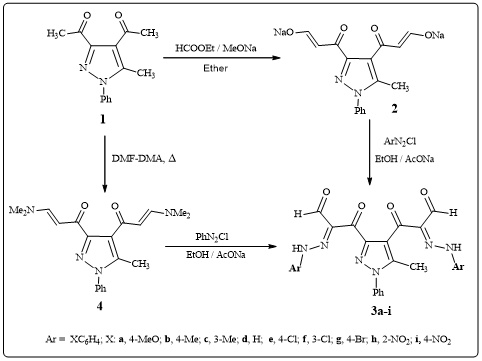
Figure 1. Synthesis of bis-arylhydrazonopropanal derivatives 3a-i.
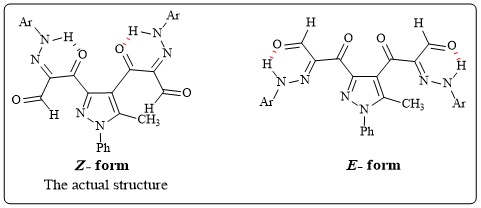
Figure 2. Isomers of bis-arylhydrazonopyrazolederivatives 3a-i.
Subsequent treatment of the bis-arylhydrazone derivatives 3a–i with hydrazine hydrate under reflux in dioxane led to the formation of single, well-defined products 5a–i, as verified through thin-layer chromatography (TLC) analysis of the crude reaction mixtures (Figure 3). The proposed molecular structures for the 5'-methyl-1'-phenyl-4,4''-bis(aryldiazenyl)-1H,1'H,1''H-3,3':4',3''-terpyrazole derivatives (5a–i) were confirmed using a combination of elemental analysis, proton nuclear magnetic resonance (^1H NMR), infrared (IR) spectroscopy, and mass spectrometry (MS).
In the IR spectra of compounds 5a–i (refer to Experimental section), each sample displayed a characteristic NH stretching vibration in the 3412–3452 cm⁻¹ range, corresponding to the hydrazone group, along with bands assignable to aliphatic CH and C=N stretching. Mass spectra for all terpyrazole derivatives revealed molecular ion peaks consistent with their theoretical molecular weights. These spectral findings collectively supported the proposed structures of 5a–i. However, they could not differentiate between the two potential tautomeric forms: the bis-arylhydrazone (5A) and bis-arylazo (5B) structures. To resolve this, UV-Vis spectroscopy was carried out at varying pH values.
The UV-Visible absorption spectra of compounds 5a–i in ethanol consistently exhibited two distinct peaks—one in the 395–414 nm range and another between 313–337 nm (Table 1). These spectral features align with those typically observed for arylhydrazone chromophores [22, 26], implying that the compounds predominantly exist as the bis-arylhydrazone tautomer (5A) in solution.
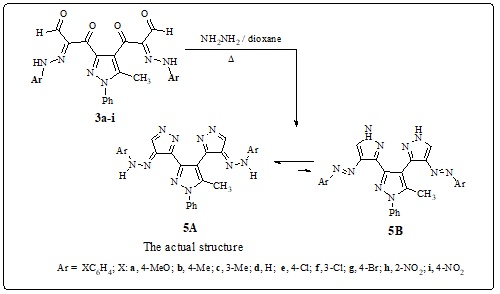
Figure 3. Synthesis of bis-arylazo-terpyrazole derivatives 5a-i.
To further validate this tautomeric assignment, the dissociation constants (pKa) of the 5a–i series were determined spectrophotometrically. A representative example is shown for compound 5d, where UV-Vis spectra were recorded across buffer solutions of varying pH (Figure 4). The pKa values were calculated based on the absorbance-pH relationship using the following equation [44, 45]:
(1)
Where Ai represents the absorbance at a specific pH (pHi), while Ab and Aa correspond to the absorbances in strongly basic and strongly acidic conditions, respectively. The determined pKa values for 5a–i are presented in Table 1.
Regression analysis yielded the following linear relationships:
(2)
(3)
Here, r denotes the correlation coefficient and s the standard deviation. The stronger correlation observed with the Hammett σ⁻ substituent constants, rather than σ, suggests that electronic effects on acidity are better explained by σ⁻. This supports the conclusion that the compounds exist primarily in the bis-hydrazone tautomeric form 5A (Figure 5). If both 5A and 5B tautomers were present in equilibrium, a clear linear correlation between pKa and σ⁻x would not be expected. Furthermore, the observed reaction constant (ρ = 1.09) is in good agreement with known values for similar bis-hydrazone systems, further reinforcing the dominance of tautomer 5A [32, 46].
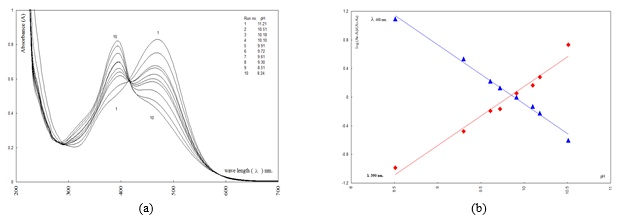
Figure 4. (a) Electronic absorption spectra of compound 5d, in solution of different pH values (1:4 (v/v) dioxane-water) at 27 °C and μ = 0.10; (b) Correlation of log(Ab - Ai)/(Ai - Aa) at two maximum electronic absorption wavelengths with pH values of compound 5d.
Table 1. UV/Vis spectra and acid dissociation constants pK of bis-arylhydrazonopyrazole derivatives 5a-i
Compound No. | λmax nm (EtOH) (log ε) | σX | σ-X | pK | λmaxa | λmaxb | Δν cm-1 | pK* |
4a | 401 (4.12), 321 (4.22) | −0.27 | −0.27 | 10.29 | 393 | 475 | 4392 | 1.06 |
4b | 397 (4.06), 325 (4.15) | −0.17 | −0.17 | 10.15 | 392 | 469 | 4188 | 1.35 |
4c | 395 (4.00), 323 (4.25) | −0.07 | −0.07 | 9.90 | 388 | 467 | 4359 | 0.78 |
4d | 392 (4.15), 313 (4.10) | 0.00 | 0.00 | 9.85 | 390 | 468 | 4273 | 0.87 |
4e | 400 (4.42), 325 (4.40) | 0.23 | 0.23 | 9.75 | 396 | 479 | 4375 | 0.56 |
4f | 406 (4.10), 337 (4.12) | 0.37 | 0.37 | 9.49 | 392 | 470 | 4233 | 0.60 |
Dg | 409 (4.40), 330 (4.45) | 0.71 | 0.71 | 9.03 | 400 | 480 | 4166 | 0.28 |
4h | 402 (4.41), 335 (4.33) | 0.5 | 0.84 | 9.04 | 400 | 483 | 4296 | 0.02 |
4i | 414 (3.39), 337 (3.54) | 0.78 | 1.28 | 8.56 | 400 | 485 | 4381 | -0.64 |
Note. a In acid medium; b in alkaline medium; ± s = 0.05.
The acid dissociation constants of compounds 5a–i in their electronically excited states (pK*) were calculated using the Förster energy cycle method [28, 29]. This method employs the following relationship (Eq. 4):
In this equation, pK and pK* represent the dissociation constants in the ground and excited states, respectively. At the same time, Δν refers to the difference in wavenumbers (cm⁻¹) between the absorption maxima (λ_max) of each compound in acidic and basic conditions. The calculated pK* values are listed in Table 1.
A correlation analysis between pK* and the Hammett substituent constants (σx and σ⁻x) was performed and is illustrated in Figure 5. The data fit the following linear regression models:.
(6)
The relatively strong correlation with σ⁻x again indicates that the bis-arylhydrazone tautomeric form (5A) remains the dominant species even in the excited state [47, 48].
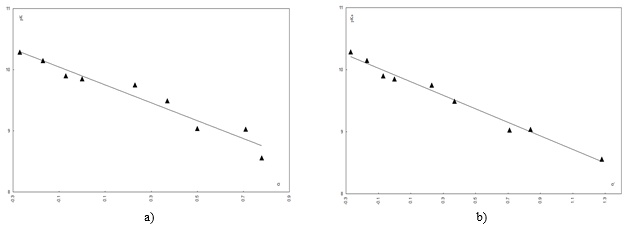
Figure 5. (a) Correlation of ground-state pKa values of bis-arylhydrazonopyrazole derivatives 5a–i with Hammett substituent constants (σx); (b) Correlation with modified Hammett constants (σx).
The synthesized terpyrazole derivatives 5a–i were evaluated for their in vitro antimicrobial activity. The testing included gram-negative bacteria such as Escherichia coli (EC) and Pseudomonas aeruginosa (PA), as well as Gram-positive strains such as Bacillus subtilis (BS) and Streptococcus pneumoniae (SP). Additionally, antifungal testing was performed against Syncephalastrum racemosum (SR), Aspergillus fumigatus (AF), Candida albicans (CA), and Geotrichum candidum (GC).
Standard antibiotics Gentamicin and Ampicillin were used as positive controls for antibacterial tests, while Amphotericin B served as the reference compound in antifungal evaluations. The antimicrobial effectiveness of the tested compounds was determined using the diffusion method, with the inhibition zone diameter (IZD) serving as the primary metric (Table 2).
Table 2. Antimicrobial activities of the synthesized bis(arylazo)-terpyrazoles (5a-i)
Comp. | Inhibition zone diameter (cm) | |||||||
Gram (+) | Gram (−) | Fungi | ||||||
Standard drugs | (SP) | (BS) | (PA) | (EC) | (AF) | (SR) | (GC) | (CA) |
23.8 ± 0.2 | 32.4 ± 0.3 | 17.3 ± 0.1 | 19.9 ± 0.3 | 23.7 ± 0.2 | 19.7 ± 0.2 | 28.7 ± 0.2 | 25.4 ± 0.1 | |
5a | 14.3 ± 0.3 | 14.9 ± 0.3 | NA | NA | 15.2± 0.5 | 11.3 ± 0.3 | 11.7 ± 0.5 | NA |
5b | 12.1 ± 0.4 | 16.3 ± 0.3 | NA | NA | 16.4± 0.3 | 11.6 ± 0.3 | 12.0 ± 0.4 | NA |
5c | 12.4 ± 0.3 | 15.2 ± 0.4 | NA | NA | 15.7 ± 0.3 | 12.1 ± 0.2 | 12.3 ± 0.3 | NA |
5d | 15.3 ± 0.3 | 17.6 ± 0.4 | 10.1 ± 0.3 | 8.2 ± 0.2 | 15.6 ± 0.6 | 12.7 ± 0.3 | 11.4 ± 0.4 | 13.6 ± 0.6 |
5e | 19.1 ± 0.4 | 22.8 ± 0.3 | 13.1 ± 0.4 | 20.3 ± 0.1 | 20.2 ± 0.6 | 16.4 ± 0.6 | 22.4 ± 0.6 | 17.9 ± 0.4 |
5f | 17.8 ± 0.5 | 20.4 ± 0.3 | 12.1 ± 0.3 | 19.1 ± 0.1 | 17.3 ± 0.4 | 13.2 ± 0.3 | 19.0 ± 0.6 | 17.3 ± 0.4 |
5g | 18.7 ± 0.6 | 20.7 ± 0.4 | 14.1 ± 0.4 | 17.3 ± 0.1 | 18.9 ± 0.6 | 15.4 ± 0.3 | 20.7 ± 0.3 | 19.4 ± 0.3 |
5h | 14.8 ± 0.6 | 15.2 ± 0.7 | 10.3 ± 0.4 | 14.6 ± 0.3 | 14.1 ± 0.5 | 14.0 ± 0.4 | 13.7 ± 0.5 | 13.7 ± 0.5 |
5i | 16.9 ± 0.4 | 19.8 ± 0.6 | 11.1 ± 0.3 | 15.7 ± 0.3 | 15.3 ± 0.6 | 14.4 ± 0.4 | 19.5 ± 0.4 | 16.2 ± 0.3 |
Note. Data are expressed in the form of mean ± SD. Mean zone of inhibition in mm ± standard deviation beyond well diameter; (6 mm) produced on a range of environmental and clinically pathogenic microorganisms using (5 mg/mL) concentration of tested sample (100 µL was tested).
The antimicrobial screening results summarized in Table 2 reveal that Streptococcus pneumoniae (SP) and Bacillus subtilis (BS) are susceptible to all tested compounds 5a–i. Moreover, Escherichia coli (EC) and Pseudomonas aeruginosa (PA) were specifically sensitive to compounds 5d-5i. Regarding antifungal activity, all derivatives except 5a–c demonstrated inhibition against the tested fungal strains, including Syncephalastrum racemosum (SR), Aspergillus fumigatus (AF), Candida albicans (CA), and Geotrichum candidum (GC). Notably, compounds 5a–c showed no antifungal activity against Candida albicans.
The high antimicrobial efficiency observed across most derivatives is attributed to the bioactive terpyrazole core structure present in compounds 5a–i. In contrast, the reduced or absent activity of 5a-c—particularly against Candida albicans and Gram-negative bacteria—is believed to result from the incorporation of electron-donating substituents, which may diminish their biological efficacy.
The potential antitumor activity of the synthesized hydrazone derivatives 5a-i was investigated against the HepG2 liver carcinoma cell line. Doxorubicin was used as a standard reference drug. A dose-response relationship was established to determine the half-maximal inhibitory concentration (IC₅₀), expressed in micromolar (μM) units. The IC₅₀ values presented in Table 3 reflect the mean of five replicates and provide insight into the cytotoxic performance of each compound.
Table 3. In vitro cytotoxic activity (IC₅₀ values in μM ± standard deviation) of compounds 5a–i against HepG2 cells.
Compound | Ar substituent | IC₅₀ (μM) | Compound | Ar substituent | IC₅₀ (μM) |
5a | 4-MeOC₆H₄ | 11.7 ± 0.19 | 5f | 3-ClC₆H₄ | 6.32 ± 0.24 |
5b | 4-MeC₆H₄ | 12.48 ± 0.26 | 5g | 4-BrC₆H₄ | 2.15 ± 0.12 |
5c | 3-MeC₆H₄ | 14.34 ± 0.21 | 5h | 2-NO₂C₆H₄ | 4.4 ± 0.15 |
5d | C₆H₅ | 14.45 ± 0.18 | 5i | 4-NO₂C₆H₄ | 2.6 ± 0.09 |
5e | 4-ClC₆H₄ | 4.35 ± 0.16 | Doxorubicin | — | — ± 0.18 |
All tested compounds showed dose-dependent cytotoxic activity against HepG2 cells. Compounds 5e and 5g–5i exhibited strong cytotoxicity, with notably low IC₅₀ values, suggesting higher potency. Compound 5f demonstrated moderate activity, whereas derivatives 5a–d showed relatively weak anticancer effects. The observed order of potency is as follows:
5g > 5i > 5e > 5h > 5f > 5a > 5b > 5c > 5d
These results underscore the significant influence of substituents on the arylhydrazone moiety. Electron-withdrawing groups, particularly nitro (NO₂), bromine (Br), and chlorine (Cl) at the para position of the aryl ring, were associated with enhanced cytotoxic effects. Conversely, electron-donating groups such as methoxy (OMe) and methyl (Me) tended to diminish anticancer activity.
In conclusion, a novel series of bis(arylazo)-terpyrazole derivatives (5a–i) was synthesized via a straightforward coupling of sodium 3,3'-(5-methyl-1-phenyl-1H-pyrazole-3,4-diyl)bis(3-oxoprop-1-en-1-olate) (2) with various arenediazonium salts, followed by condensation of the resulting intermediates (3a-i) with hydrazine hydrate. The structures of the final products were confirmed through multiple spectroscopic techniques and supported by pKa analysis to establish the dominant tautomeric form. Additionally, the newly synthesized compounds exhibited promising antibacterial and antifungal properties, as well as notable in vitro antitumor activity against the HepG2 cell line, particularly those bearing electron-withdrawing substituents.
None
None
None
None
Open Access The author(s) retain copyright. This article is licensed under the Creative Commons Attribution-NonCommercial-ShareAlike 4.0 International License. It may be shared and adapted for non-commercial purposes with appropriate attribution, an indication of changes, and distribution of adaptations under the same license. Third-party material may be subject to separate terms identified in its credit line. View the license at https://creativecommons.org/licenses/by-nc-sa/4.0/.
 Publication System