Digital batch records have commonly been implemented as electronic substitutes for paper documentation, preserving the logic of retrospective compliance rather than transforming the logic of pharmaceutical knowledge. This narrow implementation view treats the batch record as a repository of completed events, signatures, deviations, and release evidence. Such a view is increasingly insufficient for manufacturing environments shaped by automation, continuous processing, process analytical technology, and real-time quality expectations. This article reconceptualises digital batch records as pharmaceutical knowledge systems rather than electronic documentation artefacts. The central argument is that a digital batch record should not merely record what occurred during manufacturing, but should structure why it occurred, how it relates to process understanding, and how it informs quality decisions. This reframing is especially important for continuous manufacturing, where batch boundaries, material histories, and quality evidence are dynamic rather than fixed. The objective of the article is to develop a conceptual systems perspective on digital batch records for continuous manufacturing and regulatory inspection. The article synthesises peer-reviewed literature on pharmaceutical digitalisation, continuous manufacturing, data integrity, knowledge management, process control, real-time release testing, and regulatory science. It does not present new empirical data, but constructs a conceptual model from existing evidence and emerging regulatory trends. The article defines the system boundary of digital batch records, explains their knowledge logic, connects them to pharmaceutical knowledge management, and positions them as infrastructure for continuous manufacturing and inspection transformation. It argues that digital batch records can integrate process data, material traceability, critical quality attributes, audit trails, deviation logic, and lifecycle knowledge into a structured manufacturing intelligence layer. Four tables are used to clarify the proposed record logic, continuous manufacturing integration, inspection transformation, and knowledge-system architecture. The article concludes that digital batch records should be designed as the cognitive infrastructure of pharmaceutical quality. When architected as knowledge systems, they can support real-time quality assurance, predictive process oversight, continuous improvement, and more transparent regulatory interaction. The shift from record-keeping to knowledge-driven assurance is therefore not a technical upgrade alone, but a transformation in how pharmaceutical manufacturing knows, governs, and demonstrates quality.
Pharmaceutical batch records historically emerged as formal evidence that a product was manufactured according to approved procedures, specifications, and quality expectations. In that paper-based logic, the record was primarily retrospective: operators completed forms, reviewers checked entries, deviations were reconciled, and quality units reconstructed the manufacturing event after it had already occurred. The movement toward electronic batch records improved legibility, retrieval, workflow control, and error reduction, but it often preserved the underlying paper logic of documentation as proof rather than knowledge as a system property, a limitation that becomes visible in broader discussions of pharmaceutical quality evolution [1]. Yu and Kopcha frame the future of pharmaceutical quality as requiring more integrated, science-based, and risk-based systems, which implies that records must become part of quality intelligence rather than remain passive compliance files [1].
The current inflection point is driven by the convergence of continuous manufacturing, real-time data capture, process analytical technology, and digital manufacturing architectures. Nasr, Krumme, Matsuda, Trout, Badman, Mascia, Cooney, Jensen, Florence, Konstantinov, Lee, Yu, and Woodcock show that continuous manufacturing requires regulatory and technical movement from theoretical possibility to practical implementation, where quality evidence is generated continuously rather than assembled only at the end of a batch [2]. Burcham, Florence, and Johnson similarly describe continuous manufacturing as a process-development and manufacturing shift that changes how process knowledge is generated, monitored, and controlled [3]. Within this context, the digital batch record can no longer be understood as a static electronic wrapper around manufacturing documentation.
A conceptual systems perspective treats the digital batch record as an active knowledge infrastructure that links events, parameters, materials, analytical signals, interventions, deviations, and quality decisions. Vargas, Nielsen, Cárdenas, Gonzalez, Aymat, Almodovar, Classe, Colón, Sanchez, and Romañach demonstrate that process analytical technology in continuous commercial manufacturing depends on structured process data that can be interpreted in relation to product quality [4]. Rehrl, Karttunen, Nicolaï, Hoermann, Horn, Korhonen, Nopens, De Beer, and Khinast extend this logic by showing how soft sensors and control strategies can support continuous pharmaceutical manufacturing processes [5]. These developments imply that the batch record must evolve from a record of compliance to a structured representation of manufacturing knowledge.
This article therefore proposes that digital batch records should be reconceptualised as pharmaceutical knowledge systems. The objective is to articulate the design logic, system boundary, knowledge-management role, and regulatory significance of digital batch records in a manufacturing environment moving toward continuous operation and predictive quality assurance. The argument builds on the claim by Arden, Fisher, Tyner, Yu, Lee, and Kopcha that Industry 4.0 pharmaceutical manufacturing requires preparation for smart factories, not merely isolated digital tools [6]. In this framing, the DBR becomes a central knowledge node through which manufacturing, quality, and regulatory functions can share a common, inspectable, and actionable understanding of the product lifecycle.
The system boundary of a digital batch record cannot be limited to the electronic form used to document a manufacturing campaign. A knowledge-oriented DBR includes interfaces with process equipment, automation systems, material management systems, laboratory information systems, quality management systems, deviation platforms, audit-trail repositories, and regulatory communication channels. Chen, Yang, Sampat, Bhalode, Ramachandran, and Ierapetritou describe digital twins in pharmaceutical and biopharmaceutical manufacturing as models that require integration of process data, system understanding, and decision support [7]. This broader view supports a DBR boundary that extends beyond documentation into the data structures and interpretive mechanisms that make pharmaceutical manufacturing intelligible.
The proposed DBR system is also distinct from a data lake because it does not merely store large volumes of heterogeneous data. A data lake may preserve raw manufacturing information, but a knowledge system structures relationships among process parameters, critical material attributes, critical quality attributes, procedural context, equipment states, operator interventions, and deviation pathways. Leal, Chis, Caton, González-Vélez, García-Gómez, Durá, Sánchez-García, Sáez, Karageorgos, Gerogiannis, Xenakis, Lallas, Ntounas, Vasileiou, Mountzouris, Otti, Pucci, Papini, Cerrai, and Mier emphasise end-to-end traceability and data integrity in smart pharmaceutical manufacturing, which requires relational meaning rather than data accumulation alone [8]. The DBR as a knowledge system therefore transforms fragmented records into contextualised manufacturing intelligence.
The system boundary must also include governance because knowledge without control cannot support pharmaceutical assurance. Rattan’s analysis of data integrity history and remediation shows that data problems are not merely technical defects but quality-system vulnerabilities that affect trust in records and decisions [9]. Alosert, Savery, Rheaume, Cheeks, Turner, Spencer, Farid, and Goldrick similarly argue that Industry 4.0 increases the importance of data integrity within biopharmaceutical operations because digital systems intensify both opportunities and risks [10]. A pharmaceutical knowledge system must therefore bind data capture, interpretation, access control, auditability, and lifecycle governance within the same conceptual boundary.
The logic of a digital batch record as a knowledge system begins with the distinction between event recording and event interpretation. A conventional electronic record may show that a parameter remained within limits, but a knowledge-oriented DBR should show how the parameter related to material attributes, equipment state, process dynamics, control actions, and quality implications. Su, Ganesh, Moreno, Bommireddy, Gonzalez, Reklaitis, and Nagy describe Quality-by-Control as a perspective in which continuous manufacturing quality depends on control architectures capable of linking process behaviour to quality outcomes [11]. This perspective suggests that the DBR must encode relationships among data streams rather than simply preserve completed procedural evidence.
A knowledge-oriented DBR should capture not only what happened but also the context that gives manufacturing events meaning. For example, a transient excursion in a continuous process may have different quality significance depending on residence time distribution, material location, model confidence, intervention timing, and downstream segregation logic. Tian, Koolivand, Arden, Lee, and O’Connor show that flowsheet modelling can support quality risk assessment and mitigation in pharmaceutical continuous manufacturing, reinforcing the need to connect process events with system-level risk logic [12]. The DBR should therefore function as a contextual layer that links event chronology to process understanding and quality risk.
The digital batch record also becomes a mechanism for real-time evaluation, exception handling, and continuous improvement. Markl, Warman, Dumarey, Bergman, Folestad, Shi, Manley, Goodwin, and Zeitler describe real-time release testing as a state-of-the-art direction in which quality evidence is generated and interpreted during manufacturing rather than only through delayed end-product testing [13]. Sacher, Poms, Rehrl, and Khinast further explain that process analytical technology can support advanced process control in solid dosage manufacturing when implementation is designed around practical data use and quality decision-making [14]. Table 1 outlines the core components and logic of digital batch records as knowledge systems.
Table 1. Digital Batch Record Logic: Core Components, Data Flows, and Knowledge Functions
DBR component | Primary data flow | Knowledge function | Quality-system value |
Process event capture | Time-stamped equipment, operator, material, and control-system events | Converts manufacturing activity into a structured event history | Enables reconstruction of what occurred during production |
Parameter and attribute linkage | Connections among process parameters, material attributes, and critical quality attributes | Explains why specific events matter for quality | Supports science-based review rather than checklist review |
Contextual metadata | Equipment state, recipe version, operator role, environmental condition, calibration status, and system configuration | Gives manufacturing data interpretive context | Reduces ambiguity in deviation investigation and batch disposition |
Exception logic | Deviations, alarms, interventions, holds, segregation actions, and corrective actions | Differentiates routine variation from quality-relevant abnormality | Supports risk-based exception management |
Real-time quality evidence | PAT signals, model outputs, in-process controls, and release-relevant quality indicators | Converts process data into actionable assurance signals | Enables movement toward real-time release and predictive assurance |
Audit trail and data lineage | Metadata on creation, modification, review, approval, transfer, and use of data | Establishes trust in the origin and transformation of evidence | Supports inspection readiness and data-integrity assurance |
Knowledge feedback loop | Links from batch outcomes, deviations, complaints, trends, and lifecycle reviews back into process knowledge | Turns records into continuous improvement infrastructure | Supports preventive action, optimisation, and lifecycle management |
A mature DBR should therefore operate as a structured knowledge interface between manufacturing execution and pharmaceutical quality governance. Badman, Cooney, Haslam, Florence, Konstantinov, Krumme, Mascia, Nasr, Trout, and Baddour argue that continuous pharmaceutical manufacturing is needed and that its realisation depends on coordinated technical, organisational, and regulatory movement [15]. The DBR can become one of the mechanisms through which that coordination is achieved because it provides a shared representation of manufacturing reality. In this sense, DBR logic is not only documentary logic but also epistemic logic: it defines how the system knows that quality has been produced.
Pharmaceutical knowledge systems are grounded in the idea that quality is not produced by documentation alone, but by the organised use of process understanding across the product lifecycle. Lipa, Greene, and Calnan position knowledge management as an enabler of the pharmaceutical quality system and argue that enhanced knowledge transfer can help bridge the relationship between ICH Q10 and ICH Q12 [16]. This is directly relevant to DBRs because batch data are among the richest operational sources of product and process knowledge. When structured appropriately, the DBR becomes an operational knowledge-management engine rather than an endpoint archive.
The knowledge-system role of the DBR is especially important because manufacturing knowledge is often dispersed across development reports, validation documents, control strategies, deviation records, analytical datasets, and operator experience. Hole, Hole, and McFalone-Shaw argue that pharmaceutical digitalisation requires focused implementation choices rather than technology adoption for its own sake [17]. A knowledge-oriented DBR offers such focus because it connects digitalisation to the practical question of how manufacturing evidence is captured, contextualised, interpreted, and reused. It prevents digital transformation from becoming fragmented automation without cumulative learning.
A pharmaceutical knowledge system must also support lifecycle learning by converting batch-level evidence into process-level insight. Vanhoorne and Vervaet describe recent progress in continuous manufacturing of oral solid dosage forms, showing that advanced manufacturing requires integrated thinking about formulation, process design, control, and product performance [18]. Wahlich similarly reviews continuous manufacturing of small-molecule solid oral dosage forms and highlights the technical movement toward integrated production approaches [19]. In this environment, DBRs should support trend detection, process capability understanding, recurring deviation analysis, and lifecycle optimisation rather than merely confirm that individual records were completed.
The conceptual shift from digital record to knowledge system also changes the relationship between quality assurance and manufacturing operations. Instead of treating quality as a post-production review function, the DBR can embed quality interpretation within the manufacturing process itself. Pedro, Veiga, and Mascarenhas-Melo connect GAMP 5, data integrity, and quality-by-design to quality assurance in the pharmaceutical industry, reinforcing the idea that validated digital systems must serve quality reasoning rather than simple automation [20]. A DBR designed as a pharmaceutical knowledge system therefore becomes a practical expression of knowledge management, quality risk management, and lifecycle assurance within one integrated digital architecture.
Continuous manufacturing changes the meaning of a batch record because production is no longer organised around a single discrete operation with fixed start and end points. In continuous oral suspension manufacturing, Bostijn, Van Renterghem, Dhondt, Vervaet, and De Beer show that product quality depends on coordinated material feeding, process control, and continuous transformation rather than isolated unit operations [21]. This makes a conventional record structure inadequate because it tends to document completed steps rather than living process states. A DBR designed as a knowledge system must therefore represent production as a time-indexed, material-linked, and quality-relevant flow of events.
The most important integration challenge is the dynamic definition of batch identity in a continuous line. Sánchez-Paternina, Martínez-Cartagena, Li, Scicolone, Singh, Lugo, Romañach, Muzzio, and Román-Ospino demonstrate that residence time distribution can support traceability during lot changes in pharmaceutical continuous manufacturing [22]. This finding has direct implications for DBR design because the record must connect incoming material lots, residence-time behaviour, process segments, diversion decisions, and final product identity. Instead of treating batch identity as a pre-existing container, the DBR should construct batch identity from material movement, process history, and quality evidence.
Continuous manufacturing also requires DBRs to integrate model-based, sensor-based, and control-based knowledge in real time. Nambiar, Singh, Mali, Serrano, Kumar, Healy, Agrawal, and Kumar show that continuous manufacturing can be linked with molecular modelling for pharmaceutical amorphous solid dispersions, reinforcing the need to connect process behaviour with product and material understanding [23]. Celikovic, Rehrl, Fraga, Steinberger, Khinast, Horn, and Sacher further describe a modern strategy for digital real-time release testing in continuous tablet manufacturing, where digital quality evaluation depends on the integration of process data and decision logic [24]. Table 2 illustrates the integration points of digital batch records within continuous manufacturing workflows.
Table 2. Integration of Digital Batch Records in Continuous Manufacturing: Data Sources, Real-Time Capture, and Feedback Loops
Continuous manufacturing function | DBR integration point | Real-time knowledge captured | Feedback loop enabled |
Material feeding and dispensing | Links raw-material identity, lot history, feed rate, and equipment status | Material genealogy and process-entry conditions | Adjustment of feed control and material-release decisions |
Process transformation | Captures time-stamped process parameters across connected unit operations | Process trajectory and unit-operation interdependence | Process optimisation and abnormal-state detection |
Residence time tracking | Links material movement to residence time distribution and lot transition logic | Dynamic batch identity and material traceability | Segregation, diversion, and batch-boundary definition |
Process analytical technology | Integrates PAT signals with process context and quality attributes | Real-time quality evidence | Real-time release testing and control-space verification |
Control system interaction | Records set points, control actions, soft-sensor outputs, and model predictions | Control rationale and process-response history | Model review, tuning, and validated control improvement |
Exception management | Connects alarms, deviations, interventions, and product impact assessment | Risk-ranked abnormal event interpretation | Corrective action and preventive process learning |
Lifecycle review | Aggregates campaign data, trends, deviations, and performance indicators | Cumulative process knowledge | Continuous improvement and regulatory knowledge sharing |
A DBR integrated into continuous manufacturing should therefore function as both a manufacturing memory and a process-control knowledge layer. Sundarkumar, Wang, Mills, Oh, Nagy, and Reklaitis describe a modular continuous drug-product manufacturing system with real-time quality assurance for pharmaceutical mini-tablets, showing how manufacturing architecture and quality assurance can be designed together [25]. This supports the argument that DBRs should not sit downstream of manufacturing as documentary residue. They should be embedded within the digital manufacturing architecture so that quality evidence, material history, and control decisions remain connected while production is occurring.
Regulatory inspection has traditionally relied on periodic assessment, document review, batch sampling, deviation investigation, and retrospective reconstruction of manufacturing evidence. This logic remains important, but it is strained by continuous manufacturing because relevant quality evidence may be distributed across high-frequency data streams, control models, audit trails, and process-history segments. Kakhi, Li, and Dorantes describe regulatory experience with continuous manufacturing and real-time release testing for dissolution in new drug applications, showing that regulators are already encountering quality evidence that differs from traditional batch-release documentation [26]. A knowledge-oriented DBR can make such evidence inspectable by structuring the relationship between process performance and quality decisions.
The digital inspection logic proposed here does not eliminate regulatory review; it changes the object of review. Instead of reviewing a static file after production, the regulator can evaluate the architecture through which data are captured, contextualised, governed, and transformed into quality knowledge. O’Connor, Chatterjee, Lam, Pérez de la Ossa, Martinez-Peyrat, Hoefnagel, and Fisher examine process models and model-risk frameworks for pharmaceutical manufacturing, highlighting the importance of understanding how models affect manufacturing decisions [27]. A DBR that records model inputs, outputs, confidence limits, interventions, and review history can help convert model-mediated production into an inspectable quality system.
Digital knowledge-enabled inspection also supports remote and risk-based assessment because inspectors can evaluate structured evidence without depending entirely on site-bound document reconstruction. Arden, Fisher, Tyner, Yu, Lee, and Kopcha’s description of smart pharmaceutical factories implies that future inspection must account for integrated data environments, automation, and digitally mediated decisions [6]. In such environments, the regulator needs to understand not only whether an individual batch met criteria but whether the system reliably generates, preserves, and interprets quality evidence. Table 3 contrasts traditional inspection logic with the digital knowledge-driven inspection logic enabled by DBRs.
Table 3. Regulatory Inspection Logic: Traditional Batch Review versus Digital Knowledge-Enabled Inspection Using Digital Batch Records
Inspection dimension | Traditional batch-review logic | DBR-enabled knowledge inspection logic | Regulatory value |
Primary evidence object | Completed batch record and supporting paper or electronic attachments | Structured manufacturing knowledge system linking events, data, context, and decisions | Enables deeper review of how quality evidence was generated |
Timing of review | Mainly retrospective after production and batch closure | Retrospective, real-time, and predictive through structured digital evidence | Supports earlier detection of quality risks |
Batch identity | Fixed production lot with predefined boundaries | Dynamically defined material and process history supported by traceability logic | Improves inspection of continuous manufacturing |
Data interpretation | Manual reconstruction by quality reviewers and inspectors | Contextualised process, material, model, and quality relationships | Reduces ambiguity and improves review efficiency |
Deviation assessment | Case-by-case review of recorded abnormal events | Risk-ranked analysis linked to process state, product impact, and recurring trends | Supports preventive inspection logic |
Model and control review | Limited visibility unless separately documented | Inspectable model outputs, overrides, recalibrations, and control actions | Enables oversight of digitally mediated decisions |
Inspection readiness | Prepared documentation packages for periodic inspection | Persistent, searchable, audit-ready knowledge architecture | Supports remote assessment and continuous regulatory intelligence |
The result is a shift from episodic inspection toward continuous regulatory intelligence. This does not mean that regulators continuously monitor every internal data stream, but that firms can provide structured, reliable, and context-rich evidence when inspection questions arise. Maharjan, Kim, Kim, and Jeong describe transformative roles of digital twins from drug discovery to continuous manufacturing, suggesting that pharmaceutical digital systems can support lifecycle visibility across development and production [28]. A DBR knowledge system can become the regulatory interface through which that visibility is translated into inspectable manufacturing assurance.
Data traceability is the backbone of trust in a DBR knowledge system because continuous, automated, and integrated manufacturing produces quality evidence through many interconnected systems. Rattan’s discussion of data integrity shows that the reliability of pharmaceutical decisions depends on trustworthy data histories, not merely on the existence of records [9]. In DBR design, traceability must therefore include who created or modified data, when the action occurred, which system generated the data, how the data were transformed, and how they were used in quality decisions. Without this lineage, the DBR becomes a digital accumulation of evidence rather than a defensible knowledge system.
The ALCOA+ principles are especially relevant because DBRs depend on attributable, legible, contemporaneous, original, accurate, complete, consistent, enduring, and available records. Gokulakrishnan and Venkataraman discuss best practices and strategies for ensuring data integrity in the pharmaceutical industry, reinforcing the need for governance structures that protect data throughout its lifecycle [29]. Kavasidis, Lallas, Karageorgos, and Gerogiannis examine computational approaches for predicting ALCOA+ compliance, which indicates that data integrity itself can become a structured and assessable digital property [30]. A DBR knowledge system should therefore make ALCOA+ compliance visible at the level of data objects, workflows, audit trails, and decision pathways.
Audit trails are not peripheral administrative features in this model; they are part of the knowledge architecture. Alosert, Savery, Rheaume, Cheeks, Turner, Spencer, Farid, and Goldrick argue that data integrity in the Industry 4.0 era is complicated by greater interconnectivity, automation, and digital dependency [10]. This means that audit trails must show not only manual edits but also automated transfers, model outputs, system integrations, parameter changes, recipe revisions, and data-context transformations. For DBRs to support regulatory confidence, audit trails must be reviewable as narratives of knowledge generation rather than isolated logs of system activity.
Data provenance becomes more complex when continuous manufacturing lines involve multiple equipment modules, PAT instruments, control models, laboratory systems, and quality platforms. Leal, Chis, Caton, González-Vélez, García-Gómez, Durá, Sánchez-García, Sáez, Karageorgos, Gerogiannis, Xenakis, Lallas, Ntounas, Vasileiou, Mountzouris, Otti, Pucci, Papini, Cerrai, and Mier’s work on smart pharmaceutical manufacturing highlights the importance of end-to-end traceability across medicine production [8]. In a DBR knowledge system, provenance must connect each data element to its generating condition, transformation history, review status, and decision relevance. This makes traceability not only a compliance requirement but also a knowledge-design principle.
The proposed Knowledge Model defines the DBR as a layered pharmaceutical knowledge system that converts manufacturing activity into structured, inspectable, and actionable quality knowledge. The first layer is the data acquisition layer, which captures equipment signals, material information, operator actions, process parameters, PAT measurements, environmental conditions, and system events. The second layer is the contextualisation layer, where raw data are linked to recipes, control strategies, batch or segment definitions, residence-time logic, quality attributes, metadata, and deviation pathways; this layer builds on the process-control and real-time quality concepts described by Su, Ganesh, Moreno, Bommireddy, Gonzalez, Reklaitis, and Nagy [11] and by Markl, Warman, Dumarey, Bergman, Folestad, Shi, Manley, Goodwin, and Zeitler [13]. The value of the DBR emerges when these layers transform disconnected signals into manufacturing knowledge.
The third layer is the application layer, where structured DBR knowledge supports batch disposition, real-time release, deviation investigation, process optimisation, regulatory inspection, and lifecycle management. The fourth layer is the governance layer, which defines access control, auditability, data-integrity rules, model-risk oversight, validation status, and knowledge ownership. O’Connor, Chatterjee, Lam, Pérez de la Ossa, Martinez-Peyrat, Hoefnagel, and Fisher’s discussion of model-risk frameworks is important here because DBR knowledge systems may include model-mediated quality decisions that require explicit governance [27]. Table 4 presents the proposed Knowledge Model for digital batch records as pharmaceutical knowledge systems.
Table 4. Proposed Knowledge Model: Digital Batch Record as a Pharmaceutical Knowledge System — Architecture, Layers, and Functionality
Knowledge-model layer | Main components | Core functionality | Output for manufacturing, quality, and regulatory use |
Data acquisition layer | Equipment signals, operator actions, material data, PAT outputs, environmental data, alarms, and system events | Captures contemporaneous manufacturing evidence from integrated sources | Complete, time-stamped, and attributable manufacturing data |
Contextualisation layer | Recipe context, process phase, material genealogy, residence time, critical parameters, quality attributes, metadata, and deviation context | Converts raw data into structured process and quality meaning | Interpretable manufacturing history and product-impact logic |
Application layer | Batch disposition tools, real-time release functions, deviation workflows, trend analytics, process optimisation, and regulatory review views | Applies structured knowledge to operational, quality, and inspection decisions | Actionable quality intelligence and decision support |
Governance layer | Access control, audit trails, data-integrity controls, validation status, model-risk oversight, retention rules, and lifecycle ownership | Ensures trust, control, accountability, and inspection readiness | Defensible knowledge system aligned with pharmaceutical quality expectations |
Feedback mechanism | Links from outcomes, deviations, complaints, trends, and inspection findings back to process knowledge | Enables continuous learning and system improvement | Preventive action, lifecycle optimisation, and improved regulatory transparency |
This Knowledge Model positions the DBR as the connecting tissue between digital manufacturing infrastructure and pharmaceutical quality governance. Chen, Yang, Sampat, Bhalode, Ramachandran, and Ierapetritou’s review of digital twins supports this layered view because digital manufacturing value depends on connecting models, data, and decisions [7]. Lipa, Greene, and Calnan’s work on knowledge management further supports the idea that structured knowledge transfer is essential to a mature pharmaceutical quality system [16]. The DBR therefore becomes a practical architecture for transforming batch data into organisational knowledge, quality assurance, and regulatory evidence.
Figure 1 presents the proposed conceptual architecture of digital batch records as pharmaceutical knowledge systems that transform continuous manufacturing data into real-time quality knowledge and regulatory inspection intelligence.
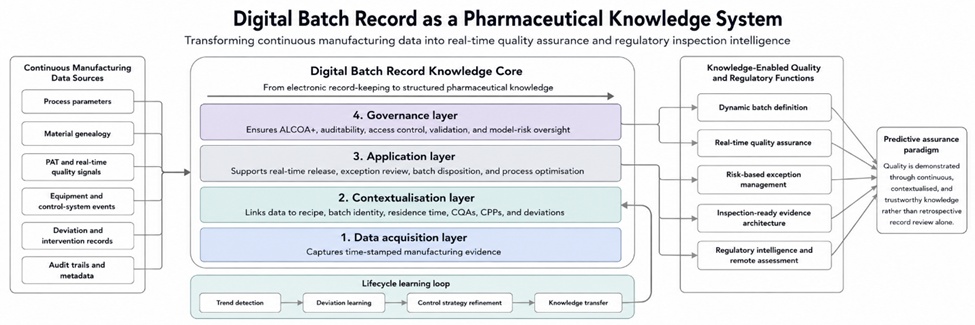
Figure 1. Digital Batch Record as a Pharmaceutical Knowledge System for Continuous Manufacturing, Real-Time Quality Assurance, and Regulatory Inspection Intelligence
The implementation pathway should begin with brownfield digitalisation, because many firms still operate with hybrid documentation environments in which paper records, electronic records, automation data, laboratory data, and quality-system records remain partially disconnected. Hole, Hole, and McFalone-Shaw argue that digital implementation in the pharmaceutical industry requires careful prioritisation, which makes a staged DBR pathway more realistic than a single disruptive transformation [17]. The first stage should map current batch-record content, identify repeated manual transcription points, connect core data sources, and remove avoidable fragmentation. At this stage, the purpose is not yet full intelligence but the creation of reliable, standardised, and validated digital record foundations.
The second stage is knowledge enablement, where the DBR begins to structure relationships among manufacturing events, process parameters, material attributes, quality attributes, deviations, and control decisions. Pedro, Veiga, and Mascarenhas-Melo show that GAMP 5, data integrity, and quality-by-design are deeply connected to quality assurance, which implies that DBR validation must consider intended knowledge use rather than simple electronic form compliance [20]. At this stage, firms should develop controlled vocabularies, metadata standards, exception taxonomies, material-traceability rules, and review dashboards. The DBR becomes valuable when it reduces ambiguity and supports risk-based interpretation.
The third stage is continuous-manufacturing integration, where DBRs support dynamic batch definition, real-time quality evidence, and feedback into process control. Burcham, Florence, and Johnson describe continuous manufacturing as a development and production shift that requires new forms of process understanding [3], while Sánchez-Paternina, Martínez-Cartagena, Li, Scicolone, Singh, Lugo, Romañach, Muzzio, and Román-Ospino show how traceability can be operationalised through residence-time distribution [22]. Implementation should therefore align DBR architecture with process-control strategy, residence-time models, PAT systems, diversion rules, and product-release logic. This stage moves the DBR from documentation support to manufacturing intelligence.
The final stage is regulatory acceptance of DBRs as inspectable knowledge systems for real-time quality assurance and more continuous regulatory interaction. Kakhi, Li, and Dorantes’ analysis of regulatory experience with continuous manufacturing and real-time release testing shows that regulatory practice is already adapting to digital and continuous evidence structures [26]. Sharma, Patel, and Shah discuss Industry 4.0 in the pharmaceutical industry in relation to sustainable development, which reinforces the broader organisational relevance of digital transformation beyond isolated production efficiency [31]. To realise this pathway, industry and regulators will need shared expectations for data standards, audit-trail review, model governance, remote assessment, and the evidentiary status of DBR-generated knowledge.
Digital batch records should no longer be understood as electronic mirrors of paper batch records. Their strategic value lies in their ability to transform manufacturing data into structured pharmaceutical knowledge. When designed as knowledge systems, they can connect process events, material history, quality attributes, deviations, control decisions, audit trails, and lifecycle learning within a unified assurance architecture.
This transformation is especially important for continuous manufacturing, where fixed batch boundaries and retrospective documentation are insufficient to represent dynamic production reality. A knowledge-oriented DBR can define batch identity through material flow, residence time, quality evidence, and process context. It can also support real-time quality assurance and make digital manufacturing more transparent to quality units and regulators.
The future of DBRs is therefore not simply an IT upgrade, but a quality infrastructure investment. Industry and regulators should collaborate to define standards, validation expectations, data-integrity requirements, and pilot pathways for DBRs as inspectable knowledge systems. Such collaboration can help move pharmaceutical manufacturing from record-keeping toward knowledge-driven assurance.
None
None
None
None
Open Access The author(s) retain copyright. This article is licensed under the Creative Commons Attribution-NonCommercial-ShareAlike 4.0 International License. It may be shared and adapted for non-commercial purposes with appropriate attribution, an indication of changes, and distribution of adaptations under the same license. Third-party material may be subject to separate terms identified in its credit line. View the license at https://creativecommons.org/licenses/by-nc-sa/4.0/.
 Publication System