This report presents a case of a potential pharmacokinetic drug-drug interaction (DDI) between fluconazole (FLU) and vancomycin (VCM) in a patient who underwent hepatobiliary surgery and biliary drainage. The patient was receiving treatment with vancomycin, meropenem, and fluconazole for an infectious condition. The exact effects of FLU and VCM on each other’s pharmacokinetics have not been fully explored. However, understanding the role of renal transporters (such as multidrug resistance-associated proteins, organic cation transporters, and P-glycoprotein) in the excretion of these drugs is crucial for predicting drug disposition and optimizing dosage. Inhibiting these transporters is often the underlying mechanism of drug interactions. Pharmacokinetic monitoring showed that when FLU was co-administered with VCM, the trough concentration and half-life of VCM increased unexpectedly compared with when VCM was given alone. These alterations in pharmacokinetic parameters suggest a possible DDI between FLU and VCM. Therefore, caution should be exercised when these drugs are used together, and VCM trough concentrations should be carefully monitored to minimize toxicity risk.
Vancomycin (VCM) is a glycopeptide antibiotic commonly prescribed for a variety of bacterial infections. It is typically given intravenously for more complex cases, such as skin infections, bloodstream infections, bone and joint infections, and endocarditis or meningitis caused by methicillin-resistant Staphylococcus aureus [1]. For years, it has been regarded as the primary treatment for diseases caused by this pathogen [2]. Therapeutic drug monitoring has enabled the determination of optimal vancomycin levels (10-20 mg/L) to prevent toxicity resulting from excessive concentrations. However, when vancomycin is used alongside other medications, particularly those with nephrotoxic effects (e.g., gentamicin, amikacin, tobramycin, colistin), or when pharmacokinetic drug-drug interactions (DDIs) are present, the drug’s elimination process may be altered, raising the likelihood of adverse effects, including nephrotoxicity and ototoxicity [3]. In this case report, we present the first documented occurrence of a potential pharmacokinetic DDI between vancomycin and fluconazole (FLU).
A 78-year-old patient, with no history of drug allergies and a background of dyslipidemia, microhematuria (2015), and a hydatid cyst (2016), was taking atorvastatin (10 mg/24h) as the sole regular medication. The patient underwent surgery on January 13, 2023, for purulent peritonitis secondary to duodenal perforation. The recovery progressed positively, with a steady reduction in bile output, leading to the closure of the Kehr’s tube after 24 hours and ultimately the primary drainage, followed by laparotomy and the suturing of the gastroenteric and bile duct anastomosis on February 2, 2023. Following surgery, an initial regimen of Meropenem, Anidulafungin, and Tigecycline was started on January 13, 2023. As microbiological results came in, the antibiotics were adjusted: fluconazole replaced anidulafungin, and tigecycline was discontinued while meropenem was continued. Due to complications with the biliary fistula, drainage cultures were taken, and broad-spectrum antibiotics were resumed on February 2, 2023 (Day 0) to treat suspected biliary sepsis. The new regimen included meropenem (1 g every 8 h) and vancomycin (1g every 12 h) intravenously, alongside subcutaneous enoxaparin (40 mg every 24 h), metamizole (2 g every 8 h), and omeprazole (40 mg every 12 h).
Table 1. Evolution of half-life and vancomycin trough concentration values, and creatinine according to vancomycin dosage regimen and day of treatment (day 0 corresponding to 02/03/2023).
Vancomycin treatment | ||||
Day | Dosage regimen | Creatinin (mg/dl) | Vancomycin trough concentration (mcg/ml) | Half-life (h-1) |
1 | 1 g/12 h | 0.33 | 13.4 | 8.2 |
3 | 1 g/12 h | 0.33 | 13.1 | 8.1 |
5 | 1 g/12 h | 0.47 | 24.6 | 12.8 |
8 | 0.75 g/12 h | 0.37 | 23.9 | 14.6 |
10 | 0.5 g/12 h | 0.46 | 23.3 | 19.7 |
12 | 0.75 g/12 h | 0.4 | 24 | 18.4 |
14 | 1 g/12 h | 0.51 | 25.7 | 15.8 |
17 | 1 g/24 h | 0.49 | 9.1 | 13.7 |
19 | 0.75 g/12 h | 0.34 | 12.6 | 9.7 |
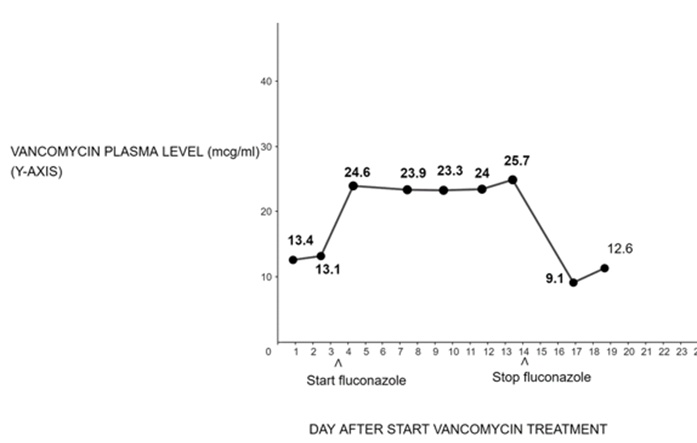
Figure 1. Trough concentration values vs day after start of vancomycin treatment. The vancomycin start date is day 0, and the combination of fluconazole plus vancomycin starts on day 4 and ends on day 15. The antibiotics used during treatment included meropenem, vancomycin, and vancomycin plus fluconazole.
After receiving microbiological results, the patient’s treatment included fluconazole (400 mg IV as a single dose on day 4, then 200 mg/24h from days 5 to 15), meropenem (1g every 8 hours from day 1 to 21), and vancomycin (administered IV every 12 to 24 hours according to plasma levels from days 1 to 21) (Table 1 and Figure 1). This regimen continued for 21 days, after which it was discontinued due to positive progress. The patient was also given additional medications, including dexketoprofen (PO 25 mg every 8 hours as needed), enoxaparin (SC 40 mg daily throughout hospitalization), lorazepam (PO 1 mg daily as required), omeprazole (IV 40 mg daily followed by oral 20 mg daily throughout hospitalization), and paracetamol (IV 1g every 8 hours followed by oral 1g daily as needed).
The patient’s condition improved significantly, remaining afebrile and stable at discharge, with normal abdominal examination, regular bowel movements, and laboratory tests within normal ranges. On February 19, 2023, the patient was moved to the surgical ward, where their condition continued to improve steadily until February 24.
During pharmacokinetic monitoring, unexpected increases in vancomycin’s trough plasma concentrations and half-life were observed when vancomycin was administered alongside fluconazole (days 4-15), compared with when vancomycin was used alone (days 1-3 and 15-19). The half-life and plasma levels gradually rose, reaching a peak before decreasing, remaining above the normal range, up to double the initial values during the non-fluconazole period. Given that no other pharmacokinetic, pharmacodynamic, or pathophysiological factors were identified, these findings suggest a probable drug-drug interaction (DDI) between fluconazole and vancomycin, with a score of 6 (probable) on the Drug Interaction Probability Scale (DIPS) [4].
Pharmacokinetic calculations were conducted using a VCM calculator based on population pharmacokinetic data, Bayesian modeling, and the Sawchuk-Zaske method to determine vancomycin dosing for an adult patient. The half-life of vancomycin was used as a primary pharmacokinetic parameter to monitor the interaction, enabling clear observation of how plasma levels varied with dosing adjustments.
The renal elimination of drugs like vancomycin (VCM) involves three key mechanisms: organic cation transporters, organic anion transporters, and P-glycoprotein (P-gp), all of which play significant roles in the excretion of drugs such as cephalosporins and vancomycin [5]. These transport systems within the renal tubules are integral to the development of drug-drug interactions (DDIs). Some lipophilic anti-infective agents, including fluconazole, are known to inhibit P-gp [6], as well as multidrug resistance-associated proteins (MRPs) and organic anion transporters (OATs), which can influence drug distribution [7]. Hydrophilic agents (such as vancomycin, which are primarily cleared by glomerular filtration and tubular secretion) may compete with other drugs, such as fluconazole, for the same renal transport pathways [2].
This renal excretion process is mediated by specific transporters located on both the basolateral and apical membranes of proximal tubule epithelial cells [8-10]. These include OATs (notably OAT1 and OAT3), organic cation transporters (OCTs), especially OCT2, and P-gp. However, the precise relationship between these transporters and alterations in vancomycin pharmacokinetics remains unclear. Understanding these renal transport mechanisms is essential for predicting drug behavior and optimizing dosing strategies. The inhibition of these transporters is a common underlying factor in DDIs.
Although fluconazole and vancomycin each do not inhibit transporters beyond 60%—a typical threshold for clinically significant DDIs—such inhibition can still lead to meaningful interactions [7]. Additionally, some studies suggest that azole antifungals, such as fluconazole, may interact with P-gp, potentially affecting the antifungal’s pharmacokinetics and contributing to observed drug interactions in clinical practice [6].
In this case, we observed a probable pharmacokinetic drug-drug interaction (DDI) between fluconazole (FLU) and vancomycin (VCM) in a patient receiving treatment for infections after hepatobiliary surgery and biliary drainage. Despite stable renal function and no notable changes in other medications, pharmacokinetic monitoring of vancomycin revealed an unusual increase in its trough concentrations and half-life when co-administered with fluconazole. This could be attributed to competitive inhibition of transporters involved in vancomycin’s renal excretion, resulting in altered drug kinetics.
These findings suggest a potential DDI between fluconazole and vancomycin. As a result, it is essential to exercise caution when using these drugs together, with a recommendation for careful monitoring of vancomycin levels to reduce the risk of nephrotoxicity.
None
None
None
None
Open Access The author(s) retain copyright. This article is licensed under the Creative Commons Attribution-NonCommercial-ShareAlike 4.0 International License. It may be shared and adapted for non-commercial purposes with appropriate attribution, an indication of changes, and distribution of adaptations under the same license. Third-party material may be subject to separate terms identified in its credit line. View the license at https://creativecommons.org/licenses/by-nc-sa/4.0/.
 Publication System