Current pharmaceutical development often treats formulation design, process control, and patient-focused performance as sequential domains rather than mutually dependent components of one technology system. This separation can produce technically elegant formulations that are difficult to manufacture, tightly controlled processes that do not fully serve patient needs, or patient-friendly dosage forms that lack robust process translation. A systems perspective is therefore needed to connect product intent, manufacturing feasibility, and real-world usability from the earliest stages of development. The central problem is the absence of an integrated theory that explains how formulation decisions, process control strategies, and patient-centric targets should be co-optimised. Existing development pathways often allow these domains to interact only after critical decisions have already been made. This creates avoidable friction during scale-up, regulatory justification, and clinical implementation. The objective of this article is to propose a theory-driven systems framework for applied pharmaceutical technologies. The framework integrates formulation design logic, process control logic, and patient-centric performance into a unified conceptual model. It is intended to guide early decision-making, cross-functional communication, and translational planning. The resulting framework identifies three interacting pillars: formulation design as the material and biopharmaceutical architecture of the product, process control as the mechanism for assuring reproducible quality, and patient-centric performance as the translation of product attributes into acceptability, adherence, and therapeutic usability. Four tables capture the formulation parameters, process control strategies, patient-centric targets, and integrated framework components. Together, these elements define a systems logic for pharmaceutical technology development. The proposed framework provides a conceptual blueprint for developing pharmaceutical products that are simultaneously manufacturable, quality-assured, and optimised for patients. It supports earlier recognition of trade-offs, clearer integration of predictive models, and stronger alignment between development choices and clinical use. Its broader value lies in reframing pharmaceutical technology as a patient-anchored system rather than a sequence of isolated technical operations.
Fragmented pharmaceutical development persists because formulation, process, and patient-focused decisions are often organised as separate technical workstreams. Quality-by-design has strengthened product understanding by linking critical material attributes and critical process parameters to quality attributes, yet its practical application can still remain bounded within formulation or manufacturing silos [1]. This separation limits the ability of development teams to recognise when a material choice intended to optimise dissolution, stability, or manufacturability may also alter patient acceptability or adherence. The problem is therefore not a lack of technical sophistication but a lack of integrative theory.
The rise of continuous manufacturing, process analytical technology, and advanced control has intensified the need for integration. Pharmaceutical manufacturing is increasingly understood as a connected digital and physical system, but smart manufacturing approaches can only deliver their full value when they are aligned with formulation intent and product use conditions [2]. If process models are built without patient-centric targets, they may optimise conventional quality attributes while overlooking dosage form characteristics that shape real-world performance. Conversely, patient-friendly designs that are not process-robust may remain difficult to translate beyond laboratory development.
Patient-centric drug product design has made adherence, acceptability, swallowability, dosing burden, and usability central development concerns. Medication adherence is affected not only by clinical need but also by product attributes such as dose frequency, size, taste, route of administration, and ease of use [3]. Innovative delivery systems can reduce adherence barriers, but their benefits depend on whether formulation design and manufacturing control are coordinated early enough to preserve both performance and feasibility [4]. A patient-centred product that cannot be manufactured reproducibly is not truly patient-centred in translational terms.
The theoretical gap is the absence of a systems framework that treats formulation, process control, and patient-centric performance as co-evolving design spaces. Current regulatory and development thinking increasingly recognises integrated product understanding, but implementation can still favour sequential documentation rather than concurrent design reasoning [5]. A theory-driven framework is needed to convert this recognition into a practical structure for early development choices, model building, and risk assessment. Such a framework should enable co-optimisation rather than late correction.
Formulation design logic begins with the recognition that drug product performance emerges from interactions among active pharmaceutical ingredient properties, excipients, microstructure, release mechanisms, and dosage form geometry. In solid oral products, continuous direct compression studies show that sustained release performance depends on the compatibility of material properties with processing pathways, not simply on composition alone [6]. Hot-melt extrusion and downstream tableting further illustrate that polymer choice, thermal history, particle attributes, and compression behaviour jointly influence the final dosage form [7]. Formulation design is therefore a structured logic for translating molecular and material properties into intended quality and performance.
Critical material attributes are central because they shape both manufacturability and biopharmaceutical behaviour. Amorphous solid dispersion development demonstrates how process route, excipient selection, and downstream powder properties affect flow, compression, and dissolution [8, 9]. Supersaturated dissolution behaviour can also be modified by tablet formulation and film coating, showing that release performance is a system property rather than a property of the active ingredient alone [10]. These examples indicate that formulation design should be treated as a dynamic architecture of interacting material functions.
Formulation logic also extends beyond oral solid dosage forms into topical, transdermal, paediatric, and personalised product design. Quality target product profiles for semisolid topical products show how attributes such as rheology, drug release, skin delivery, and patient use conditions must be specified together [11]. Paediatric fixed-dose combination mini-tablets illustrate how dose flexibility, swallowability, drug loading, and regimen design interact in patient-specific formulation decisions [12]. Advances in oral and transdermal delivery reinforce that formulation design increasingly operates at the interface of biopharmaceutics, usability, and therapeutic context [13, 14].
Despite this breadth, formulation design is often applied before process control and patient implementation are fully specified. A question-based quality-by-design approach can structure formulation decisions, but its systems value depends on whether questions include process constraints and patient-centred performance from the beginning [15]. Strategies for poorly water-soluble drugs show that improving bioavailability may require trade-offs among excipient burden, dosage form size, release behaviour, and manufacturing complexity [16]. Table 1 summarises the formulation design parameters and their influence on product performance.
Table 1. Formulation Design Parameters and Their Impact on Drug Product Quality and Patient Outcomes
Formulation design parameter | Product quality influence | Patient outcome influence | Systems implication |
Active pharmaceutical ingredient properties | Solubility, stability, permeability, crystallinity, and particle behaviour shape drug release and manufacturability. | Poor solubility or high dose can increase dosage form size, dosing burden, or variability in exposure. | API properties should be mapped simultaneously to release targets, process feasibility, and patient usability. |
Excipient selection | Excipients control flow, compressibility, stability, release, taste masking, and delivery performance. | Excipient burden can affect swallowability, tolerability, acceptability, and population suitability. | Excipient choice should be evaluated as both a material function and a patient-experience determinant. |
Drug loading | Drug content influences tablet size, blend uniformity, injection volume, and delivery device compatibility. | High drug loading may reduce dosing frequency but increase size, viscosity, or administration difficulty. | Drug loading should be optimised against both manufacturing robustness and patient burden. |
Release-controlling system | Polymers, matrices, coatings, and carrier systems regulate immediate, delayed, sustained, or targeted release. | Release profiles influence dosing frequency, adherence, onset, and therapeutic consistency. | Release design should connect pharmacokinetic intent to manufacturable control strategies. |
Dosage form geometry | Shape, size, coating, surface area, and mechanical strength influence processing and dissolution. | Geometry affects swallowing, handling, mouthfeel, device fit, and administration confidence. | Physical design should be treated as a shared formulation, process, and patient variable. |
Microstructure | Porosity, dispersion state, crystallinity, and matrix organisation influence stability and performance. | Microstructural instability can change efficacy, safety, or sensory properties during use. | Microstructure should be monitored and controlled through linked formulation and process models. |
Process control logic provides the operational mechanism through which formulation intent is translated into reproducible product quality. Model predictive control has been applied to continuous tablet compaction to manage process variability and maintain critical quality attributes within target limits [17]. Integrated continuous manufacturing further shows that upstream and downstream unit operations can be coordinated through predictive models and control loops [18]. In this logic, quality is not only designed into the formulation but actively maintained through measurement, prediction, and intervention.
Process analytical technology is central because it turns manufacturing into an information-rich system. Inline Raman spectroscopy for blend monitoring demonstrates how real-time spectral data can provide direct insight into content uniformity and material distribution during tablet production [19]. Real-time release testing extends this principle by replacing delayed end-product testing with process-embedded evidence of quality [20]. Such approaches shift control from retrospective inspection toward prospective assurance.
The process control logic is increasingly moving toward Quality-by-Control, Pharma 4.0, and digitally enabled manufacturing. Quality-by-Control frames process control as an extension of quality-by-design, using feedback and feedforward strategies to maintain performance under variable operating conditions [21]. Cyber-physical process analytical technology frameworks position sensors, models, data infrastructure, and control systems as integrated components of pharmaceutical manufacturing [22]. These developments make process control a systems discipline rather than a narrow manufacturing function.
Process control cannot be separated from formulation design because material behaviour determines the sensitivity of a process to disturbances. Deep learning approaches for continuous solid dosage manufacturing and practical guides to process analytical technology implementation both emphasise that data-driven control depends on meaningful links among material attributes, process parameters, and product quality [23, 24]. Continuous technology reviews similarly show that process integration is strongest when unit operations, formulation design space, and control strategy are developed together [25]. Table 2 outlines the process control strategies and their integration points with formulation design.
Table 2. Process Control Strategies and Their Interdependencies with Formulation Design
Process control strategy | Primary control function | Interdependency with formulation design | Systems value |
Process analytical technology | Measures critical material or product attributes during processing. | Requires formulation attributes that generate reliable measurable signals, such as blend uniformity or moisture state. | Enables real-time understanding of whether formulation intent is being preserved. |
Model predictive control | Predicts future process behaviour and adjusts operating conditions proactively. | Depends on formulation-specific process response models and sensitivity to material variability. | Converts formulation knowledge into operational control decisions. |
Continuous manufacturing | Links unit operations into an integrated production train. | Requires formulations with robust flow, compressibility, thermal behaviour, and residence-time compatibility. | Reduces scale-up discontinuities and supports end-to-end quality assurance. |
Real-time release testing | Uses process and analytical evidence to support quality release decisions. | Requires validated relationships between formulation attributes, process measurements, and final quality. | Aligns product understanding with faster and more responsive release pathways. |
Digital and cyber-physical platforms | Integrate sensors, data models, automation, and control architecture. | Require formulation data structures that connect material behaviour to patient-relevant product attributes. | Creates a shared information layer for formulation, process, and patient-centric decisions. |
Machine learning and deep learning | Detect complex patterns linking process data to quality attributes. | Require representative formulation variability and mechanistic interpretation to avoid purely empirical control. | Supports adaptive learning across development, scale-up, and commercial manufacturing. |
Patient-centric performance reframes drug product success as the alignment of therapeutic function with patient needs, preferences, abilities, and contexts of use. Patient-centric product development has shown that regulatory, chemistry, manufacturing, and device considerations must be connected to human use factors rather than treated as downstream additions [5]. Oral solid dosage form research further identifies size, shape, surface, taste, dosing frequency, and handling as attributes that can affect acceptance in older patients [26]. These attributes are not cosmetic details; they are determinants of whether a medicine can be used as intended.
Adherence is a system outcome because it depends on both the patient and the product technology. Medication adherence can be improved when drug product design reduces complexity, improves acceptability, or enables more convenient administration [3]. Mixed-methods evidence in older populations indicates that oral solid dosage form characteristics can influence both acceptance and adherence [27]. Therefore, patient-centricity must be built into formulation targets and process specifications rather than appended as a late usability assessment.
Different patient populations impose different design requirements. Paediatric products may require flexible dosing, mini-tablets, taste masking, and caregiver-friendly administration, while geriatric and dysphagic populations may require smaller dosage forms, easier swallowing, or alternative delivery systems [28, 29]. Paediatric tuberculosis mini-tablet optimisation illustrates how fixed-dose combination design can connect therapeutic regimen needs with formulation and dosing constraints [12]. Patient-centric design is therefore population-specific, not a generic preference layer.
Patient-centric performance also creates manufacturing and control requirements because acceptability attributes must be produced consistently. Long-acting, targeted, transdermal, and advanced oral delivery strategies can improve adherence or usability, but they require formulation structures and processes that reliably maintain drug release, dose accuracy, and administration performance [4, 13, 14]. Patient preferences for solid oral dosage form attributes show that patient-relevant features should be translated into measurable product requirements [29]. Table 3 maps patient-centric performance targets to formulation and process requirements.
Table 3. Patient-Centric Performance Targets and Corresponding Formulation and Process Design Requirements
Patient-centric performance target | Formulation requirement | Process requirement | Expected patient-centred value |
Swallowability | Appropriate size, shape, coating, surface texture, and disintegration behaviour. | Consistent compression, coating uniformity, and mechanical integrity. | Improves acceptability for paediatric, geriatric, and dysphagic patients. |
Taste and mouthfeel acceptability | Taste masking, suitable excipients, controlled disintegration, and sensory compatibility. | Reproducible coating, granulation, or matrix formation that preserves taste masking. | Reduces refusal, improves caregiver administration, and supports adherence. |
Reduced dosing burden | Sustained release, fixed-dose combinations, long-acting systems, or high-efficiency delivery. | Robust control of release-controlling structures, content uniformity, and dose accuracy. | Supports adherence by simplifying treatment routines. |
Personalised or flexible dosing | Scored tablets, mini-tablets, multiparticulates, adjustable strengths, or adaptable delivery formats. | Precise dose control, scalable segmentation, and reliable unit-to-unit consistency. | Enables age, weight, disease, or preference-based therapy. |
Targeted or site-specific delivery | Coatings, carriers, matrices, or delivery systems designed for spatial or temporal release. | Tight control of microstructure, coating thickness, particle properties, or device assembly. | Improves therapeutic efficiency and may reduce systemic burden. |
Ease of handling and administration | Packaging compatibility, device usability, low administration complexity, and suitable physical robustness. | Control of friability, stability, viscosity, packaging integration, or device performance. | Increases real-world usability for patients, caregivers, and healthcare professionals. |
A major barrier to integration is the persistence of organisational structures that divide pharmaceutical development into formulation, manufacturing, clinical, regulatory, and commercial functions. Quality-by-design has encouraged systematic development, yet reviews of its implementation show that practical adoption can remain uneven when knowledge is not shared across development stages [30]. This creates a pattern in which formulation teams define product attributes, process teams later solve manufacturability problems, and patient-facing concerns are addressed only after technical decisions have narrowed the design space. The result is an avoidable loss of optionality.
A second barrier is the lack of predictive models that connect material, process, and patient scales. Process models can predict tablet compaction behaviour or continuous manufacturing performance, but they are often not designed to incorporate patient-centred attributes such as swallowability, acceptability, dosing flexibility, or administration burden [17]. Machine learning for ultrasonic quality assessment and near-infrared evaluation of continuous manufacturing show the growing ability to predict quality attributes, but these tools still require broader integration with formulation intent and patient performance criteria [31, 32]. Without cross-scale models, co-optimisation remains more aspirational than operational.
Regulatory and documentation practices can also reinforce sequential thinking when product understanding is presented as a set of separated justifications. Regulatory CMC and device considerations for patient-centric products show that patient-focused design must be supported by evidence linking product attributes, manufacturing controls, and use conditions [5]. Real-time release testing and process analytical technology frameworks demonstrate how integrated evidence can support more responsive quality assurance, but their use depends on confidence in validated relationships among formulation, process, and final performance [20]. The barrier is therefore not regulation itself but the limited maturity of integrated evidence packages.
Economic incentives can discourage early co-optimisation because integrated development appears resource-intensive before its risk-reduction benefits are visible. Continuous manufacturing and integrated pharmaceutical technologies can reduce scale-up risk and improve process understanding, yet they require early investment in models, sensors, digital infrastructure, and cross-functional coordination [2, 25]. Patient-centred innovations may similarly be undervalued if adherence, usability, and real-world performance are treated as commercial or clinical considerations rather than core technology requirements [3]. Integration fails when short-term development efficiency is prioritised over long-term translational robustness.
The proposed systems framework begins with a patient-anchored quality target product profile that defines therapeutic intent, user context, acceptability, adherence, and administration needs before formulation and process decisions are locked. Patient preference evidence for solid oral dosage forms shows that patient-relevant features can be translated into concrete product attributes rather than left as general design aspirations [29]. These attributes then become design constraints for formulation composition, dosage form geometry, release mechanism, and route of administration. The framework therefore reverses the usual sequence by treating patient performance as an upstream design driver.
Figure 1 presents the proposed patient-anchored systems framework linking patient-centric performance targets, formulation design logic, process control strategies, predictive modelling, and lifecycle translation in applied pharmaceutical technology development.
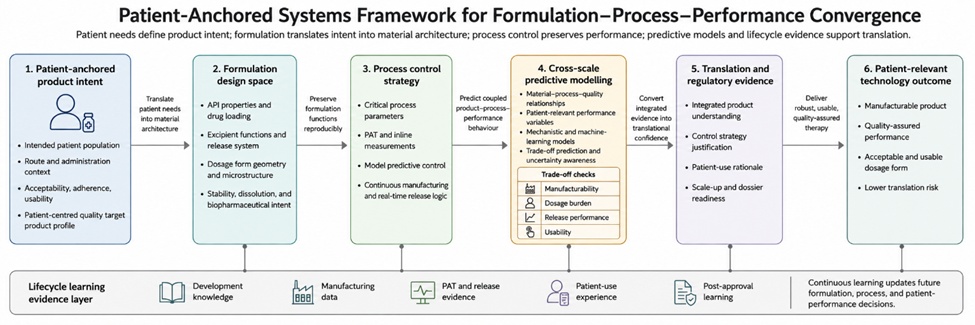
Figure 1. Patient-Anchored Systems Framework for Formulation–Process–Performance Convergence in Applied Pharmaceutical Technologies
The second layer maps patient-centric targets into formulation design space. For example, a requirement for reduced dosing burden may imply sustained release, fixed-dose combination design, or long-acting delivery, each of which imposes different demands on excipient selection, drug loading, and microstructure [4]. Poorly water-soluble drug strategies illustrate how improvements in bioavailability must be balanced against excipient burden, dosage form size, and manufacturability [16]. In this layer, formulation design is not an isolated search for optimal composition but a translation of patient-centred performance into material architecture.
The third layer maps formulation design space into process control space. A sustained-release tablet, amorphous solid dispersion, semisolid topical product, or transdermal system requires process controls that preserve the structures responsible for release, stability, dose uniformity, and usability [8, 11, 14]. Process analytical technology, model predictive control, and continuous manufacturing then become mechanisms for maintaining the formulation functions that matter to both quality and patients [18, 21]. This layer makes manufacturing control an expression of formulation intent rather than a separate production activity.
The fourth layer consists of predictive models, feedback loops, and decision gates that connect patient, formulation, and process information. Deep learning, cyber-physical systems, and smart manufacturing approaches can support this layer when they are trained and interpreted around mechanistically meaningful product attributes [2, 22, 23]. A practical process analytical technology implementation strategy can then define when measurements should trigger formulation redesign, process adjustment, or reassessment of patient-centred targets [24]. Table 4 presents the integrated systems framework linking formulation, process, and patient-centricity.
Table 4. Integrated Systems Framework for Formulation-Process-Patient Convergence in Pharmaceutical Technologies
Framework layer | Core design question | Key inputs | Integration mechanism | Development output |
Patient-centric target layer | What must the product enable for the intended patient population? | Patient needs, disease context, route preference, adherence barriers, administration setting, and usability constraints. | Patient-centred quality target product profile and human-use scenarios. | Defined acceptability, adherence, dosing, handling, and performance targets. |
Formulation design layer | What material architecture can deliver the patient-centred target? | API properties, excipient functions, drug loading, release mechanism, dosage form geometry, and stability requirements. | Mapping of patient targets to critical material attributes and formulation design space. | Candidate formulations with explicit patient and quality rationales. |
Process control layer | What process strategy can reproducibly preserve the intended formulation functions? | Unit operations, critical process parameters, sensor strategy, process models, and control limits. | PAT, model predictive control, continuous manufacturing, and real-time release logic. | Control strategy linking process behaviour to critical quality and patient-relevant attributes. |
Predictive modelling layer | How can formulation, process, and patient variables be predicted together? | Experimental data, mechanistic models, machine learning outputs, prior knowledge, and risk assessments. | Cross-scale models and digital representations of product-process-performance relationships. | Predictive decision support for trade-offs, redesign, and scale-up. |
Translation layer | How can integrated understanding support development, regulation, and implementation? | Product knowledge, manufacturing evidence, patient-performance rationale, and lifecycle data. | Integrated dossier logic, lifecycle control strategy, and post-approval learning. | Faster translation, lower development risk, and stronger alignment with real-world use. |
The final layer of the framework is lifecycle learning, where commercial manufacturing, patient experience, and post-approval knowledge feed back into product and process understanding. Real-time release testing and continuous manufacturing provide the technical foundation for this loop because they generate ongoing evidence about process performance and product quality [20, 25]. Patient-centric design extends the loop by requiring that usability, adherence, and administration experience remain visible after approval [3]. The framework is therefore not a static design template but a learning architecture for pharmaceutical technology.
The framework supports translation by aligning development decisions with patient needs before costly formulation and process commitments are made. Paediatric mini-tablet optimisation shows how patient population needs, dosing flexibility, formulation constraints, and regimen design can be addressed together rather than sequentially [12]. Similar logic applies to older adults, where oral solid dosage form attributes can affect acceptance and adherence, making patient-centred requirements important early design variables [26, 27]. Translation improves when the product being scaled is already aligned with use.
Integrated formulation-process reasoning also reduces scale-up surprises. Downstream processing studies of amorphous solid dispersions show that spray drying, hot-melt extrusion, powder flow, compression, and dissolution are interconnected development concerns [9]. Continuous direct compression and hot-melt extrusion-to-tablet workflows likewise demonstrate that manufacturability and performance should be considered as coupled properties [6, 7]. When formulation choices are evaluated through process-control consequences from the start, translation becomes a controlled expansion of knowledge rather than a late-stage troubleshooting exercise.
The framework can strengthen regulatory dossiers by presenting product understanding as an integrated argument. Quality-by-design reviews emphasise the importance of defining design space and control strategy, while Quality-by-Control extends this by showing how process decisions can actively maintain quality under real manufacturing conditions [1, 21]. Patient-centric regulatory considerations further require that product attributes and device or dosage-form decisions be justified in relation to intended use [5]. A dossier built around formulation-process-patient convergence can therefore show not only what the product is, but why its design and control strategy are appropriate.
Technology translation is also accelerated when digital and analytical tools are connected to development strategy rather than deployed as isolated innovations. Inline Raman blend monitoring, near-infrared assessment of granule effects, and machine learning-based tablet quality assessment show how analytical data can inform manufacturing control [19, 31, 32]. These methods become more translationally powerful when their outputs are linked to formulation functions and patient-relevant attributes rather than only conventional release specifications. In this way, analytics become part of an integrated evidence chain from design intent to patient benefit.
Implementation should begin with cross-functional development teams organised around shared product-performance questions rather than disciplinary deliverables. A question-based pharmaceutical development approach can help teams identify what must be known about materials, process behaviour, quality attributes, and patient use before key decisions are made [15]. These teams should include formulation scientists, process engineers, analytical scientists, clinicians, human factors specialists, regulatory experts, and manufacturing representatives. Their shared task is to maintain visibility of formulation-process-patient interdependencies throughout development.
The second implementation step is adoption of model-informed and digitally enabled decision-making. Model predictive control, cyber-physical process analytical technology, and Industry 4.0 concepts provide the technical basis for linking process data to control decisions [2, 17, 22]. However, implementation should require that models explicitly state which formulation attributes and patient-centred outcomes they support. This prevents digitalisation from becoming a manufacturing-only exercise and instead turns it into a cross-domain learning system.
The third step is construction of shared digital platforms that integrate formulation data, process data, analytical measurements, risk assessments, and patient-centred requirements. Integrated continuous pharmaceutical technologies show that connected unit operations depend on coherent data flows and common interpretation of process and product variables [25]. Process analytical technology implementation guidance further indicates that measurement strategies must be practical, validated, and embedded in decision workflows [24]. A shared platform should therefore function as both a technical repository and a design reasoning environment.
The fourth step is to establish pilot projects that demonstrate the value of the framework in focused development settings. Suitable pilots include paediatric flexible-dose products, geriatric-friendly oral solids, amorphous solid dispersion tablets, semisolid topical products, or transdermal systems where formulation, manufacturing, and patient requirements are visibly interdependent [8, 11, 14, 28]. Each pilot should define patient-centred targets, map them to formulation attributes, connect those attributes to process controls, and evaluate whether the resulting evidence improves translation. Over time, these pilots can build organisational confidence in integrated development as a practical operating model.
This article has proposed a theory-driven systems framework for integrating formulation design, process control, and patient-centric performance in applied pharmaceutical technologies. Its central contribution is to redefine pharmaceutical product development as a convergence problem rather than a sequence of independent technical tasks. The framework positions patient needs as upstream design drivers, formulation as material architecture, and process control as the operational mechanism that preserves intended performance.
The framework has practical implications for development planning, translation, and implementation. It encourages teams to identify trade-offs earlier, build predictive models across scales, and create control strategies that protect both quality attributes and patient-relevant product functions. It also provides a conceptual basis for stronger regulatory justification because it links product design, manufacturing evidence, and intended use within one coherent logic.
Future work should validate the framework through case studies, pilot development programmes, and lifecycle implementation projects. Such work should examine whether integrated design reduces late-stage reformulation, improves manufacturing robustness, and produces products that are more acceptable and useful to patients. Broader adoption would help pharmaceutical technology move from fragmented optimisation toward a patient-anchored systems paradigm.
None
None
None
None
Open Access The author(s) retain copyright. This article is licensed under the Creative Commons Attribution-NonCommercial-ShareAlike 4.0 International License. It may be shared and adapted for non-commercial purposes with appropriate attribution, an indication of changes, and distribution of adaptations under the same license. Third-party material may be subject to separate terms identified in its credit line. View the license at https://creativecommons.org/licenses/by-nc-sa/4.0/.
 Publication System