Drug–device combination products occupy a technically demanding position between pharmaceutical formulation, engineered device performance, and real-world user interaction. Their development requires the simultaneous control of drug product quality, delivery-system reliability, and safe administration by intended users. Yet these domains are still frequently treated as separable workstreams rather than as mutually shaping elements of one system. This conceptual framework article addresses the limitations of sequential development models in which formulation is stabilised first, device selection follows, and user validation is deferred until late-stage development. Such sequencing may appear efficient during early development, but it can conceal incompatibilities that only emerge during device verification, usability testing, clinical bridging, or regulatory review. The result is often redesign, delayed translation, or unresolved uncertainty about whether the final product can perform reliably under intended conditions of use. The objective of this article is to propose and defend the Formulation–Device–User Triangle as a unified design logic for drug–device combination products. The triangle positions formulation, device, and user as co-equal vertices that continuously constrain and enable one another. It is intended not as a replacement for existing quality, design-control, or human-factors processes, but as an integrating framework that makes their interdependence explicit. The proposed triangle reframes combination product design as a system-level co-development problem. It argues that a product is not ready for translation simply because its formulation is stable, its device is functional, or its users can pass a summative test. Readiness depends on whether the formulation tolerates device action, the device accommodates formulation variability, and the user interface supports reliable administration across real-world conditions.
Drug–device combination products have become central to modern therapy because they allow complex medicines to be delivered through prefilled syringes, autoinjectors, inhalers, pumps, implants, and other integrated delivery platforms. Anderson, Liu, Subramony, and Cammack described biologic-device combination products as development systems in which product performance depends on both drug quality and device function [1]. Choi, Wang, Conti, Raney, Delvadia, Leboeuf, and Witzmann similarly emphasised that generic combination products require careful attention to device-related substitutability, user interface, and therapeutic equivalence rather than drug formulation alone [2]. These observations show that combination products are not merely medicines with accessories; they are regulated systems whose clinical performance depends on coordinated design.
The growth of injectable biologics has sharpened this integration challenge because many products must now deliver high-concentration, high-viscosity, or large-volume formulations through patient-operated systems. Li and Easton argued that clinical strategy for biologic combination products must consider the transition between prefilled syringes and autoinjectors, since device changes may affect bridging, user handling, and evidence expectations [3]. DeGrazio and Paskiet further linked injectable combination product development to risk-based assessment and patient-centric outcomes, indicating that design decisions must connect product attributes to actual administration conditions [4]. In this context, formulation, device, and user interaction are not downstream details but core determinants of product viability.
Regulatory scrutiny reflects the same system logic because reviewers increasingly expect evidence that the final combination product is robust under its intended conditions of use. Hu, Wang, Florian, Shatzer, Stevens, Gertz, Ji, Huang, Zineh, and Wang showed that bridging studies for biologic-device combination products often depend on device parameters, study design, and the relationship between presentation and clinical performance [5]. Lambert’s analysis of bridging from prefilled syringes to autoinjectors showed that bioequivalence studies are commonly used because small presentation changes may raise comparability concerns [6]. These studies demonstrate that integration failures may become visible only when a nominally mature product is examined as a full delivery system.
This article proposes the Formulation–Device–User Triangle as a conceptual framework for overcoming this recurrent fragmentation. The framework builds on regulatory, pharmaceutical, device, and human-factors literature but reorganises these domains around their bidirectional dependencies. Tian, Song, Wang, Cheng, Lu, Xu, Gao, Sun, Tang, Wang, and Zhang presented combination products as regulatory objects that require coordinated evidence across constituent parts, while Kumoluyi and Khanolkar stressed the need for risk management during development [7, 8]. The objective here is to convert that need for coordination into a clear design logic that can guide early concept definition, development communication, verification planning, and translation.
The central conceptual gap in current combination product development is that formulation, device, and user are often governed by different disciplinary assumptions. Formulation teams may frame the product around stability, compatibility, viscosity, aerosolisation, or dose delivery, while device teams may focus on mechanics, actuation, container closure, tolerances, and reliability. Human-factors work is then frequently introduced as a validation activity rather than as an upstream design input, even though user performance can determine whether the drug and device actually function as intended [9, 10]. This produces a development pathway in which each domain can appear successful in isolation while the integrated product remains fragile.
Sequential development is especially problematic because latent failures may be introduced before the full use system is tested. For example, a high-viscosity injectable may be pharmaceutically acceptable but may require injection forces or hold times that challenge the intended user population, as discussed in work on high-dose and high-volume biologic delivery [11, 12]. Similarly, an inhalation product may meet formulation targets but still fail in practice if the user interface does not support correct technique, a concern reinforced by reviews of electronic approaches to inhaler technique assessment [10]. The gap is therefore not simply technical; it is architectural, because the development model fails to treat formulation behaviour, device function, and user action as one coupled system.
Existing quality and regulatory tools provide important controls, but they are often applied within rather than across domains. Risk management frameworks can identify hazards, design controls can structure device development, and usability engineering can evaluate use-related risks, but these methods do not automatically create a shared conceptual model linking formulation critical quality attributes to device performance and user interaction [8, 13]. Latoz, Larkin, and Huynh-Ba showed that stability considerations for drug-device combination products require attention to regulatory expectations and product configuration, yet stability is still commonly documented in ways that can remain separated from usability logic [9]. The missing element is an integrative framework that forces teams to specify how each domain changes the design space of the others.
The triangle metaphor is proposed because a drug–device combination product is the smallest system in which three non-reducible design domains interact. A line between formulation and device would capture compatibility and delivery mechanics, but it would miss the fact that the product must be operated by an intended user. A line between device and user would capture ergonomics and usability, but it would miss the formulation behaviours that make the device easier or harder to use. A line between formulation and user would capture acceptability and administration burden, but it would miss the engineered mediation through which the formulation reaches the patient [3, 4].
Each vertex exerts both constraints and opportunities on the other two vertices. Formulation properties such as viscosity, stability, reconstitution behaviour, and dose volume constrain device architecture and affect user burden, while device parameters such as needle geometry, spring force, plume generation, or actuation sequence influence formulation performance and user perception [11, 14]. User abilities, preferences, training needs, and use environments then constrain both formulation presentation and device interface, as shown in usability studies of autoinjectors and patient-operated delivery systems [15, 16]. The triangle therefore captures reciprocal shaping rather than parallel development.
The framework also differs from simple concurrent engineering because it emphasises emergent system properties. A product can have an acceptable formulation, a technically functional device, and a favourable formative usability result, yet still fail if the interactions among these domains create unacceptable variability under real use conditions. Valentine, Newswanger, Prestrelski, Andre, and Garibaldi showed that human-factors validation in a simulated emergency use scenario can reveal whether a device supports safe rescue behaviour, not merely whether the device mechanism works [17]. Such evidence illustrates why use-error resilience must be treated as a system property created by the full formulation–device–user configuration.
Figure 1 presents the Formulation–Device–User Triangle as a bidirectional conceptual architecture in which product quality, usability, and robustness emerge from the interaction of three co-equal design vertices.
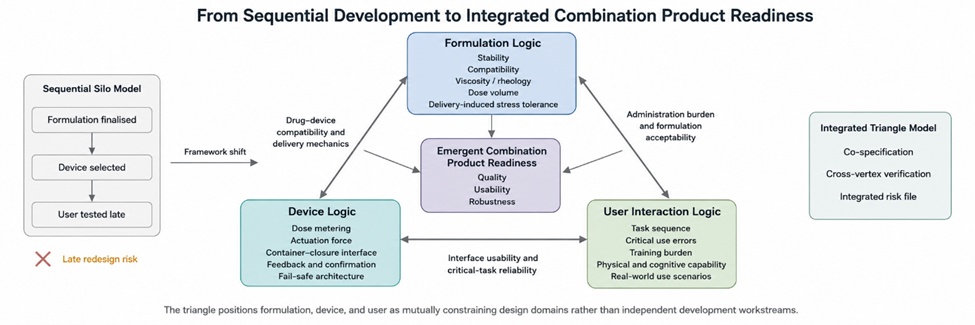
Figure 1. The Formulation–Device–User Triangle as an Integrated Conceptual Architecture for Drug–Device Combination Product Design
The triangle is also useful as a communication and documentation tool because it provides a common map for cross-functional teams. Combination product development often requires pharmaceutical scientists, device engineers, clinicians, regulatory specialists, human-factors experts, quality units, and manufacturing teams to align their assumptions. Machal, Cartwright, Shockey, and O’Connor’s framework for qualified medical device development tools highlights the importance of structured evidence and shared development logic in device-related decision-making [13]. The Formulation–Device–User Triangle extends this idea by making the interface among formulation evidence, device evidence, and user evidence visible from the earliest design stage.
Formulation logic refers to the set of pharmaceutical attributes that determine whether the drug product can remain stable, deliverable, compatible, and clinically usable within the selected device and use context. In injectable combination products, this includes concentration, viscosity, aggregation risk, excipient behaviour, container interaction, and sensitivity to mechanical stress. Badkar, Gandhi, Davis, and LaBarre described the practical challenges of subcutaneous high-dose and high-volume biologic delivery, where formulation requirements directly influence device feasibility and patient experience [11]. This means formulation design must anticipate delivery mechanics rather than treating the device as a neutral container.
For prefilled syringes and autoinjectors, formulation behaviour becomes visible through injection force, delivery time, glide performance, dose accuracy, and residual volume. Rini, Roberts, Vaidyanathan, Klug, Sherman, and Pettis discussed technologies for faster subcutaneous delivery of larger-volume and higher-viscosity fluids, showing that formulation properties and device capability jointly define feasible administration [12]. Wu, Li, Wang, Wang, Sun, and Zhang advanced injection-force modelling and viscosity-dependent injectability evaluation for prefilled syringes, further demonstrating that formulation CQAs must be translated into mechanical performance requirements [18]. In the triangle framework, viscosity is therefore not only a formulation parameter but also a device load and a user burden.
Formulation logic also applies to inhalation and other delivery routes where aerosolisation, powder dispersion, plume behaviour, or reconstitution can be shaped by both device architecture and user technique. Carpenter, Roberts, Sage, George, and Horne showed that inhaler technique can be assessed through electronic devices, indirectly reinforcing that drug delivery performance depends on user-device coordination as well as formulation properties [10]. When a formulation demands a specific inspiratory flow, shaking step, priming sequence, or reconstitution action, it creates human-factors requirements that must be designed into the interface. Table 1 defines the formulation logic elements that must be harmonised with device and user requirements.
Table 1. Formulation Logic for the Formulation–Device–User Triangle: Key Attributes, Device-Imposed Constraints, and Quality Targets
Formulation logic element | Device-imposed constraint | User-related implication | System-level quality target |
Drug substance and product stability | Exposure to container materials, silicone oil, elastomers, metals, plastics, or mechanical stress | Product must remain reliable despite storage, handling, and administration by intended users | Stability profile aligned with final device configuration and use conditions |
Viscosity and concentration | Spring force, needle gauge, plunger glide force, delivery time, pump pressure, or actuator capability | Higher force, longer hold time, or discomfort may increase incomplete dosing or user hesitation | Deliverability within acceptable mechanical and human-use limits |
Dose volume and fill configuration | Container capacity, dead space, residual volume, priming requirement, and dose metering tolerance | Larger or multi-step doses may increase training burden and administration complexity | Accurate dose delivery without excessive user workload |
Compatibility with primary container closure | Extractables, leachables, sorption, aggregation, lubrication effects, and closure integrity | Hidden incompatibility may appear as device malfunction, dose variability, or loss of confidence | Compatible formulation–container–device system over shelf life |
Rheology and flow behaviour | Needle, nozzle, pump, valve, or actuator geometry | Flow resistance may affect perceived usability and completion of administration | Predictable flow under intended mechanical and temperature conditions |
Aerosolisation, plume, or powder dispersion | Device resistance, mesh/nozzle design, airflow pathway, and actuation energy | User inhalation, coordination, and technique influence delivered dose | Consistent emitted and delivered dose across realistic use scenarios |
Reconstitution or preparation behaviour | Cartridge, vial, dual-chamber, mixing, or transfer mechanism | Preparation steps may generate critical use errors if not simplified or guided | Preparation process compatible with intended users and environments |
Delivery-induced stress sensitivity | Shear, compression, agitation, pressure, or impact during device actuation | Product degradation may be invisible to users but clinically relevant | Mechanical action controlled within formulation tolerance limits |
Formulation logic must therefore be defined in relation to the final delivery system rather than as an isolated CMC endpoint. Latoz, Larkin, and Huynh-Ba’s discussion of stability for drug-device combination products supports the need to connect formulation stability with device configuration and regulatory expectations [9]. Guo, Weng, Zhu, Zhou, Chen, Gu, and Zhou’s review of recent FDA-approved biologic-device combination products also suggests that approved products increasingly reflect integrated pharmaceutical and device considerations [19]. Within the proposed triangle, formulation is the vertex that translates molecular and material behaviour into delivery feasibility, but it can only do so when device and user constraints are specified early.
Device logic refers to the engineered system that transforms a formulation into a reproducible administered dose through controlled mechanics, materials, interface design, and verification evidence. In the triangle framework, the device is not a passive delivery shell but an active mediator between pharmaceutical behaviour and user performance. Autoinjectors, prefilled syringes, inhalers, pumps, smart accessories, and other delivery platforms each impose distinct actuation, metering, containment, and feedback requirements that can alter both delivery performance and use difficulty [3, 5]. For this reason, device selection should begin as a co-specification exercise rather than as a late matching process after formulation decisions have already narrowed the design space.
A device must accommodate formulation variability within proven acceptable ranges, especially when the formulation presents high viscosity, large dose volume, sensitivity to shear, or route-specific delivery demands. Schneider, Jost, Jordi, and Lange described large-volume subcutaneous autoinjectors as systems whose feasibility depends on the relationship among formulation load, delivery time, mechanical architecture, and patient acceptability [14]. Rini, Roberts, Vaidyanathan, Klug, Sherman, and Pettis likewise framed faster delivery of high-viscosity fluids as an engineering and user-experience challenge, not only a formulation challenge [12]. Device logic therefore requires margins that are wide enough to tolerate normal product variability without transferring excessive burden to the user.
The device vertex also includes the human-machine interface, because every mechanical function is eventually encountered as a user task. Dose confirmation, activation sequence, grip geometry, needle shielding, error prevention, status feedback, audible or visual cues, and digital connectivity all influence whether the user can complete administration safely. Studies of adalimumab biosimilar prefilled pens, autoinjectors, and rheumatoid arthritis delivery systems show that usability depends on the alignment of device form, task sequence, and patient capability [15–18]. Table 2 characterises the device logic dimensions and their relationship to formulation and user interaction.
Table 2. Device Logic in the Triangle: Functional Requirements, Mechanical Design Principles, and Interface with Drug Product
Device logic dimension | Functional requirement | Relationship to formulation | Relationship to user interaction |
Dose metering and delivery accuracy | Deliver the intended dose within defined tolerance | Must account for fill volume, residual volume, viscosity, priming, and flow behaviour | Must minimise user actions that can interrupt or distort dosing |
Actuation mechanism | Convert user or stored mechanical energy into delivery action | Must match formulation resistance, container geometry, and pressure sensitivity | Must require force and coordination compatible with intended users |
Primary container interface | Maintain closure integrity and enable reliable delivery | Must prevent incompatibility, aggregation, leachables risk, and material interaction | Must remain invisible or simple from the user perspective |
Needle, nozzle, valve, or aerosol pathway | Control route-specific delivery geometry | Must support injectability, aerosolisation, powder dispersion, or infusion flow | Must reduce discomfort, uncertainty, incorrect positioning, or technique dependence |
Fail-safe and lockout features | Prevent repeated dosing, premature activation, or incomplete administration | Must not introduce stress or dose loss during protective operation | Must prevent foreseeable use errors without increasing task complexity |
Feedback and confirmation system | Indicate readiness, progress, completion, or error state | Must reflect actual delivery state rather than only device movement | Must be perceivable, interpretable, and timely under real use conditions |
Ergonomic architecture | Support grip, alignment, placement, and stable handling | Must accommodate route, container size, dose volume, and delivery duration | Must match dexterity, strength, vision, cognition, and use environment |
Connectivity or smart accessory function | Capture, guide, or communicate use events | Must not compromise core delivery reliability or product stability | Must support adherence, confidence, and feedback without creating new errors |
Device logic further requires that verification evidence be structured around final product use, not only component function. Hu, Wang, Florian, Shatzer, Stevens, Gertz, Ji, Huang, Zineh, and Wang showed that device parameters can determine whether bridging evidence is needed for biologic-device presentations [5]. Lambert similarly showed that moving from a prefilled syringe to an autoinjector may require comparability evidence because the device can change delivery dynamics, even when the active drug remains unchanged [6]. Within the triangle, device verification must therefore demonstrate not only that the device works, but that it works with the formulation and remains usable for the intended population.
User interaction logic refers to the structured understanding of how intended users perceive, prepare, handle, administer, monitor, and respond to a combination product in real or simulated conditions of use. It includes task analysis, use scenarios, critical tasks, foreseeable misuse, training needs, cognitive workload, sensory feedback, environmental constraints, and emotional responses such as hesitation or confidence. Human-factors validation studies of glucagon rescue autoinjectors show that emergency context can profoundly affect whether users complete tasks correctly, even when the device is mechanically functional [17]. The user vertex is therefore not a final inspection point but a design source that shapes the entire product architecture.
The user interaction vertex directly constrains formulation and device choices because user capacity determines how much complexity the product can safely absorb. A formulation requiring long injection time, strong activation force, preparation steps, refrigeration handling, or precise technique may be pharmaceutically sound but interactionally fragile. Usability and preference studies in rheumatoid arthritis populations have shown that patients evaluate devices through handling, confidence, clarity, and practical fit, not only through pharmacological equivalence [15, 16]. This means user evidence must be treated as a design input capable of changing formulation presentation and device configuration.
User interaction logic is especially important when the interface includes both physical and digital elements. Wegner, Lange, Mertens, Schmid, Widmer, and Ravaynia evaluated a smart autoinjector accessory designed to improve self-injection outcomes and user confidence, showing that connectivity can support use only when it is integrated into the administration pathway [20]. Carpenter, Roberts, Sage, George, and Horne’s review of electronic inhaler technique assessment similarly illustrates how digital monitoring can reveal technique problems that traditional product specifications may miss [11]. Table 3 summarises the user interaction logic that must be embedded in the triangle framework.
Table 3. User Interaction Logic: Human Factors Considerations, Use Error Risks, and Design Mitigations for Combination Products
User interaction element | Use error risk | Relationship to formulation | Relationship to device | Design mitigation |
Task sequence | Omitted preparation, premature activation, wrong order of steps | Complex formulation preparation may increase task burden | Interface may either simplify or multiply steps | Reduce steps, sequence actions visibly, and test critical tasks early |
Activation and administration | Failure to activate, incomplete dose, incorrect hold time | Viscosity or dose volume may lengthen delivery | Actuation force and feedback determine completion confidence | Provide clear activation cues and reliable end-of-dose confirmation |
Preparation or reconstitution | Incorrect mixing, contamination, dose loss, or delay | Reconstitution behaviour may be sensitive to technique | Device may guide or complicate mixing and transfer | Integrate preparation into device design or minimise preparation steps |
Route-specific technique | Incorrect inhalation, injection angle, placement, or positioning | Delivery performance may depend on user-generated conditions | Device geometry shapes technique requirements | Align interface with natural movements and realistic environments |
Sensory feedback | Misinterpretation of clicks, lights, resistance, or dose completion | Formulation flow can alter perceived device behaviour | Feedback must correspond to actual delivery state | Use redundant visual, tactile, or auditory confirmation when needed |
Training burden | Reliance on memory or professional instruction | Complex storage or preparation needs may increase burden | Interface may require learned steps | Design for intuitive use and validate with representative users |
Physical capability | Excessive force, poor grip, low dexterity, or visual limitation | Formulation resistance may increase force demand | Device ergonomics can amplify or reduce difficulty | Specify force, grip, and readability requirements from user data |
Real-world use environment | Distraction, urgency, travel, privacy, lighting, or stress | Storage and handling sensitivity may limit use context | Portability and robustness influence practical use | Test realistic scenarios, including intended and foreseeable conditions |
User interaction logic also helps reveal why summative usability testing should not be treated as a late regulatory hurdle. Ghil, Zielińska, and Lee evaluated the usability and safety of prefilled syringe and autoinjector presentations, while Serrecchia, Waller, Ishikawa, Muniz, and Varricchione used human-factors validation to assess an adalimumab biosimilar autoinjector [21, 22]. Lageat, Combedazou, Ramus, Guerrero, Frolet, and Glezer further showed how formative and validation studies can support development of a disposable autoinjector for chronic disease therapies [23]. In the triangle framework, these activities become iterative evidence-generation tools that should reshape design before final validation.
The Formulation–Device–User Triangle assembles the three vertices into a single conceptual architecture for combination product development. The formulation vertex defines what the drug product requires to remain stable, deliverable, and therapeutically reliable; the device vertex defines how mechanical, material, and interface systems control administration; and the user vertex defines how real people execute the intended use process. Tian, Song, Wang, Cheng, Lu, Xu, Gao, Sun, Tang, Wang, and Zhang framed combination products as regulatory objects requiring integrated evidence across constituent components [7]. The triangle translates that regulatory reality into an operational design model.
The first edge of the triangle, formulation–device, captures compatibility, mechanical action, dose delivery, flow, aerosolisation, container closure, and stress sensitivity. The second edge, device–user, captures ergonomics, feedback, task sequence, critical use errors, and interface interpretation. The third edge, user–formulation, captures acceptability, administration burden, preparation tolerance, storage handling, route preference, and adherence-related feasibility. Stevenson, Poker, Schoss, Campbell, Everitt, Holly, Stones, Pettis, and Sanchez-Felix highlighted the industry relevance of optimising patient experience and adherence through subcutaneous drug delivery design, which aligns closely with this edge-based interpretation [24].
The framework is governed by three principles: co-specification, iterative cross-vertex verification, and integrated system-level risk documentation. Co-specification means that formulation CQAs, device essential performance requirements, and user critical-task requirements are defined together rather than sequentially. Iterative cross-vertex verification means that changes in viscosity, delivery time, actuation force, feedback, training, or preparation steps trigger reassessment across all vertices. Kumoluyi and Khanolkar’s emphasis on risk management in combination product development supports this integrated risk logic, while Shokry, DeGrazio, Paskiet, and Rathore’s specification framework points toward the need for clearer product-level alignment [8, 25]. Table 4 presents the complete Formulation–Device–User Triangle framework with its governing principles.
Table 4. The Formulation–Device–User Triangle Framework: Principles, Inter-Vertex Relationships, and System-Level Quality Metrics
Triangle component | Core design question | Inter-vertex relationship | Governing principle | System-level quality metric |
Formulation vertex | Can the drug product remain stable, compatible, and deliverable in the final configuration? | Constrains device force, materials, flow path, delivery time, and user burden | Formulation CQAs must be specified against device and use conditions | Stability, compatibility, dose delivery, injectability, aerosolisation, or preparation success |
Device vertex | Can the device repeatedly deliver the formulation under intended use conditions? | Mediates formulation behaviour and user action through mechanical and interface design | Device requirements must reflect formulation variability and user capability | Dose accuracy, reliability, force margin, feedback validity, and fault tolerance |
User vertex | Can intended users complete critical tasks safely and consistently? | Converts device architecture and formulation demands into real administration behaviour | User needs must be design inputs, not only validation endpoints | Critical task success, error resilience, comprehension, confidence, and reduced training dependence |
Formulation–device edge | Does the device preserve and deliver the formulation without unacceptable variability? | Links material compatibility, flow, stress, dose accuracy, and container performance | Verify drug–device compatibility in final presentation | Consistent delivered dose and preserved product quality |
Device–user edge | Does the interface support correct, confident, and safe operation? | Links ergonomics, task sequence, force, cues, and feedback | Design for foreseeable use, misuse, and representative users | Low critical-use-error rate and high task completion reliability |
User–formulation edge | Does the formulation presentation fit user capability and real-world use? | Links dose volume, route, preparation, storage, duration, and acceptability | Translate user burden into formulation and presentation constraints | Practical acceptability and feasible administration |
Integrated risk file | Are formulation, device, and user risks analysed as one system? | Connects CQA risk, device FMEA, and usability risk assessment | Maintain a shared risk file across development | Traceable mitigation of cross-domain hazards |
Translation readiness | Is the final product robust enough for regulatory and real-world use? | Synthesises all vertices and edges into development evidence | Demonstrate system readiness, not isolated component success | Aligned verification, validation, usability, and submission evidence |
The triangle also reframes robustness as an emergent property. A robust combination product is one in which the formulation tolerates device action, the device tolerates formulation variability, and the user interface tolerates foreseeable human variation. DeGrazio and Paskiet linked risk-based injectable combination product development with efficiency and patient-centric outcomes, which supports this broader interpretation of robustness [4]. In the proposed framework, quality is not simply manufactured into the drug or engineered into the device; it is produced through the stable interaction of formulation, device, and user.
The triangle can be translated into design strategy by using it as an organising structure from concept definition to regulatory submission. At the concept stage, teams should define the target product profile as a triadic profile that includes formulation feasibility, device feasibility, and user feasibility. Anderson, Liu, Subramony, and Cammack emphasised design-control considerations for biologic-device products, showing that early design decisions should be connected to later verification and validation expectations [1]. In the triangle approach, design controls become more effective because they are mapped to cross-domain dependencies rather than maintained as isolated documentation streams.
During development, the framework requires that formulation studies, device verification, and human-factors work proceed through linked decision points. A change in formulation concentration should trigger reassessment of injection force, delivery time, feedback clarity, and use-related risk; a change in device actuation should trigger reassessment of drug stress, dose accuracy, and user comprehension. Choi, Wang, Conti, Raney, Delvadia, Leboeuf, and Witzmann’s discussion of generic combination products reinforces the importance of aligning device characteristics, user interface, and performance expectations when sameness or substitutability is being evaluated [2]. Table 5 translates the triangle framework into actionable design and regulatory strategies.
Table 5. Translation Implications of the Triangle Framework: Design Controls, Verification and Validation Activities, and Regulatory Submission Alignment
Development stage | Triangle-based design strategy | Verification or validation activity | Regulatory submission alignment |
Concept definition | Define formulation, device, and user requirements together | Initial risk analysis across all three vertices | Product rationale linking drug, device, and intended users |
Formulation development | Specify CQAs in relation to final device and use conditions | Stability, compatibility, rheology, injectability, aerosolisation, or preparation testing | CMC narrative tied to device configuration and delivery performance |
Device design input | Translate formulation and user constraints into engineering requirements | Design input review, tolerance analysis, mechanical testing, and interface review | Device description and essential performance justification |
Cross-vertex risk management | Integrate formulation risk, device FMEA, and usability risk | Shared risk file and mitigation traceability | Risk management summary demonstrating system-level control |
Formative usability phase | Use representative users to refine device and formulation presentation | Formative studies, task analysis, comprehension testing, and interface iteration | Human-factors rationale supporting design evolution |
Design verification | Test device performance under formulation-relevant conditions | Dose accuracy, force testing, delivery time, reliability, and environmental stress testing | Verification evidence linked to final combination product requirements |
Design validation and summative testing | Confirm intended users can use the final product safely and effectively | Summative usability testing and simulated or actual use validation | Human-factors validation report aligned with intended use |
Lifecycle and post-market learning | Feed real-world use, complaints, and device data back into the triangle | Trend analysis, design review, CAPA, and usability surveillance | Lifecycle evidence supporting continued product robustness |
The framework also supports a unified documentation structure in which formulation CQAs, device essential performance, and user-related risk controls are traceably connected. Latoz, Larkin, and Huynh-Ba’s work on stability considerations for combination products suggests that documentation must reflect the final configured product rather than abstract drug substance quality alone [9]. Machal, Cartwright, Shockey, and O’Connor’s discussion of qualified medical device development tools further supports the value of structured evidence that can be used consistently during development and review [13]. The triangle turns this evidence structure into a practical map for showing why each design decision is justified.
Figure 2 translates the Formulation–Device–User Triangle into a staged development pathway that links early co-specification, cross-vertex verification, usability validation, regulatory alignment, and lifecycle learning.
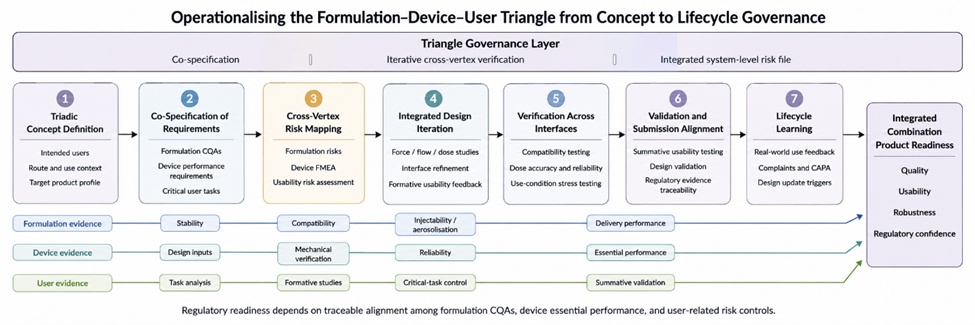
Figure 2. Translation Pathway for Applying the Formulation–Device–User Triangle Across Combination Product Development
The translation advantage of the triangle is that it can reduce late-stage surprises by making cross-domain dependencies explicit before pivotal studies, design validation, or submission assembly. Guo, Weng, Zhu, Zhou, Chen, Gu, and Zhou’s review of FDA-approved biologic-device combination products indicates that modern approvals depend on increasingly sophisticated integration of biologic and device evidence [19]. Fleischmann, Bock, Zhang, Godfrey, Vranic, Cronenberger, and Dokoupilová showed how usability evidence can be embedded in a clinical development setting for a biosimilar prefilled pen, illustrating the value of linking device presentation to user performance [26]. The proposed framework therefore offers a practical pathway for aligning scientific development, usability evidence, and regulatory communication.
The first limitation is that the Formulation–Device–User Triangle is a conceptual framework rather than an empirically validated development method. It synthesises evidence from combination product design, injectability, usability, device development, and regulatory science, but it has not been prospectively tested against standard development pathways. The available literature supports the need for integration, risk management, user-centred development, and delivery-system alignment, but it does not yet establish whether using the triangle reduces development time, review cycles, or post-market use problems [4, 8, 24]. Future work should therefore evaluate the framework through case studies, retrospective regulatory analyses, or controlled development comparisons.
A second limitation is that the triangle may simplify jurisdictional and product-category variability. Combination product expectations differ across injectable biologics, inhalation products, emergency rescue medicines, connected devices, biosimilar presentations, and other platforms. Regulatory interpretation may also vary depending on whether the product is reviewed primarily through drug, biologic, or device pathways, as reflected in discussions of regulatory perspectives, generic combination products, and biologic-device bridging [2, 5, 7]. The triangle should therefore be treated as a design logic rather than as a substitute for product-specific regulatory strategy.
A third limitation is that implementation requires organisational conditions that may be difficult to create. Cross-functional co-specification requires early collaboration among formulation scientists, device engineers, human-factors specialists, clinicians, quality teams, manufacturing experts, and regulatory strategists. It also requires management willingness to revise early decisions when evidence from another vertex reveals incompatibility, even if that revision disrupts timelines or established work packages [1, 13, 25]. Without such organisational commitment, the triangle risks becoming a diagrammatic ideal rather than a working development discipline.
The Formulation–Device–User Triangle replaces the sequential silo model with an integrated, bidirectional logic for designing drug–device combination products. Its central claim is that formulation, device, and user should be treated as co-equal vertices of one development system rather than as separate workstreams joined late in the process. This shift allows teams to identify incompatibilities earlier and to frame product readiness as a property of the complete delivery system.
The core contribution of the framework is its redefinition of quality, usability, and robustness as emergent system properties. A stable formulation, reliable device, and successful usability test are necessary, but they are not sufficient if their interactions remain weakly specified. Combination product quality arises when the formulation tolerates the device, the device supports the user, and the user can administer the formulation safely and consistently through the final product configuration.
Industry and regulators should pilot the triangle in real development programmes to determine whether it improves design traceability, reduces late-stage redesign, and strengthens regulatory submissions. Such pilots could help convert the framework from conceptual synthesis into an evidence-supported development practice. The long-term goal is not merely better documentation, but more reliable combination products that perform robustly in the hands of the people who depend on them.
None
None
None
None
Open Access The author(s) retain copyright. This article is licensed under the Creative Commons Attribution-NonCommercial-ShareAlike 4.0 International License. It may be shared and adapted for non-commercial purposes with appropriate attribution, an indication of changes, and distribution of adaptations under the same license. Third-party material may be subject to separate terms identified in its credit line. View the license at https://creativecommons.org/licenses/by-nc-sa/4.0/.
 Publication System