Digital twins promise to reshape pharmaceutical development and manufacturing by creating virtual replicas that mirror physical systems over time. Their value lies in linking process knowledge, real-time data, predictive modelling, and decision support into a single operational framework. In pharmaceutical contexts, this promise is especially relevant because product quality is tightly coupled to process history, material attributes, and patient-facing performance. The core problem is that digital twin development in pharma remains fragmented across manufacturing, drug delivery, regulatory modelling, and digital transformation literatures. Manufacturing studies often focus on process control, PAT, and continuous production, whereas drug delivery studies emphasise physiological prediction, formulation performance, and patient-specific behaviour. These areas share mechanistic foundations, but they are rarely treated as parts of a unified pharmaceutical digital twin ecosystem. This conceptual review analyses digital twin logic across pharmaceutical manufacturing and drug delivery systems. It focuses on how mechanistic models, hybrid modelling, and real-time data infrastructures can be combined to support quality, performance prediction, and regulatory decision-making. The central argument is that digital twins must become not only predictive but also explainable and governable. The synthesis defines the architecture of pharmaceutical digital twins, catalogues their manufacturing and drug delivery applications, and identifies unresolved challenges in model coupling, parameter identifiability, uncertainty handling, and regulatory credibility. It also maps technological, organisational, economic, and regulatory barriers that prevent promising models from becoming routine industrial tools. Five tables summarise the conceptual architecture, application domains, model architectures, integration problems, and implementation barriers. Realising the full potential of pharmaceutical digital twins will require mechanistic rigour, explainable analytics, high-quality data connectivity, and early alignment with regulatory expectations. The future of the field will depend less on isolated demonstrations and more on reusable validation strategies, transparent model governance, and cross-sector collaboration. Digital twins should therefore be understood as evolving regulatory-scientific infrastructures rather than as standalone computational artefacts.
Digital twins have entered pharmaceutical science as a way to connect physical processes, computational replicas, and decision-making into a continuously updating system. In pharmaceutical manufacturing, Chen, Yang, Sampat, Bhalode, Ramachandran, and Ierapetritou [1] describe digital twins as process-oriented virtual representations that can support optimisation, monitoring, and control. This framing is attractive because pharmaceutical quality is not merely tested at the end of production but emerges from material properties, process trajectories, and control strategies.
The need for digital twins is intensified by the shift from batch production toward continuous manufacturing and real-time quality assurance. Continuous pharmaceutical production creates dense process data streams, making it suitable for model predictive control, PAT-enabled monitoring, and real-time release strategies as discussed by Su, Ganesh, Moreno, Bommireddy, Gonzalez, Reklaitis, and Nagy [2]. Yet the same transition creates a conceptual challenge: models must be fast enough for control, mechanistic enough for interpretation, and reliable enough for regulated use.
Drug delivery systems create a parallel but distinct need for digital twin thinking because formulation performance depends on multiscale interactions between device, dosage form, physiology, and patient variability. Bahrami, Rossi, De Nys, and Defraeye [3] show how patient-specific transdermal fentanyl simulations can function as individualized digital twins, while Defraeye, Bahrami, Ding, Malini, Terrier, and Rossi [4] demonstrate the importance of mechanistic prediction in linking delivery design to therapeutic exposure. These examples suggest that digital twins can bridge product design, delivery behaviour, and patient response, but they also expose the difficulty of validating such systems across biological variability.
The core problem addressed in this review is that pharmaceutical digital twin research remains distributed across manufacturing informatics, delivery modelling, PBPK science, regulatory modelling, and industrial digitalisation. Hole, Hole, and McFalone-Shaw [5] highlight that digital transformation in pharma requires choices about infrastructure, skills, and implementation priorities, while Perno, Hvam, and Haug [6] show that process-industry adoption depends on organisational as well as technical readiness. This review therefore asks how digital twins can integrate manufacturing and drug delivery through mechanistic modelling while remaining explainable, governable, and practically implementable.
The logic of a pharmaceutical digital twin begins with a physical system whose state must be mirrored with sufficient fidelity for prediction and intervention. In manufacturing, that physical system may be a feeder, blender, granulator, tablet press, bioreactor, lyophilizer, or integrated continuous line, as reflected in digital twin and continuous manufacturing studies [1, 7]. In drug delivery, the physical system may instead be a nanocarrier, implant, patch, dosage form, organ-level transport environment, or patient-specific exposure pathway [3, 4].
The second element is a virtual model that expresses the system’s behaviour through mechanistic, statistical, or hybrid representations. Davidopoulou and Ouranidis [8] link Pharma 4.0 digital twins to intelligent modelling of nanosuspension solidification, while Rogers and Ierapetritou [9] emphasise the broader modelling challenges that arise in pharmaceutical manufacturing. The strongest pharmaceutical digital twins are therefore not merely dashboards; they combine physical theory, process data, and predictive algorithms into a model structure that can be updated and interrogated.
The third element is a data connection that keeps the virtual representation aligned with the physical system. PAT implementation, near infrared spectroscopy, and informatics infrastructures are central because they convert physical process states into model-readable signals, as shown by Sacher, Poms, Rehrl, and Khinast [10] and by Chen, Sampat, Huang, Ganesh, Singh, Ramachandran, Reklaitis, and Ierapetritou [11]. Without this connection, the “twin” becomes a static simulator rather than a living representation of current process or product state.
The fourth element is decision support, where model predictions are translated into control actions, quality assessments, design choices, or regulatory evidence. Phalak, Tomba, Jehoulet, Kapitan-Gnimdu, Soladana, Vagaggini, Brochier, Stevens, Peel, Strodiot, and Dessoy [12] illustrate this logic in adjuvant manufacturing, while Fischer, Volpert, Antonino, and Ahrens [13] extend the idea toward patient-specific therapeutics and manufacturing. Table 1 outlines the core components and enabling technologies of a pharmaceutical digital twin.
Table 1. Core Components of a Pharmaceutical Digital Twin: Physical System, Virtual Model, Data Connectivity, and Decision Support
Digital twin component | Pharmaceutical interpretation | Enabling technologies | Main contribution to the twin |
Physical system | Manufacturing unit operation, dosage form, delivery device, biological exposure pathway, or patient-specific therapy context | Continuous lines, sensors, dosage platforms, controlled delivery systems, patient monitoring interfaces | Provides the real-world object or process whose state must be mirrored |
Virtual model | Mechanistic, data-driven, or hybrid representation of process behaviour, product performance, or exposure dynamics | First-principles models, PBPK models, machine learning, model predictive control, simulation environments | Predicts current and future system behaviour under defined assumptions |
Data connectivity | Real-time or near-real-time link between measured system states and the model | PAT, near infrared spectroscopy, process historians, cloud platforms, data pipelines | Keeps the model synchronised with physical reality |
Decision support | Translation of model outputs into process, formulation, clinical, or regulatory decisions | Control algorithms, quality dashboards, explainable AI, uncertainty metrics, validation reports | Converts prediction into actionable and auditable decisions |
Governance layer | Documentation, validation, model lifecycle control, and accountability | Model repositories, change control, credibility assessment, audit trails | Makes the twin usable in regulated pharmaceutical environments |
Figure 1 presents the integrated architecture of a pharmaceutical digital twin, showing how physical systems, mechanistic and hybrid models, real-time data connectivity, decision support, and lifecycle governance jointly support manufacturing and drug delivery applications.
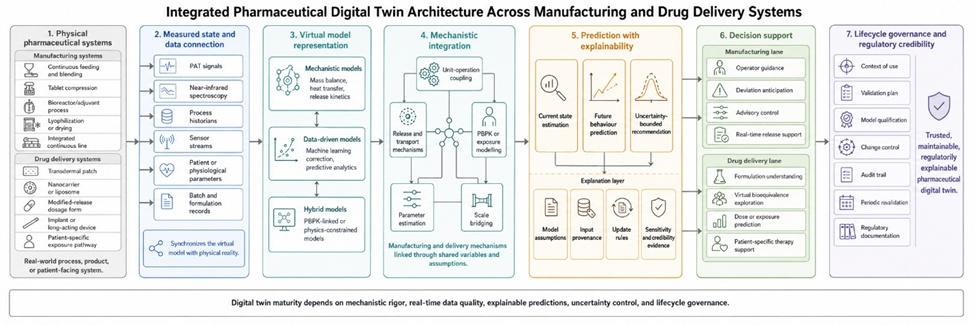
Figure 1. Integrated Pharmaceutical Digital Twin Architecture Across Manufacturing and Drug Delivery Systems
Pharmaceutical manufacturing is the most mature application area for digital twin logic because process states can be measured, controlled, and linked to quality attributes. Continuous manufacturing provides a particularly strong foundation because material flow, residence time, mixing, compaction, and dissolution-relevant attributes can be modelled dynamically [7]. Badman, Cooney, Florence, Konstantinov, Krumme, Mascia, Nasr, and Trout [14] argue that continuous production is needed to modernise pharmaceutical manufacturing, and digital twins provide a conceptual mechanism for making that modernisation intelligent and adaptive.
Tablet production illustrates how digital twins can integrate unit operation models with control systems. Bhaskar, Barros, and Singh [15] developed advanced model predictive control for tablet compaction, while Celikovic, Rehrl, Kruisz, Sacher, and Khinast [16] applied model predictive control to continuous feeding and blending units. These studies show that manufacturing twins can target blend uniformity, tablet weight, hardness, process stability, and disturbance rejection rather than only retrospective process description.
PAT-enabled monitoring is another central manufacturing use case because it provides the real-time measurements needed to update the twin. Velez, Drennen, and Anderson [17] discuss near infrared spectroscopy for blend uniformity monitoring, and Rangel-Gil, Nasrala-Álvarez, Romañach, and Méndez [18] show how stream sampling and near infrared methods can support continuous low-dose formulation monitoring. Table 2 summarises the key manufacturing applications of digital twins and their mechanistic underpinnings.
Table 2. Pharmaceutical Manufacturing Applications of Digital Twins: Unit Operations, Mechanistic Models, and Quality Outcomes
Manufacturing application | Representative physical system | Mechanistic or hybrid model basis | Data connection | Targeted quality or operational outcome |
Continuous feeding and blending | Feeders, blenders, powder transfer systems | Residence time distribution, powder flow, mass balance, model predictive control | PAT, feeder signals, spectroscopic blend monitoring | Blend uniformity, content uniformity, disturbance rejection |
Tablet compression | Tablet press and compaction process | Compaction mechanics, compression force models, tablet property prediction | Compression force, tablet weight, process sensors | Tablet weight, hardness, tensile strength, process robustness |
Integrated continuous manufacturing | End-to-end drug product production line | Coupled unit-operation models, moving horizon estimation, nonlinear predictive control | Integrated data management and process informatics | Real-time release support, plant-wide quality control |
Biopharmaceutical and adjuvant manufacturing | Bioreactor-like or biologically derived manufacturing systems | Reaction kinetics, mass transfer, process-response models, hybrid analytics | Online sensors, process data streams, batch records | Process consistency, yield, critical quality attributes |
Freeze-drying and drying-related operations | Lyophilization or solidification process | Heat transfer, mass transfer, phase behaviour, product-state prediction | Temperature, pressure, product-state measurements | Drying endpoint, product stability, cycle optimisation |
Digital twins also support plant-wide control by combining state estimation with predictive control. Huang, Chen, Singh, Ramachandran, and Reklaitis [19] demonstrate how moving horizon estimation and nonlinear model predictive control can manage plant-model mismatch in continuous pharmaceutical manufacturing, while Mesbah, Paulson, Lakerveld, and Braatz [20] show model predictive control at an integrated pilot-plant scale. The manufacturing twin thus becomes an operational layer that links process understanding, real-time data, and quality decisions in a regulated production environment.
Drug delivery system digital twins shift attention from factory operations to formulation performance, biological transport, and patient-specific exposure. Transdermal fentanyl modelling provides a clear example because patch design, skin transport, patient physiology, and dosing transitions can be represented mechanistically [3, 21]. In this setting, the twin is not only a product-performance simulator but also a possible therapy-support tool that anticipates exposure under patient-specific conditions.
Nanocarriers and non-biological complex drugs present a broader drug delivery challenge because their in vivo behaviour may depend on size distribution, composition, release kinetics, surface properties, and biological interactions. Malheiro, Duarte, Veiga, and Mascarenhas-Melo [22] discuss Pharma 4.0 technologies for non-biological complex drug manufacturing, while Zagalo, Simões, and Sousa [23] emphasise the regulatory science issues surrounding follow-on versions of such products. Digital twins for these systems must therefore connect formulation structure, manufacturing history, and biological performance rather than modelling delivery as a simple input function.
PBPK modelling offers a bridge between drug delivery mechanisms and systemic exposure prediction. Zhao, Zhang, Grillo, Liu, Bullock, Moon, Song, Brar, Madabushi, Wu, Booth, Rahman, Reynolds, Gil Berglund, Lesko, and Huang [24] show how PBPK has been used in regulatory review, while Arav, Broccatelli, Dressman, Kostewicz, Lennernäs, and Kesisoglou [25] describe advances in modelling approaches for oral drug delivery. Table 3 maps the drug delivery system applications and their model architectures.
Table 3. Drug Delivery System Digital Twins: Nanocarriers, PBPK Integration, and Predictive Performance
Drug delivery application | System represented by the twin | Model architecture | Main predictive task | Principal implementation challenge |
Transdermal patches | Patch, skin barrier, patient physiology, systemic exposure | Mechanistic transport model linked to patient-specific parameters | Dose selection, switching strategy, exposure prediction | Capturing inter-patient variability and validating clinical relevance |
Nanocarriers and liposomes | Particle attributes, release behaviour, biological distribution | Particle-level release model coupled with physiological disposition model | In vitro–in vivo translation and performance prediction | Linking manufacturing attributes to biological fate |
Polymeric micelles and complex formulations | Formulation structure, dissolution or release kinetics, tissue exposure | Hybrid formulation model plus PBPK or compartmental exposure model | Predicting release, absorption, and systemic concentration | Parameter identifiability and sparse biological data |
Implantable or long-acting devices | Device geometry, matrix degradation, local release, systemic exposure | Diffusion, degradation, and PBPK-coupled model | Long-term release and patient-specific exposure | Long validation horizons and uncertainty propagation |
Oral modified-release systems | Dosage-form behaviour, gastrointestinal transit, absorption, systemic PK | Dissolution model integrated with PBPK absorption framework | Food effects, bioequivalence, formulation optimisation | Physiological variability and credibility of extrapolation |
Regulatory credibility is especially important for drug delivery twins because their predictions may influence bioequivalence, product sameness, or patient-specific dosing decisions. Grimstein, Yang, Zhang, Grillo, Huang, Zineh, and Wang [26] describe PBPK’s expanding role in regulatory science, and Kuemmel, Yang, Zhang, Florian, Zhu, Tegenge, Huang, Wang, Morrison, and Zineh [27] frame credibility assessment as essential for model-informed decisions. For complex delivery products, Liu, Chen, Tseng, Jiang, Gau, and Chang [28] indicate that regulatory considerations extend beyond simple chemical equivalence, making explainable model structure and transparent assumptions central to any delivery-system digital twin.
Mechanistic model integration is the technical core of pharmaceutical digital twins because it determines whether the virtual system can explain why a process or product behaves as predicted. In manufacturing, this means linking mass balances, powder flow, residence time, compaction physics, heat transfer, and sensor-derived state estimation into a coherent dynamic model [29]. In drug delivery, the same integration logic connects release kinetics, membrane transport, dissolution, tissue distribution, and systemic pharmacokinetics [25]. A digital twin therefore becomes credible only when its components are coupled in a way that preserves both predictive utility and physical interpretability.
The most difficult integration problem is scale bridging. A tablet manufacturing twin may need to connect particle-level behaviour to feeder dynamics, blending uniformity, tablet compression, and downstream dissolution, while a delivery twin may need to connect carrier microstructure to organ-level exposure [15]. Such coupling is rarely neutral because errors can propagate from one model layer to another, especially when parameters are estimated from sparse or indirect data [9]. Hybrid modelling offers a practical compromise by allowing mechanistic equations to define system structure while data-driven components correct residual behaviour.
Parameter identifiability is a recurring challenge because many pharmaceutical systems contain more mechanistic parameters than can be estimated reliably from routine measurements. Shebley, Sandhu, Emami Riedmaier, Jamei, Narayanan, Patel, Peters, Reddy, Zheng, de Zwart, Beneton, Bouzom, Chen, Chen, Cleary, Collins, Dickinson, Djebli, Einolf, Gardner, Huth, Kazmi, Khalil, Lin, Odinecs, Patel, Rong, Schuck, Sharma, Wu, Xu, Yamazaki, Yoshida, and Rowland [30] emphasise the need for disciplined model qualification and reporting in PBPK submissions. That principle extends to digital twins because unidentifiable parameters can create a false sense of mechanistic certainty even when model outputs appear accurate. Table 4 categorises the challenges and strategies for mechanistic model integration.
Table 4. Mechanistic Model Integration Challenges and Strategies: Coupling, Identifiability, and Hybrid Modelling Approaches
Integration challenge | Pharmaceutical manifestation | Risk for digital twin performance | Practical integration strategy | Regulatory relevance |
Model coupling | Linking unit-operation models, PBPK modules, release models, or patient physiology modules | Error propagation across model layers | Define explicit interfaces, shared variables, and coupling assumptions | Makes model structure auditable and interpretable |
Parameter identifiability | Too many kinetic, transport, or process parameters relative to available measurements | Plausible but non-unique parameter sets | Sensitivity analysis, parameter reduction, staged calibration | Supports confidence in model predictions |
Hybrid model design | Combining first-principles equations with machine-learning corrections | Loss of interpretability if data-driven layers dominate | Constrain data-driven components with mechanistic boundaries | Preserves explainability for regulated decisions |
Uncertainty propagation | Variability in materials, sensors, physiology, or model assumptions | Overconfident predictions and poor decision thresholds | Quantify uncertainty at each module and propagate to outputs | Enables risk-based model use |
Lifecycle maintenance | Physical process, formulation, or patient population changes over time | Model drift and declining relevance | Continuous monitoring, change control, periodic revalidation | Aligns the twin with quality-system expectations |
Figure 2 maps the mechanistic integration challenges that determine whether a pharmaceutical digital twin remains scientifically interpretable, including model coupling, parameter identifiability, hybrid model boundaries, uncertainty propagation, and lifecycle maintenance.
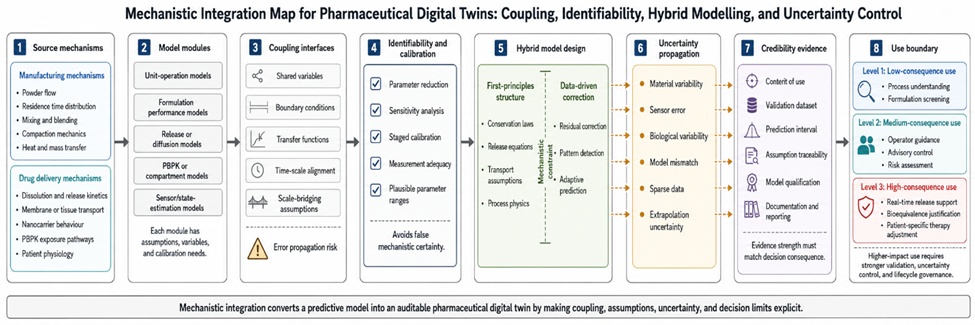
Figure 2. Mechanistic Integration Map for Pharmaceutical Digital Twins: Coupling, Identifiability, Hybrid Modelling, and Uncertainty Control
Uncertainty quantification is not an optional add-on but a core mechanism for deciding how a digital twin should be used. A twin used for operator guidance may tolerate broader uncertainty than one used for real-time release, bioequivalence justification, or patient-specific therapy adjustment [27]. The integration task is therefore both mathematical and regulatory because the model must communicate not only what it predicts but also how much confidence should be placed in that prediction. This makes uncertainty, sensitivity, and credibility assessment central design features of pharmaceutical digital twins rather than late-stage validation exercises.
Regulatory explainability requires that a model’s predictions can be traced to transparent assumptions, validated inputs, documented mechanisms, and clearly bounded contexts of use. Marshall, Burghaus, Cosson, Cheung, Chenel, DellaPasqua, Frey, Hamrén, Harnisch, Ivanow, Kerbusch, Lippert, Milligan, Rohou, Staab, Steimer, Tornøe, and Visser [31] describe good practices for model-informed drug discovery and development, including documentation and communication of model assumptions. For digital twins, these expectations become more demanding because the model may update over time and influence operational decisions continuously. Explainability must therefore include model structure, data provenance, update rules, uncertainty, and decision logic.
Manufacturing digital twins face regulatory questions about whether model outputs can support process control, deviation management, or real-time release. Lee, O’Connor, Yang, Cruz, Chatterjee, Madurawe, Moore, Yu, and Woodcock [32] position continuous manufacturing as part of pharmaceutical modernisation, but digital twins add a further layer by making model-based intervention part of the quality system. A regulator must be able to understand how the twin links critical material attributes, process parameters, sensor signals, and critical quality attributes. The question is not simply whether the model is accurate, but whether it is sufficiently explainable for its intended quality decision.
Drug delivery digital twins face a different explainability burden because their predictions often extend from formulation attributes to biological performance. PBPK models have already created a regulatory pathway for physiology-based prediction, but Grimstein, Yang, Zhang, Grillo, Huang, Zineh, and Wang [26] show that regulatory use depends on context, evidence, and transparent justification. For delivery systems such as nanocarriers, patches, implants, and complex generics, explainability must clarify how in vitro measurements, release mechanisms, and physiological assumptions support the predicted in vivo outcome. This is especially important when model predictions contribute to bioequivalence, product sameness, or dose selection.
A useful regulatory strategy is to define the digital twin’s context of use before finalising its architecture. Nijsen, Wu, Bansal, Bradshaw-Pierce, Chan, Liederer, Mettetal, Schroeder, Schuck, Tsai, Xu, and Chimalakonda [33] show that quantitative systems pharmacology practices vary across the pharmaceutical industry, which reinforces the need for clear expectations around purpose and evidence. A twin used for exploration, process monitoring, or formulation screening should not be judged by the same evidentiary standard as one used for release testing or clinical decision support. Regulatory explainability is therefore best understood as proportional transparency: the higher the consequence of the decision, the stronger the model documentation, validation, and uncertainty control must be.
Implementation barriers begin with data infrastructure. A pharmaceutical digital twin requires reliable sensors, interoperable data systems, model execution environments, cybersecurity controls, and mechanisms for handling missing or drifting data [11]. PAT and near infrared spectroscopy can provide important real-time signals, but Velez, Drennen, and Anderson [17] show that spectroscopic monitoring still requires careful calibration, maintenance, and process-specific interpretation. Without a robust data layer, even a strong mechanistic model cannot operate as a dependable twin.
A second barrier is organisational capability. Digital twins require collaboration among formulation scientists, process engineers, control engineers, data scientists, quality specialists, and regulatory teams, yet Hole, Hole, and McFalone-Shaw [5] indicate that digitalisation in pharma depends heavily on implementation focus and organisational readiness. Workforce gaps may prevent companies from maintaining models after initial deployment, especially when the original academic or vendor team is no longer involved. This creates a lifecycle risk: the twin may work at launch but lose credibility as process, product, or data conditions evolve.
Economic barriers arise because the return on investment is not always immediate. Continuous manufacturing, PAT infrastructure, and model predictive control can create long-term value, but they require upfront investment, validation effort, and changes to operating routines [2]. Smaller firms may struggle to justify twin development unless it is linked to clear use cases such as reduced batch failure, faster tech transfer, improved release decisions, or better product understanding. Table 5 identifies the key implementation barriers and proposed mitigation strategies.
Table 5. Implementation Barriers and Proposed Mitigations for Industrial Adoption of Pharmaceutical Digital Twins
Barrier category | Specific barrier | Consequence for adoption | Proposed mitigation strategy | Expected translation benefit |
Technological | Insufficient sensor density or unreliable real-time data | Twin cannot remain synchronised with the physical system | Begin with high-value measurable states and expand sensor networks gradually | Builds confidence without excessive initial complexity |
Data infrastructure | Fragmented systems and poor interoperability | Models cannot access clean, contextualised data | Develop integrated data architecture and controlled data pipelines | Supports scalable twin deployment |
Organisational | Limited cross-functional digital and modelling expertise | Model development and maintenance become isolated tasks | Build multidisciplinary teams and shared model governance processes | Improves lifecycle ownership |
Economic | Uncertain return on investment | Projects remain experimental rather than operational | Link twins to measurable business and quality outcomes | Strengthens investment justification |
Regulatory | Limited precedent for dynamic model-based decisions | Hesitation to use twins for high-impact decisions | Co-develop context-of-use, validation, and documentation strategies with regulators | Enables progressive movement toward regulated use |
Cultural resistance may be the hardest barrier because digital twins shift decision-making from experience-only judgement toward model-informed judgement. Perno, Hvam, and Haug [6] show that implementation in process industries depends on enablers and barriers beyond technical feasibility. In pharma, this issue is amplified by regulated quality cultures that rightly prioritise traceability, reproducibility, and control. Adoption will therefore require digital twins to be framed not as replacements for expert judgement but as transparent decision-support systems embedded within pharmaceutical quality systems.
A realistic translation pathway should begin with low-risk, well-characterised systems where digital twin value can be demonstrated without making high-consequence regulatory claims. Feeding, blending, compaction, and PAT-supported monitoring are suitable entry points because the physical systems are measurable and the quality outcomes are well defined [16]. Early twins should focus on operator guidance, process understanding, and deviation anticipation before progressing toward release or adaptive control. This staged approach reduces implementation risk while creating evidence for broader adoption.
The next step is to formalise model lifecycle governance. A pharmaceutical digital twin should have a documented context of use, input data requirements, calibration strategy, validation plan, uncertainty framework, update policy, and change-control procedure [30]. These elements should be established before the model becomes central to quality or regulatory decisions. In practice, lifecycle governance transforms the twin from an experimental computational tool into a controlled pharmaceutical knowledge asset.
For manufacturing, translation should move from local unit-operation twins to integrated line-level twins. Mesbah, Paulson, Lakerveld, and Braatz [20] demonstrate that integrated continuous manufacturing can be controlled using predictive modelling, while Huang, Chen, Singh, Ramachandran, and Reklaitis [19] show the importance of handling plant-model mismatch. A staged manufacturing pathway would therefore begin with state estimation and monitoring, progress to advisory control, and later support autonomous or semi-autonomous control under defined regulatory conditions. Real-time release should be treated as an advanced endpoint rather than the first deployment target.
For drug delivery, translation should move from mechanism-specific models to patient- or product-specific twins only after credibility has been established. Transdermal fentanyl examples show how patient-specific simulations may support therapy tailoring [3, 21], but such applications require careful validation, uncertainty communication, and clinical interpretation. Complex formulations and PBPK-linked delivery models should first support formulation understanding, virtual bioequivalence exploration, and risk assessment before being used for pivotal decisions [23]. Across both manufacturing and delivery, the central translation principle is co-development: digital twins should be built with regulators, quality teams, and end users rather than handed to them after technical completion.
Figure 3 illustrates the staged translation pathway through which pharmaceutical digital twins can progress from bounded exploratory applications to regulated decision-support roles only after validation, lifecycle governance, uncertainty control, and regulatory co-development are established.
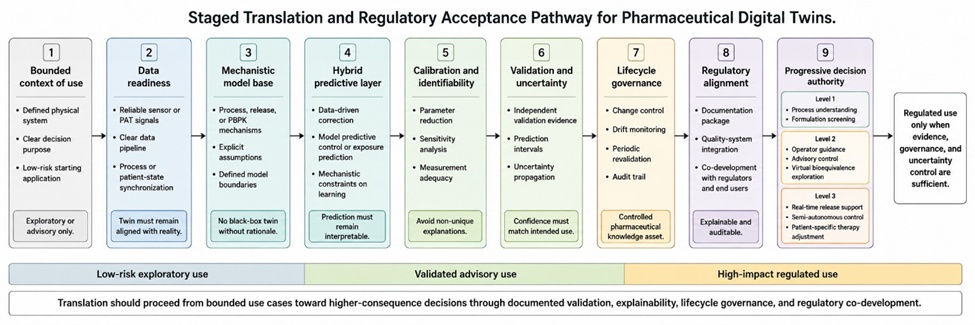
Figure 3. Staged Translation and Regulatory Acceptance Pathway for Pharmaceutical Digital Twins
Digital twins offer a powerful conceptual bridge between pharmaceutical manufacturing and drug delivery systems. Their promise lies in connecting physical products and processes with virtual models that can predict, explain, and support decisions over time. This review has argued that pharmaceutical digital twins should be understood as integrated scientific and regulatory infrastructures rather than as isolated simulation tools.
The central requirement is mechanistic integration. Digital twins will be most valuable when they combine first-principles understanding with real-time data and carefully constrained data-driven methods. This balance allows them to remain predictive without becoming opaque, and flexible without losing scientific credibility.
Regulatory explainability is equally important. A digital twin that cannot communicate its assumptions, uncertainty, validation status, and context of use will struggle to support high-impact pharmaceutical decisions. Explainable models are therefore not merely desirable for transparency; they are essential for quality assurance, regulatory confidence, and responsible implementation.
The path forward requires staged translation, cross-functional collaboration, and early alignment between developers, manufacturers, clinicians, and regulators. Pharmaceutical digital twins should begin with bounded use cases and mature through documented validation, lifecycle governance, and progressive expansion of decision authority. Their long-term success will depend on whether the field can turn promising computational models into trusted, maintainable, and regulatorily acceptable systems.
None
None
None
None
Open Access The author(s) retain copyright. This article is licensed under the Creative Commons Attribution-NonCommercial-ShareAlike 4.0 International License. It may be shared and adapted for non-commercial purposes with appropriate attribution, an indication of changes, and distribution of adaptations under the same license. Third-party material may be subject to separate terms identified in its credit line. View the license at https://creativecommons.org/licenses/by-nc-sa/4.0/.
 Publication System