Pharmaceutical translation depends on coordinated movement across discovery, formulation, engineering, clinical development, regulatory assessment, and real-world adoption. Yet these domains are not organised around a single language, evidence standard, or professional logic. Scientists, engineers, clinicians, and regulators often evaluate the same innovation through different assumptions about value, risk, feasibility, and acceptable uncertainty. A critical but under-recognised cause of translational delay is the absence of shared artefacts that can carry meaning across these disciplinary worlds. When a formulation concept, manufacturing constraint, clinical use condition, or regulatory concern is represented only in the vocabulary of one group, it becomes difficult for others to interpret its implications. This produces misaligned specifications, late-stage redesign, evidence fragmentation, and avoidable regulatory friction. This article introduces boundary object theory as a translational lens for pharmaceutical innovation. Boundary objects are artefacts that remain stable enough to support shared work while remaining flexible enough to be interpreted by different professional communities. Applied to pharmaceutical development, they include target product profiles, critical quality attributes, design space diagrams, pharmacokinetic–pharmacodynamic models, control strategies, clinical administration guides, and regulatory summaries. The article constructs an original translational framework that identifies how boundary objects can be designed, evaluated, and positioned across formulation science, process engineering, clinical practice, and regulatory assessment. It argues that pharmaceutical translation should not be understood only as the transfer of data or documentation, but as the progressive alignment of meanings, expectations, and decisions through structured artefacts. The proposed framework positions boundary object design as a practical intervention for improving translational continuity. By making assumptions, sensitivities, use conditions, uncertainties, and decision consequences visible across disciplines, boundary objects can reduce communication failure and support more coherent innovation pathways. The article calls for deliberate integration of boundary object thinking into pharmaceutical development programmes, regulatory communication, and translational training.
Pharmaceutical innovation is frequently described through the language of discovery, optimisation, development, approval, and adoption, but the route between these stages remains vulnerable to discontinuity. Translational science has highlighted how promising biomedical discoveries may fail when preclinical evidence, development decisions, clinical feasibility, and regulatory expectations are not aligned, producing the well-known “valley of death” between scientific potential and patient benefit [1]. Recent analyses of drug development failure similarly show that attrition is rarely explained by a single technical weakness; rather, it emerges from interacting scientific, clinical, organisational, and evidentiary uncertainties that accumulate across development stages [2].
The communication problem is intensified because pharmaceutical translation requires cooperation among communities that do not simply use different words, but often work with different epistemic priorities. Formulation scientists may focus on molecular stability, release behaviour, and product performance, while process engineers translate those attributes into manufacturable operations, clinicians interpret them through dosing, adherence, administration, and outcome relevance, and regulators examine whether the evidence is structured enough to support quality, safety, efficacy, and benefit–risk decisions. Boundary object theory offers a useful conceptual bridge because it explains how artefacts can support cooperation across social worlds without requiring complete agreement on meaning [3].
This article applies boundary object theory to pharmaceutical translational science and proposes a framework for intentionally designing shared artefacts across disciplinary interfaces. The central argument is that translational success depends not only on generating stronger evidence, but also on representing evidence in forms that can be interpreted, negotiated, and acted upon by different professional communities. By treating target product profiles, critical quality attributes, design spaces, pharmacokinetic–pharmacodynamic models, control strategies, clinical artefacts, and regulatory summaries as boundary objects, the framework reframes documentation as an active translational infrastructure rather than a passive record of decisions [4, 5].
The pharmaceutical translation problem can be understood as a sequence of interface failures in which information is transferred but not fully translated. A formulation team may define critical attributes in technically precise terms, yet these attributes may not communicate why a small change in particle size, excipient grade, viscosity, release rate, or storage condition matters for manufacturing robustness, clinical administration, or regulatory justification. Quality-by-design literature has improved the discipline of structured pharmaceutical development, but even systematic approaches can remain internally focused if design rationales are not made interpretable across downstream communities [6].
At the formulation–engineering interface, development teams often struggle to convert laboratory-scale product understanding into scalable and controllable manufacturing logic. Early pharmaceutical research and development increasingly emphasises quality-by-design thinking, but translational problems persist when target product characteristics, critical quality attributes, process parameters, and control strategies are documented as separate technical items rather than as a connected representation of product behaviour under real production conditions [7]. This means that knowledge exists, but it is not always assembled into a form that allows engineers, quality teams, and later clinical stakeholders to understand consequences and trade-offs.
At the clinical and regulatory interfaces, the same fragmentation can reappear as a gap between product design intent and evidence use. Model-informed drug development has shown how quantitative models can support regulatory and clinical decision-making, yet models function effectively only when assumptions, uncertainty, decision relevance, and evidentiary limits are communicated in ways that multiple stakeholders can interpret [5, 8]. The root problem is therefore socio-cognitive as much as technical: pharmaceutical development produces many artefacts, but not all of them function as boundary objects capable of sustaining shared meaning across professional worlds.
Boundary objects are useful because they explain how interdisciplinary work can proceed even when actors do not share a complete vocabulary, method, or value system. A boundary object has enough structure to remain recognisable across contexts, but enough interpretive flexibility to be useful to different communities for different purposes [3]. In design and organisational settings, prototypes and structured artefacts have been shown to mediate collaboration by allowing participants to coordinate around something concrete rather than relying only on abstract discussion [9, 10].
In pharmaceutical translation, a boundary object is not merely a document, diagram, model, or table; it is an artefact that enables coordinated decision-making across disciplinary boundaries. A target product profile can help scientists, clinicians, commercial teams, and regulators discuss what a product is expected to achieve, while a critical quality attribute framework can help formulation and manufacturing teams connect product performance to controllable variables [4, 11]. A pharmacokinetic–pharmacodynamic model can also act as a boundary object when it links dose, exposure, response, uncertainty, and clinical interpretation in a shared decision space [8].
The effectiveness of a pharmaceutical boundary object depends on three properties: shared syntax, negotiated meaning, and decision relevance. Shared syntax allows different groups to recognise the artefact, negotiated meaning allows them to adapt it to their own professional concerns, and decision relevance ensures that it guides action rather than becoming decorative documentation. Table 1 defines boundary objects for pharmaceutical translation and their essential properties.
Table 1. Boundary Objects for Pharmaceutical Translation: Types, Essential Properties, and Their Translation Functions across Disciplines
Boundary object type | Essential property | Primary disciplinary users | Translation function | Common weakness if poorly designed |
Target product profile | Stable product intent with flexible interpretation | Scientists, clinicians, commercial teams, regulators | Converts development ambition into shared expectations for indication, population, route, dose, benefit, and feasibility | Becomes aspirational rather than operational when not connected to formulation and evidence constraints |
Critical quality attribute map | Linkage between product attributes and performance risk | Formulation scientists, process engineers, quality teams, regulators | Translates product characteristics into measurable and controllable quality priorities | Becomes a checklist when it lacks clinical or manufacturing consequence |
Design space diagram | Visualisation of acceptable operating ranges | Formulation scientists, process engineers, manufacturing teams, quality teams | Communicates how formulation and process variables interact within acceptable performance boundaries | Fails when ranges are presented without sensitivity, robustness, or uncertainty context |
Control strategy table | Structured link between risks, controls, monitoring, and acceptance criteria | Process engineers, quality assurance, manufacturing teams, regulators | Translates process understanding into routine governance and lifecycle control | Becomes static when not updated through lifecycle learning |
Pharmacokinetic–pharmacodynamic model | Quantitative bridge between product behaviour and clinical response | Pharmacometricians, clinicians, regulators, development teams | Converts formulation and dosing assumptions into exposure–response and decision logic | Loses boundary value when assumptions and uncertainty are hidden |
Clinical administration guide | Practical representation of product use | Clinicians, pharmacists, patients, trial teams, sponsors | Converts technical product requirements into usable clinical procedures | Fails when administration burden, training needs, and patient context are underrepresented |
Regulatory summary artefact | Formal synthesis of evidence and justification | Sponsors, regulators, quality teams, clinical teams | Converts development evidence into reviewable regulatory reasoning | Becomes fragmented when quality, clinical, and risk arguments are not integrated |
Existing pharmaceutical boundary objects differ substantially in maturity. The target product profile is increasingly recognised as a structured tool for regulatory and development communication, especially when it is dynamic enough to incorporate payer, patient, and clinical perspectives [11, 12]. By contrast, many technical artefacts used in formulation and process development are still designed primarily for internal expert use, which limits their capacity to translate assumptions and trade-offs across scientific, engineering, clinical, and regulatory communities.
Figure 1 illustrates how boundary objects translate pharmaceutical innovation across formulation, engineering, clinical, and regulatory worlds without requiring full disciplinary consensus.
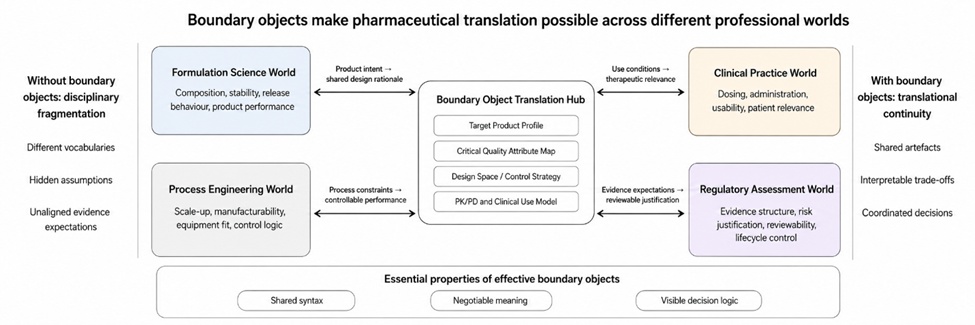
Figure 1. Boundary Object Logic for Pharmaceutical Translation across Formulation Science, Process Engineering, Clinical Practice, and Regulatory Assessment
The formulation science interface is where product essence is first translated into a form that downstream disciplines can evaluate. Formulation scientists often represent the product through composition, stability, dissolution, release profile, manufacturability, compatibility, route of administration, and performance specifications. These representations are necessary, but they become weak boundary objects when they communicate values without explaining the rationale, sensitivity, uncertainty, and real-world implications of those values [6, 13].
A purely numerical specification can tell an engineer or regulator what range has been selected, but it may not explain why that range matters, how close it is to a performance boundary, or what trade-off was accepted to preserve stability, release behaviour, or patient usability. Quality-by-design approaches can help by linking formulation variables to critical quality attributes and development rationale, but the translational value depends on whether the artefacts make causal logic visible to people outside the formulation group [6, 7]. For this reason, formulation boundary objects should include not only target values and acceptance criteria, but also explanatory design narratives.
An enriched formulation boundary object would combine a target product profile, a critical quality attribute map, and a dynamic design space narrative. Such an artefact would show how formulation choices relate to therapeutic intent, manufacturability, clinical administration, and regulatory evidence, while also making uncertainty and acceptable operating ranges explicit. This approach aligns with model-informed and structured development practices because it treats formulation knowledge as a shared translational resource rather than a discipline-specific technical file [5, 14].
The process engineering interface is where formulation intent must be converted into reproducible, scalable, and controllable production. Scale-up failure can occur when the formulation is technically feasible at laboratory scale but poorly represented in terms of process sensitivity, equipment dependency, batch variability, residence time, mixing behaviour, environmental exposure, or control requirements. In this sense, the scale-up problem is partly a boundary object problem because the artefacts used for handover may describe what was made without adequately translating how and why it remains robust under altered manufacturing conditions [6, 7].
Technology transfer documents, scale-down models, process descriptions, and control strategy tables already function as practical boundary objects between development and manufacturing teams. Their weakness is that they often become repositories of validated facts rather than living representations of uncertainty, operational fragility, and unresolved assumptions. More effective process-engineering boundary objects would link critical quality attributes to process parameters, equipment choices, monitoring strategies, and failure modes in a way that allows formulation scientists, engineers, quality teams, and regulators to negotiate acceptable risk before late-stage transfer [15].
Model-informed development offers a useful template for strengthening process boundary objects because it makes assumptions, parameter dependencies, and decision consequences explicit. Although model-informed drug development is often associated with clinical pharmacology and regulatory decision-making, its broader translational logic can be extended to process engineering when models are used to connect product behaviour, process variability, and control strategy design [8, 16]. A resilient process boundary object should therefore represent not only the preferred manufacturing pathway, but also the conditions under which that pathway may fail and the controls required to maintain acceptable performance.
The clinical interface translates pharmaceutical design into human use, clinical decision-making, and patient experience. Product attributes such as release profile, dosing frequency, device requirements, storage conditions, preparation steps, administration technique, and tolerability may be highly technical during development but become clinically meaningful only when they are represented in terms of usability, adherence, workflow, and therapeutic consequence. Advanced drug delivery research has emphasised the importance of patient-facing and practice-facing translation, yet many development artefacts still fail to show clinicians how formulation and process characteristics shape real-world use [13].
Labels, instructions for use, clinical trial material descriptions, dosing guides, administration manuals, and patient-reported outcome measures can all function as clinical boundary objects. Their value depends on whether they translate product design into actionable clinical and patient-centred meaning rather than merely restating technical specifications. Table 2 maps existing and proposed boundary objects at the clinical interface.
Table 2. Boundary Objects at the Clinical Interface: Translating Formulation and Process Characteristics into Clinically Meaningful Artefacts
Clinical boundary object | Development information translated | Clinical users | Translation purpose | Proposed improvement |
Clinical trial material description | Dosage form, strength, storage, handling, preparation, and administration constraints | Investigators, pharmacists, trial coordinators | Ensures that investigational product use reflects development assumptions | Add explicit links between product handling deviations and expected performance consequences |
Dosing and administration guide | Formulation behaviour, release profile, device interaction, and patient-use requirements | Clinicians, pharmacists, nurses, patients | Converts product design into safe and consistent use procedures | Include usability risks, training needs, and decision pathways for missed or delayed doses |
Label and prescribing information | Approved indication, dosage, contraindications, precautions, and use instructions | Clinicians, pharmacists, regulators, patients | Converts evidence and regulatory decisions into clinical practice guidance | Make product-specific administration complexity and adherence implications more visible |
Pharmacokinetic–pharmacodynamic model summary | Exposure–response assumptions, dosing rationale, variability, and uncertainty | Clinicians, pharmacometricians, regulators | Links product performance to therapeutic interpretation | Present model assumptions in clinically interpretable language and visual formats |
Patient-reported outcome strategy | Patient experience, symptom burden, treatment acceptability, and meaningful benefit | Clinicians, patients, sponsors, regulators | Translates product value into patient-relevant evidence | Co-design outcome selection with patients, clinicians, and regulators early in development |
Clinical usability risk map | Preparation, administration, storage, training, and adherence vulnerabilities | Clinicians, pharmacists, human factors teams, sponsors | Identifies where product design may fail in real-world use | Connect usability risks to formulation, device, packaging, and clinical workflow decisions |
Patient input further strengthens clinical boundary objects because it prevents translation from being limited to professional interpretation alone. When patient perspectives are incorporated into target product profiles or clinical outcome assessment strategies, the artefact can align product development with clinically meaningful benefit, treatment burden, and real-world acceptability [12, 17]. This is particularly important for advanced therapies and complex delivery technologies, where clinical translation may fail not because the science is weak, but because evaluation, administration, reimbursement, and implementation pathways are difficult to coordinate [18].
The regulatory interface is the most formalised boundary in pharmaceutical translation because sponsors must convert complex development evidence into a reviewable structure. The Common Technical Document, quality overall summary, risk assessments, model reports, and structured submission components already function as boundary objects by organising evidence for health authority interpretation. However, these artefacts can lose translational force when they present quality, clinical, modelling, and risk arguments as separate modules rather than as an integrated account of why the product can be reliably manufactured and safely used [15, 19].
Regulatory communication increasingly depends on structured data, model-informed reasoning, and explicit justification of development decisions. Model-informed drug development has become an important regulatory language because it can connect evidence, assumptions, uncertainty, and decision-making across development stages [14, 16]. Yet models become effective regulatory boundary objects only when they are interpretable to reviewers, traceable to source data, transparent about uncertainty, and clearly linked to the regulatory question being addressed [20, 21].
The next generation of regulatory boundary objects should therefore move beyond static summaries toward interactive, traceable, and risk-linked representations. Structured content and data management can support this shift by making submissions more navigable and by improving the continuity between development evidence and regulatory review [15]. Interactive design-space visualisations, shared risk models, lifecycle control dashboards, and transparent model summaries could help sponsors and regulators negotiate expectations in a more continuous way, while preserving the formal accountability required for regulatory decisions.
The proposed framework positions pharmaceutical translation as a sequence of boundary object-mediated interfaces rather than as a linear handoff of information. At each interface, a specific artefact must translate the priorities of one professional world into a form that another world can interpret and use. This framing is consistent with healthcare knowledge mobilisation research showing that boundary objects can link different communities when they are embedded in collaborative routines rather than treated as stand-alone documents [22, 23].
The first interface is formulation–engineering, where product design intent must be translated into manufacturable control logic. The second is engineering–clinic, where process and product characteristics must be translated into clinical handling, dosing, administration, and patient-use implications. The third is clinic–regulator, where observed clinical relevance and development evidence must be translated into structured benefit–risk, quality, and review logic. Table 3 presents the complete translation framework with boundary objects assigned to each disciplinary interface.
Table 3. Proposed Translation Framework Using Boundary Objects: Interfacing Scientists, Engineers, Clinicians, and Regulators through Shared Artefacts
Translational interface | Primary communication gap | Existing boundary objects | Proposed enhanced boundary objects | Expected translation function |
Formulation science to process engineering | Formulation intent is not fully translated into scale-up sensitivity and manufacturing constraints | Critical quality attribute lists, design space diagrams, technology transfer reports | Dynamic formulation–process design narrative linking attributes, mechanisms, ranges, sensitivity, and control needs | Converts product design into scalable manufacturing logic |
Process engineering to clinical development | Manufacturing choices are not clearly connected to clinical use consequences | Batch records, specifications, control strategy tables, clinical trial material descriptions | Process-to-use consequence map showing how variability, storage, handling, and release behaviour affect clinical administration | Converts process control into clinical reliability and use expectations |
Clinical development to regulatory assessment | Clinical relevance, product performance, and evidence justification are fragmented across documents | Clinical study reports, labels, pharmacokinetic–pharmacodynamic models, regulatory summaries | Integrated clinical–quality evidence map linking product attributes, exposure, response, usability, and benefit–risk rationale | Converts development evidence into reviewable regulatory reasoning |
Regulatory assessment to lifecycle learning | Post-approval learning is not always fed back into product design and control strategy | Commitments, variation files, periodic reports, lifecycle management documents | Lifecycle boundary object dashboard combining quality signals, clinical feedback, regulatory commitments, and risk updates | Converts post-approval evidence into adaptive governance |
Cross-cutting scientist–engineer–clinician–regulator interface | Each discipline uses different vocabularies for value, risk, and uncertainty | Target product profile, quality overall summary, risk assessments | Shared translational dossier built around assumptions, uncertainties, decisions, and unresolved questions | Maintains continuity of meaning across the full development pathway |
The framework is governed by three design principles: shared syntax, negotiable content, and visible translation logic. Shared syntax means the artefact must be recognisable across disciplines, negotiable content means each group can add its own interpretation without destroying the artefact’s identity, and visible translation logic means the artefact shows how one form of evidence becomes meaningful for another decision context. These principles draw on boundary organising perspectives in healthcare, where practical coordination depends on artefacts and routines that allow professional boundaries to be crossed without erasing professional expertise [24, 25].
The framework also requires bidirectional use rather than one-way transfer. A boundary object should not simply carry formulation information forward to engineering, clinical development, and regulation; it should also allow downstream concerns to reshape upstream design. Dynamic target product profiles, co-designed outcome assessment strategies, and harmonised model-informed development practices demonstrate how iterative artefacts can support this loop by connecting early assumptions to later decisions and evidence needs [11, 16, 17].
Figure 2 presents the proposed boundary-object translation pathway from formulation intent to process control, clinical use, regulatory assessment, and lifecycle learning.
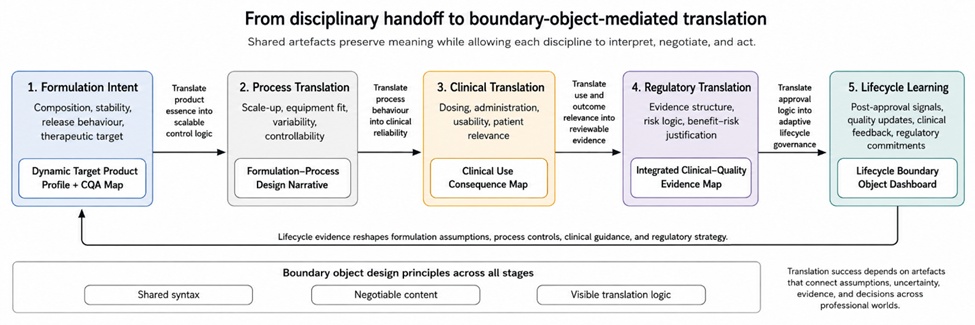
Figure 2. Proposed Boundary-Object Translation Pathway for Moving Pharmaceutical Innovation from Formulation Intent to Lifecycle Learning
Implementation should begin with a boundary object audit inside pharmaceutical development teams. Such an audit would identify which artefacts currently guide translation, which professional communities use them, what assumptions they contain, and where interpretation breaks down. This step is important because pharmaceutical teams may already possess many documents, models, and tables, yet only some of them function as effective boundary objects across formulation, engineering, clinical, and regulatory worlds [3, 22].
The second step is co-design through structured workshops that include formulation scientists, process engineers, clinicians, pharmacometricians, quality specialists, regulatory affairs professionals, and, where appropriate, patient representatives. Co-design is essential because boundary objects cannot be optimised by one discipline alone; they must be tested against the interpretive needs of multiple communities. Patient-centred target product profile development and co-created clinical outcome assessment strategies show how shared artefacts become stronger when stakeholders participate in defining the meaning and use of the artefact from the beginning [12, 17].
The third step is integration into development governance and regulatory communication. Boundary object design should be embedded in milestone reviews, technology transfer gates, model-informed development plans, clinical protocol preparation, and regulatory submission strategy. Structured regulatory submissions and electronic common technical document practices provide a foundation for this integration because they already require evidence to be organised in a format that can travel between sponsor and regulator [15, 19].
The fourth step is training. Scientists should be trained not only to generate technically valid data, but also to translate product knowledge into shared artefacts that can support decisions beyond their own discipline. This requires curricula in translational communication, model interpretation, quality-by-design reasoning, clinical usability, regulatory writing, and stakeholder negotiation, so that boundary object design becomes a core competence of pharmaceutical innovation rather than an informal skill acquired late in development [20, 26].
Pharmaceutical translation is not only a technical progression from discovery to development, approval, and use. It is also a socio-cognitive process in which different professional communities must coordinate around shared representations of value, risk, feasibility, and evidence. When those representations are weak, innovation may fail despite strong science because the meaning of the product does not travel effectively across disciplinary boundaries.
This article has proposed boundary objects as a practical and theoretically grounded mechanism for improving pharmaceutical translation. By reframing target product profiles, critical quality attributes, design spaces, control strategies, pharmacokinetic–pharmacodynamic models, clinical guides, patient-reported outcome strategies, and regulatory summaries as boundary objects, the framework shows how shared artefacts can make assumptions, sensitivities, uncertainties, and decision consequences visible across professional worlds.
Future work should test this framework in real pharmaceutical development programmes and examine which boundary objects most effectively reduce misunderstanding, redesign, regulatory friction, and clinical implementation failure. Case studies, comparative evaluations, and prospective translational audits would help refine the framework and determine how boundary object interventions can become routine elements of pharmaceutical innovation practice.
None
None
None
None
Open Access The author(s) retain copyright. This article is licensed under the Creative Commons Attribution-NonCommercial-ShareAlike 4.0 International License. It may be shared and adapted for non-commercial purposes with appropriate attribution, an indication of changes, and distribution of adaptations under the same license. Third-party material may be subject to separate terms identified in its credit line. View the license at https://creativecommons.org/licenses/by-nc-sa/4.0/.
 Publication System