Artificial intelligence is increasingly being positioned as a transformative tool in pharmaceutical formulation and process development because it can model complex relationships among molecular properties, excipient behaviour, formulation variables, processing conditions, and product performance. Machine learning, deep learning, hybrid modelling, and optimisation algorithms are now used to support decisions that were previously dominated by empirical screening and expert judgement. Despite this promise, the practical translation of artificial intelligence into pharmaceutical development remains uneven. Many models demonstrate high retrospective accuracy but provide limited mechanistic insight, weak interpretability, and uncertain relevance when moved beyond the specific datasets, formulations, equipment, or scales on which they were trained. This critical review examines artificial intelligence in pharmaceutical formulation and process development through three linked lenses: explainability, transferability, and regulatory trust. It argues that these issues are not secondary implementation details but core determinants of whether artificial intelligence can become credible within quality-driven pharmaceutical development. The analysis shows that artificial intelligence can support formulation and process understanding only when predictive performance is accompanied by transparent reasoning, domain-aware validation, lifecycle governance, and evidence of transferability across development contexts. A coordinated pathway involving explainable-by-design models, standardised transferability testing, and regulatory learning environments is required to move pharmaceutical artificial intelligence from technical promise toward justified regulatory trust.
Artificial intelligence has become increasingly visible in pharmaceutical formulation and process development because it offers a way to extract patterns from complex, multidimensional datasets that are difficult to interpret using conventional empirical approaches. Early and recent applications include formulation prediction, solid dispersion stability modelling, drug delivery design, 3D printing performance prediction, and continuous manufacturing support [1-4]. These developments indicate that AI is no longer confined to discovery-stage informatics but is now entering domains directly linked to product design, manufacturability, and quality.
The central problem is that predictive performance alone does not make an AI model suitable for pharmaceutical development decisions. A model may accurately classify formulation outcomes, predict printability, or estimate dissolution behaviour while still failing to explain why a prediction is scientifically plausible or how it would behave under changed excipient grades, process scales, or manufacturing conditions [5-7]. This creates a tension between computational efficiency and pharmaceutical accountability, especially where decisions affect product quality, process control, or regulatory evidence.
This review is organised around three critical concepts: explainability, transferability, and regulatory trust. Explainability refers to the degree to which AI outputs can be connected to scientifically meaningful formulation or process logic; transferability refers to whether a model remains valid across products, platforms, equipment, and scales; and regulatory trust refers to whether AI-derived evidence can be documented, validated, audited, and governed within pharmaceutical quality systems [8-10]. These concepts are treated as interdependent because poor explainability weakens transferability assessment, and weak transferability undermines regulatory confidence.
Figure 1 presents the central critical architecture linking AI model opacity, limited transferability, and the regulatory trust deficit in pharmaceutical formulation and process development.
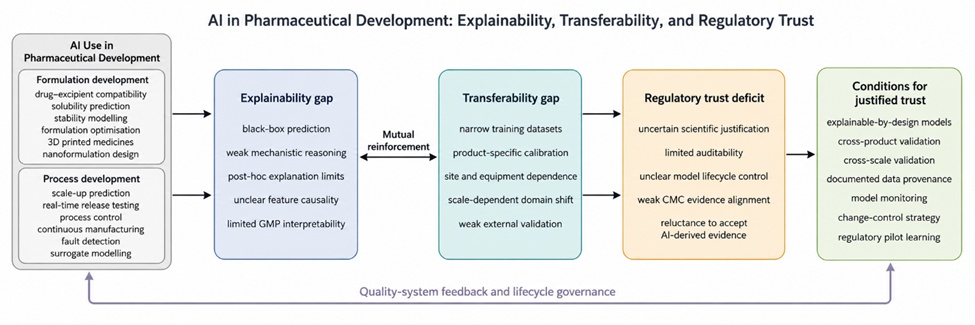
Figure 1. Critical architecture of the explainability–transferability–regulatory trust gap in AI-assisted pharmaceutical formulation and process development.
The scope of this review is limited to AI in pharmaceutical formulation and process development rather than AI in target discovery, clinical trial design, or pharmacovigilance. The review critically evaluates applications in formulation optimisation, drug delivery systems, solid dosage forms, 3D printing, continuous manufacturing, process control, and regulatory-facing development decisions [11-14]. Its argument is that AI can support pharmaceutical development only when it is designed and validated as a quality-relevant decision-support system, not merely as a high-performing predictive tool.
The literature base for this critical review was defined by the title focus, the 2017–2025 time window, and the requirement to include peer-reviewed journal articles relevant to AI in formulation development, process development, explainability, transferability, and regulatory trust. The selected literature includes articles from pharmaceutical sciences, drug delivery, pharmaceutics, process modelling, continuous manufacturing, and explainable AI because the topic sits between technical modelling and regulated development practice [4, 11, 15, 16]. The search logic prioritised studies and reviews that connected AI methods to formulation performance, process behaviour, quality attributes, or implementation barriers.
The selection emphasised articles that addressed pharmaceutical formulation or process decision-making rather than general AI theory alone. Studies on oral disintegrating tablets, solid dispersions, 3D printed medicines, nanoparticle optimisation, liquisolid systems, and ocular drug development were included because they illustrate how AI is applied to concrete formulation problems with data-driven performance claims [1, 2, 17-19]. Process-oriented articles were included when they addressed scale-up, real-time release testing, model predictive control, continuous manufacturing, or process monitoring, since these areas directly affect manufacturability and regulatory evidence [6, 9, 15, 20].
The inclusion logic also considered whether articles contributed to the review’s critical concepts. Publications on explainable AI were included where they clarified the limits of model interpretation or the difference between post-hoc explanation and mechanistic understanding [8, 10]. Regulatory-facing and implementation-oriented articles were included when they discussed AI adoption in pharmaceutical technology, drug delivery, development strategy, or regulatory perspectives [14, 21, 22]. Articles were excluded when they were not peer-reviewed journal publications, fell outside the defined time window, lacked direct relevance to formulation or process development, or addressed AI only in a general biomedical context without pharmaceutical development implications.
AI applications in formulation development commonly begin from the premise that formulation performance is controlled by nonlinear interactions among drug properties, excipient characteristics, processing variables, and dosage-form architecture. Neural networks and other machine learning models have been used to predict oral disintegrating tablet formulations, formulation performance, drug delivery behaviour, and solid dispersion stability [1, 2, 5]. These studies demonstrate that AI can reduce the search space for formulation design, but they also show that model utility depends heavily on the quality, diversity, and representativeness of the underlying formulation datasets.
Drug delivery and advanced formulation design have been particularly active areas for AI because they involve multiple interacting variables and performance constraints. Reviews of AI in drug delivery and machine-learning-directed formulation development show that AI can support carrier selection, formulation screening, optimisation, and performance prediction [4, 11, 23]. However, the critical limitation is that formulation models often learn statistical regularities from narrow experimental domains rather than robust pharmaceutical principles, making them vulnerable to failure when formulation composition, manufacturing route, or target product profile changes.
AI has also become prominent in 3D printed medicines and personalised dosage-form design. Machine learning has been used to predict the printability of medicines, evaluate large sets of drug delivery systems, and integrate multimodal data for selective laser sintering of printed drug products [3, 7, 12, 24]. These studies are important because they show that AI can connect material properties and process parameters to manufacturability, yet they also reveal a recurring limitation: predictive models may be highly useful for platform-specific development while remaining insufficiently validated for broader regulatory or cross-platform use.
In newer formulation studies, AI has been applied to drug–excipient compatibility prediction, microemulsion optimisation, nanoformulation design, liquisolid systems, and PLGA nanoparticle production [18, 19, 25-27]. These applications show increasing methodological sophistication, including combinations of design of experiments, machine learning, and multi-criteria decision methods, but they also reinforce the same critical concern: formulation AI often performs best inside carefully bounded datasets. Table 1 summarises the major AI methodologies applied in formulation development and their critical limitations.
Table 1. AI Methods in Pharmaceutical Formulation Development: Approaches, Data Requirements, and Performance Gaps
AI method or application area | Formulation development use | Typical data requirements | Reported value | Critical limitation | Explainability concern | Transferability gap |
Neural networks for dosage-form prediction | Prediction of oral disintegrating tablet and general formulation outcomes | Drug properties, excipient descriptors, composition variables, performance labels | Can identify nonlinear relationships in formulation design | Often trained on limited historical datasets | Internal decision logic may not map clearly to formulation science | May not generalise to new drugs or excipient grades |
Machine learning for solid dispersion stability | Prediction of physical stability and formulation risk | Polymer, drug, miscibility, storage, and stability descriptors | Supports early risk ranking of candidate systems | Stability mechanisms may be oversimplified by available descriptors | Feature importance may not establish causal stability mechanisms | Limited transfer across polymer families and storage conditions |
AI for drug delivery system design | Carrier selection, delivery performance prediction, and optimisation | Material properties, formulation variables, release or targeting outcomes | Accelerates screening of complex design spaces | Model performance depends on heterogeneous and uneven datasets | Predictions may lack mechanistic explanation of delivery behaviour | Difficult to transfer across routes, tissues, and carrier classes |
AI for 3D printed medicines | Printability, geometry, release behaviour, and manufacturing feasibility | Material, printer, geometry, process, and performance data | Links formulation design with manufacturability | Platform-specific datasets dominate | Model outputs may not explain material–process interactions | Weak transfer between printing technologies and equipment settings |
Hybrid design of experiments and machine learning | Nanoformulation, microemulsion, and nanoparticle optimisation | Structured experimental designs and measured formulation responses | Improves optimisation efficiency and ranking | Still dependent on experimental design boundaries | Optimisation may obscure underlying formulation mechanisms | Limited extrapolation beyond studied formulation space |
Machine learning for drug–excipient compatibility | Prediction of compatibility and potential instability | Drug descriptors, excipient descriptors, interaction data, compatibility outcomes | Supports early pre-formulation screening | Compatibility labels may be sparse or inconsistently defined | Statistical association may not reveal interaction chemistry | Poor generalisation to novel excipients or degradation pathways |
AI for liquisolid and specialised systems | Prediction of system properties and formulation behaviour | Formulation composition, carrier/coating variables, flow and performance metrics | Generates data-driven insight into complex systems | Dataset size is often constrained by experimental cost | Model interpretation may not capture physical structure formation | Transfer across formulation classes remains uncertain |
AI in pharmaceutical process development is most valuable when it helps connect processing conditions to material transformation and critical quality attributes. Early work on high-shear wet granulation showed how AI tools could support process scale-up by learning relationships between formulation composition, process parameters, and granule or tablet outcomes [15]. This type of application is important because process development is rarely governed by a single variable; instead, product quality emerges from interactions among equipment design, material behaviour, shear history, residence time, and process control strategy.
In continuous manufacturing, AI and data-driven models have been explored as part of real-time monitoring, process prediction, and release-oriented decision-making. Deep learning has been applied to pharmaceutical solid dosage continuous manufacturing, while surrogate modelling has supported real-time release testing of dissolution using near-infrared spectra, compression force, and particle size distribution as input information [6, 20]. These applications show clear technical promise, but they also reveal a central weakness: if the model is trained mainly on one product, one line, or one operating envelope, it may function more as a calibrated local predictor than as a transferable process-understanding tool.
Model predictive control represents a particularly important intersection between AI, process engineering, and quality assurance. In pharmaceutical continuous manufacturing, model predictive control can support more systematic process adjustment, but user-oriented analyses stress that implementation depends on model reliability, usability, maintenance, and integration with existing production systems [9]. The regulatory significance of such models is high because they may influence process decisions in real time, making validation, drift monitoring, and traceable model behaviour essential rather than optional.
AI-based process development also intersects with broader drug delivery and multiscale modelling because manufacturing processes shape final product performance. Mathematical modelling and machine learning have been used together in drug delivery contexts to connect experimental data, transport behaviour, and predictive simulation [28]. This hybrid direction is promising because it can reduce purely empirical development, but its value for regulated pharmaceutical process development depends on whether the model can remain valid across scale, equipment, raw material variability, and manufacturing site differences.
The explainability problem in pharmaceutical AI is not simply that complex models are difficult to understand. The deeper issue is that pharmaceutical development requires decisions to be justified in relation to material attributes, process mechanisms, product performance, and patient-relevant quality, whereas many AI systems provide outputs without a transparent chain of reasoning [8]. A highly accurate model may therefore remain weak as regulatory evidence if it cannot explain which variables shaped the prediction, whether the relationships are scientifically plausible, and whether the output is robust under realistic development changes.
Post-hoc explainability methods such as SHAP and LIME are often presented as solutions to black-box modelling, but their relevance to pharmaceutical decisions must be assessed critically. These methods can identify influential features and provide local or global approximations of model behaviour, yet they do not automatically establish mechanistic causality or regulatory adequacy [10]. In formulation development, for example, feature attribution may indicate that polymer concentration or drug loading influenced a stability prediction, but it may not demonstrate the physical basis of miscibility, crystallisation inhibition, or degradation control.
Explainability is especially difficult in advanced formulation and manufacturing applications where inputs are heterogeneous and outputs are platform-specific. AI models for 3D printed medicines, selective laser sintering, and large drug delivery system datasets can integrate material, formulation, geometry, and process variables, but the resulting models may be difficult to interpret in a way that supports product-quality justification [3, 7, 24]. Table 2 categorises the explainability techniques applicable to pharmaceutical AI and their limitations in regulatory contexts.
Table 2. Explainability Techniques for AI in Pharmaceutical Development: Methods, Maturity, and Acceptance Barriers
Explainability technique | Main function in AI interpretation | Pharmaceutical use case | Maturity for development decisions | Regulatory acceptance barrier | Critical limitation |
Feature importance ranking | Identifies variables that strongly influence model output | Ranking formulation or process variables affecting performance | Moderate for exploratory analysis | Does not prove causal or mechanistic relevance | Can be unstable across datasets and model types |
SHAP analysis | Estimates contribution of each input feature to predictions | Interpreting formulation optimisation or quality prediction models | Moderate and increasingly visible | May be difficult to translate into CMC justification | Explains model behaviour, not necessarily product behaviour |
LIME analysis | Provides local approximations of individual predictions | Investigating specific formulation or batch-level predictions | Moderate for local interpretation | Local explanations may not generalise | Approximation can misrepresent complex model boundaries |
Attention maps | Highlights influential input regions or features in deep learning models | Spectral, image, or sequence-like pharmaceutical data | Emerging | Attention is not always equivalent to explanation | May create visually persuasive but weakly validated explanations |
Rule extraction | Converts model behaviour into simplified decision rules | Translating AI output into development heuristics | Limited to moderate | Simplified rules may lose predictive fidelity | May oversimplify nonlinear formulation or process behaviour |
Hybrid mechanistic–data-driven explanation | Combines mechanistic models with machine learning | Process control, scale-up, and drug delivery modelling | Promising but uneven | Requires validation of both mechanistic and data-driven components | Integration can be technically complex and context-specific |
Sensitivity analysis | Tests how output changes when inputs are perturbed | Assessing robustness of formulation or process predictions | Useful for development risk assessment | Requires agreed thresholds for acceptable sensitivity | Does not fully address domain shift or external validity |
Model documentation and audit trails | Records model design, training, validation, and update history | Supporting quality-system governance of AI models | Essential but inconsistently standardised | Lack of harmonised pharmaceutical AI documentation expectations | Documentation does not substitute for scientific validity |
The maturity of explainability should therefore be judged by its usefulness for pharmaceutical reasoning, not by the availability of visualisations or feature rankings alone. Reviews of AI in pharmaceutical technology and drug delivery show that the field increasingly recognises interpretability as necessary for adoption, yet many applications still emphasise predictive performance more than transparent scientific justification [14, 16, 21]. A regulatory-quality explanation must help reviewers and developers understand why a model is reliable, where it is limited, and how its use can be controlled during development and manufacturing.
Transferability is one of the most persistent weaknesses in pharmaceutical AI because formulation and process datasets are usually narrow, expensive to generate, and strongly conditioned by local experimental choices. A model trained on one dosage form, excipient set, printer, polymer system, or manufacturing line may appear accurate during internal validation but fail when exposed to new chemistry, new material grades, new process histories, or new equipment geometries [4, 12]. This makes transferability not merely a performance issue but a core validation criterion for AI-assisted development.
Domain shift is especially problematic in formulation development because small changes in excipient source, particle size, drug loading, moisture content, or processing route can alter product behaviour. AI models for drug–excipient compatibility, solid dispersion stability, microemulsions, liquisolid systems, and nanoparticles show that data-driven methods can support optimisation, but they are often bounded by the experimental design space from which the training data were generated [2, 18, 19, 25-27]. Without external validation across formulation families and development settings, such models risk becoming efficient interpolation tools rather than generalisable pharmaceutical knowledge systems.
Process development introduces additional transferability barriers because scale-up changes the physical meaning of process variables. A mixing speed, compression force, shear condition, or residence-time distribution may not have the same implication across laboratory, pilot, and production equipment [9, 15, 20]. This weakens the assumption that a model trained at one scale can be directly extended to another, especially when the model has learned correlations rather than process mechanisms.
Transferability is also limited by the absence of widely accepted benchmark datasets for pharmaceutical formulation and process AI. In fields such as 3D printed medicines and AI-supported drug delivery, large datasets have begun to demonstrate the value of broader learning, but platform specificity remains a major constraint [7, 17, 24]. For AI to become a reliable development tool, validation must move beyond random train-test splitting and include cross-product, cross-platform, cross-site, and cross-scale testing as part of model qualification.
Regulatory trust depends on whether AI-derived outputs can be understood, verified, documented, and controlled within the pharmaceutical quality system. Regulatory-facing discussions of AI and machine learning in drug and biological product development show that authorities are attentive to model purpose, data provenance, validation logic, lifecycle management, and the risk of unsupported automation [22]. The difficulty is that many pharmaceutical AI studies are designed to demonstrate technical feasibility rather than to generate evidence that aligns with chemistry, manufacturing, and controls expectations.
Implementation barriers also arise from the gap between data science culture and pharmaceutical development culture. Data science often rewards predictive accuracy, model novelty, and computational efficiency, whereas pharmaceutical development requires traceability, robustness, deviation management, change control, and reproducible justification [8, 14, 21]. Table 3 identifies the core regulatory trust deficits and implementation barriers that stall AI adoption.
Table 3. Regulatory Trust and Implementation Barriers for AI-Assisted Pharmaceutical Development: Gaps and Mitigation Pathways
Regulatory trust deficit | Why it matters in pharmaceutical development | Typical implementation barrier | Evidence needed | Mitigation pathway |
Weak explainability | Regulators and quality units need scientific justification for development decisions | Black-box models provide predictions without defensible reasoning | Model interpretation linked to formulation or process science | Use explainable-by-design models and structured interpretation reports |
Limited transferability | Models must remain reliable across products, sites, and scales | Validation often remains internal to a narrow dataset | Cross-product, cross-scale, and external validation evidence | Establish standardised transferability testing protocols |
Poor data provenance | Data quality determines model reliability and auditability | Historical datasets may be incomplete, inconsistent, or poorly annotated | Traceable data origin, preprocessing, and quality records | Implement data governance and model-ready dataset standards |
Unclear lifecycle control | AI models may drift or require updates after deployment | Change control for adaptive models is often undefined | Model monitoring, update triggers, and revalidation plans | Treat AI models as lifecycle-managed quality-system assets |
Inadequate documentation | Regulatory reviewers need transparent evidence packages | Model development records are often not CMC-ready | Complete model cards, validation files, and decision logs | Create pharmaceutical AI documentation templates |
Misalignment with GMP expectations | GMP requires controlled, reproducible, and auditable decision-making | AI workflows may sit outside validated quality systems | Governance procedures and defined user responsibilities | Integrate AI tools into pharmaceutical quality systems |
Lack of regulatory learning environments | Novel AI uses may not fit existing review pathways | Sponsors may avoid submitting AI-derived evidence | Controlled pilot cases and shared evaluation criteria | Develop regulatory sandbox and pilot programmes |
A major regulatory challenge is the status of adaptive or frequently updated models. If a model changes as new data become available, the development team must define when the model remains the same controlled tool and when it becomes a new or modified system requiring revalidation [22]. Without explicit lifecycle governance, AI risks being perceived as unstable evidence rather than as a controlled decision-support technology.
A credible future pathway for pharmaceutical AI must begin with explainable-by-design modelling rather than treating explanation as an afterthought. Hybrid mechanistic–data-driven models, constrained learning architectures, transparent feature engineering, and structured sensitivity analysis can help align AI outputs with formulation science and process engineering logic [9, 16, 28]. This does not mean that every model must be simple, but it does mean that model complexity should be justified by development value, interpretability, and controllability.
Transferability testing should become a standard part of AI model qualification in pharmaceutical development. Models should be evaluated not only by internal predictive accuracy but also by performance across external formulations, equipment configurations, operating ranges, material sources, and manufacturing scales [9, 11, 21]. Pre-competitive data sharing could support this goal by enabling broader benchmark datasets while protecting proprietary product details through controlled data structures and collaborative consortia.
Regulatory pilot programmes and sandbox-style evaluation environments are needed to build shared expectations for AI-derived pharmaceutical evidence. Such programmes could test model documentation formats, explainability reports, transferability protocols, lifecycle monitoring plans, and decision-use boundaries before AI is embedded in high-impact regulatory submissions [14, 21, 22]. The future of AI in formulation and process development therefore depends less on algorithmic novelty alone and more on coordinated governance among academia, industry, technology developers, and regulators.
Figure 2 outlines a future development pathway for converting AI outputs into explainable, transferable, and regulatory-trustworthy pharmaceutical development evidence.
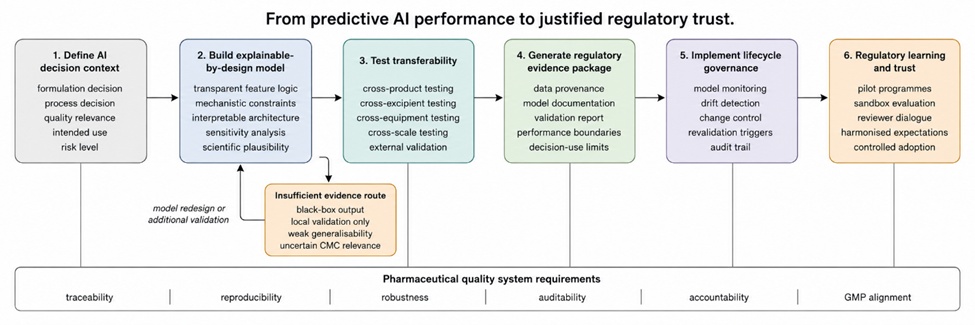
Figure 2. Future development pathway for explainable, transferable, and regulatory-trustworthy AI in pharmaceutical formulation and process development.
Artificial intelligence has clear potential to improve pharmaceutical formulation and process development by accelerating screening, revealing complex patterns, and supporting more systematic decision-making. However, this potential cannot be separated from the quality expectations that define pharmaceutical development. Models that are accurate but opaque, locally calibrated but non-transferable, or technically impressive but poorly governed cannot provide a durable basis for regulatory trust.
The central conclusion of this review is that explainability and transferability are not optional refinements to pharmaceutical AI. They are foundational requirements for converting AI predictions into credible development knowledge. Without them, AI remains vulnerable to overinterpretation, brittle deployment, and limited acceptance in quality-driven and regulatory-facing contexts.
Responsible integration of AI in pharmaceutical development requires a coordinated transformation in modelling practice, validation culture, documentation standards, and regulatory learning. The field should move from isolated demonstrations of predictive performance toward explainable, transferable, and lifecycle-managed AI systems. Only then can AI become a trusted component of pharmaceutical formulation and process development rather than a promising but weakly governed analytical accessory.
None
None
None
None
Open Access The author(s) retain copyright. This article is licensed under the Creative Commons Attribution-NonCommercial-ShareAlike 4.0 International License. It may be shared and adapted for non-commercial purposes with appropriate attribution, an indication of changes, and distribution of adaptations under the same license. Third-party material may be subject to separate terms identified in its credit line. View the license at https://creativecommons.org/licenses/by-nc-sa/4.0/.
 Publication System