Continuous pharmaceutical manufacturing has matured from a technical alternative to batch production into a strategically important manufacturing paradigm. Its promise lies in integrated material flow, smaller production footprints, improved process understanding, flexible scale-out, and the possibility of real-time quality assurance. Yet the quality systems used to govern continuous manufacturing often remain conceptually anchored in batch-era assumptions. The central problem addressed in this article is the mismatch between continuous manufacturing’s dynamic data environment and the inherited quality logic of discrete batch testing, fixed specifications, and retrospective release decisions. In batch quality logic, quality is often treated as a property confirmed after production. In continuous manufacturing, however, quality must be interpreted, predicted, and controlled while the process is still unfolding. This article proposes Lifecycle Intelligence as a theory-driven model for rethinking quality in continuous pharmaceutical manufacturing systems. Lifecycle Intelligence is defined as a quality paradigm in which process data, predictive models, control strategies, and lifecycle learning mechanisms are integrated to maintain quality dynamically across development, validation, commercial production, and post-approval improvement. The model shifts attention from isolated product release to continuous quality cognition. The argument advanced is that continuous manufacturing cannot reach its full quality and regulatory potential if it is governed primarily by batch quality logic. A lifecycle intelligence paradigm is needed to convert continuous data streams into validated quality decisions. This shift will require not only technical advances, but also new validation practices, model governance structures, regulatory dialogue, and workforce capabilities.
Continuous pharmaceutical manufacturing has moved from an aspirational technology platform toward a practical manufacturing strategy for solid dosage products, integrated process trains, and real-time quality assurance. Regulatory and scientific discussions have increasingly framed continuous manufacturing as a way to improve flexibility, reduce variability, strengthen process understanding, and move pharmaceutical production closer to modern process engineering practice [1]. The development of continuous direct compression platforms and sustained-release tablet manufacturing further illustrates that continuous production is no longer limited to isolated unit operations but can support structured product and process design [2, 3].
The technological logic of continuous manufacturing differs fundamentally from the batch paradigm because material is processed as a flowing stream rather than as a bounded lot that can be sampled and tested after completion. Residence time distribution, material traceability, process start-up, and disturbance propagation become central quality concepts because quality is distributed across time and process location rather than contained within a discrete batch vessel [4, 5]. This transformation requires quality assurance systems to interpret temporal process behaviour rather than merely verify finished-product compliance.
Despite this transformation, much pharmaceutical quality thinking remains shaped by batch quality logic. Traditional systems assume that validated operating ranges, end-product testing, deviation investigation, and lot release can provide sufficient assurance of product quality after production has occurred. In continuous manufacturing, however, real-time release testing and process analytical technology have shown that quality can be assessed during production, which challenges the idea that quality is primarily a post-hoc judgement [6-8].
The objective of this article is to construct a theory-driven model that shifts the quality paradigm from batch quality to Lifecycle Intelligence. The model argues that quality in continuous manufacturing should be understood as a continuously learned, predicted, and controlled property supported by integrated data streams, predictive analytics, feedback loops, and lifecycle model governance. This argument builds on emerging evidence from real-time release testing, continuous process verification, soft sensing, machine learning, and model-based control [9-11].
The first theoretical foundation of Lifecycle Intelligence is Quality-by-Design, understood as the systematic construction of quality through process understanding, risk management, design space logic, and control strategy development. Continuous manufacturing extends this logic because it requires the relationship between material attributes, process parameters, residence time behaviour, and critical quality attributes to be understood dynamically rather than statically [4, 12]. In this sense, Quality-by-Design provides the philosophical foundation for Lifecycle Intelligence, but it must be expanded from design-stage assurance into continuous lifecycle learning.
The second foundation is Process Analytical Technology, which transforms quality assurance from delayed testing into real-time measurement, modelling, and control. PAT tools have been applied to continuous tableting, spectroscopic monitoring, blend uniformity assessment, and real-time release testing, demonstrating that quality-relevant signals can be captured while manufacturing is still occurring [7, 13, 14]. Table 1 maps the foundational theories that underpin the shift from batch quality to lifecycle intelligence.
Table 1. Foundational Theories for Lifecycle Intelligence in Continuous Manufacturing: Quality-by-Design, Process Analytical Technology, and Cyber-Physical Systems
Foundational theory | Core quality assumption | Contribution to continuous manufacturing | Limitation when used alone | Role within Lifecycle Intelligence |
Quality-by-Design | Quality should be designed into the product and process rather than inspected into the final product. | Defines critical quality attributes, critical process parameters, design space, and risk-based control strategy. | Can remain static if design knowledge is not updated during commercial operation. | Provides the structured knowledge base that lifecycle models continuously refine. |
Process Analytical Technology | Quality-relevant information can be measured during processing and used for control. | Enables real-time monitoring, release testing, and continuous process verification. | Measurement alone does not guarantee learning, prediction, or adaptive decision-making. | Supplies real-time data streams for predictive analytics and quality decisions. |
Cyber-physical systems | Physical processes and digital models can be integrated through sensing, computation, and control. | Connects equipment, sensors, models, data systems, and automated control loops. | May prioritise automation without sufficient pharmaceutical validation logic. | Provides the architecture for closed-loop, model-mediated quality governance. |
Lifecycle validation theory | Control strategies must remain valid as products, processes, materials, and models evolve. | Supports model maintenance, change control, and continued process verification. | Often applied retrospectively rather than as a proactive intelligence layer. | Converts lifecycle learning into governed quality evidence. |
The third foundation is cyber-physical system theory, which views manufacturing as the integration of physical process flows with digital sensing, computation, prediction, and control. Continuous manufacturing increasingly depends on such integration because process disturbances must be detected and corrected before they compromise downstream quality or release decisions [15, 16]. Lifecycle Intelligence therefore emerges not from one theory alone, but from the integration of Quality-by-Design, PAT, and cyber-physical learning systems into a unified quality model.
The rationale for a new model begins with the recognition that continuous manufacturing produces data at a velocity and density that batch quality systems were not designed to absorb. A continuous line may generate process measurements, spectral signals, material flow data, equipment states, and quality predictions across every moment of production. When such data are interpreted using batch-era categories, the system risks reducing dynamic intelligence to retrospective documentation [5, 8].
A second rationale is that continuous manufacturing changes the meaning of quality decisions. In batch manufacturing, many quality decisions occur after production, when the product can be held, sampled, tested, investigated, or rejected. In continuous manufacturing, decisions must often be made while material is moving through the system, making residence time distribution, diversion logic, start-up behaviour, and disturbance tracking essential elements of quality governance [4, 17].
A third rationale is the increasing role of predictive models, machine learning, soft sensors, and simulation in quality decision-making. Deep learning, soft-sensor architectures, benchmark simulators, and machine-learning-enabled real-time testing indicate that continuous manufacturing quality systems are becoming computationally mediated rather than purely inspection-based [9-11, 18]. A Lifecycle Intelligence Model is therefore needed to explain how data, models, controls, and lifecycle evidence can form a coherent theoretical quality system.
Batch quality logic rests on the assumption that pharmaceutical quality can be assured through validated process conditions, defined specifications, controlled documentation, representative sampling, and end-product testing. This logic has historically provided a robust basis for quality assurance because it fits discrete production units, where the batch can be treated as a bounded object of investigation and release. However, this same logic becomes strained when the manufacturing process is continuous and quality-relevant variation may occur across time, residence location, and material trajectory [1, 6].
The strength of batch quality logic is that it provides clear accountability. A batch has a beginning, an end, a record, a deviation history, a release decision, and a regulatory identity. In continuous manufacturing, this clarity becomes more difficult because material flow is not naturally partitioned into discrete units, and traceability depends on residence time models, process segmentation, and control strategy definitions [4, 5].
Batch logic also tends to treat deviations as events that are investigated after they are observed. In continuous manufacturing, this reactive orientation is insufficient because process disturbances can propagate downstream before a traditional investigation cycle is complete. Model-based quality risk assessment and flowsheet modelling show that continuous systems require anticipatory control strategies that can identify, localise, and mitigate quality risks as they emerge [12, 17].
The deepest limitation of batch quality logic is conceptual rather than procedural. It treats quality primarily as a compliance state to be confirmed, whereas continuous manufacturing invites a view of quality as an information-rich process state to be predicted and maintained. Real-time release testing, continuous process verification, and integrated continuous technologies therefore point beyond batch quality logic toward a quality paradigm based on continuous evidence generation and lifecycle intelligence [8, 13, 19].
Lifecycle Intelligence begins from the premise that continuous pharmaceutical manufacturing requires quality to be treated as a dynamic, data-mediated property rather than a retrospective batch attribute. In this logic, process analytical signals, residence time knowledge, equipment data, and quality predictions are interpreted continuously to support timely decisions about control, diversion, release, and process improvement [5, 7, 8]. Unlike batch quality logic, Lifecycle Intelligence does not wait for the product to become a completed object before quality is judged; it constructs quality assurance while the product is still being made.
The defining feature of Lifecycle Intelligence is the integration of learning into the quality system itself. Continuous manufacturing studies on process start-up, continuous granulation, and tablet production show that process behaviour changes across operating phases and cannot be reduced to a single validated steady state [15, 20, 21]. A lifecycle intelligence approach therefore requires models that are not merely developed once, but maintained, challenged, updated, and justified across development, scale-up, commercial production, and post-approval change.
Lifecycle Intelligence should not be confused with simple automation. Automation can execute fixed instructions, whereas intelligence requires contextual interpretation, prediction, and adaptation based on data streams and governed decision rules [9-11]. Table 2 defines the core elements of Lifecycle Intelligence and their contrast with batch quality logic.
Table 2. Lifecycle Intelligence Logic versus Batch Quality Logic: Definitions, Operational Contrasts, and Quality Functions
Quality dimension | Batch quality logic | Lifecycle Intelligence logic | Operational implication | Quality function |
Unit of quality assurance | Discrete batch or lot | Continuous material stream over time | Quality must be tracked through residence time, process location, and temporal segmentation. | Converts quality from a batch verdict into a time-resolved process state. |
Main evidence source | End-product testing and batch records | Integrated process data, PAT signals, model predictions, and lifecycle evidence | Quality evidence is generated during production rather than only after production. | Enables real-time quality interpretation and release support. |
Control orientation | Fixed parameters and retrospective deviation handling | Predictive monitoring, adaptive control, and proactive risk mitigation | Control strategies must anticipate emerging variation before it becomes a deviation. | Maintains quality through forward-looking intervention. |
Model role | Supporting development or validation documentation | Operational quality decision layer | Models become part of routine quality governance and require lifecycle management. | Links data, prediction, control, and regulatory evidence. |
Learning mechanism | Periodic review and post-hoc investigation | Continuous process verification and model updating | Knowledge is accumulated across batches, campaigns, products, and lifecycle stages. | Turns manufacturing history into quality intelligence. |
The value of Lifecycle Intelligence lies in its ability to connect quality decisions across time. Development data can inform initial control strategy design, commercial manufacturing data can refine predictive models, and post-approval learning can support controlled process improvement [19, 22, 23]. The paradigm therefore reframes continuous manufacturing as a lifecycle knowledge system in which process understanding is continuously converted into quality decisions.
Continuous learning systems depend on the ability to convert heterogeneous manufacturing data into interpretable quality knowledge. Soft sensors provide one key mechanism by estimating critical quality attributes that cannot be measured directly or continuously during production [10]. Digital and in silico frameworks extend this capability by enabling simulated assessment of robustness, process sensitivity, and control strategy performance before changes are introduced into the physical line [11, 23].
Data integration is especially important because continuous manufacturing quality does not reside in any single signal. NIR spectroscopy, machine vision, residence time models, equipment data, blend uniformity measurements, dissolution predictions, and material tracking must be linked into coherent temporal and causal structures [4, 13, 24]. Without this contextualisation, a data-rich manufacturing system may remain intelligence-poor because signals are collected but not transformed into actionable quality meaning.
The central challenge is model maintenance under changing process, material, and operating conditions. Empirical predictive models and PAT implementation studies show that models may perform well under defined development conditions but require careful validation, transfer, monitoring, and recalibration as products and processes evolve [14, 22]. Lifecycle Intelligence therefore requires model governance procedures that can detect drift, distinguish normal variation from meaningful process change, and preserve regulatory confidence in data-driven quality decisions.
Manufacturing feedback loops are the operational mechanism through which Lifecycle Intelligence becomes more than observation. At the simplest level, feedback loops maintain process variables within defined limits through routine control actions, but this only partially captures the intelligence potential of continuous manufacturing [15, 17]. In an intelligence-driven system, feedback loops connect measured process states, predicted quality outcomes, risk-based decision rules, and control actions in a structured hierarchy.
Feedforward control expands this logic by using upstream information to anticipate downstream quality effects. In continuous manufacturing, material attributes, feeding behaviour, residence time distribution, and early PAT signals can be used to adjust downstream operations before a quality defect is produced [4, 12]. This anticipatory orientation is especially important because the material stream continues moving, and delayed decisions can lead to avoidable diversion, waste, or release uncertainty.
Model-predictive control and data-driven control represent a higher level of feedback intelligence because they use models to forecast future process behaviour and optimise control actions over time. Data-driven model predictive control and machine-learning control studies suggest that continuous pharmaceutical manufacturing can move toward quality decisions that are not only reactive but predictive and optimisation-oriented [25, 26]. Table 3 categorises feedback loop types in continuous manufacturing and their role in intelligence-driven quality.
Table 3. Feedback Loop Architectures in Continuous Pharmaceutical Manufacturing: Types, Input–Output Structures, and Quality Control Integration
Feedback loop type | Primary input | Control output | Intelligence level | Integration with quality system |
Fixed feedback loop | Measured process variable | Adjustment to maintain predefined set point | Low | Supports basic process stability but provides limited quality prediction. |
PAT-enabled feedback loop | Real-time analytical signal | Correction of process parameter or material diversion | Moderate | Links measurement to quality-relevant intervention during production. |
Feedforward loop | Upstream material or process signal | Downstream adjustment before quality impact occurs | Moderate to high | Anticipates disturbance propagation across connected unit operations. |
Model-predictive loop | Current and predicted future process states | Optimised control action over a defined time horizon | High | Uses predictive modelling to align process control with expected quality outcomes. |
Lifecycle learning loop | Historical production data, deviations, model performance, and post-approval evidence | Model update, control strategy refinement, or change control proposal | Very high | Converts accumulated manufacturing experience into governed lifecycle improvement. |
The most advanced feedback loop is the lifecycle learning loop, in which manufacturing history itself becomes part of the quality control architecture. Regulatory experience with continuous manufacturing and real-time release testing indicates that quality decisions must remain explainable, validated, and compatible with submission expectations even when real-time data and models are used operationally [1, 27]. The challenge is therefore not only to design feedback loops that work technically, but to embed them within a quality system that can justify their decisions across the lifecycle.
The proposed Lifecycle Intelligence Model contains five interacting layers: data acquisition and integration, predictive analytics and soft sensors, risk-based decision logic, closed-loop control, and lifecycle learning with model evolution. The first layer captures process, material, equipment, analytical, and quality data across the continuous line, while the second layer transforms these data into predictions of critical quality attributes and process states [10, 13, 24]. These layers create the informational foundation for intelligence but do not by themselves constitute a quality decision system.
The third layer introduces risk-based decision logic that determines how predictions should be interpreted. For example, a predicted deviation from blend uniformity, dissolution performance, or tablet content may trigger continued monitoring, parameter adjustment, material diversion, investigation, or model review depending on risk severity and confidence in the prediction [6, 8, 27]. This layer is essential because Lifecycle Intelligence must distinguish between data availability and justified quality action.
The fourth layer consists of closed-loop and feedforward control mechanisms that act on quality-relevant information during manufacturing. Integrated continuous manufacturing studies show that flow synthesis, crystallisation, filtration, formulation, and tableting can be connected into end-to-end systems, but such integration increases the need for coordinated control and quality interpretation across unit operations [16, 19]. Table 4 presents the proposed Lifecycle Intelligence Model with its components and operational logic.
Table 4. Proposed Lifecycle Intelligence Model for Continuous Pharmaceutical Manufacturing: Model Elements, Data Flows, and Quality Decision Layers
Model layer | Main function | Data flow | Decision logic | Expected quality contribution |
Data acquisition and integration | Capture and align process, material, equipment, PAT, and quality data | From sensors, PAT tools, batch records, equipment systems, and laboratory data into contextualised data architecture | Data are time-stamped, linked to residence time, and mapped to quality-relevant process segments. | Creates the evidence base for continuous quality interpretation. |
Predictive analytics and soft sensors | Estimate current and future critical quality attributes | From integrated process data into predictive models, soft sensors, and digital simulations | Model outputs are evaluated for uncertainty, validity, and process relevance. | Enables real-time prediction where direct measurement is delayed or unavailable. |
Risk-based decision logic | Translate predictions into quality decisions | From model outputs and control limits into decision rules | Decisions are based on severity, detectability, uncertainty, and regulatory impact. | Prevents data-driven action from becoming ungoverned automation. |
Closed-loop control | Adjust process behaviour during production | From decision logic into process parameter adjustment, diversion, or intervention | Control action is proportional to risk and supported by validated control strategy. | Maintains quality while material remains in motion. |
Lifecycle learning and model evolution | Update process knowledge across the product lifecycle | From production history, deviations, model performance, and post-approval learning into model governance | Updates are handled through validation, change control, and documented justification. | Converts accumulated manufacturing experience into sustained quality intelligence. |
The fifth layer, lifecycle learning and model evolution, is what distinguishes the proposed model from a real-time monitoring framework. Lifecycle learning ensures that start-up experience, disturbance history, model performance, regulatory commitments, and post-approval process knowledge are systematically reviewed and converted into governed improvements [21, 23, 28]. The model therefore defines pharmaceutical quality as a continuously updated relationship among process evidence, predictive validity, control action, and lifecycle governance.
Figure 1 presents the Lifecycle Intelligence Model as a layered quality-decision architecture that converts continuous manufacturing data into predictive control, risk-based action, and lifecycle learning.
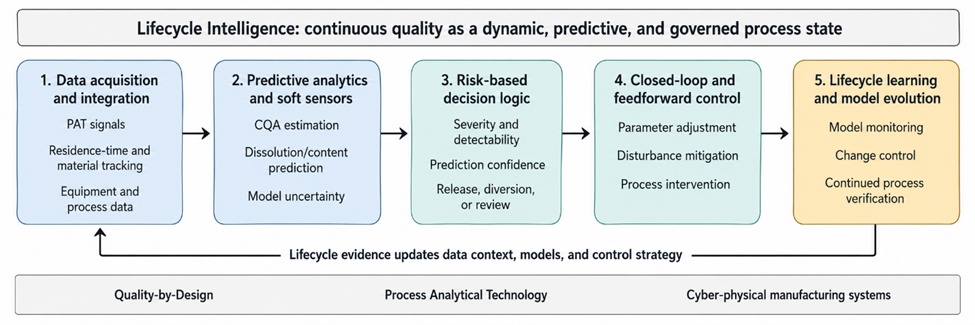
Figure 1. Lifecycle Intelligence Model for Continuous Pharmaceutical Manufacturing Systems: From Real-Time Data Streams to Predictive Quality Decisions and Lifecycle Learning
Implementation should begin with a digital maturity assessment that evaluates whether the manufacturing site has the data architecture, sensor strategy, modelling capability, control infrastructure, and quality governance needed to support Lifecycle Intelligence. Continuous direct compression platforms, PAT case studies, and empirical predictive models suggest that technical feasibility depends on the interaction between equipment design, data quality, process understanding, and model interpretability [2, 3, 22]. A site cannot implement Lifecycle Intelligence merely by installing sensors if the surrounding quality system cannot contextualise and validate the resulting data.
The next step is to build data infrastructure capable of linking process time, residence time, material genealogy, equipment status, analytical measurements, and quality outcomes. Material tracking and residence time distribution studies show that continuous systems require traceability concepts that are more temporal and probabilistic than conventional batch records [4, 5]. This infrastructure should therefore support not only data storage but also causal interpretation, regulatory retrieval, model training, and quality decision reconstruction.
Validation must then be reframed from one-time model qualification to lifecycle model governance. Real-time release testing, digital real-time release strategies, and machine-learning-based quality assessment all require evidence that models remain suitable for their intended use under defined process conditions [18, 24, 28]. Validation pathways should include model development records, independent challenge datasets, uncertainty assessment, drift monitoring, periodic review, change control triggers, and documented criteria for model update or retirement.
Regulatory implementation should proceed through transparent engagement, staged piloting, and explicit linkage between model outputs and quality decisions. Experience with continuous manufacturing submissions and real-time release testing shows that regulators are willing to evaluate innovative control strategies when the scientific rationale, validation evidence, and decision logic are clear [1, 27]. The practical pathway for Lifecycle Intelligence is therefore incremental: begin with monitored prediction, progress to advisory decision support, move toward validated closed-loop control, and finally establish lifecycle learning as a governed part of the pharmaceutical quality system.
Figure 2 translates the Lifecycle Intelligence Model into a practical implementation and validation pathway for continuous pharmaceutical manufacturing systems.
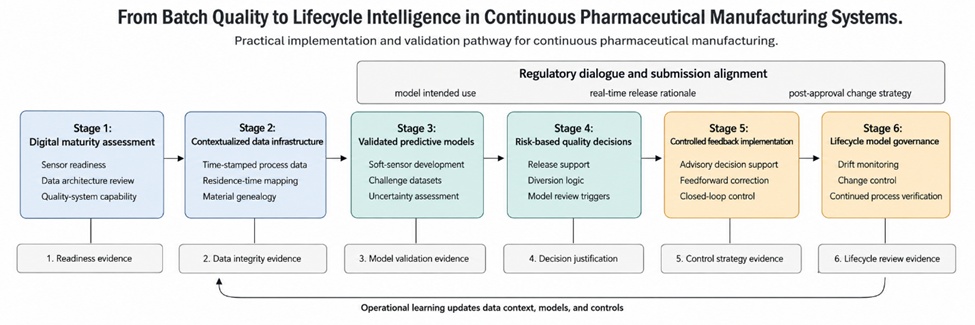
Figure 2. Practical Implementation and Validation Pathway for Lifecycle Intelligence in Continuous Pharmaceutical Manufacturing: From Digital Readiness to Governed Adaptive Quality Control
Continuous pharmaceutical manufacturing cannot be fully governed by a quality logic inherited from batch production. Batch quality logic remains valuable for accountability, documentation, and compliance, but it is not sufficient for systems in which material, data, and quality risks move continuously through integrated process trains. The full value of continuous manufacturing will be realised only when quality is treated as a dynamic, predictive, and lifecycle-governed property.
The Lifecycle Intelligence Model proposed in this article offers a conceptual pathway for that transition. It links data acquisition, predictive analytics, risk-based decision logic, closed-loop control, and lifecycle learning into a unified quality paradigm. The model does not replace established quality principles; rather, it extends them into a continuous, data-rich, model-mediated manufacturing environment.
Future progress will require collaboration among pharmaceutical manufacturers, regulators, technology developers, data scientists, and academic researchers. Standards for model validation, data contextualisation, adaptive control, and lifecycle change management must be co-developed so that intelligent manufacturing can remain both innovative and trustworthy. Lifecycle Intelligence should therefore be understood not as a technological add-on, but as the next conceptual stage in pharmaceutical quality systems.
None
None
None
None
Open Access The author(s) retain copyright. This article is licensed under the Creative Commons Attribution-NonCommercial-ShareAlike 4.0 International License. It may be shared and adapted for non-commercial purposes with appropriate attribution, an indication of changes, and distribution of adaptations under the same license. Third-party material may be subject to separate terms identified in its credit line. View the license at https://creativecommons.org/licenses/by-nc-sa/4.0/.
 Publication System