Advanced drug delivery systems promise more precise, durable, and patient-centred therapy through nanomedicines, long-acting formulations, implantable platforms, smart delivery devices, and personalised dosage forms. These technologies can reduce dosing burden, improve therapeutic control, and expand the design space of pharmaceutical care. Yet the same sophistication that makes them attractive can also make them expensive, infrastructure-dependent, and difficult to use. The equity implications of these technologies therefore require systematic attention. The central problem addressed in this article is that pharmaceutical innovation is often evaluated through performance, safety, manufacturability, and market value, while equity remains treated as a downstream access issue. This creates a risk that advanced drug delivery systems will reach populations already well served by health systems while excluding communities facing poverty, geographic isolation, disability, low literacy, weak infrastructure, or limited digital access. Equity cannot be repaired only after launch if exclusion has already been built into the technology. It must be considered during design, development, evaluation, pricing, procurement, and implementation. This article develops the concept of pharmaceutical technology equity as a deliberate design and policy goal for advanced drug delivery systems. It argues that equitable pharmaceutical technology requires simultaneous attention to access, affordability, and usability. Access concerns whether the technology can physically and institutionally reach the people who need it. Affordability concerns whether patients and health systems can obtain it without unacceptable financial burden, while usability concerns whether diverse users can safely and effectively engage with the product in real settings. The article defines pharmaceutical technology equity, identifies structural barriers, and proposes design principles for inclusive advanced drug delivery systems. Four tables support the argument by defining equity logic, cataloguing access barriers, mapping design principles, and presenting a decision-oriented framework. The core conclusion is that equity must become an explicit and measurable goal of pharmaceutical technology development. Advanced drug delivery should not merely produce better products for privileged users; it should expand therapeutic capability for populations historically excluded from high-value innovation.
Advanced drug delivery systems are increasingly positioned as solutions to long-standing therapeutic limitations, including poor adherence, unstable exposure, invasive dosing schedules, and insufficient targeting. Long-acting injectables, nanomedicines, 3D-printed dosage forms, self-injection devices, and digitally supported technologies promise more personalised and durable care, but their benefits are unevenly distributed when health systems lack infrastructure, financing, and user support. The global access literature shows that medicines do not become equitable simply because they are clinically valuable, since availability depends on health-system capacity, supply chains, procurement, and affordability [1]. This tension between technological progress and unequal reach is the starting point for pharmaceutical technology equity.
Health equity requires more than equal availability of products after they are developed; it requires attention to avoidable and unjust differences in who can benefit from innovation. Braveman and colleagues define equity as a justice-oriented concern with systematic disadvantage, which is directly relevant to pharmaceutical technologies that may require specialised facilities, trained professionals, digital literacy, or high out-of-pocket payment [2]. In biomedical engineering, human-centred and equity-centred approaches have similarly argued that technical design choices can reproduce exclusion when the intended user is imagined too narrowly [3]. Pharmaceutical technology equity therefore asks whether advanced delivery systems are designed for the real diversity of patients, caregivers, health workers, and health-system environments.
This article proposes pharmaceutical technology equity as a normative design and policy framework for advanced drug delivery systems. The framework treats access, affordability, and usability as primary performance domains rather than secondary implementation concerns. It builds on the affordability literature, which shows that high-value medicines can remain inaccessible when price and financing models are misaligned with health-system capacity [4]. The objective is to articulate a practical equity framework that can guide researchers, developers, regulators, payers, and policymakers before inequity becomes locked into pharmaceutical technology trajectories.
The equity problem begins when advanced pharmaceutical technologies are treated as universally beneficial despite being developed for environments with strong infrastructure, specialist workforces, and high purchasing power. Nanomedicine illustrates this risk because sophisticated formulations can offer therapeutic advantages while also depending on costly manufacturing, complex quality control, and uneven global research capacity [5]. Discussions of nanotechnology and global health have warned that scientific advances may widen rather than close health gaps when governance and access mechanisms are weak [6]. In this sense, technological sophistication can become a pathway to exclusion unless equity is incorporated deliberately.
Long-acting and extended-delivery systems provide another example because they may reduce dosing frequency and improve adherence, yet their implementation often depends on trained providers, clinic attendance, injection infrastructure, and reliable follow-up. HIV prevention and treatment debates have shown that long-acting technologies can transform care only if accelerated access is secured in low- and middle-income countries and among underserved populations [7]. Jenkins and colleagues argue that access to long-acting injectable cabotegravir requires attention to licensing, manufacturing scale-up, pricing, regulatory pathways, and delivery infrastructure rather than clinical promise alone [8]. These examples show that advanced delivery systems can create a two-tier therapeutic landscape when implementation capacity is unequally distributed.
Personalised and decentralised technologies such as 3D-printed medicines can also deepen inequity if their infrastructure requirements are ignored. Decentralised manufacturing may support tailored dosing and flexible production, but it requires validated equipment, trained personnel, quality assurance systems, and regulatory oversight [9]. Reviews of pharmaceutical 3D printing emphasise its promise for patient-specific medicine while also highlighting technical, regulatory, and manufacturing barriers that remain unresolved [10, 11]. Equity therefore depends on whether personalisation is designed for broad public value or only for highly resourced institutions.
The most serious equity risk is that advanced delivery systems may be celebrated as innovation while functioning as technologies of exclusion. Smart devices and self-administered systems can assume dexterity, vision, literacy, stable housing, refrigeration, privacy, and digital connectivity that many users do not have. Studies of home medical devices and health technology design show that usability failures are not merely inconveniences but safety and access problems, especially when products are transferred from controlled clinical environments into diverse homes [12]. Pharmaceutical technology equity must therefore shift the question from whether a delivery system works under ideal conditions to whether it can be accessed, afforded, and used safely by those most likely to be excluded.
Pharmaceutical technology equity can be defined as the deliberate design, development, financing, regulation, and implementation of drug delivery technologies so that therapeutic benefit is not restricted by geography, income, disability, literacy, infrastructure, or social position. This definition extends health equity principles into the material and operational design of pharmaceutical products. It recognises that inequity can arise from formulation complexity, device interface design, storage requirements, clinical administration pathways, intellectual property structures, and procurement models. The logic is consistent with equity-centred biomedical design, which treats social context as part of technical performance rather than an external afterthought [3].
The first dimension is access, which refers to whether a technology can be physically, institutionally, and logistically available to the populations that need it. Access depends on manufacturing geography, supply continuity, cold-chain capacity, workforce skills, regulatory approval, procurement channels, and care delivery models. Ozawa and colleagues show that access to medicines in low- and middle-income countries depends on the interaction of health systems, financing, regulation, and supply rather than product existence alone [1]. For advanced delivery systems, access must therefore be designed into the product’s lifecycle from early development.
The second dimension is affordability, which refers to the economic reach of a technology for patients, payers, and health systems. Affordability is not equivalent to price alone because it includes budget impact, reimbursement rules, insurance design, procurement leverage, patient cost-sharing, and opportunity cost. Antoñanzas and colleagues show that affordability is difficult to define and measure because it depends on the payer’s resources and the consequences of financial burden [4]. Advanced drug delivery systems make this problem sharper because high research costs, specialised inputs, complex manufacturing, and intellectual property can push prices beyond the capacity of many health systems.
The third dimension is usability, which refers to whether diverse users can safely, correctly, and confidently use the technology in real-world conditions. Usability includes language, literacy, culture, disability, dexterity, vision, cognition, caregiver involvement, workflow compatibility, and digital access. Human factors studies of autoinjectors and home medical devices demonstrate that device success depends on fit between the product, the user, and the use environment [12-14]. Table 1 defines the dimensions and logic of pharmaceutical technology equity.
Table 1. Pharmaceutical Technology Equity Logic: Dimensions, Definitions, and Normative Goals
Equity dimension | Definition in pharmaceutical technology | Main exclusion risk | Normative goal | Development implication |
Access | The ability of intended populations and health systems to obtain, store, deliver, and maintain the technology across real settings | Products reach only urban, specialist, high-income, or well-infrastructured sites | Structural availability across geography, care levels, and health-system capacity | Design for distribution, storage, administration, workforce feasibility, and regulatory portability |
Affordability | The ability of patients, payers, and health systems to finance the technology without unacceptable burden or displacement | High prices, uncertain reimbursement, and weak procurement restrict use to affluent groups | Economic reach without catastrophic cost or unjust rationing | Design for cost reduction, scalable manufacturing, price-sensitive value assessment, and equitable licensing |
Usability | The ability of diverse patients, caregivers, and health workers to use the technology safely and effectively | Products assume literacy, dexterity, language, vision, digital access, or cultural norms not shared by all users | Safe and effective use across social, physical, linguistic, and cognitive diversity | Design through human factors, inclusive testing, participatory co-design, and accessible instructions |
Equity governance | The mechanisms that ensure access, affordability, and usability are assessed and corrected throughout the lifecycle | Equity is addressed only after market entry, when design and pricing are already fixed | Accountability for inclusive innovation from concept to post-market learning | Integrate equity audits, procurement criteria, regulatory incentives, and real-world monitoring |
Access barriers for advanced drug delivery systems are not merely failures of distribution; they are often consequences of design decisions that assume high-resource environments. Cold-chain requirements, sterile administration, specialist injection services, surgical insertion, continuous monitoring, and complex quality systems can restrict access in rural, underfunded, or fragmented health systems. Long-acting therapy implementation studies in sub-Saharan Africa illustrate how infrastructure, workforce capacity, acceptability, supply continuity, and service delivery models shape whether advanced technologies can be adopted equitably [15]. Access therefore begins with asking whether a delivery system is feasible outside the best-resourced settings.
Manufacturing and regulatory structures also shape access because complex products may depend on centralised production, narrow supplier networks, and slow approval pathways across jurisdictions. Advanced therapy market access studies show that even when products are authorised, access decisions vary across countries because health technology assessment, reimbursement, evidence expectations, and affordability constraints differ substantially [16]. For 3D printing and decentralised production, the access promise is similarly conditional on validated quality systems and regulatory clarity [9, 17]. Table 2 catalogues access barriers for advanced drug delivery systems across different settings.
Table 2. Access Barriers for Advanced Drug Delivery Systems: Geographic, Infrastructure, Regulatory, and Supply-Chain Constraints
Barrier category | How the barrier appears in advanced delivery systems | Populations or settings most affected | Equity consequence | Design or policy response |
Geographic concentration | Specialist clinics, urban hospitals, or centralised manufacturing sites become the only feasible access points | Rural communities, remote regions, small health facilities, displaced populations | Travel burden, delayed treatment, and exclusion from high-value therapy | Decentralised delivery models, regional manufacturing capacity, mobile administration pathways |
Infrastructure dependence | Cold-chain systems, sterile procedures, device maintenance, and digital connectivity are required for safe use | Low-resource facilities, unstable electricity settings, underfunded public systems | Technologies fail to scale beyond pilot or elite settings | Stability-oriented formulation design, simplified administration, infrastructure-light packaging |
Workforce requirements | Products require trained injectors, surgeons, pharmacists, technicians, or device educators | Facilities with workforce shortages and communities with limited specialist access | Access becomes dependent on scarce professional capacity | Task-sharing models, simplified interfaces, training packages, competency-based implementation |
Regulatory fragmentation | Different evidence, quality, and approval requirements slow cross-country access | Smaller markets, low- and middle-income countries, regional procurement systems | Delayed entry and uneven availability | Regulatory harmonisation, reliance pathways, early multi-jurisdictional regulatory engagement |
Supply-chain fragility | Advanced excipients, device components, or biologic materials rely on narrow supplier networks | Countries with limited procurement leverage or import dependence | Stockouts, high prices, and discontinuity of care | Supplier diversification, technology transfer, pooled procurement, resilient inventory planning |
Service pathway mismatch | Delivery systems require follow-up schedules or administration sites that do not match local care pathways | Patients with unstable work, transport barriers, caregiving responsibilities, or stigma concerns | Lower uptake and discontinuation despite clinical efficacy | Care-pathway co-design, flexible visit models, community-based administration options |
Access must therefore be redefined as a product attribute as well as a system outcome. A delivery platform that requires fragile logistics, high-cost maintenance, specialist oversight, or rigid clinic attendance embeds exclusion even before pricing and reimbursement are considered. Nanomedicine and advanced delivery scholarship has repeatedly shown that technical promise must be evaluated alongside manufacturing scalability, distribution capacity, and public-health relevance [5, 6, 18]. The central equity lesson is that access is not what happens after innovation; it is one of the conditions that determines whether innovation is socially legitimate.
Affordability barriers arise when advanced drug delivery systems are priced according to technological novelty rather than equitable therapeutic reach. Nanomedicines, implantable platforms, long-acting injectables, 3D-printed dosage forms, and advanced therapy delivery systems can involve costly materials, specialised manufacturing, quality assurance complexity, intellectual property protection, and limited competition. Uskoković argues that nanomedicine’s promise for underserved populations is constrained when technological development is disconnected from cost reduction and global public-health need [5]. The affordability question is therefore not only whether a product is clinically valuable, but whether its value can be translated into broad and sustainable access.
Health technology assessment can also reproduce inequity when it evaluates cost-effectiveness without adequately accounting for distributional consequences. Advanced therapies and complex delivery platforms often challenge conventional reimbursement because evidence may be uncertain, upfront costs may be high, and benefits may accrue over long time horizons [19, 20]. Hampson and colleagues show that gene therapy raises difficult questions about evidence, value, and affordability in health systems that must decide who receives extremely costly innovation [21]. If affordability frameworks ignore equity, they may legitimise access for populations with stronger insurance coverage while leaving lower-resource systems behind.
Potential remedies include tiered pricing, pooled procurement, voluntary licensing, patent pools, public-interest manufacturing partnerships, and value frameworks that include equity impact. Ogbogu and Albrecht argue that advanced therapies require strategic approaches to affordability and accessibility rather than reliance on conventional market diffusion [22]. Innovative insurance and payment models may improve access to high-cost therapies, but they must be designed to avoid shifting risk to patients or excluding those outside well-funded insurance systems [23]. Pharmaceutical technology equity therefore requires affordability to be treated as a development constraint, not merely a post-approval negotiation.
Usability barriers occur when a delivery system assumes a user who is literate, digitally connected, physically able, culturally aligned with the design, and supported by stable care infrastructure. Self-injection devices, home-use platforms, and digital companion tools may appear convenient while placing substantial cognitive, manual, visual, linguistic, or technological demands on patients and caregivers. Human factors studies of biologic self-injection devices show that patient involvement in device design can improve treatment experience and reduce barriers to correct use [13]. Usability is therefore an equity issue because unsafe or confusing use can convert access into failure.
Device design must also account for the fact that health knowledge and prior experience are unequally distributed. Chaniaud and colleagues show that prior health knowledge can shape the usability of home medical devices, meaning that products may be easier for already empowered users than for those with limited health-system familiarity [24]. Autoinjector studies further demonstrate that apparently small design attributes, such as cap-removal force, can affect whether users can operate a product confidently and safely [25]. When pharmaceutical technologies ignore these differences, they transfer the burden of adaptation from developers to patients.
Usability should not be framed as a niche concern for device engineers after formulation development is complete. It is a central condition of therapeutic equity because a medicine that cannot be correctly prepared, administered, stored, activated, monitored, or discontinued is not meaningfully available. Human factors validation studies of disposable autoinjectors and actual-use evaluations of biologic delivery systems show that usability must be tested under conditions that resemble real patient interaction rather than idealised professional handling [14, 26]. Equity-oriented pharmaceutical technology must therefore include diverse users in design, testing, labelling, training, and post-market learning.
The first equity design principle is universal design from the start, meaning that advanced delivery systems should be developed for the widest feasible range of users rather than retrofitted for accessibility after market entry. This requires attention to dexterity, vision, cognition, language, cultural context, health literacy, transport burden, storage capacity, and caregiver involvement during early product definition. Rodriguez and colleagues argue that human- and equity-centred approaches require designers to think beyond the device and consider the wider social and health-system environment in which technologies are used [3]. For pharmaceutical technology, universal design means that the intended user must include people commonly excluded from clinical, commercial, and engineering assumptions.
The second principle is frugal and infrastructure-sensitive innovation, which asks whether the delivery system can maintain therapeutic value while reducing dependence on scarce resources. Nanomedicine and global health discussions show that technological sophistication must be balanced with cost, manufacturability, scalability, and relevance to underserved settings [6, 18]. In 3D printing, the promise of decentralised and personalised production is strongest when platform design, quality control, and regulatory pathways are simplified enough to serve diverse health systems rather than elite centres alone [9, 10, 17]. Equity by design therefore requires developers to optimise not only for novelty and precision, but also for operational simplicity and public-health reach.
The third principle is participatory co-design with intended users, especially communities facing poverty, rurality, disability, language barriers, stigma, or limited digital access. Equity by design principles for digital health interventions emphasise that technologies should be developed with attention to structural inequities rather than assuming that access to a device or platform automatically produces benefit [27]. Participatory design can reveal hidden burdens such as travel costs, refrigeration limits, fear of injections, privacy concerns, cultural meanings of implants, or mistrust of remote monitoring. Table 3 maps equity design principles to the three barrier categories of access, affordability, and usability.
Table 3. Equity Design Principles for Advanced Drug Delivery Systems: Strategies to Address Access, Affordability, and Usability Barriers
Equity design principle | Access barrier addressed | Affordability barrier addressed | Usability barrier addressed | Practical design implication |
Universal design from the start | Reduces exclusion caused by narrow assumptions about care settings and user groups | Prevents costly redesign after market entry | Supports use by people with varied literacy, language, dexterity, vision, cognition, and caregiver support | Include diverse users and low-resource settings in early target product profiles and formative testing |
Frugal innovation | Reduces dependence on specialist infrastructure, cold chains, and centralised services | Lowers production, implementation, and maintenance costs | Simplifies handling, administration, and training requirements | Design stable, robust, low-maintenance, and easy-to-teach delivery platforms |
Participatory co-design | Aligns product design with real community pathways and service constraints | Identifies hidden patient costs and affordability burdens | Reveals cultural, linguistic, disability-related, and workflow barriers | Involve patients, caregivers, community health workers, pharmacists, and local implementers before design freeze |
Open or modular platforms | Enables wider manufacturing participation and adaptation across settings | Reduces monopoly dependence and supports lower-cost production | Allows interfaces and instructions to be adapted to local users | Develop interoperable, transparent, and adaptable platform components where appropriate |
Equity-focused regulatory engagement | Anticipates approval needs across different jurisdictions and care settings | Encourages evidence generation relevant to reimbursement and public procurement | Supports labelling and instructions for diverse users | Engage regulators early on equity evidence, inclusive usability testing, and real-world implementation claims |
Lifecycle equity monitoring | Identifies post-market access gaps, unaffordable uptake patterns, and incorrect use | Tracks whether price and reimbursement create unequal adoption | Detects user errors and discontinuation among underserved populations | Use real-world evidence, equity audits, and post-market corrective action plans |
The fourth principle is proactive equity governance across the lifecycle, including open or modular platform thinking where appropriate, early regulatory engagement, inclusive evidence generation, and post-market equity monitoring. Machine learning and 3D printing are already reshaping pharmaceutical development, but disruptive tools can accelerate inequity if their outputs remain available only to well-resourced institutions [28]. Long-acting HIV technologies similarly show that implementation planning, pricing, supply, and service delivery must be considered before clinical promise can become equitable public-health benefit [7, 8, 29]. Equity design is therefore a continuous discipline rather than a single consultation exercise.
The proposed Pharmaceutical Technology Equity Framework begins with equity need identification, where developers define the populations most likely to benefit and the populations most likely to be excluded. This stage requires developers to identify access constraints, affordability risks, usability demands, and health-system conditions before committing to a product architecture. Access-to-medicines scholarship shows that medicine availability depends on health-system structures and not merely on scientific development [1]. The framework therefore asks whether a proposed delivery system solves a therapeutic problem in a way that is reachable by those with the greatest unmet need.
The second stage is equity-oriented design and development, in which formulation choices, device interfaces, manufacturing strategies, intellectual property plans, evidence generation, and implementation pathways are assessed against access, affordability, and usability criteria. Advanced therapy market access research shows that variation across reimbursement and health technology assessment systems can shape whether innovation becomes broadly available or remains limited to selected jurisdictions [16, 19]. Developers should therefore treat payers, regulators, procurement agencies, community representatives, and care providers as equity stakeholders rather than late-stage adoption actors. Table 4 presents the proposed Pharmaceutical Technology Equity Framework.
Table 4. Pharmaceutical Technology Equity Framework: Components, Stakeholder Roles, and Decision Checkpoints
Framework component | Core equity question | Developer role | Regulator role | Payer and procurement role | Community and user role | Decision checkpoint |
Equity need identification | Who needs the technology most, and who is most likely to be excluded? | Define unmet need, target populations, and exclusion risks | Encourage early equity rationale in development planning | Identify affordability and procurement constraints | Describe lived barriers, preferences, and service realities | Proceed only if the product addresses a meaningful equity-relevant need |
Access feasibility assessment | Can the technology reach diverse settings without unrealistic infrastructure assumptions? | Assess storage, administration, workforce, and supply requirements | Clarify evidence needs across settings and jurisdictions | Evaluate distribution and system-readiness implications | Identify geographic, transport, stigma, and care-pathway barriers | Revise design if access depends on narrowly resourced environments |
Affordability planning | Can patients and health systems obtain the product without unjust financial burden? | Design for scalable manufacturing and cost reduction | Support evidence relevant to fair pricing and reimbursement | Use value assessment, procurement leverage, and equity-sensitive pricing | Identify direct and indirect patient costs | Revise pricing, licensing, or manufacturing strategy if affordability is implausible |
Inclusive usability development | Can diverse users operate the product safely and effectively? | Conduct inclusive human factors testing and accessible labelling | Require usability evidence for intended users and settings | Support implementation resources and training | Participate in co-design, formative testing, and post-market feedback | Revise interface, instructions, training, or delivery pathway if usability gaps persist |
Equity-focused evaluation | Does real-world uptake show fair distribution of benefit? | Monitor access, adherence, discontinuation, safety, and user errors by equity-relevant groups | Encourage post-market equity evidence and corrective action | Link procurement and reimbursement to equitable performance | Report barriers and unintended consequences | Continue, scale, restrict, redesign, or renegotiate based on equity outcomes |
Figure 1 illustrates the proposed Pharmaceutical Technology Equity Framework as an integrated access–affordability–usability system for embedding equity into advanced drug delivery development, policy, and implementation.
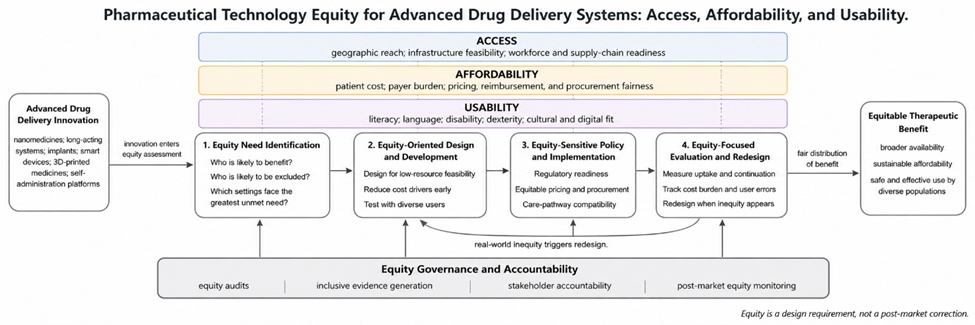
Figure 1. Pharmaceutical Technology Equity Framework for Advanced Drug Delivery Systems: Integrating Access, Affordability, and Usability across Design, Development, Policy, and Evaluation
The final stage is equity-focused evaluation, where real-world uptake, continuation, correct use, safety, affordability, and distribution of benefit are monitored across equity-relevant groups. This stage is essential because even well-intended design may fail when exposed to fragmented systems, unstable supply, weak reimbursement, or unanticipated user burdens. Innovative financing for cell and gene therapies shows that access solutions must be evaluated for who actually benefits, not merely whether payment mechanisms exist [23]. The framework therefore creates a continuous loop from design to policy and back to redesign.
Implementation should begin by integrating equity criteria into target product profiles for advanced drug delivery systems. Target product profiles should specify not only therapeutic indication, pharmacokinetics, stability, and route of administration, but also acceptable infrastructure requirements, cost constraints, user-interface demands, training needs, and minimum access conditions. Reviews of 3D-printed medicines and pharmaceutical innovation show that technical feasibility alone is insufficient without attention to regulation, quality, and implementation context [10, 11]. Equity criteria would make exclusion visible before it becomes embedded in final product design.
Equity audits should be conducted at major development checkpoints, including concept selection, prototype testing, clinical evaluation, regulatory submission, reimbursement planning, procurement, and post-market surveillance. These audits should assess whether design decisions increase burdens for rural users, low-income health systems, people with disabilities, people with low literacy, or communities with limited specialist access. Home medical device research demonstrates that real-world usability challenges emerge when products move into domestic environments where users and contexts vary widely [12, 24]. Evaluation should therefore include equity endpoints such as distribution of uptake, discontinuation by subgroup, user-error patterns, cost burden, travel burden, and service readiness.
Policy levers are needed because voluntary equity commitments may be insufficient when commercial incentives reward premium technologies for high-income markets. Regulators can encourage inclusive usability evidence, payers can require equity-sensitive value assessment, and procurement agencies can favour products that reduce infrastructure burden and patient cost. Long-acting therapy access debates demonstrate that licensing, manufacturing scale-up, pricing, regulatory strategy, and delivery models must be aligned if advanced technologies are to reach underserved populations [7, 8, 15]. Pharmaceutical technology equity will require coordinated governance across science, industry, health systems, and communities.
Advanced drug delivery systems should not be judged only by technical sophistication, pharmacological performance, or market novelty. They should also be judged by whether they expand or restrict the fair distribution of therapeutic benefit. Equity is not a post-market concern that can be solved after design, pricing, and infrastructure requirements are fixed. It is a foundational design requirement for socially legitimate pharmaceutical innovation.
The Pharmaceutical Technology Equity Framework developed in this article reframes access, affordability, and usability as interdependent dimensions of advanced drug delivery design and policy. It shows that exclusion can arise through supply chains, manufacturing models, reimbursement systems, device interfaces, clinical pathways, language, disability, digital access, and patient cost. By making these dimensions explicit, the framework gives researchers, developers, regulators, payers, procurement agencies, and communities a shared structure for equity-oriented decision-making.
The future of pharmaceutical technology should not be a two-tier landscape in which sophisticated therapies are reserved for those already advantaged by wealth, geography, infrastructure, and literacy. A more just future is possible if advanced delivery systems are designed for broad reach, priced for sustainable access, and made usable by diverse populations in real settings. Innovation should be measured not only by how far technology can advance, but by how many people it can genuinely serve. The aim is pharmaceutical progress that uplifts all rather than deepening the divides it has the power to reduce.
None
None
None
None
Open Access The author(s) retain copyright. This article is licensed under the Creative Commons Attribution-NonCommercial-ShareAlike 4.0 International License. It may be shared and adapted for non-commercial purposes with appropriate attribution, an indication of changes, and distribution of adaptations under the same license. Third-party material may be subject to separate terms identified in its credit line. View the license at https://creativecommons.org/licenses/by-nc-sa/4.0/.
 Publication System